
By Anik Kumar Majumdar, Asst. Manager, Project Management (Muspana)
In an increasingly connected world, safety is no longer a luxury. It is a necessity. From busy city streets to offices, schools, hospitals, and homes, Closed-Circuit Television (CCTV) systems have become a silent guardian, working around the clock to protect people, assets, and infrastructure.
Unlike regular television broadcasting, CCTV operates on a closed network, meaning video footage is transmitted only to authorized monitors or recording devices. This controlled access makes CCTV a powerful tool for security, monitoring, and evidence collection.
Why CCTV Matters
The primary purpose of a CCTV system is to prevent crime before it happens. The visible presence of cameras alone acts as a strong deterrent against theft, vandalism, and unauthorized access. CCTV also enables real-time monitoring of activities, helps investigate incidents through recorded footage, and allows supervisors to manage operations remotely and efficiently.
Core Components of a CCTV System

A complete CCTV solution consists of several interconnected components, each playing a critical role. The camera captures live video and can be installed indoors or outdoors depending on the requirement. Common camera types include dome cameras for indoor spaces, bullet cameras for outdoor surveillance, PTZ cameras for wide-area control, and IP or analog cameras based on network design.
Captured video is stored in a recording device. Analog cameras use a DVR (Digital Video Recorder), while IP cameras rely on an NVR (Network Video Recorder). Storage is handled by internal hard disks, typically ranging from 1 TB to 4 TB or more, depending on recording duration and resolution.
The system is supported by proper cabling and networking, such as CAT-6 cables for IP cameras or RG-59 coaxial cables for analog setups. Power is supplied through SMPS, PoE switches, and often UPS systems to ensure uninterrupted operation during power failures. Finally, a monitor or display allows live viewing and playback of recorded footage.
How CCTV Works
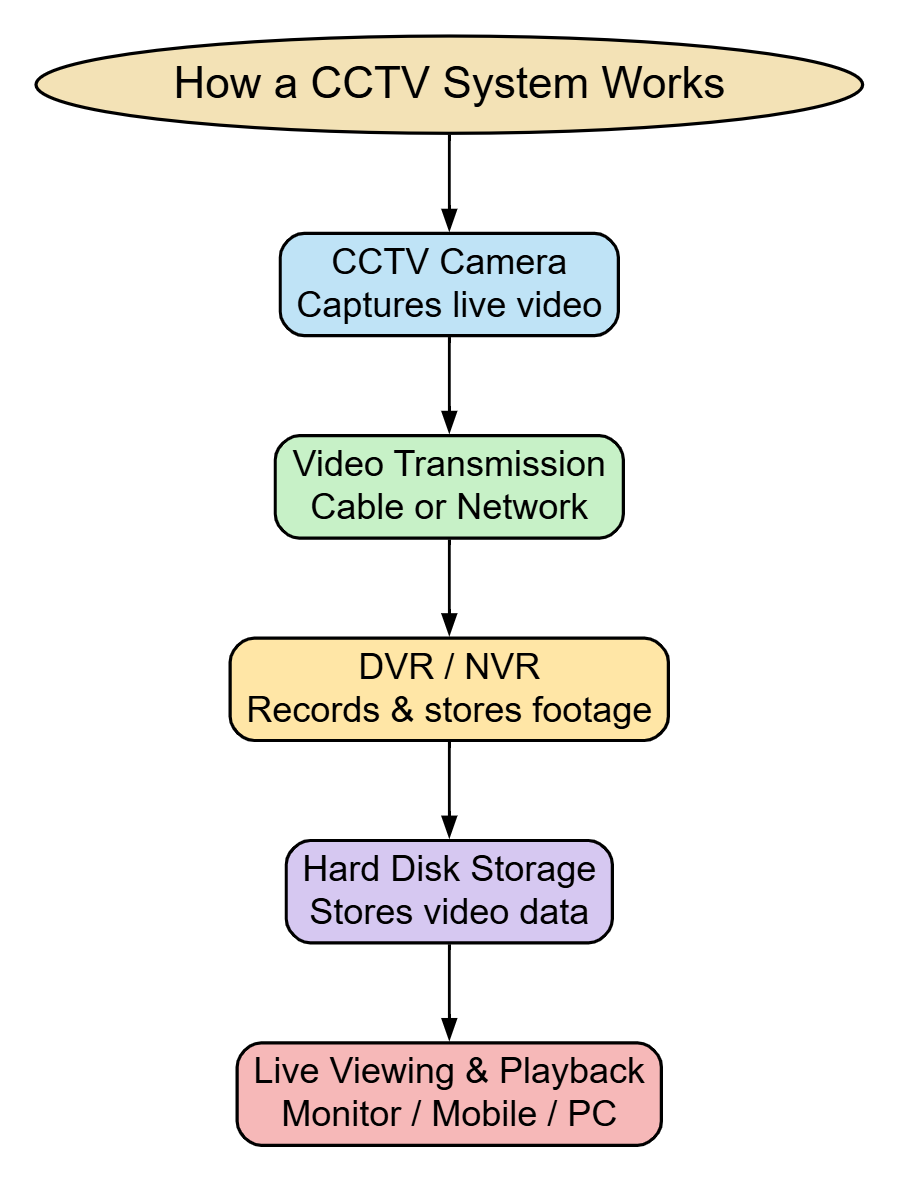
The working principle of CCTV is straightforward yet highly effective. Cameras capture video continuously, transmit it through cables or networks to the DVR or NVR, where footage is recorded and stored. Authorized users can view live feeds or playback recordings on monitors, computers, or even mobile devices through secure access.
Types of CCTV Systems
CCTV systems are broadly classified into Analog CCTV and IP CCTV. Analog systems are cost-effective and suitable for small installations, while IP-based systems offer higher resolution, advanced analytics, and remote monitoring over the internet, making them ideal for modern, scalable security solutions
In a world where safety, accountability, and efficiency matter more than ever, CCTV surveillance systems have become an essential part of modern infrastructure. From deterring crime to enabling real-time monitoring and reliable evidence collection, a well-designed CCTV system delivers peace of mind across homes, businesses, and public spaces. By combining the right camera technology, recording systems, power backup, and network design, organizations can create a security solution that is both dependable and scalable. At Muspana, we believe that effective surveillance is not just about installing cameras, but about designing intelligent systems that protect people, assets, and operations around the clock.