–By Ashraful Islam, Executive HR (Muspana)
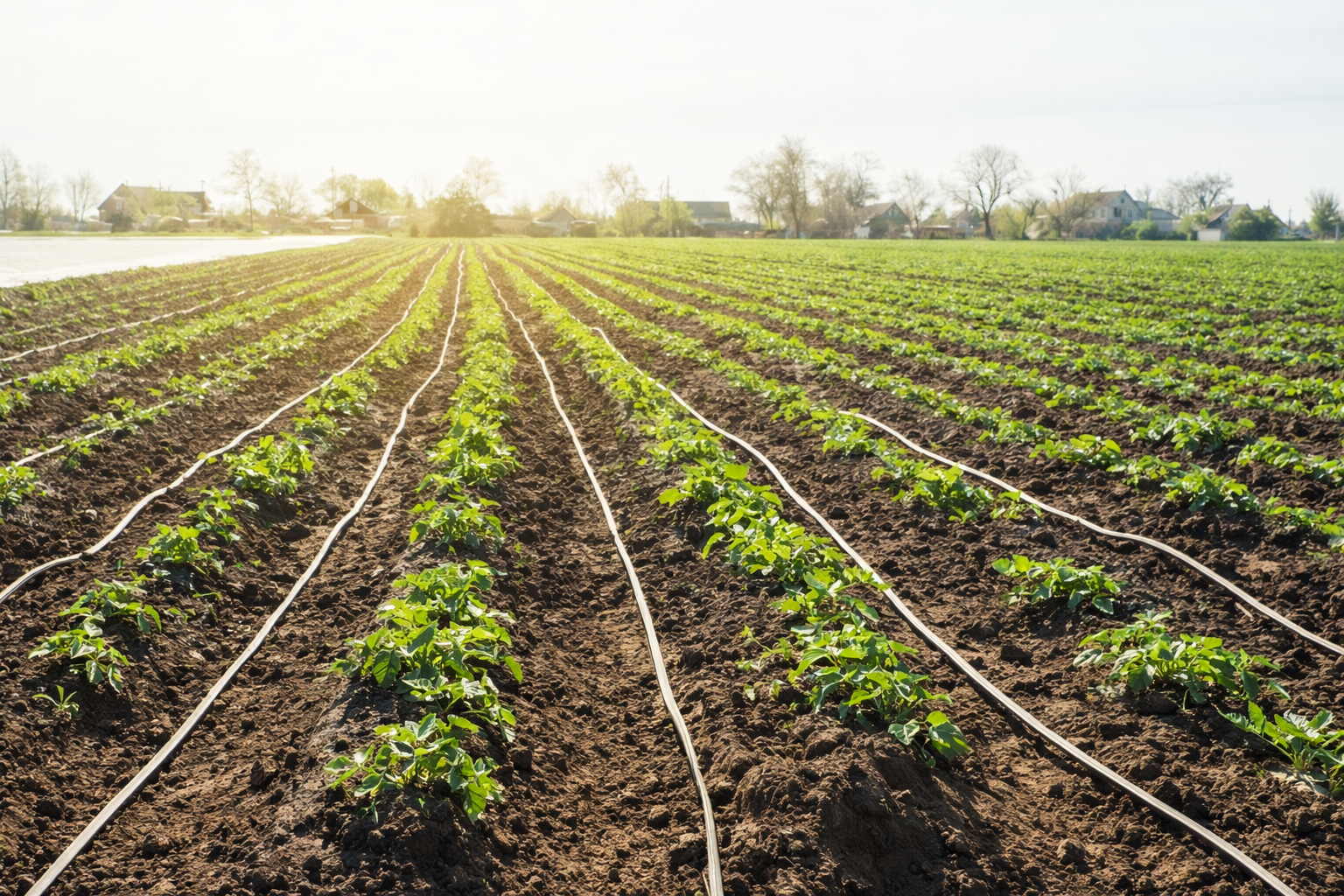
Drip irrigation is a modern micro-irrigation method that delivers water directly to the plant root zone through a network of pipes, filters, valves, and emitters. By minimizing water loss from evaporation, runoff, and deep percolation, it offers significantly higher efficiency than traditional surface irrigation methods and is widely used in water-scarce regions.
In this article, we discuss the key design criteria and layout planning considerations that ensure uniform water distribution, optimal pressure, and efficient use of water in drip irrigation systems.
Objectives
The main objectives include:
- Supplying the required amount of water to crops at the right time
- Ensuring uniform water distribution
- Reducing water losses and energy consumption
- Improving crop yield and water-use efficiency
- Adapting the system to soil type, crop type, and climatic conditions
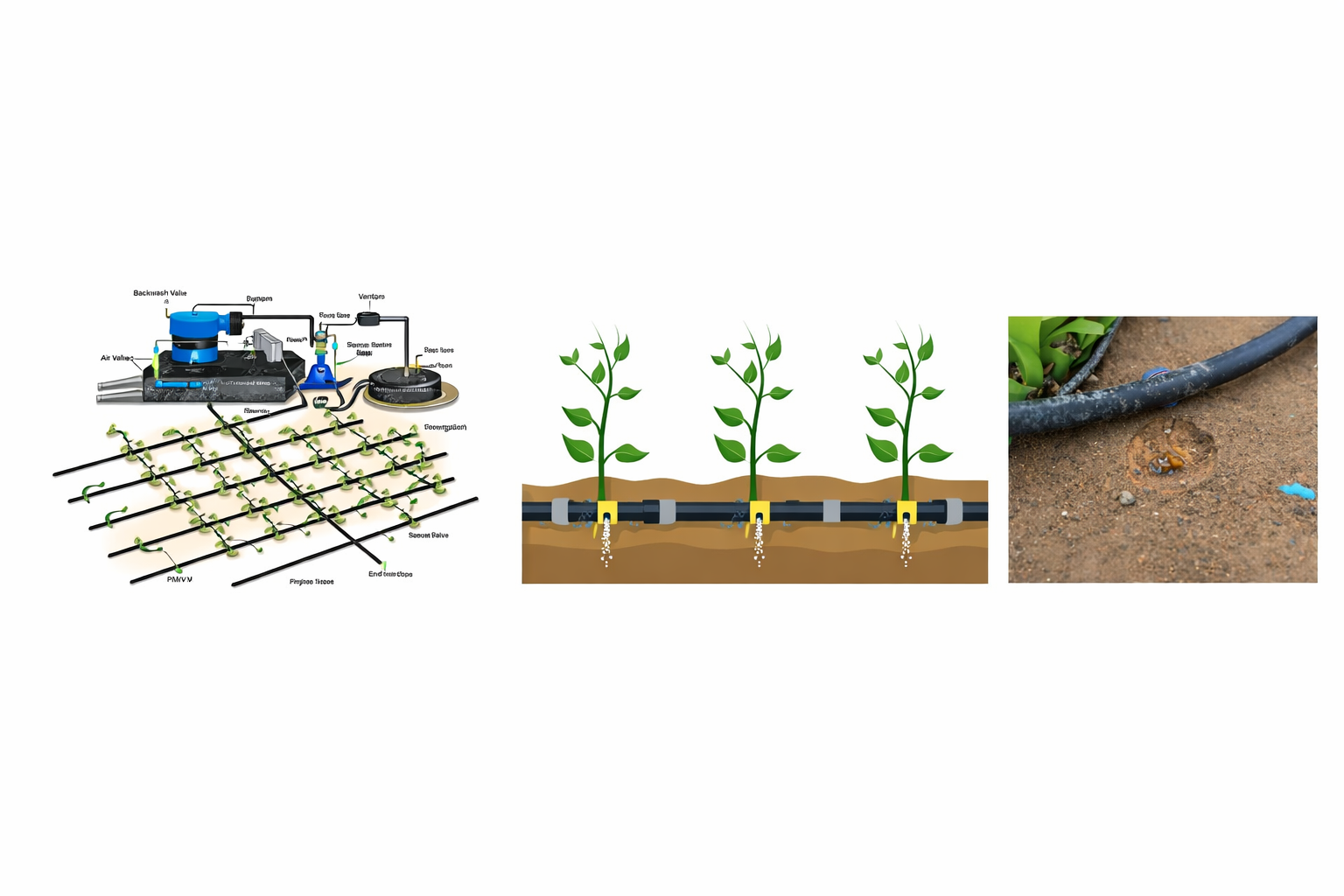
Components
A typical drip irrigation system consists of:
- Water source (tube well, reservoir, river, or tank)
- Pump unit to provide required discharge and pressure
- Filtration system (sand, screen, or disc filter)
- Main line carrying water from the source
- Sub-main line distributing water to laterals
- Laterals laid along crop rows
- Emitters (drippers) delivering water at controlled rates
- Valves and fittings for flow and pressure control
- Fertilizer injection unit for fertigation

Design Criteria of Drip Irrigation Systems
1. Crop Water Requirement
Crop water requirement is calculated using:
ETc = ETo × Kc
Where:
- ETc = Crop evapotranspiration (mm/day)
- ETo = Reference evapotranspiration (mm/day)
- Kc = Crop coefficient
2. Soil Characteristics
Soil type affects:
- Emitter discharge rate
- Spacing between emitters
- Irrigation duration
|
Soil Type |
Infiltration Rate | Emitter Spacing |
|
Sandy |
High | Close |
| Loamy | Medium |
Moderate |
| Clay | Low |
Wider |
3. Emitter Selection
- Emitter discharge rates usually range from 1 to 8 L/hr
- Selection depends on soil infiltration rate, crop water demand, and plant spacing
- Uniformity coefficient (EU) should be ≥ 90% for efficient systems
4. Operating Pressure
- Typical operating pressure: 8 – 1.5 bar
- Pressure variation along laterals should not exceed 20%
- Pressure regulators are used to maintain uniform flow
5. Pipe Diameter Design
Pipe diameters are selected to minimize friction losses:
- Mainline: larger diameter (PVC / HDPE)
- Sub-main: medium diameter
- Laterals: small diameter (12–16 mm)
6. Filtration Requirement
Proper filtration is essential to prevent clogging:
- Sand filter removes organic matter
- Screen or disc filter removes fine particles
- Filter selection depends on water quality

Calculation of Crop Evapotranspiration (ETc)
Using the formula:
ETc = ETo × Kc
ETc = 5.0 × 1.10 = 5.5 mm/day
This represents the daily water demand of the crop.
1. Daily Water Requirement per Plant
Assumptions:
- Plant spacing: 1.0 m × 1.0 m
- Area per plant: 1.0 m²
- System efficiency: 90%
Calculation:
Daily water requirement = (ETc × Area) / Efficiency
= (5.5 × 1.0) / 0.9
= 6.1 liters per plant per day
2. Results and Discussion
The ETc value of 5.5 mm/day reflects the crop’s water demand under given climatic conditions. This scientific approach ensures accurate system design. The calculated daily water requirement helps in selecting appropriate emitter discharge rates and determining irrigation duration.
Layout Planning of Drip Irrigation Systems

1. Field Layout Considerations
Layout planning depends on:
- Field size and shape
- Crop row spacing
- Topography (flat or sloping)
- Location of water source
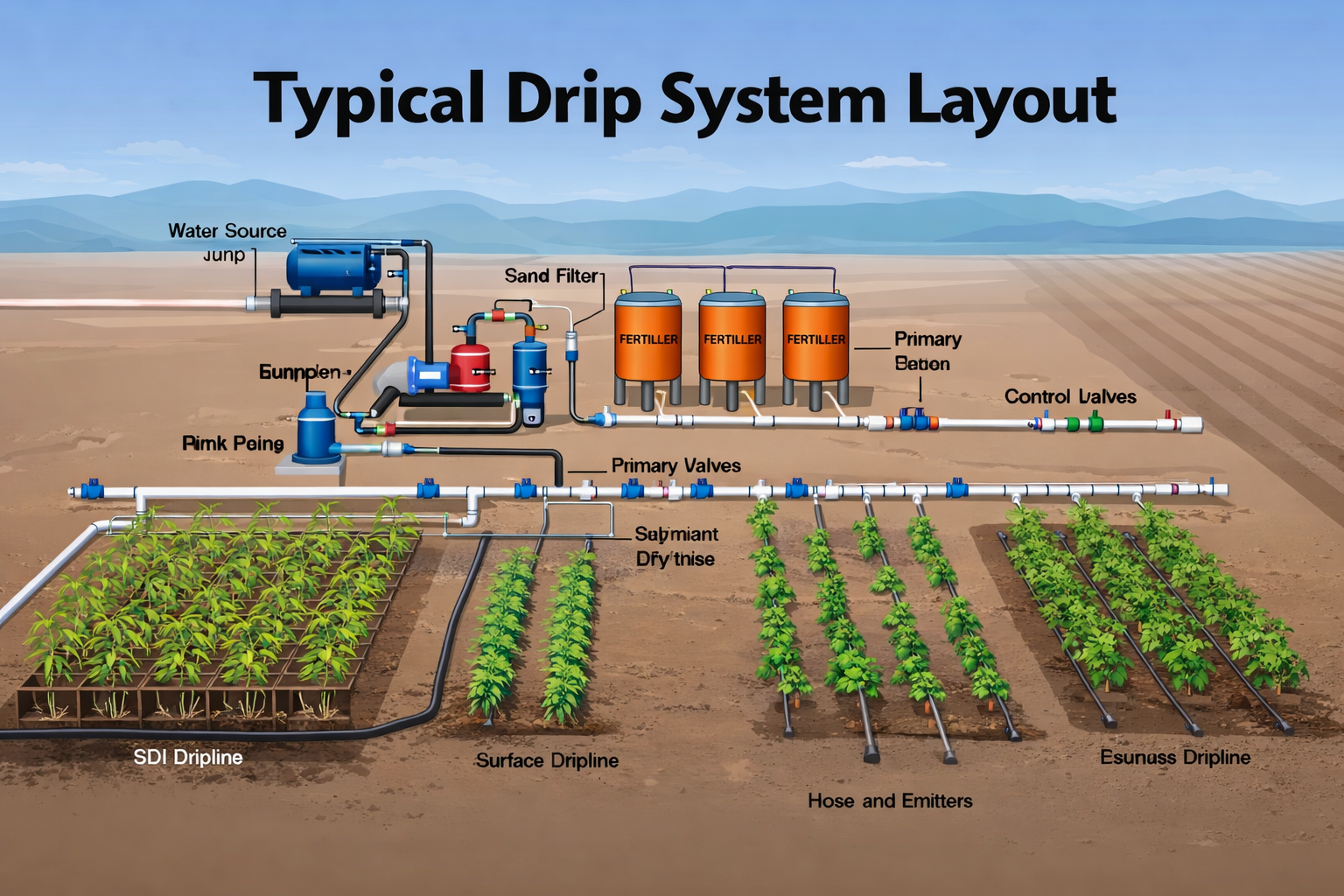
2. Mainline and Sub-main Layout
- Mainline is laid along the field boundary or center
- Sub-mains branch from the mainline
- Valves are installed at sub-main inlets
3. Lateral and Emitter Arrangement
- Laterals are placed along crop rows
- Emitters are positioned near the root zone
Multiple emitters may be used for orchard crops
4 Layout on Sloping Land
- Laterals are laid along contour lines
- Pressure-compensating emitters are preferred
- Air release valves are installed at high points
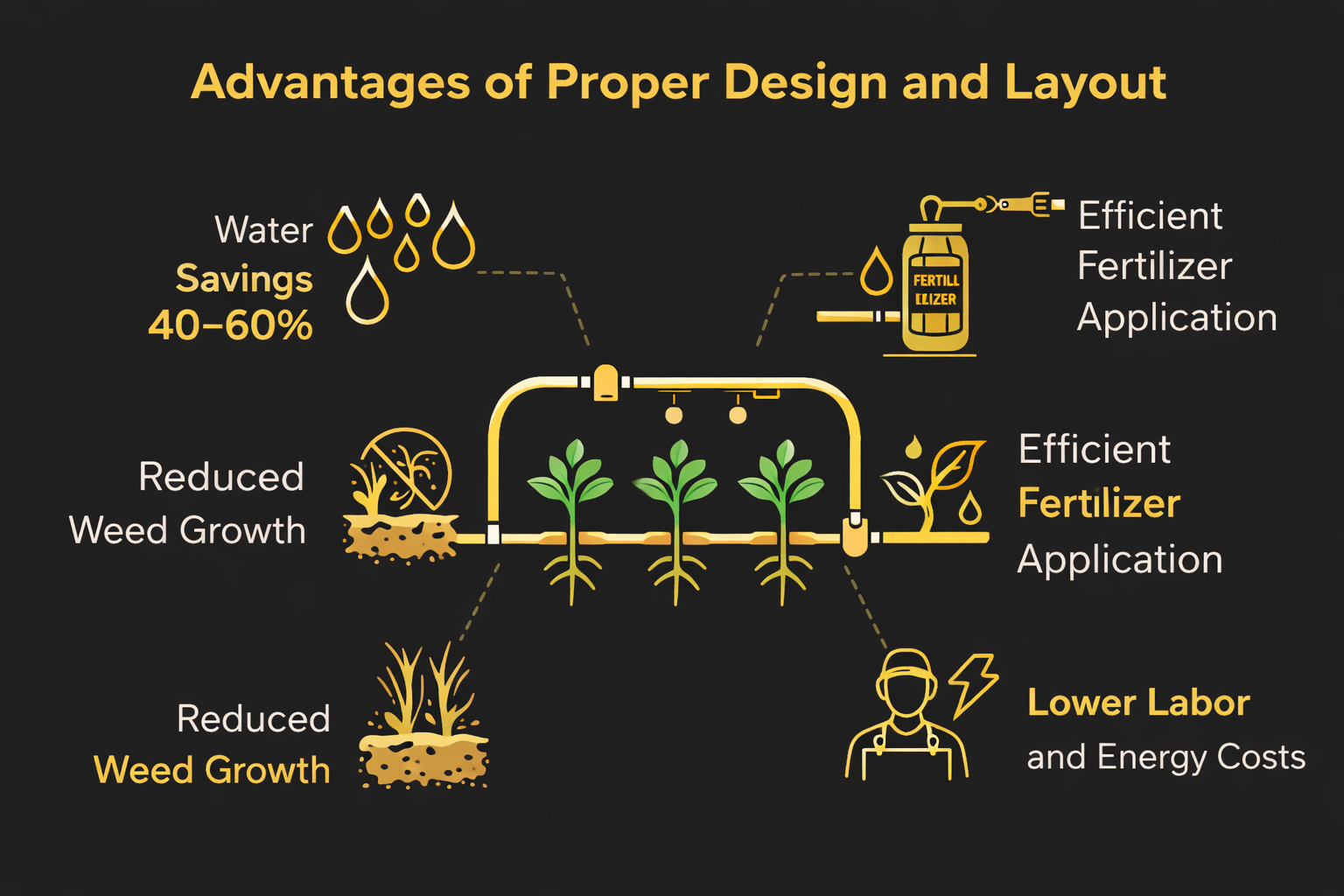
Advantages of Proper Design and Layout
- Water savings of 40–60%
- Increased crop yield and quality
- Reduced weed growth
- Efficient fertilizer application
- Lower labor and energy costs
Limitations
- High initial installation cost
- Requires skilled design and maintenance
- Sensitive to clogging without proper filtration
A properly designed drip irrigation system ensures efficient water use, uniform distribution, and improved crop productivity. Understanding crop water requirements, soil characteristics, hydraulic design, and field layout is essential for successful implementation. Regular maintenance and effective filtration further enhance system performance and lifespan.