
-By Md. Kamrul Hassan, Procurement officer, Procurement
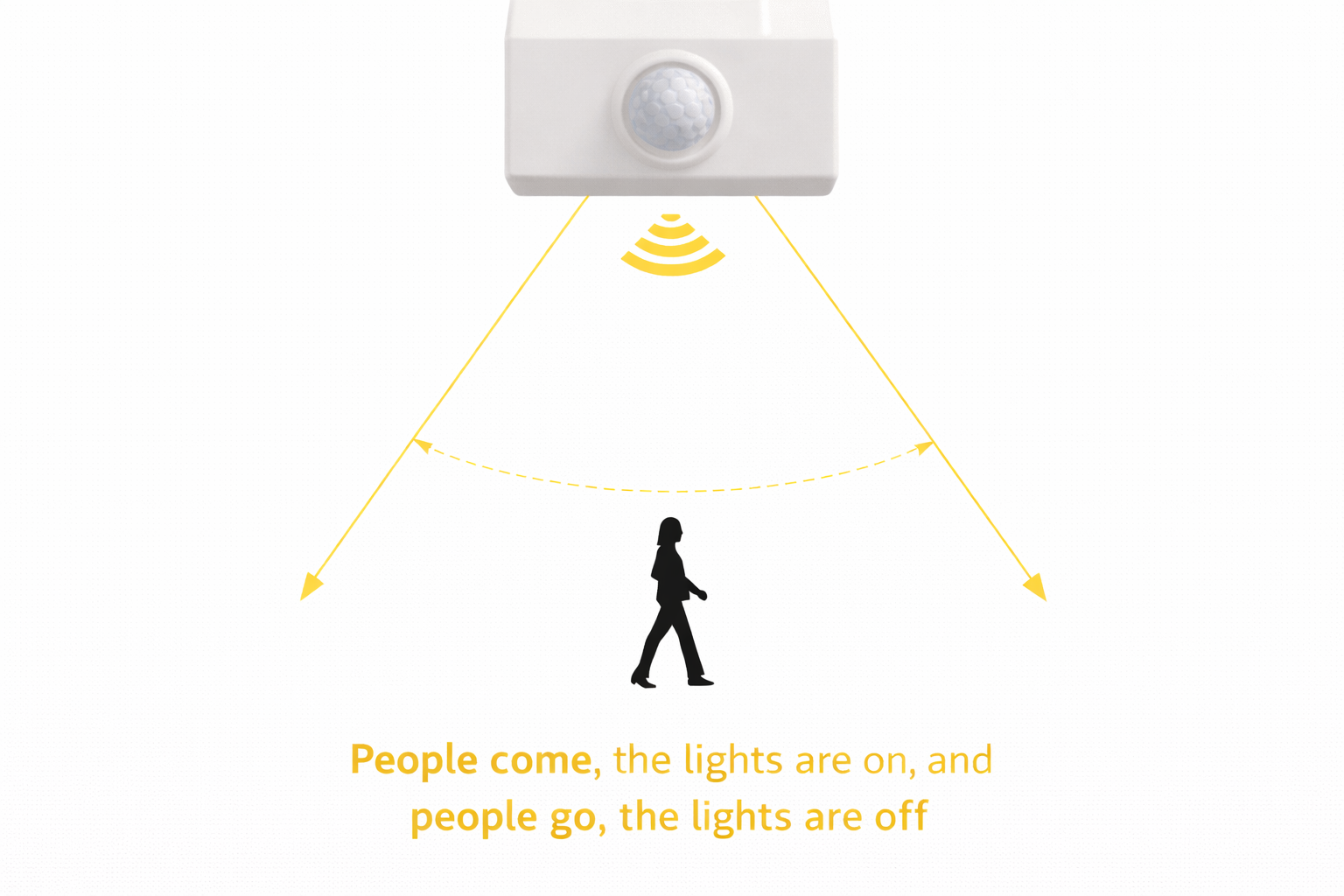
Motion sensors are everywhere. They play a critical role in making our daily lives smarter, safer, and more efficient. From security systems to traffic control and industrial automation, motion sensors based on induction mechanisms are now widely used for detecting movement in a variety of settings. These sensors detect changes in electromagnetic or magnetic fields when an object moves nearby and convert them into electrical signals to indicate motion.
In this blog, we’ll explore how these sensors work, their types, advantages, limitations, and applications.
What is an Induction Mechanism?
At the core of induction-based motion sensors lies electromagnetic induction. According to this principle, when a changing magnetic field comes close to a conductor, it induces an electric current in the conductor. This electric current is then detected as motion. When a metallic object moves into this field, it disturbs the magnetic field, and the sensor detects this disturbance as movement.
How Do Induction-Based Motion Sensors Work?
The working process of an induction-based motion sensor can be explained in simple steps:
-
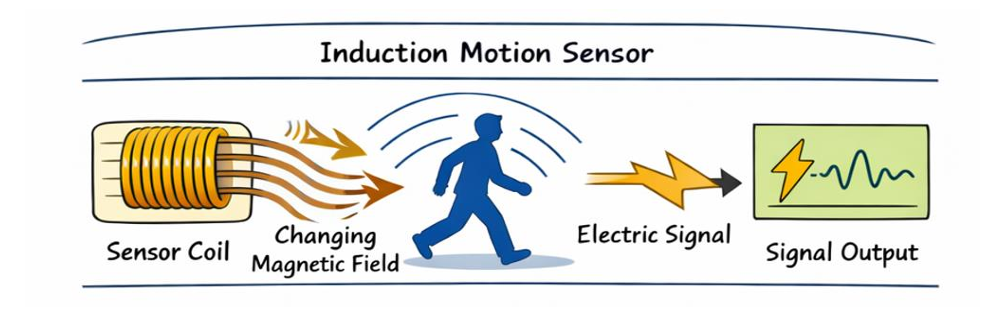
Sensor Coil: A coil inside the sensor generates a magnetic field.
-
Movement: When a metallic object moves into this magnetic field, eddy currents are produced on the surface of the object.
-
Disturbance: These eddy currents disturb or weaken the magnetic field.
-
Detection: The sensor detects the change in the magnetic field.
-
Signal Output: An electrical signal is generated, which indicates the motion or presence of the object.
This process enables the detection of metallic objects without physical contact, making it ideal for automation and security purposes.
Types of Induction-Based Motion Sensors
Induction-based motion sensors come in various forms, depending on the application and type of object they are designed to detect:
-
Inductive Proximity Sensors
-
Used in industrial automation to detect metal objects on machines and conveyor belts.
-
-
Eddy Current Sensors
-
Used for precise measurement of motion, distance, or displacement.
-
-
Inductive Loop Sensors
-
Commonly used in traffic control systems to detect vehicles at traffic signals.
-
Advantages of Induction-Based Motion Sensors
There are several reasons why induction-based motion sensors are favored in industrial, security, and traffic systems:
-
Non-Contact Sensing: These sensors work without any physical contact with the object being detected.
-
Reliability in Harsh Environments: They are effective in dusty, oily, and harsh conditions where other sensors might fail.
-
Quick Response: They offer a fast response time and accurate detection, making them perfect for real-time applications.
-
Long Lifespan: Induction sensors have a long service life with minimal maintenance.
Limitations of Induction-Based Motion Sensors
While induction-based motion sensors are effective, they come with some limitations:
-
Metallic Object Detection Only: These sensors can only detect metallic objects and are not suitable for detecting non-metal objects like humans or animals.
-
Limited Sensing Range: Compared to optical sensors, induction-based sensors generally have a shorter sensing range.
-
Cannot Detect Humans: They struggle to detect human presence or non-metal objects, limiting their application in some scenarios.
Applications of Induction-Based Motion Sensors
Induction-based motion sensors have found a wide range of applications:
-
Industrial Automation: To detect and monitor metal objects on machines and conveyor belts.
-
Traffic Management: Used in traffic signals to detect vehicles at intersections.
-
Security Systems: Integrated into alarm systems for detecting unauthorized movement.
-
Precision Measurement: Used in distance measurement applications for accurate monitoring.
Conclusion
Motion sensors based on induction mechanisms are simple, reliable, and widely used in various industries. Thanks to their ability to detect metallic objects without physical contact, they are crucial for automation systems, traffic control, and security solutions. With their accuracy, durability, and low maintenance, they have become an essential component of modern technology.
If you’re looking to integrate motion sensors into your projects or operations, Muspana offers advanced solutions that can help you optimize efficiency and safety.