If you’ve spent any time reading about solar energy recently, you’ve probably run into a headline promising something like “new solar cell breaks 30% efficiency.” It sounds like the panels on your roof are about to become obsolete overnight.
They’re not. At least, not yet.
The technology behind those headlines is called perovskite — sometimes paired with silicon in what’s known as a tandem solar cell. It’s genuinely exciting science. It’s also, right now, almost entirely confined to research labs. If you’re trying to decide whether to install solar this year or hold off for something better, that gap between “lab result” and “product you can buy” is the single most important thing to understand.
What Is a Perovskite Solar Cell?
A perovskite solar cell uses a crystal-structured material — named after the mineral perovskite — instead of (or alongside) the silicon wafers used in nearly every solar panel sold today. In lab conditions, perovskite cells have already crossed efficiencies of 30%, well past what a single layer of silicon can manage on its own.
That number gets repeated a lot, and for good reason — it’s real. What usually gets left out is that it’s a lab measurement on a small test cell, not a spec sheet for a panel you could put on your roof. There’s a long, difficult road between a record set in a controlled lab environment and a product that can survive ten or twenty years of monsoon humidity, heat, and UV exposure on a rooftop in Dhaka.
Why Does Silicon Alone Have a Ceiling?
Every solar cell works by absorbing sunlight and converting it into electricity, but a single layer of silicon can only efficiently capture a specific slice of the light spectrum. Photons outside that range either pass through unused or get lost as heat. This is a physical limit, not an engineering shortfall — it’s why even the best commercial silicon panels available in Bangladesh today plateau in the low-to-mid twenties for efficiency, no matter how well they’re manufactured.
To get meaningfully past that ceiling, you need to capture more of the spectrum. That’s where tandem cells come in.
What Is a Tandem Solar Cell?
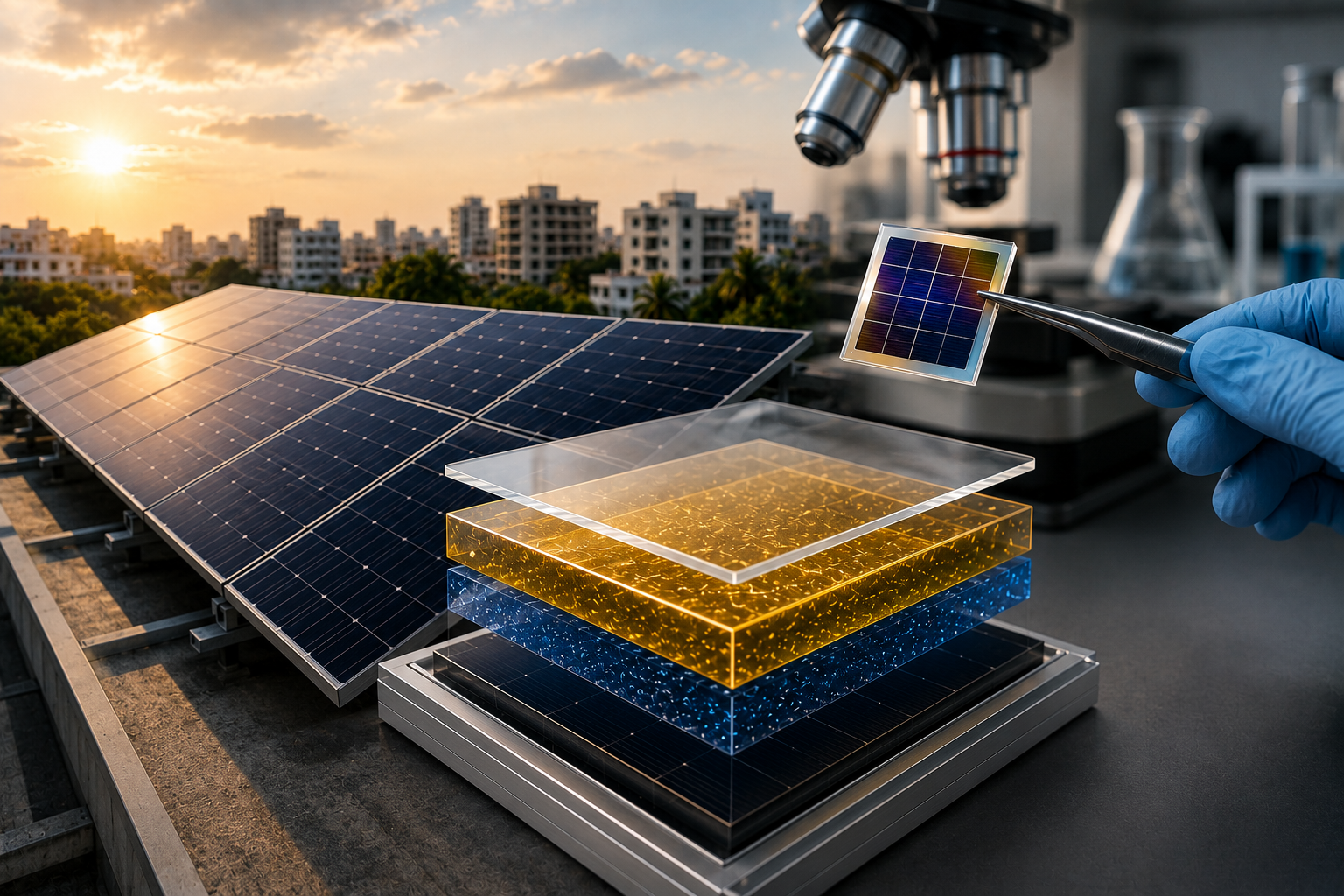
A tandem solar cell stacks two different light-absorbing layers on top of each other — typically a perovskite layer on top of a conventional silicon layer. Each layer is tuned to absorb a different part of the sunlight spectrum, so together they capture more usable energy from the same amount of sunlight than silicon could on its own.
Think of it less as “replacing” silicon and more as giving silicon a partner that catches what it misses.
The efficiency gains from this approach are the whole reason tandem technology has generated so much attention. Stack the layers correctly, and you get a cell capable of noticeably higher output than anything currently sold as a mainstream residential or commercial panel.
The Real Challenge: Durability, Not Just Efficiency
Here’s the part competing solar sites tend to skip past: efficiency was never really the hard problem. Durability is.
Perovskite material is chemically sensitive to moisture and heat in ways silicon simply isn’t. In early lab and field trials, perovskite layers have degraded far faster than the silicon layers next to them — sometimes losing meaningful performance within months rather than years. For a technology that needs to survive two decades on a roof, that’s a serious unresolved issue, not a minor footnote.
Manufacturers are working through several connected challenges before this becomes a real commercial product:
- Encapsulation — sealing the perovskite layer well enough to block moisture over the long term
- Manufacturing yield — producing tandem cells consistently at scale, not just as one-off lab samples
- Cell-to-module integration — getting the efficiency gains seen in a small lab cell to hold up in a full-size panel
- Long-term field data — actual multi-year rooftop performance data, which by definition takes years to collect
None of these are solved problems yet. They’re active areas of research and pilot manufacturing.
Lab Efficiency vs. Commercial Reality
This table sums up where things genuinely stand right now:
| Single-Junction Silicon (today’s standard) | Perovskite-Silicon Tandem (lab stage) | |
| Typical efficiency | Low-to-mid 20s% | 30%+ in lab conditions |
| Commercial availability | Widely available, including in Bangladesh | Not yet commercially available |
| Proven durability | 20-25 year performance warranties, well-established | Still under evaluation; historically degrades faster |
| Manufacturing scale | Mature, high-volume global supply chains | Early-stage, pilot manufacturing only |
The gap in that last row — manufacturing scale — is really the whole story. A technology can be scientifically proven and still be years from being something you can actually order.
Should You Wait to Go Solar?
If you’re currently weighing a solar purchase in Bangladesh, here’s the honest answer: don’t delay it for this.
Today’s silicon panels — including newer variants like PERC and TOPCon cells that are already improving on older silicon designs — are proven, bankable, and backed by decades of field performance data. Tandem and perovskite technology, however promising, doesn’t have a local supply chain, doesn’t have long-term durability data, and doesn’t have a commercial release date. Waiting for it means delaying real, immediate savings on your electricity bill for a technology that isn’t ready to sell, with no guarantee of when it will be.
There’s also a practical local angle worth mentioning: rooftop space is often tight in urban Bangladesh, particularly for apartment buildings and smaller homes in dense areas like Dhaka or Chattogram. Higher-efficiency panels matter more when you don’t have much roof to work with. That’s a genuine reason to keep an eye on tandem technology’s progress — it just isn’t a reason to put off a decision you can make today with equipment that already works.
When Might This Reach Bangladesh?
There’s no reliable timeline yet for when tandem panels will be commercially available anywhere, let alone in Bangladesh specifically. Solar technology adoption in Bangladesh has historically followed international markets by a few years, since the country relies on imported panels rather than domestic manufacturing. Realistically, tandem technology would need to first prove itself at scale in larger manufacturing markets before it becomes something local suppliers stock and installers recommend.
If and when that happens, it’s reasonable to expect the technology will reach Bangladesh only after it has a track record elsewhere — not as an early adopter market.
At Muspana, we keep a close eye on where solar technology is heading so we can guide customers toward genuinely proven options rather than chasing headlines. Right now, that means helping Bangladeshi homeowners and businesses choose from today’s reliable, well-tested panel technology — and we’ll bring next-generation options into that conversation once they’ve actually earned their place on a roof.
FAQs
Are perovskite solar panels available to buy yet?
No. Perovskite and tandem solar cells currently exist as lab and pilot-manufacturing technology. They aren’t sold as commercial rooftop or industrial panels anywhere yet, including in Bangladesh.
How long do perovskite solar cells last?
This is still being determined. Early perovskite materials have historically degraded faster than silicon when exposed to moisture and heat, and manufacturers are actively working on encapsulation methods to fix this before any commercial release.
Why are tandem solar cells more efficient than silicon alone?
Tandem cells stack a perovskite layer on top of a silicon layer, so each layer captures a different part of the sunlight spectrum. Together they convert more of the available sunlight into electricity than silicon can on its own.
Should I wait for tandem solar technology before installing solar in Bangladesh?
No. There’s no confirmed timeline for commercial availability, and today’s silicon-based panels are proven, reliable, and already deliver strong long-term savings. Waiting means giving up real, immediate benefits for a technology that isn’t ready to purchase.
What’s the difference between perovskite and silicon solar panels?
Silicon panels use a single semiconductor layer and are the current global standard, with efficiencies typically in the low-to-mid twenties percent. Perovskite panels use a different crystal-structured material and have shown lab efficiencies above 30%, either alone or stacked with silicon in a tandem design — but they aren’t yet commercially available or field-proven.