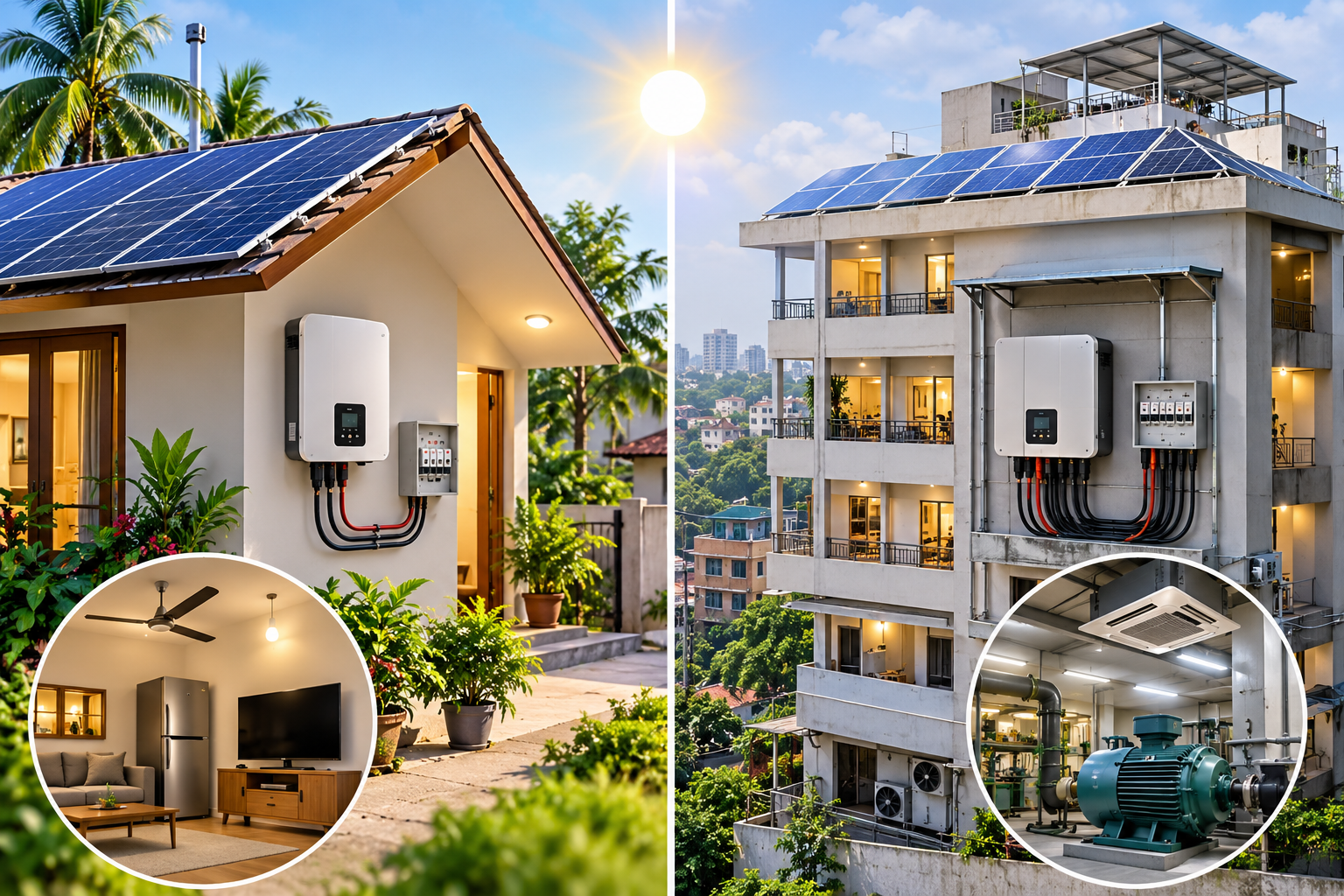
Single-Phase vs. Three-Phase Solar Inverters: Which One Do You Actually Need?
If two installers gave you two different answers — one quoting a single-phase inverter, the other insisting you need three-phase — you’re not imagining things. Both could be right, depending on one detail most homeowners never think about: what kind of electrical connection you actually have.
Here’s the short version. A single-phase inverter sends out one AC waveform. A three-phase inverter sends out three, spaced 120 degrees apart, which lets it deliver power more smoothly and handle much bigger loads. Single-phase covers most homes and small shops. Three-phase is standard for larger buildings, factories, and anything running heavy machinery.
But “bigger system = three-phase” is an oversimplification, and it’s the reason so many people end up confused. The real answer depends on three things working together, not just system size.
The Quick Comparison
| Feature | Single-Phase Inverter | Three-Phase Inverter |
| Typical Capacity | 1kW – 10kW | 10kW – MW scale |
| Output Voltage | 220–240V | 380–415V |
| Power Delivery | Pulses slightly with each half-cycle | Smooth and constant |
| Best For | Homes, small shops | Commercial buildings, factories, farms |
| Cost | Lower upfront | Higher upfront, but more efficient per kW at scale |
Keep this table in mind as you read on — most of what follows is really just unpacking why these numbers look the way they do.
It Starts With What’s Already Coming Into Your Building
Before capacity or load type even enters the picture, there’s a harder constraint: you can’t install a three-phase inverter on a single-phase connection, full stop. The inverter has to match the type of supply your building already has from the distribution utility — whether that’s BPDB, BREB, DESCO, DPDC, WZPDCL, or NESCO depending on where you are.
In Bangladesh, most homes and small shops are connected on single-phase service, because their sanctioned load doesn’t require anything more. Larger residential buildings, commercial establishments, and almost every industrial facility are given three-phase service instead, because their sanctioned load is high enough to need it.
This is actually good news for anyone trying to figure out which inverter they need — you don’t have to guess. Check your electricity bill or ask your utility what your connection type is, and that answers the first and biggest question before you even think about system size.
System Size Matters — But Not the Way People Assume
Once your connection type is settled, capacity becomes the next factor. Single-phase inverters are cost-effective and perfectly capable for smaller systems, generally up to around 10kW. Push much past that on a single phase, and you start running into per-phase current limits — the utility simply won’t let that much power flow through one phase line.
Three-phase inverters exist precisely to get around that ceiling. By splitting the load across three separate waveforms, they can scale from around 10kW up into the megawatt range without hitting the same limits, which is why virtually every serious commercial or industrial solar installation uses one.
There’s an honest nuance worth mentioning here that a lot of comparisons skip: single-phase power delivery genuinely does pulse — it dips slightly with each half-cycle rather than flowing perfectly evenly. For a home running lights, fans, and a fridge, this is completely imperceptible and doesn’t matter in the slightest. It only becomes a real consideration once you’re running sensitive industrial equipment that benefits from perfectly smooth, constant power.
What You’re Actually Powering Changes the Equation Too
The third factor is load type, and it’s the one that trips up commercial buyers the most. Heavy machinery, large motors, and pumps typically need three-phase power to start and run properly — a single-phase supply struggles with the high starting current these loads demand. This is generally true, though it’s worth noting that many smaller motors are designed to run just fine on single-phase.
Standard home appliances, on the other hand — your fans, fridge, TV, lights, even most air conditioners — are built for single-phase power and don’t benefit at all from three-phase, no matter how large your solar array is.
So a factory in Gazipur running production-line motors needs three-phase regardless of how modest its solar capacity might be. A household in a smaller city like Bogura running a typical mix of appliances has no real use for three-phase, even if it eventually adds a larger system.
For Homeowners and Small Shop Owners
If you’re in this category, the decision is usually simpler than it feels. Confirm your connection type first — that alone tells you most of what you need to know. If you’re on single-phase supply with a fairly typical load, a single-phase inverter is not a downgrade or a compromise; it’s the correctly sized tool for the job, and it costs less upfront.
Be cautious if an installer recommends three-phase equipment for a small single-phase household system — ask them directly why, since it may not be technically possible to install without upgrading your utility connection first, and that’s a separate cost and process altogether.
For Industrial and Commercial Buyers
Here, the calculation shifts. If your facility already carries a three-phase utility connection — which most commercial and industrial sites in Bangladesh do — and you’re running any meaningful production machinery, three-phase inverters are generally the right call even for systems that might technically still fit under 10kW on paper. The smoother power delivery and freedom from per-phase current limits matter more as your operation scales, and they avoid future headaches if you plan to expand.
It’s also worth checking with your installer or utility how your system’s export capacity interacts with net metering rules at your scale — this varies by installation size and utility, so it’s a conversation worth having early rather than assuming.
Can You Switch Later?
Not easily, and it’s better to know that upfront. Moving from a single-phase to a three-phase system generally means upgrading your utility connection itself, not just swapping the inverter — a separate process involving your distribution utility and a higher sanctioned load approval. If there’s any realistic chance you’ll scale up significantly within a few years, it’s worth having that conversation with your installer before your initial installation, not after.
Getting This Right the First Time
The good news is that none of this requires guesswork on your part. Before recommending an inverter type, a proper installer should confirm your utility connection type and sanctioned load, not just size the system to your rooftop space or budget. That verification step is what separates a system that gets approved smoothly from one that runs into problems at the utility interconnection stage. If you’re comparing quotes and one recommends a phase type without asking about your actual electrical connection, that’s worth questioning.
FAQs
Can I install a three-phase inverter on a single-phase connection?
No. The inverter type has to match your existing utility connection. If you only have single-phase service, you’d need to apply for a three-phase upgrade through your distribution utility before a three-phase inverter could be installed.
Is a three-phase inverter always better than single-phase?
Not necessarily. Three-phase offers smoother power delivery and higher capacity, but for a typical home running standard appliances, single-phase is the right fit and costs less. “Better” depends entirely on your connection type, system size, and what you’re powering.
How do I know if my home or business has a single-phase or three-phase connection?
Check your electricity bill or meter, or ask your local distribution utility directly. This is the fastest way to confirm before discussing inverter options with an installer.
Do I need three-phase power for home appliances?
No. Standard home appliances like fans, refrigerators, lights, and most air conditioners are designed for single-phase power and gain no benefit from three-phase.
Can I upgrade from single-phase to three-phase later if my system grows?
It’s possible, but it usually means upgrading your utility connection and sanctioned load, not just replacing the inverter. If you expect to scale up in the next few years, it’s worth planning for that upfront rather than switching later.