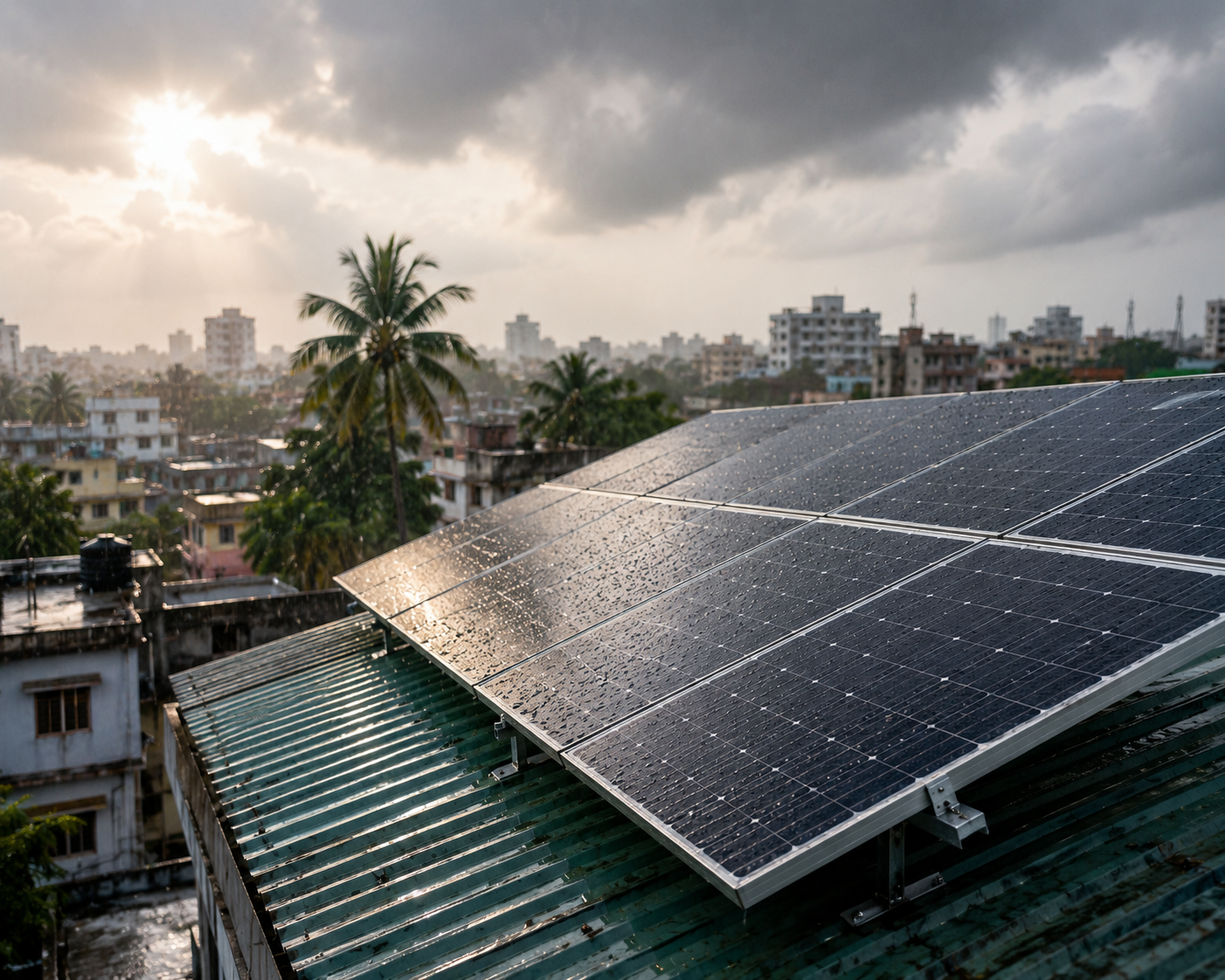
Your Solar Panel Was Tested at 25°C. Bangladesh Rarely Is.
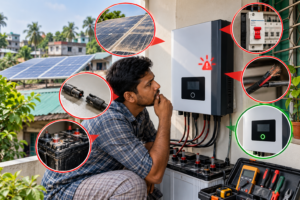
Every solar panel sold in Bangladesh carries a spec sheet number — its rated wattage — measured under something called Standard Test Conditions, or STC. That test happens at a cool, controlled 25°C. Walk onto a Dhaka rooftop in May, though, and the panel surface itself can sit well above 50°C, even if the air temperature is “only” 38-40°C.
So does that mean solar doesn’t work here? No. Bangladesh gets strong, consistent sunlight for most of the year, and solar remains one of the more reliable ways to cut a power bill. But there’s a real, measurable performance gap between the number on the box and what a panel produces on a genuinely hot, humid afternoon — and almost nobody selling you a system will walk you through why.
That’s the gap this article is for.
Why Heat Actually Reduces Solar Panel Output
This trips people up because it seems backwards — more sun and more heat should mean more electricity, right? Not quite. Sunlight (irradiance) and heat aren’t the same thing, and they affect a panel in opposite directions.
A solar cell generates electricity when sunlight knocks electrons loose, creating voltage and current. More sunlight generally means more current — that part scales the way you’d expect. But as the cell itself gets hotter, its voltage drops. And because power is voltage multiplied by current, a hotter panel produces measurably less power even under identical bright sunlight.
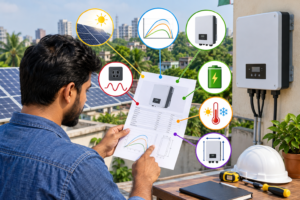
Manufacturers quantify this with something called a temperature coefficient, usually expressed as a percentage loss in power for every degree Celsius above that 25°C test baseline. This number varies by panel technology and manufacturer, so it’s worth checking the actual datasheet for any system you’re considering rather than assuming a universal figure — but it’s common for crystalline silicon panels to lose somewhere in the range of a few tenths of a percent per °C above 25°C. On a panel surface running 25-30°C above the STC baseline during a Bangladeshi summer afternoon, that adds up to a real, noticeable dip in output — even though the sun overhead is doing exactly what it’s supposed to.
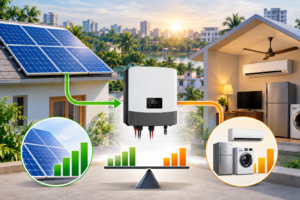
What this means practically: your system won’t produce its full rated wattage on the hottest afternoons of the year, and any honest quote or sizing calculation should already account for that — not treat the nameplate wattage as a year-round guarantee.
Humidity, Monsoon, and Cloud Cover: The Part Most Articles Skip
Most solar content written for global audiences frames “extreme climate” as a choice between scorching desert and frozen tundra. That framing is close to useless if you’re trying to figure out solar for Bogura or Sylhet, because Bangladesh’s real extremes are different: relentless humidity, a monsoon season that can blot out the sky for days, and heat that comes bundled with moisture rather than dry desert air.
A few things worth understanding here:
- Cloud cover during monsoon reduces direct sunlight, but panels still produce power from diffuse light on overcast days — output drops, it doesn’t disappear. This is one reason system sizing in Bangladesh should account for seasonal variation rather than assuming peak-season output year-round.
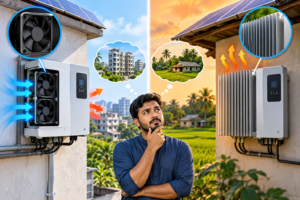
- High ambient humidity can worsen the heat problem, because moist air doesn’t shed heat away from a panel’s surface as efficiently as dry air does, particularly on rooftops with limited airflow underneath the panels.
- Long-term moisture exposure is a durability concern, not just a performance one. Persistent humidity can gradually degrade certain panel materials or contribute to a phenomenon called potential-induced degradation (PID) in some panel types over years of exposure — this is a slower, cumulative effect rather than something that shows up in month one, and it varies significantly by panel build quality and encapsulation.
- Dust and airborne particulates matter too. Between monsoon downpours (which naturally rinse panels) and drier stretches where dust and pollution settle on the surface, soiling losses are a real and separate factor from heat or humidity — one that regular cleaning can largely address.
A common rooftop reality in Bangladesh — tin-shed roofing, which absorbs and radiates heat aggressively — can push the air directly beneath a rooftop-mounted panel hotter than a typical concrete-roof or ground-mounted setup elsewhere. This is a genuine local consideration when it comes to mounting design and airflow, even though there isn’t a single universal number to attach to how much hotter it gets — that depends on the roof, the mounting gap, and the specific installation.
Coastal Conditions: Salt Air, Cyclones, and Flooding
If you’re anywhere near the coastal belt — Chattogram, Cox’s Bazar, Khulna — there’s a third factor beyond heat and humidity: salt-laden air and storm exposure.
Salt mist can corrode unprotected metal components over time, particularly mounting structures, frames, and electrical connections. This is a well-established enough concern that there’s an international test standard for it — IEC 61701, salt-mist corrosion testing — and panels or mounting hardware certified to that standard are generally a safer bet for coastal installations. Worth confirming with any installer whether the specific hardware they’re proposing has been tested for this, rather than assuming standard components are coastal-rated by default.
Beyond corrosion, coastal and low-lying areas also carry cyclone-season wind loading and monsoon flooding risk, both of which are primarily mounting-design and site-selection issues rather than panel-performance ones — a well-engineered mounting structure rated for local wind conditions, positioned above likely flood lines, matters as much as the panel itself in these areas.
Heat vs. Humidity vs. Coastal Conditions: A Quick Comparison
| Condition | What actually happens | Main mitigation |
| High heat | Panel voltage drops as cell temperature rises, reducing power output despite strong sunlight | Choose panels with a lower temperature coefficient; ensure a ventilation gap beneath mounted panels for airflow |
| Humidity & monsoon cloud cover | Reduced direct sunlight on overcast days; moist air can slow heat dissipation; long-term moisture exposure is a durability factor | Size the system accounting for seasonal output variation; choose panels with strong encapsulation and PID resistance |
| Coastal salt air & storms | Salt mist can corrode unprotected metal over years; cyclone winds and flooding threaten poorly designed mounts | Use IEC 61701 salt-mist certified hardware where available; engineer mounting for local wind and flood conditions |
What This Means When You’re Choosing a System
None of this is a reason to avoid solar in Bangladesh — it’s a reason to be specific about what you’re buying and why. A few practical things worth asking any installer or supplier:
- What’s the temperature coefficient on the actual panel model being quoted, and does the quote’s production estimate already account for it?
- Is there a genuine ventilation gap in the proposed mounting design, or are panels sitting flush against a hot roof surface?
- If you’re in a coastal district, has salt-mist-rated hardware been specifically considered, or is this a standard inland design?
- Does the system sizing account for lower monsoon-season output, or is it based purely on peak dry-season numbers?
This is the kind of detail that separates a system sized for a lab spec sheet from one sized for how your roof actually behaves through a full Bangladeshi year. It’s also where Muspana’s approach differs in practice — climate-appropriate system design isn’t an add-on, it’s part of how a system should be sized and specified from the start, whether that’s a home rooftop or a factory installation in an industrial zone like Gazipur or Narayanganj. If you’re weighing options for your own roof or facility, it’s worth getting a system sized around your actual site conditions rather than a generic estimate.
Frequently Asked Questions
Does heat really reduce solar panel efficiency?
Yes. As a panel’s cell temperature rises above the 25°C test standard, its voltage drops, which reduces power output even under strong sunlight. The exact loss depends on the panel’s temperature coefficient, which varies by model and manufacturer.
Do solar panels work during Bangladesh’s monsoon season?
Yes, but at reduced output. Panels still generate electricity from diffuse light on cloudy days — they just produce less than they would in direct, bright sunlight. Well-designed systems account for this seasonal dip rather than assuming year-round peak output.
Are solar panels safe to install in cyclone-prone coastal areas?
They can be, with the right mounting design and hardware. The key is wind-rated mounting structures, flood-conscious site placement, and ideally salt-mist-certified components (IEC 61701) to resist corrosion from coastal air over time.
Does humidity damage solar panels over time?
Persistent humidity can contribute to gradual degradation in some panel types over years, though this varies significantly with panel build quality and encapsulation. It’s a slower, cumulative consideration rather than something that affects performance immediately.
Do I need a bigger system to compensate for heat and humidity losses in Bangladesh?
Possibly — it depends on the specific site, roof type, and panel chosen. This is exactly why proper system sizing (rather than a generic quote) matters; a system sized only around peak dry-season, lab-condition output can under-deliver across a full year.