The pitch always sounds the same. “No money down. Immediate savings. Zero maintenance headaches.” A solar rep says it with a straight face, and honestly, it’s not even a lie. It’s just half the story.
If you’re a business owner or the person in charge of facilities decisions, you’ve probably had this conversation more than once. Someone shows you a proposal, the numbers look great, and then you ask the one question that actually matters: who owns this thing when it’s done?
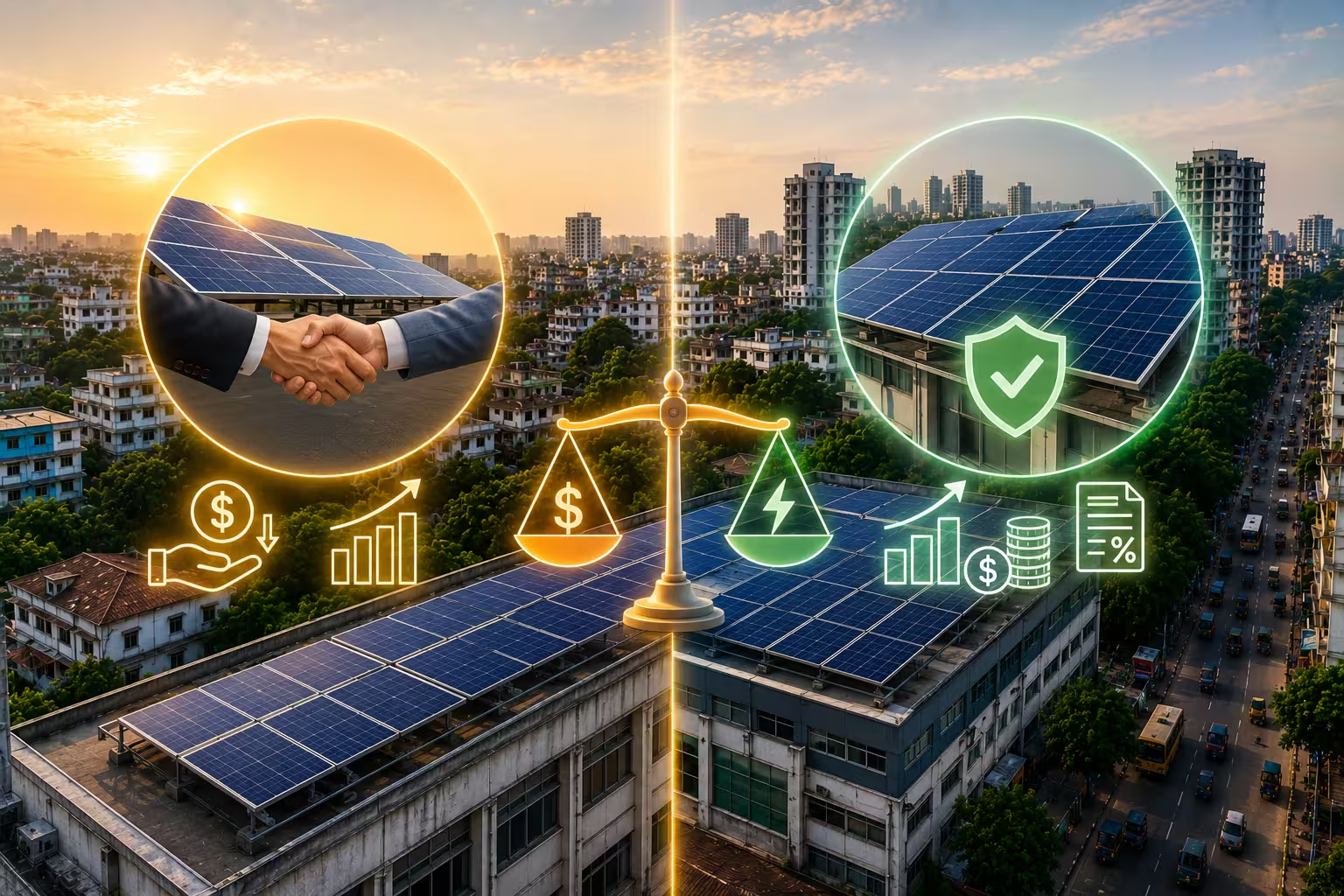
That question is the whole ballgame. A Power Purchase Agreement (PPA) and a self-owned solar system solve the same basic problem — cutting your electricity bill with panels on your roof — but they get you there through completely different financial roads. One trades long-term upside for short-term simplicity. The other asks you to put money on the table today in exchange for owning the asset outright.
Neither one is the “right” answer in some universal sense. But one of them is almost certainly right for your situation, and figuring out which takes more than a five-bullet comparison list.
The Short Answer, If You’re in a Hurry
A self-owned system usually delivers more total savings over 15–25 years because you keep every dollar the system generates, plus you can claim the federal Investment Tax Credit and depreciation benefits. A PPA gets you solar with no upfront cost and a discounted electricity rate — typically 10 to 20 percent below your current utility rate — but a third party owns the system, claims the tax benefits, and you’re locked into a long contract with built-in rate increases.
If you have the capital and can use the tax incentives, ownership almost always wins on pure dollars. If capital is tight, or if your business doesn’t have enough tax liability to use the incentives anyway, a PPA can be the smarter move — not a consolation prize.
What a Solar PPA Actually Is
A PPA is a power purchase agreement, not a sale of equipment. A solar developer installs, owns, and maintains a system on your roof or property, and you agree to buy the electricity it produces at a set rate — usually lower than what your utility charges. You never own the hardware. You’re essentially becoming your own micro-utility customer, except the “utility” is the array bolted to your own building.
The developer takes on the installation cost, the maintenance, and the performance risk. If a panel fails, that’s their problem to fix, not yours. In exchange, they collect the tax credits, the depreciation benefits, and a steady stream of payments from you for the length of the contract, which is often 15 to 25 years.
Most PPAs include a buyout option, typically starting somewhere between year five and year seven, where you can purchase the system at its fair market value and finally own it outright. A lot of businesses forget this clause exists until they’re three years into the contract wondering if they made the right call.
What Owning the System Actually Involves
Buying the system yourself — whether with cash or a solar loan — means you’re footing the upfront cost, which for a mid-sized commercial installation can run anywhere from a few hundred thousand dollars to well over a million, depending on system size. In return, you get to keep everything: every kilowatt-hour of savings, every tax benefit, and the asset itself sitting on your balance sheet.
You’re also on the hook for maintenance, though realistically, panels are low-maintenance and inverters (the part most likely to need attention) usually come with 10-to-15-year warranties. The bigger commitment isn’t labor, it’s capital. Money spent on solar panels is money not spent expanding a warehouse, hiring, or sitting in reserve.
Ownership also means you control the asset completely. Want to add battery storage in three years? Your call. Want to expand the system when you add a second building? No developer’s contract to renegotiate. That flexibility has real value, even if it’s harder to put a dollar figure on it than the electricity savings are.
Solar PPA vs. Self-Owned: Side by Side
| Factor | Solar PPA | Self-Owned System |
| Upfront cost | None | Full system cost (or loan payments) |
| Who owns the system | Third-party developer | Your business |
| Maintenance responsibility | Developer | You (typically minimal) |
| Tax credits (ITC/MACRS) | Claimed by developer | Claimed by you |
| Electricity rate | Fixed discount, often with annual escalator | Effectively $0 marginal cost after payback |
| Control over the system | Limited — governed by contract | Full |
| Contract length | 15–25 years | None (you own it) |
| Long-term savings | Moderate, capped by contract terms | Higher, especially after payback period |
| Risk exposure | Low (developer bears performance risk) | Moderate (you bear it, but warranties help) |
| End-of-term outcome | Buyout, renewal, or removal | You already own it |
A Real Numbers Example
Let’s say your business needs a 200 kW commercial system. Rough industry pricing puts that around $1.50 to $2.00 per watt installed for cash purchases, so call it roughly $350,000 for the system before incentives.
If you buy it: You pay $350,000 upfront. The federal ITC currently allows you to claim a substantial percentage of that cost as a direct tax credit (the exact rate depends on the tax year and any bonus adders your project qualifies for), and MACRS depreciation lets you write down most of the remaining cost over five years. Between the credit and depreciation, it’s common for the effective net cost to drop by 40–50% within the first two years, assuming your business has enough tax liability to use those benefits. After that, you’re generating electricity at close to zero marginal cost for the next 20-plus years.
If you sign a PPA: You pay nothing upfront. The developer sets a rate — say, 15% below your current utility rate — and that rate typically increases 1–3% annually for the life of the contract. Over 20 years, that escalator can quietly erode a meaningful chunk of your early savings. You never see the tax credit; the developer keeps it. If you want to buy the system at year seven, you’re paying its fair market value at that point, which isn’t necessarily a bargain.
The gap over 20 years usually favors ownership by a wide margin, sometimes by hundreds of thousands of dollars on a system this size. But that gap only matters if you can actually afford the $350,000 today and have the tax appetite to use the incentives. If either of those isn’t true, the comparison flips.
The Tax Credit Wrinkle Almost Nobody Mentions
Here’s the part that gets glossed over in most of these comparisons: not every business can actually use the ITC and depreciation benefits, even if they own the system.
If your company doesn’t owe enough in federal taxes in a given year, those credits and deductions don’t do you much good — you can carry some forward, but that’s a slower payoff than people expect. And if your business is subject to the Alternative Minimum Tax, that can further limit how much of the depreciation benefit you can actually claim in the short term.
This is exactly why a PPA makes sense for some financially healthy businesses, not just cash-strapped ones. If you can’t fully use the tax benefits of ownership, letting the developer claim them and pass a portion back to you through a discounted rate is often the more efficient outcome. You’re not losing the value of those incentives — you’re just receiving it in a different form.
There’s also a broader financial argument some CFOs are making in 2026: with borrowing costs elevated, capital tied up in a solar system might earn a better return if it’s redeployed into core business growth instead. A PPA frees up that capital while still delivering an electricity discount from day one.
Which One Fits Your Business
You’re probably leaning toward ownership if:
- You have the capital available without straining cash flow
- Your business has enough tax liability to actually use the ITC and depreciation
- You plan to stay in the building for 15-plus years
- You want full control to expand or modify the system later
- Long-term total savings matter more to you than short-term simplicity
You’re probably leaning toward a PPA if:
- Preserving capital for other business priorities matters more right now
- Your tax situation means ownership incentives wouldn’t fully apply to you anyway
- You want predictable savings with zero maintenance responsibility
- You’re not certain you’ll stay in the property long-term
- You’d rather have a guaranteed discount than take on performance risk
Neither list is a moral judgment. Plenty of financially strong companies choose PPAs deliberately, and plenty of smaller businesses stretch to buy because the 20-year math works out heavily in their favor.
When Each Option Is a Bad Idea
Ownership becomes a bad idea when you’re financing it with debt you can’t comfortably service, or when there’s real uncertainty about whether you’ll be in that building in ten years. Solar panels don’t move with you, and selling a building with an owned system attached isn’t always as simple as buyers expect.
A PPA becomes a bad idea when the contract’s escalator clause isn’t clearly explained upfront, or when the buyout terms at year five to seven are vague. Some businesses sign a PPA assuming they’ll buy the system out later, only to find the fair-market-value calculation leaves them paying more than expected. Read that clause carefully before you sign anything — it matters more than almost any other line in the contract.
FAQs
Who owns the solar panels in a PPA?
The third-party developer or investor owns the system for the length of the contract. You’re purchasing the electricity it generates, not the equipment itself.
Can you get tax credits with a solar PPA?
Not directly. The developer claims the ITC and depreciation benefits since they own the system. Some of that value gets passed to you indirectly through a lower electricity rate, but you don’t file for the credit yourself.
What happens at the end of a PPA contract?
Most agreements offer a few options: buy the system at fair market value, renew the contract, or have the developer remove the equipment. Buyout options often become available starting around year five to seven.
Is a solar PPA a good deal or a scam?
It’s not a scam — it’s a legitimate financing structure that works well for specific situations. It’s just not automatically the best deal for everyone, and the value depends heavily on your rate discount, contract length, and escalator terms.
Does owning solar panels increase your property value?
Generally, yes, since a self-owned system is a paid-for asset attached to the building. A PPA-financed system is more complicated, since the buyer would need to either take over the contract or negotiate a buyout as part of the sale.
Is a self-owned system always cheaper long-term than a PPA?
In most cases, yes, largely due to keeping the tax incentives and avoiding decades of rate escalators. But that assumes you have the upfront capital and enough tax liability to actually use the incentives — without both, the math can shift toward a PPA.
Bottom Line
If you can afford the upfront cost and your business can actually use the tax incentives, ownership is usually the stronger long-term play — the math tends to favor it clearly once you run the real numbers over a decade or two. But if capital is tight, your tax situation limits the benefit of ownership, or you’d simply rather hand off the maintenance and performance risk to someone else, a PPA isn’t a downgrade. It’s a different tool for a different set of priorities.
The mistake most businesses make isn’t choosing the “wrong” option — it’s choosing without actually running their own numbers first. Before you sign anything, get a real quote for both paths, check your tax situation with your accountant, and read the escalator and buyout clauses like they’re the most important part of the contract. Because they are.
Want to understand the broader solar landscape before you commit to a financing model? See our guides on on-grid solar systems, how different solar system types compare, and how solar stacks up against fossil fuels for more context on the technology behind the decision.