Solar energy has moved far beyond being an alternative energy technology.
In 2025 alone, the world added more than 600 GW of new solar photovoltaic (PV) capacity, pushing total installed solar PV capacity globally to around 2.8 terawatts (TW). Solar accounted for more than three-quarters of all new renewable power capacity added worldwide that year.
To put that number into perspective, 1 terawatt equals 1,000 gigawatts.
The scale of this growth is enormous.
But for someone living in Dhaka, running a factory in Gazipur, managing an office in Chattogram, or operating a business anywhere in Bangladesh, the more important question is:
What does this global solar boom actually mean for Bangladesh?
The answer is more significant than it may first appear.
Global solar manufacturing is influencing the price and availability of panels in Bangladesh. Improvements in photovoltaic technology are making better panels available to local consumers. Battery storage is becoming increasingly important. Rooftop solar is gaining attention among businesses and households. And Bangladesh’s own net-metering framework is creating a stronger connection between rooftop solar and the national electricity grid.
This article looks at the latest global solar adoption trends and statistics—and explains what they mean for Bangladesh.
Solar Energy Adoption: The Numbers at a Glance
The global solar market is expanding at a remarkable pace.
Some of the most important recent figures include:
- More than 600 GW of solar PV capacity was added globally in 2025.
- Global installed solar PV capacity reached approximately 2.8 TW by the end of 2025.
- Solar represented more than three-quarters of new renewable capacity added globally in 2025.
- Solar PV generated around 2,000 TWh of electricity in 2024, representing about 7% of global electricity generation.
- The IEA expects renewable power capacity to increase by around 4,600 GW between 2025 and 2030, with solar PV accounting for almost 80% of that expansion.
- China remains the dominant force in global solar manufacturing, accounting for more than 80% of global solar PV module manufacturing capacity.
These numbers tell us something important:
Solar is no longer a small part of the global energy transition. It is one of the main technologies driving it.
And Bangladesh is increasingly becoming part of that global story.
How Fast Is Solar Energy Growing Worldwide?
Solar PV has been setting new installation records for several consecutive years.
In 2024, global solar PV additions reached roughly 550 GW, according to the IEA. That was already a record year.
Then in 2025, annual solar PV additions increased again, surpassing 600 GW for the first time. Global cumulative solar PV capacity reached around 2,800 GW.
This is important because solar growth is not simply continuing at the same pace.
The scale of annual deployment itself is increasing.
More panels are being manufactured.
More countries are installing them.
More households and businesses are considering rooftop systems.
And more electricity grids are learning how to manage distributed solar generation.
Why Is Solar Growing So Quickly?
There isn’t one single reason.
The global solar boom is the result of several trends happening at the same time.
1. Solar Technology Is Getting Cheaper
Solar manufacturing has reached enormous scale.
Factories can now produce huge quantities of photovoltaic cells and modules, spreading manufacturing costs across millions of units.
This has helped push down the cost of solar equipment worldwide.
For Bangladesh, this matters because local solar prices are connected to the international supply chain.
When global manufacturing costs fall, Bangladeshi importers, distributors and installers can potentially access more competitive equipment—although local prices still depend on exchange rates, shipping, taxes, duties, financing and distribution costs.
2. Solar Panels Are Becoming More Efficient
Solar technology has improved significantly over the past decade.
Modern photovoltaic modules can generate more electricity from the same amount of roof space than older generations of panels.
That matters particularly in cities such as Dhaka.
Urban rooftops are valuable.
A homeowner or business may have only a limited amount of usable roof area. Higher-efficiency panels can therefore help generate more electricity without requiring a proportionally larger installation area.
3. Solar Is Becoming an Economic Decision
Solar adoption is no longer driven only by environmental concerns.
In many countries, consumers install solar because it can make financial sense.
They want to:
- Reduce electricity bills
- Generate electricity during the daytime
- Improve energy independence
- Reduce exposure to rising electricity costs
- Provide backup power when combined with batteries
- Make better use of unused rooftop space
This is particularly relevant to Bangladesh.
For many Bangladeshi consumers, the most convincing argument for solar is not necessarily climate policy.
It is the question:
“Can this system reduce my long-term electricity costs?”
China Dominates the Global Solar Supply Chain
One of the biggest facts behind the modern solar boom is China’s manufacturing dominance.
China accounts for more than 80% of global solar PV module manufacturing capacity and an even larger share of some upstream components, including wafers.
China’s role extends across much of the solar supply chain:
- Polysilicon
- Ingots
- Wafers
- Solar cells
- Solar modules
- Manufacturing equipment
This level of scale has helped reduce solar manufacturing costs around the world.
But it also creates a supply-chain concentration risk.
If international trade rules change, shipping becomes more expensive, manufacturing is disrupted, or geopolitical tensions affect supply chains, solar equipment prices in importing countries can also be affected.
For Bangladesh, this is important because the local solar market is closely connected to international equipment supply.
Why China’s Solar Manufacturing Matters to Bangladesh
A solar panel installed on a rooftop in Dhaka may have a surprisingly international journey.
Its components may originate from different stages of the global manufacturing chain before reaching Bangladesh through importers and distributors.
This means global solar manufacturing trends can eventually affect the price of a solar system in Bangladesh.
For example:
More global manufacturing → greater supply → stronger competition → potentially lower equipment costs.
The opposite can also happen.
Supply disruption → higher component or shipping costs → higher local system prices.
So when we talk about global solar statistics, we are not talking about something completely separate from Bangladesh.
The connection is direct.
Solar Energy Adoption in Emerging Markets
One of the most interesting developments is that solar adoption is no longer limited to wealthy economies.
Emerging markets are increasingly using solar to solve practical energy problems.
Three examples from the original analysis are particularly useful.
Brazil: Solar and Energy Security
Brazil has expanded solar partly because of its dependence on hydropower.
Hydropower can be affected by drought.
Solar provides another source of electricity generation that can complement hydropower and diversify the country’s energy mix.
The broader lesson is important:
Countries adopt solar not only because it is renewable, but because it can improve energy security.
Pakistan: Rooftop Solar Driven by Consumers
Pakistan has experienced rapid rooftop solar adoption, with households and businesses turning to solar partly to reduce dependence on an expensive and unreliable electricity system.
This is an especially interesting comparison for Bangladesh.
Consumers in both countries can be highly sensitive to electricity costs and reliability.
When rooftop solar becomes financially attractive, adoption can accelerate from the bottom up.
People do not necessarily need to wait for a large national solar programme.
They can make individual investment decisions.
Vietnam: Solar and Industrial Growth
Vietnam has also expanded solar as electricity demand has grown alongside industrialisation.
Manufacturing economies require reliable electricity.
Solar can help diversify energy supply while reducing dependence on imported fossil fuels.
Bangladesh faces a similar long-term challenge as industrial production and electricity demand continue to grow.
What Do Global Solar Trends Mean for Bangladesh?
This is the part that matters most to Bangladeshi readers.
The global solar boom creates several opportunities for Bangladesh.
Lower-Cost Technology
Global manufacturing scale can make solar equipment more affordable.
Bangladesh does not need to wait for the technology to be developed domestically.
It can import and deploy technologies already being produced at enormous scale worldwide.
Better Solar Panels
As manufacturers compete globally, panel efficiency and performance continue to improve.
This is particularly useful for Bangladesh’s urban rooftops.
A smaller roof can potentially generate more electricity with a higher-efficiency module than it could with an older-generation panel.
Better Inverters
The solar inverter has become much more than a basic device that converts DC electricity into AC electricity.
Modern systems can provide:
- Energy monitoring
- Grid management
- System protection
- Battery integration
- Remote monitoring
- Load management
This makes modern solar systems more intelligent than earlier installations.
Better Battery Storage
Battery technology is also developing rapidly.
This matters because solar generation and electricity demand do not always occur at the same time.
Solar panels generate electricity during daylight hours.
A battery can store some of that energy for later use.
For Bangladesh, this could make hybrid solar systems increasingly attractive for homes and businesses that want both bill savings and backup power.
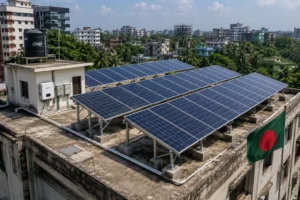
Bangladesh’s Rooftop Solar Opportunity
Bangladesh has an important advantage:
A huge number of buildings have rooftops.
Those rooftops can potentially become distributed power-generation sites.
Consider the potential across:
- Dhaka
- Chattogram
- Gazipur
- Narayanganj
- Sylhet
- Rajshahi
- Khulna
- Cumilla
- Mymensingh
- Bogura
- Other cities and industrial areas
A rooftop does not have to become a large solar farm.
Even a modest installation can generate electricity for the building beneath it.
For commercial and industrial properties, the opportunity can be particularly interesting because electricity consumption often occurs during the day—when solar panels are generating electricity.
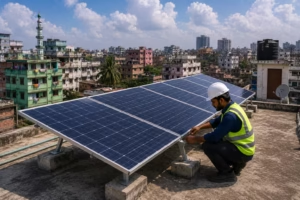
Why Dhaka Is Important for Rooftop Solar
Dhaka has an enormous concentration of:
- Residential buildings
- Offices
- Commercial properties
- Educational institutions
- Hospitals
- Shopping centres
- Warehouses
- Industrial facilities
At the same time, rooftop space in Dhaka is limited and valuable.
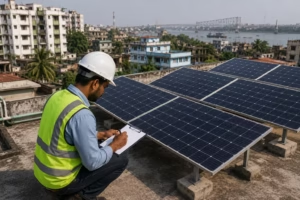
This makes proper system design essential.
Installing more panels is not automatically better.
A good rooftop solar design needs to consider:
Available Roof Area
How much space can actually be used?
Shading
Do neighbouring buildings, water tanks, trees or other structures block sunlight?
Roof Orientation
How are the panels positioned relative to the Sun?
Electricity Consumption
When does the building consume electricity?
System Capacity
How large should the solar system actually be?
Battery Requirement
Is battery storage necessary, or would an on-grid system be more suitable?
Grid Connection
Does the property qualify for net metering under the applicable requirements?
These questions are more important than simply asking how many panels can fit on the roof.
Net Metering Is Changing the Rooftop Solar Conversation in Bangladesh
One of the most important developments for Bangladesh’s rooftop solar market is net metering.
Under the current framework, eligible consumers can use electricity generated by renewable-energy systems installed on their premises and export surplus electricity to the distribution grid. The exported electricity is credited against the consumer’s electricity bill, with remaining credits adjusted according to the applicable rules.
The scale is already meaningful.
According to Bangladesh’s Net Metering Guidelines 2025, more than 3,763 net-metered rooftop solar systems had been connected across the country’s six electricity distribution utilities, with a combined capacity of more than 185 MW at the time of the guideline’s publication.
That gives us an important indication:
Rooftop solar in Bangladesh is already moving beyond isolated projects.
It is becoming part of the country’s distributed energy infrastructure.
Solar Capacity Does Not Mean Constant Electricity Production
There is an important distinction when reading solar statistics.
A system’s installed capacity is not the same as the amount of electricity it produces every hour.
For example, a 100 kW solar system does not generate 100 kW continuously throughout a 24-hour day.
Solar generation depends on:
- Sunlight intensity
- Time of day
- Weather
- Season
- Panel orientation
- Shading
- Temperature
- System losses
This is why solar-resource assessment matters.
A good solar project should estimate actual expected energy production rather than simply focusing on the nameplate capacity of the panels.
For Bangladesh, this distinction is especially important when calculating expected electricity savings and project payback.
Why Solar Prices Are Falling
The falling cost of solar is one of the strongest drivers behind global adoption.
Several forces are working together.
Manufacturing Scale
Large factories produce enormous quantities of panels.
Technology Improvements
Higher-efficiency cells produce more electricity per unit of area.
Competition
Manufacturers compete aggressively on price and performance.
Supply-Chain Development
Global logistics and component supply have matured significantly.
Installation Experience
Solar installers are becoming more experienced in major markets.
The result is a technology that is far more affordable than it was a decade or two ago.
But Global Solar Prices Are Not the Same as Bangladesh Solar Prices
This distinction is important for Bangladeshi buyers.
You may see an international article reporting a very low solar cost per watt.
That does not mean a Bangladeshi homeowner can simply multiply that number by the size of their system and get the final installation price.
A complete solar project may include:
- Solar panels
- Inverter
- Mounting structure
- DC cables
- AC cables
- Protection equipment
- Earthing
- Installation
- Engineering
- Monitoring
- Battery, if required
- Transportation
- Import-related costs
- Taxes and duties
- Financing costs
Therefore, the final cost in Bangladesh depends on the complete system rather than the panel alone.
This is particularly important when comparing quotations from different solar companies.
Solar + Battery Storage: The Next Big Trend
The next major stage of solar adoption is increasingly connected to energy storage.
Solar panels generate the most electricity during daylight.
But households may need electricity in the evening.
Businesses may have different consumption patterns.
A battery can help bridge that gap.
A hybrid solar system can potentially:
- Use solar electricity during the day
- Store excess solar generation
- Provide electricity later
- Reduce grid dependence
- Provide backup during outages
However, batteries add cost and eventually need replacement.
Therefore, battery storage should be evaluated according to the customer’s actual requirements.
For some Dhaka homes, an on-grid solar system may make more financial sense.
For a business that needs backup power, a hybrid system may be more appropriate.
There is no universal solution.
The Grid Challenge
Rapid solar growth also creates a challenge.
Electricity grids were historically designed around large, centralised power stations.
Solar changes that model.
Instead of electricity flowing only from large power plants to consumers, thousands of buildings can potentially generate electricity themselves.
That means grids need to become more flexible.
They may require:
- Better monitoring
- Better forecasting
- Grid upgrades
- Energy storage
- Smart inverters
- Improved distribution infrastructure
- Better power management
This challenge is not unique to Bangladesh.
Countries around the world are working through the same problem as solar deployment accelerates.
Will Solar Become the World’s Largest Source of Electricity?
Solar is on a very strong trajectory.
The IEA expects renewable capacity to expand by around 4,600 GW between 2025 and 2030, with solar PV accounting for almost 80% of the increase.
That does not mean solar will replace every other source of electricity.
Solar is intermittent.
The Sun does not shine at night, and generation changes with weather and season.
Therefore, solar will continue to operate alongside:
- Natural gas
- Hydropower
- Wind
- Nuclear
- Batteries
- Other energy technologies
The future electricity system is likely to be a combination of technologies rather than a single winner.
What Does This Mean for Bangladesh by 2030?
If global solar deployment continues at anything close to its current trajectory, Bangladesh is likely to have access to increasingly advanced and competitive solar technology.
Several trends could become particularly important.
More Rooftop Solar
Residential, commercial and industrial rooftops could become increasingly valuable energy assets.
More Net-Metered Systems
As awareness and implementation improve, more eligible consumers may consider exporting surplus electricity to the grid.
More Hybrid Systems
Solar combined with batteries could become more common where backup power is important.
Higher-Efficiency Panels
Better technology could allow more electricity generation from limited rooftop space.
More Industrial Solar
Factories and large commercial facilities could increasingly use rooftop solar to reduce daytime electricity consumption.
Smarter Energy Management
Monitoring systems and smart inverters could allow consumers to better control when and how they use solar electricity.
What Global Solar Growth Means for a Bangladeshi Homeowner
Global solar statistics may sound abstract.
But they eventually affect everyday purchasing decisions.
A homeowner in Dhaka considering solar today has access to technology that is:
- More efficient than older generations
- More widely available
- Supported by a much larger global industry
- Available with modern monitoring
- Compatible with different system configurations
- Increasingly integrated with batteries
However, homeowners should not buy solar based solely on the number of panels.
The right questions are:
How much electricity do I use?
How much usable roof space do I have?
How much sunlight reaches that roof?
Do I need battery backup?
Can I benefit from net metering?
How much electricity can the system realistically generate?
What is the expected payback period?
Those questions produce a much more useful answer than simply asking for the price of a 5 kW or 10 kW system.
What Global Solar Growth Means for Bangladeshi Businesses
For businesses, rooftop solar can be particularly interesting.
Many commercial and industrial facilities consume electricity during the daytime.
That matches naturally with solar generation.
A factory in Gazipur, a warehouse in Narayanganj or an office building in Dhaka may have a large rooftop and substantial daytime electricity demand.
In these cases, solar can potentially reduce the amount of electricity purchased from the grid.
But the economics should be calculated carefully.
A business should evaluate:
- Electricity consumption
- Load profile
- Roof area
- Solar resource
- System size
- Electricity tariff
- Net-metering eligibility
- Battery requirements
- Installation cost
- Maintenance
- Financing
- Expected payback
The objective should not simply be to install the largest possible solar system.
The objective should be to install the right-sized system.
Solar Energy Is Becoming an Energy-Security Strategy
One of the most important lessons from global adoption is that solar is no longer only a climate technology.
It is increasingly an energy-security technology.
Countries use solar to:
- Reduce fossil-fuel dependence
- Diversify electricity generation
- Reduce exposure to fuel-price volatility
- Improve energy independence
- Support economic growth
Businesses can apply the same logic on a smaller scale.
A company that generates part of its electricity on-site is less dependent on purchasing every unit of electricity from the grid.
That does not eliminate grid dependence.
But it can diversify the company’s energy supply.
The Economic Ripple Effect of Solar Growth
The solar boom is also creating economic activity.
Rapid deployment creates demand for:
- Solar engineers
- Electrical engineers
- Installers
- Maintenance technicians
- Project managers
- Equipment distributors
- Importers
- Energy consultants
- Monitoring and software services
- Grid infrastructure
For Bangladesh, a growing solar market could therefore create opportunities beyond simply installing panels.
It can support a wider renewable-energy ecosystem.
The Biggest Challenge: Keeping Up With Solar Growth
Solar’s rapid growth is good news, but it creates new challenges.
The source material correctly highlights that adding solar capacity is not the same thing as integrating that capacity effectively into a 24-hour electricity system.
As more solar comes online, countries need enough:
- Grid capacity
- Transmission
- Distribution infrastructure
- Storage
- Flexible generation
- Skilled workers
- Financing
Without these supporting systems, solar deployment can eventually run into bottlenecks.
For Bangladesh, this means the future of solar is not simply about importing more panels.
It is also about building the infrastructure and expertise needed to use those panels effectively.
The Future of Solar in Bangladesh
Bangladesh has a strong opportunity to benefit from the global solar revolution.
The country does not need to reinvent photovoltaic technology.
It can take advantage of decades of global research, manufacturing and engineering development.
The most promising areas include:
Residential Rooftop Solar
For homes looking to reduce electricity purchases and potentially add backup capability.
Commercial Rooftop Solar
For offices, shopping centres, hospitals, schools and other daytime electricity users.
Industrial Rooftop Solar
For factories and manufacturing facilities with large daytime loads.
Solar + Battery
For properties where backup power and energy management are important.
Net-Metered Solar
For eligible grid-connected consumers who want to make better use of surplus generation.
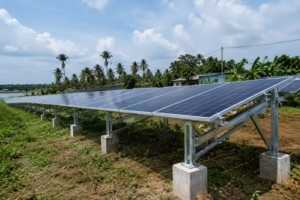
Rural and Distributed Solar
For areas where decentralised electricity generation can provide practical advantages.
Global Solar Statistics Tell a Bigger Story
The headline numbers are impressive.
More than 600 GW of solar PV was added globally in 2025.
Global solar PV capacity reached around 2.8 TW.
Solar represented more than three-quarters of new renewable capacity added in 2025.
Solar PV generated around 2,000 TWh of electricity in 2024.
And the IEA expects solar PV to account for almost 80% of global renewable capacity expansion through 2030.
These figures show that solar is no longer a small experiment.
It is becoming one of the foundations of the global electricity system.
And Bangladesh has a growing opportunity to participate.
From Global Solar Growth to Bangladesh’s Rooftops
The global solar revolution may have started with massive factories and utility-scale projects, but its effects are increasingly reaching individual buildings.
A rooftop in Dhaka can now become a small electricity-generating asset.
A factory roof in Gazipur can generate power during working hours.
A commercial building in Chattogram can potentially reduce its dependence on grid electricity.
A properly designed hybrid system can combine solar generation with battery storage.
And eligible grid-connected consumers can potentially use net metering to make better use of surplus solar generation.
That is the real significance of global solar adoption.
The technology is global.
The manufacturing is global.
The investment is global.
But the decision to install solar is ultimately local.
It depends on the building, the roof, the electricity consumption, the grid connection and the financial goals of the customer.
Final Thoughts
Solar energy has entered a new phase.
The question is no longer whether solar technology can work.
It clearly can.
The question is how quickly countries, businesses and households can integrate it into their electricity systems.
Globally, the growth is accelerating.
Manufacturing capacity is expanding.
Solar technology is becoming more efficient.
Battery storage is improving.
And costs have fallen dramatically compared with previous generations.
For Bangladesh, these global trends create a major opportunity.
The country can use existing rooftops, modern photovoltaic technology and evolving grid policies to generate more electricity closer to where it is consumed.
For a homeowner or business considering solar, however, global statistics are only the starting point.
The real decision comes down to the numbers for your own property:
How much electricity do you use?
How much solar can your roof generate?
What system size makes financial sense?
Would battery storage help?
Can you benefit from net metering?
At Muspana, we believe solar should be approached as both an engineering project and a financial investment.
The best solar system is not necessarily the biggest one.
It is the one that is properly designed for the property, the electricity demand and the long-term goals of the customer.
Global solar adoption is accelerating. The next opportunity is turning that global progress into practical solar solutions for Bangladesh.