Most battery mistakes happen before anyone buys a battery. Someone gets a quote, it says “5 kWh” or “200Ah,” and there is no way to tell whether that number is right for their fans, lights and fridge, or just what happens to be on the shelf.
Too small, and the backup dies an hour into the outage. Too big, and you have paid for capacity that never gets used.
The good news: sizing a battery is arithmetic, not guesswork. This guide gives you a solar battery calculator method you can run on paper (or a phone) in about five minutes, with worked examples for a home and for a small factory.
The quick answer: the battery size formula
Battery size (kWh) = energy you need during backup ÷ (usable depth of discharge × inverter efficiency)
Here is what each part means:
- Energy you need is the total watts of your backup loads multiplied by the hours you want them running.
- Depth of discharge (DoD) is the share of the battery you can safely use. A battery with 90% DoD lets you draw 90% of its rated capacity before it needs recharging.
- Inverter efficiency covers the energy lost when the inverter converts battery DC power to AC for your appliances.
A 30-second example: a 400 W load running for 4 hours needs 1.6 kWh. With a lithium (LFP) battery at an assumed 90% DoD and 90% inverter efficiency, you need about 2 kWh of battery. The percentages are assumptions for this example. Always check your own battery and inverter datasheets.
How do you calculate battery size for solar backup, step by step?
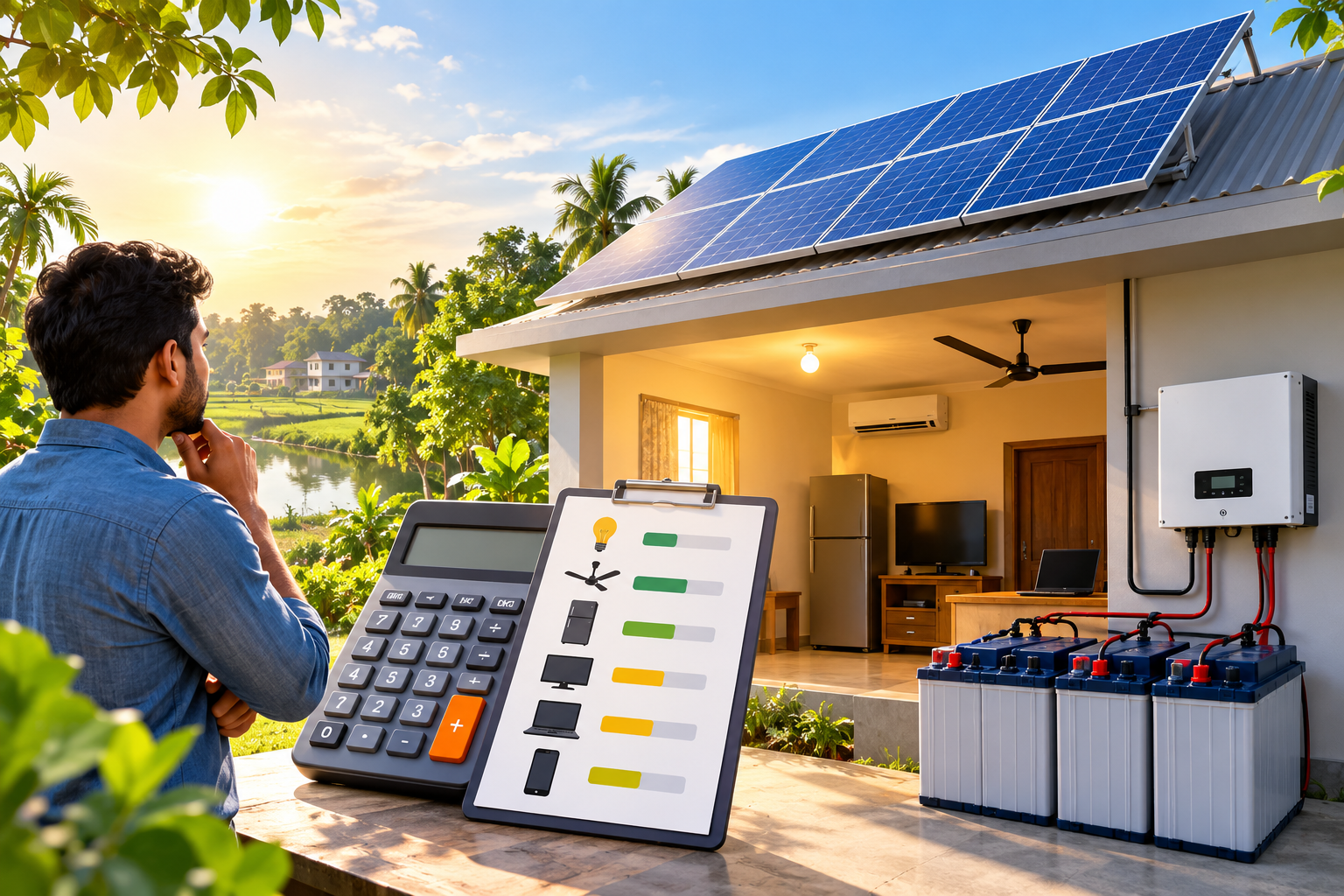
Step 1: List what you actually want to keep running
Not everything in the house needs backup. Start with the essentials, and be honest about it. Fans, LED lights, a Wi-Fi router, a TV, maybe a fridge. An air conditioner is a different conversation (more on that below).
This is also where you can save the most money. Every 100 W you leave off the backup list is 100 W of battery you don’t have to buy.
Step 2: Find the watts
Check the label or nameplate on each appliance. The numbers below are typical examples only. Your own appliances will differ.
| Appliance | Example wattage | Notes |
| Ceiling fan | 60–75 W | Older fans often draw more than newer efficient models |
| LED bulb | 8–12 W | Very cheap to back up |
| Wi-Fi router | 10–15 W | Small load, big convenience |
| LED TV | 80–150 W | Depends on screen size |
| Refrigerator | Varies widely | Cycles on and off, so average use is lower than the label, but the startup surge is high |
| Air conditioner | Check the nameplate | Draws far more than everything else on this list combined |
Step 3: Multiply by backup hours
Add up the watts, then multiply by the hours of outage you want to cover. Think about the outages you actually get. If they usually last one or two hours, sizing for eight is money spent on a problem you don’t have.
Step 4: Divide by DoD and inverter efficiency
Apply the formula from the top. This step is where the chemistry of your battery matters, which we’ll come to shortly.
Step 5: Match the voltage and round up to a real product
Batteries don’t come in every size. Once you have the kWh, you also need the right system voltage (12V, 24V or 48V), which is decided by your inverter. Divide watt-hours by system voltage to get amp-hours:
Ah = Wh ÷ system voltage
Then round up to the nearest size that actually exists.
Worked example: a family’s home backup
Picture a family in a Dhaka apartment. They want the basics running during load-shedding. This is a hypothetical example, and the wattages are typical, not measured.
- 3 ceiling fans at 70 W = 210 W
- 4 LED lights at 10 W = 40 W
- Wi-Fi router = 15 W
- TV = 135 W
- Total: 400 W
They want 4 hours of backup, so energy needed is 400 W × 4 h = 1.6 kWh.
With an LFP lithium battery (assumed 90% DoD, 90% inverter efficiency): 1.6 ÷ (0.9 × 0.9) ≈ 2.0 kWh. On a 48V system that is about 42 Ah, so a 48V 50Ah battery (2.4 kWh) would cover it with some room to spare.
With a tubular lead-acid battery (assumed 50% DoD, 85% inverter efficiency): 1.6 ÷ (0.5 × 0.85) ≈ 3.8 kWh of nominal battery. On a 24V system that is roughly 157 Ah, so in practice you would round up to something like two 12V 200Ah batteries in series.
Same load, same 4 hours, and the lead-acid bank is nearly twice the size on paper. That is the whole lithium vs lead-acid story in one calculation, and we’ll unpack it below.
Now add the fridge. If we assume it averages 150 W while running, the total goes to 550 W and the 4-hour need rises to 2.2 kWh. And if that family wants a split AC on battery? A 1.5-ton unit can draw well over a kilowatt while running (check your nameplate). Four hours of AC alone can add several kWh, which roughly doubles the size and cost of the battery. That is why many households choose to back up fans and lights and let the AC wait for grid power or solar hours.
Worked example: a small factory’s critical load
Industrial sizing has the same logic but different questions. This is a hypothetical example.
A small manufacturer near Gazipur wants battery backup to cover critical loads only (control panels, IT, lighting in key areas) while a generator is started, or to ride through short grid interruptions. Suppose the critical load is 20 kW and they want 1 hour.
- Energy needed: 20 kW × 1 h = 20 kWh
- Assumed LFP DoD 90%, inverter/PCS efficiency 95%
- 20 ÷ (0.9 × 0.95) ≈ 23.4 kWh
- Add an ageing margin of, say, 20% (an assumption) and you land near 28 kWh
There’s a second number that matters here: power, not just energy. A battery pack has a maximum output in kW as well as a capacity in kWh. A 28 kWh pack that can only deliver 15 kW would not carry a 20 kW load, no matter how full it is. Check the continuous and peak power ratings, and check what your motors and compressors draw at startup.
For factories, the useful question is often not “how big a battery?” but “what does an hour of downtime cost us, and which loads truly must not stop?” Sizing the battery to those loads, rather than the whole plant, keeps the project realistic.
LFP vs lead-acid: why the same backup needs different battery sizes
The difference comes down to how much of the battery you can safely use, and how much energy is lost on the way in and out.
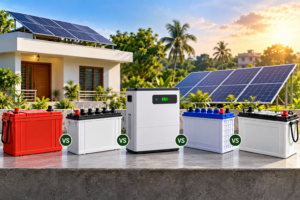
| LFP (lithium iron phosphate) | Tubular lead-acid | |
| Usable depth of discharge | High (often quoted around 80–90% or more; check the datasheet) | Lower (commonly around 50% for a longer life) |
| Efficiency | Higher | Lower |
| Maintenance | Minimal | Regular checks; water topping up for flooded types |
| Upfront cost | Usually higher | Usually lower |
| Lifespan | Usually longer (see the manufacturer’s cycle rating) | Usually shorter, and sensitive to deep discharge and heat |
| Size and weight for the same usable energy | Smaller and lighter | Larger and heavier |
Notice what the table doesn’t say: that one is better. It depends on your budget, space, how often the power goes out, and how long you plan to keep the system.
The fair way to compare them is cost per usable kWh over the battery’s life, not the sticker price. When you get quotes, divide the price by the usable kWh (nominal capacity × DoD) and then think about how many years each will realistically last. A cheaper battery that needs replacing twice is not always the cheaper option.
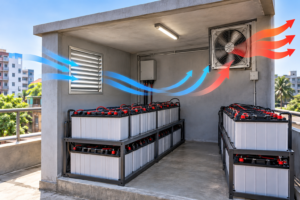
Chemistry also affects safety and placement. Lead-acid batteries need ventilation. Lithium batteries need a good BMS (battery management system) and sensible installation. If you are putting batteries in an apartment, read our guides on BMS basics and battery room ventilation before deciding where they go.
What changes the number in Bangladesh
The formula stays the same everywhere, but a few local conditions push the real answer around.
Heat and humidity. Much of the battery advice online is written for cold climates, where low temperatures shrink capacity. Here the bigger concern is the opposite: sustained heat speeds up ageing, especially for lead-acid. A battery crammed into a hot, closed balcony cupboard will not last as long as one in a cooler, ventilated spot. Our guide to solar in extreme climates covers this in more detail.
Surge loads. Refrigerators, water pumps and air conditioners draw a burst of current when they start. Your inverter has to handle that surge, and your battery has to be able to deliver it. Undersizing for surge is a common reason a system trips even though “the battery still has charge.”
Ageing margin. Batteries lose capacity over time. Adding some extra capacity at the start (10–20% is a common rule of thumb, but treat it as an assumption) means the system still meets your needs a few years in.
Your outage pattern. The right backup duration depends on how long your outages actually run in your area, which varies. Track them for a few weeks before you decide.
Space and apartment life. Apartment dwellers often have limited room and building rules to think about. Compact lithium can help, but only if it is installed safely.
Solar and grid rules. If you’re pairing the battery with rooftop solar or thinking about selling power back, the rules on net metering can change. Check the current requirements before you finalise your design. Our explainer on net metering vs gross metering is a good place to start.
Where sizing goes wrong
- Sizing for the whole house when you only need essentials. The most expensive mistake, and the easiest to avoid.
- Ignoring inverter losses. Batteries rated in kWh don’t deliver that full amount to your appliances.
- Forgetting DoD. A 200Ah lead-acid battery does not give you 200Ah of usable power if you want it to last.
- Confusing Ah and kWh. Ah only makes sense alongside voltage. A 100Ah battery at 48V holds four times the energy of a 100Ah battery at 12V.
- No margin for ageing or surge. The system works on day one and disappoints in year three.
- Buying the battery before the inverter. The inverter’s voltage decides which battery configuration works.
For a longer list, see our piece on solar sizing mistakes.
How to check an installer’s battery quote
You don’t need to be an engineer to sanity-check a quote. Ask for these things and see whether the numbers line up with your own calculation:
- The load list they used. If they can’t tell you what loads the battery is supposed to carry, be careful.
- Usable capacity, not just nominal. Ask for nominal kWh, DoD and the resulting usable kWh.
- System voltage and configuration. How many batteries, in series or parallel, and does it match the inverter?
- Backup time for your loads. They should be able to tell you roughly how many hours the system will run your listed appliances.
- Surge handling. Can the inverter and battery handle your fridge, pump or AC starting up?
- Warranty terms. What is covered, for how long, and who services it locally? With imported batteries, after-sales support matters as much as the specification.
- Where the battery will sit. Ventilation, heat and safety should be part of the conversation.
If their number is much higher than yours, ask why. There may be a good reason (extra loads, a larger margin), or the system may simply be oversized. For more on this, read our guide to evaluating solar quotes.
When a smaller battery is the smarter choice
Sometimes the cheapest kWh is the one you never store. Before buying a bigger battery, look at whether you can lower the load: swap old fans for efficient ones, move to LED lighting, and keep the AC off the backup circuit. Shaving 150 W off a 400 W load cuts the battery you need by more than a third.
Once you have your own number, take a look at the deeper guides on battery bank sizing, inverter sizing and solar energy storage to check the rest of the system against it. If you are still choosing a system type, hybrid solar systems and off-grid systems are the two to compare first.
FAQs
How do I calculate the battery size I need for solar backup?
Multiply the watts of your backup appliances by the hours you want them running to get watt-hours. Then divide by the battery’s usable depth of discharge and your inverter’s efficiency. Convert to amp-hours by dividing by system voltage.
How many batteries do I need for a 3 kW solar system?
The solar panel size alone doesn’t decide this. Battery size depends on your loads and backup hours, not the size of the solar array. Size the battery from your load calculation, then check that the inverter and voltage match.
How long will a 100Ah battery run a fan and lights?
It depends on the battery voltage and the load. A 12V 100Ah battery holds about 1.2 kWh of nominal energy, and you can only use part of it (about 50% for lead-acid, more for lithium). A load of 200 W would run for roughly 2 to 3 hours on lithium, less on lead-acid once inverter losses are included. Treat this as a rough example and calculate with your own numbers.
Is lithium (LFP) better than tubular lead-acid?
Lithium usually has more usable capacity, higher efficiency, less maintenance and a longer life, but costs more upfront. Tubular lead-acid is cheaper to buy and familiar, but you need a larger bank for the same usable energy. Compare cost per usable kWh over the expected lifetime.
Can I run an air conditioner on a solar battery?
Yes, but it needs a much larger battery and inverter than fans and lights. Check the AC’s nameplate power and startup surge. Many households back up essentials only and keep the AC off the battery circuit.
What does depth of discharge (DoD) mean?
DoD is the percentage of a battery’s capacity you can use before recharging. A 10 kWh battery with 90% DoD gives about 9 kWh of usable energy. Manufacturers set DoD limits to protect battery life, so follow the datasheet.
Do I need a bigger battery if I add more solar panels?
Not necessarily. More panels give you more energy to charge the battery and run loads during the day, but the battery size is driven by how much energy you need when the sun or grid isn’t available.
Does heat affect battery size and life in Bangladesh?
Yes. High temperatures speed up ageing, especially in lead-acid batteries. Placing batteries in a cooler, ventilated spot and adding a modest ageing margin helps them last.