The label says 150Ah. The shopkeeper said “it will run your fans all evening.” Then the power goes out and your IPS gives up in under two hours.
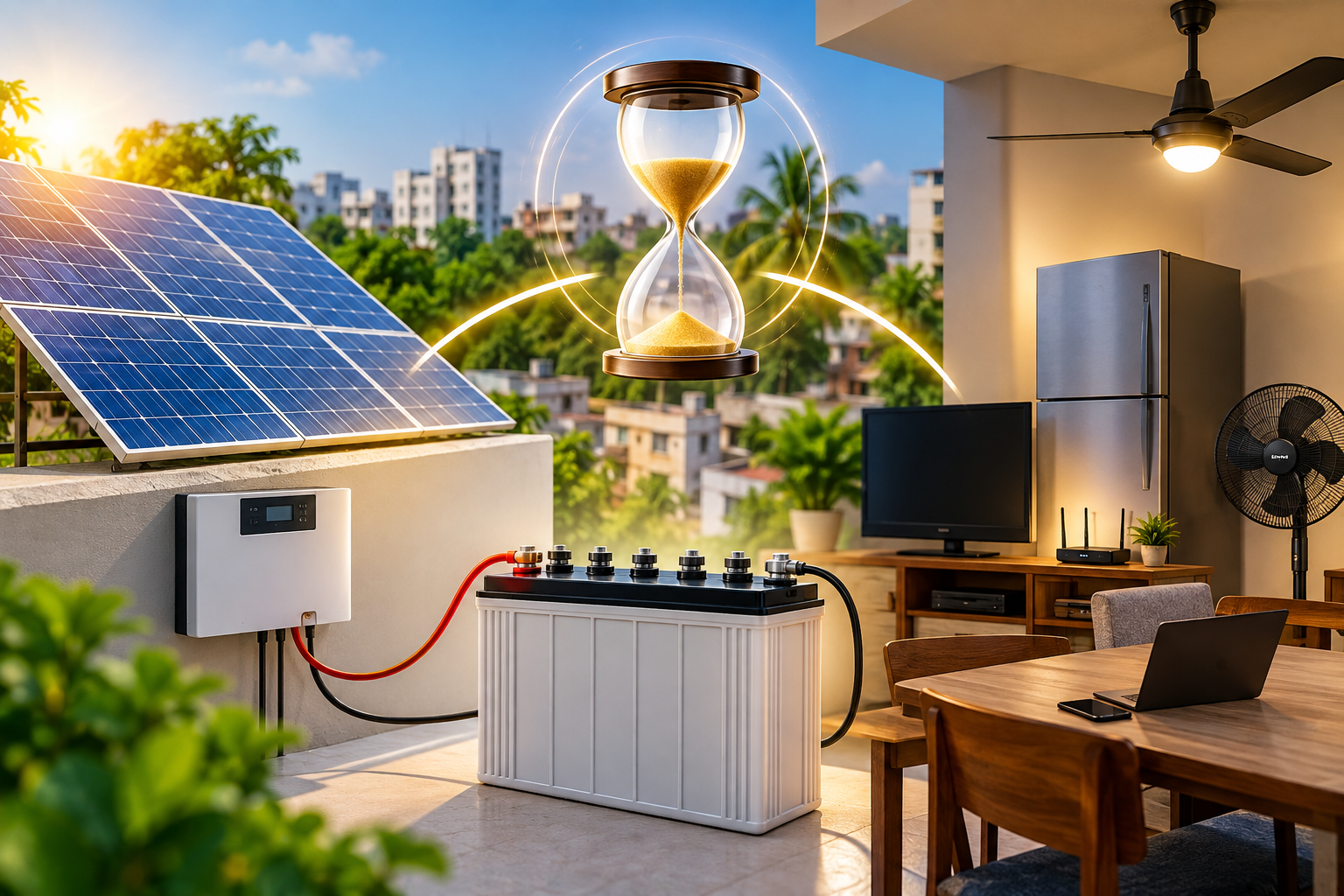
Nothing is broken. The number on the battery just doesn’t tell you the runtime. A proper battery backup time calculation does, and it takes about two minutes once you know which numbers to use.
What is the formula for battery backup time?
Backup time (hours) = Battery Ah × Battery voltage × Depth of discharge × Inverter efficiency ÷ Load in watts
In plain words: work out how much energy the battery can safely give, then divide it by how fast your appliances use it.
Five inputs go into it:
| Input | What it means | Where to find it |
| Battery capacity (Ah) | How much charge the battery holds | Label on the battery |
| Battery voltage (V) | Usually 12V per battery; banks can be 24V or 48V | Label, or your IPS/inverter setup |
| Depth of discharge (DoD) | The share of the battery you can use without shortening its life | Battery datasheet |
| Inverter efficiency | Energy lost turning DC into AC, plus heat and wiring | Inverter/IPS datasheet, or assume roughly 85% |
| Load (W) | Total power your appliances draw together | Appliance labels |
Multiplying Ah by volts gives watt-hours (Wh), the actual energy stored. That is the number that matters, and the Ah figure alone hides it.
A worked example with a normal Bangladeshi home load
Say you want the essentials running during an outage. These wattages are typical example values. Check the labels on your own appliances.
- 3 ceiling fans × 75W = 225W
- 6 LED lights × 10W = 60W
- 1 TV = 100W
- 1 Wi-Fi router = 15W
Total load: 400W
The battery is a 12V, 150Ah tubular lead-acid battery. For this example, we assume 50% DoD and 85% inverter efficiency.
- Stored energy: 150 × 12 = 1,800 Wh
- Usable energy: 1,800 × 0.50 × 0.85 = 765 Wh
- Runtime: 765 ÷ 400 = 1.91 hours
That is about 1 hour 55 minutes, not the “all evening” the seller promised.
The 50% DoD figure is the reason. Lead-acid batteries lose life quickly if you drain them deeply and often, so treat half the label capacity as the practical limit. DoD varies by battery, so check the datasheet.
Does the battery type change the answer?
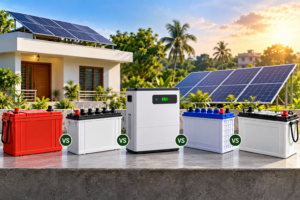
Yes, mostly through DoD. Lithium iron phosphate (LiFePO4) batteries typically allow a much deeper safe discharge, often in the range of 80–90%.
Here is the same 150Ah, 12V battery with 90% DoD and the same 400W load:
1,800 × 0.90 × 0.85 = 1,377 Wh, and 1,377 ÷ 400 = about 3.4 hours.
| Lead-acid (tubular) | Lithium (LiFePO4) | |
| Typical usable capacity | About 50% | About 80–90% |
| Runtime in our example | About 1 h 55 min | About 3 h 26 min |
| Upfront cost | Generally lower | Generally higher |
| Things to check | Water top-up on flooded types, heat | Needs a compatible inverter/charger and a good BMS |
Lithium is not automatically the right answer. If outages are short and your budget is tight, a well-sized lead-acid battery can be the sensible choice. If you want more usable capacity from the same rating, lithium gives that. Compare prices from suppliers rather than relying on general claims, since they change.
The VA vs watts mistake that ruins most calculations
Your IPS is probably sold in VA (for example, 1000VA), but the formula needs watts.
Watts = VA × power factor
If a 1000VA unit has a power factor of 0.8, it can supply about 800W. The power factor differs between units, so read the datasheet instead of assuming.
This matters in two ways:
- The rating is a ceiling, not your load. A 1000VA IPS doesn’t draw 1000W. It draws whatever your appliances draw.
- Don’t plug your load into the formula as VA. That gives a wrong runtime.
For inverter selection, see our inverter sizing guide.
Why is real backup time shorter than the calculation?
Because the formula gives an estimate under ideal conditions. Four things usually cut into it:
- Battery age. A battery that is a few years old no longer delivers its label capacity. Older batteries deliver less.
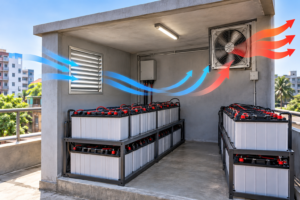
- Heat. Bangladesh’s warm, humid conditions stress batteries. Heat can shorten battery life over time. The size of the effect depends on the battery, so we won’t put a number on it.
- High loads (the Peukert effect). Pulling power fast from a lead-acid battery reduces the capacity you actually get. A heavy load drains the battery faster than the simple formula predicts.
- Startup surges. A fridge, water pump or air conditioner draws far more power for a moment when it starts. Use your average load for runtime, but check that your IPS can handle those surge peaks.
Treat the formula’s answer as the best case. As a sensible habit, plan for somewhat less than the number you calculate.
How long will a 100Ah or 150Ah battery last?
It depends on the load. The table below uses 12V lead-acid, 50% DoD and 85% efficiency. These are examples, not measurements.
| Load | 12V 100Ah | 12V 150Ah |
| 100W (a fan, some lights) | about 5 h 6 min | about 7 h 39 min |
| 200W | about 2 h 33 min | about 3 h 50 min |
| 400W | about 1 h 17 min | about 1 h 55 min |
| 600W | about 51 min | about 1 h 17 min |
Double the load and you halve the runtime. That is why adding a TV or a second fan changes the outcome so much.
How big a battery do you need for 4 hours of backup?
Run the formula backwards.
Required battery Wh = Load × hours ÷ (DoD × efficiency)
For a 400W load and 4 hours on lead-acid (50% DoD, 85% efficiency):
- Energy needed at the load: 400 × 4 = 1,600 Wh
- Battery energy required: 1,600 ÷ (0.50 × 0.85) = about 3,765 Wh
- At 12V, that is about 314Ah
So a single 150Ah battery isn’t enough. You would need roughly 315Ah or more. Add some margin for battery aging.
With lithium (90% DoD), the same job needs about 2,091 Wh, or roughly 174Ah at 12V.
For sizing a whole system, our battery bank sizing guide goes deeper.
What changes when you connect batteries together?
- In parallel: capacity (Ah) adds up and voltage stays the same. Two 12V 150Ah batteries give 12V 300Ah.
- In series: voltage adds up and capacity stays the same. Two 12V 150Ah batteries give 24V 150Ah.
Total energy (Wh) is the same either way, so runtime comes from total Wh. Use matching batteries of the same age and type. Mixing old and new ones drags the bank down to the weakest battery.
What about factories and commercial backup?
The formula is the same, but the mindset shifts. Facility managers and engineers usually think in autonomy time: how long the critical load must keep running before a generator or the grid takes over.
The loads that matter most are the ones you can’t afford to lose, such as control systems, servers, emergency lighting and safety equipment. Keep those on a separate backup circuit from everything else. Add a larger safety margin for aging and surge loads, and use manufacturer datasheets for the real DoD and efficiency figures. For solar and storage in industrial settings, see solar for industries.
Where solar fits in
If outages are frequent, a battery that only ever charges from the grid ends up doing the same job over and over. Pairing storage with solar is one way people reduce that dependence. A hybrid solar system charges the battery from the sun as well as the grid, and the calculation above still tells you how long the stored energy lasts. To understand the wider picture, read about solar energy storage.
If you’re planning a solar-plus-battery setup and want the sizing done properly, start with our solar load calculation guide. It shows how to list your appliances and build the load number this calculation needs.
FAQs
How long will a 12V 100Ah battery last?
On a 100W load with a lead-acid battery (50% DoD, 85% efficiency), about 5 hours. On 400W, about 1 hour 17 minutes. Your load decides the answer.
How do I calculate IPS backup time?
Multiply battery Ah by voltage, then by DoD and inverter efficiency, and divide by your total load in watts. The result is hours.
How do I convert VA to watts?
Multiply VA by the power factor. A 1000VA unit with a power factor of 0.8 gives 800W. Check your IPS datasheet for the actual figure.
Why is my backup shorter than the calculated time?
Battery age, heat, heavy loads and startup surges all reduce real runtime. The formula is an estimate for ideal conditions.
Can I add another battery to increase backup time?
Yes. Connect a matching battery in parallel to double capacity at the same voltage, provided your IPS supports it. Use batteries of the same type, capacity and age.
Is lithium better than lead-acid for backup time?
For the same Ah rating, lithium usually gives more usable energy because of its deeper safe discharge. It costs more upfront, so compare prices and your outage pattern before choosing.
How do I calculate battery size for 4 hours of backup?
Use load × hours ÷ (DoD × efficiency) to get the Wh needed, then divide by voltage for Ah. For 400W and lead-acid, that comes to roughly 314Ah.
Does a bigger battery always mean longer backup?
Only if your IPS or inverter can charge it and handle the load. An undersized inverter or charger can limit what a big battery delivers.