A solar plant in Bangladesh doesn’t fail because the panels stop working. It fails because someone picked the wrong mounting structure for the site — and found out during the first real cyclone season.
That’s not an exaggeration. Ask anyone who’s inspected a damaged array after a Bay of Bengal storm and they’ll tell you the panels are usually fine. It’s the racking underneath — bent purlins, sheared bolts, piles pulled clean out of soft delta soil — that took the hit. And once the structure goes, the panels go with it.
So this guide isn’t another rundown of generic mounting terminology. It’s about what actually changes when you’re designing or specifying a structure for Bangladeshi conditions specifically — the wind zones, the soil, the humidity, the budget realities — and how to avoid the mistakes that show up here more than almost anywhere else in South Asia.
Why Wind, Not Weight, Decides Everything Here
Most people assume a mounting structure just needs to be strong enough to hold the panel’s weight. It doesn’t. A typical module weighs next to nothing compared to the uplift force wind generates once it hits a tilted panel surface at an angle. Wind doesn’t push down on your array — it tries to lift it, like an airplane wing working in reverse.
That distinction matters more in Bangladesh than in most countries, because the solar-angles-explained tilt choice you make for energy yield directly changes how much uplift your structure has to survive. A steeper tilt catches more sun in winter but also catches more wind. In a cyclone-exposed coastal site, that trade-off isn’t optional — it’s often the first design decision that gets made.
The Bangladesh National Building Code (BNBC), currently the 2020 edition, sets basic wind speed requirements for structural design across the country, and the range is wide. Coastal and cyclone-belt locations — Cox’s Bazar, Chattogram, parts of Barisal and Khulna divisions — sit at the upper end of the national range, while inland areas further from the Bay see meaningfully lower design speeds. That means a structure engineered for a Dhaka rooftop and one engineered for a Cox’s Bazar ground-mount aren’t the same product, even if the panels on top are identical.
Here’s a detail most guides skip entirely: the panels sitting at the corners and edges of an array face 2 to 3 times more uplift pressure than the ones in the middle. Wind doesn’t distribute evenly across a solar field — it concentrates at the boundaries. If your structural design uses one flat pressure value for the whole array instead of separate zone-specific values, the corner rows are quietly under-designed. That’s exactly where post-cyclone inspections tend to find the first failures.
Dead Load and Live Load — Real, but Secondary
Dead load — the permanent weight of the modules, rails, purlins, and fittings — still needs to be calculated properly. A standard 540–550W module in the 27–28 kg range works out to roughly 12–13 kg per square metre once you factor in the mounting hardware and spacing. Get this wrong and you undersize the members before wind is even in the picture.
Live load matters too, mostly during installation and maintenance, when a technician’s weight adds temporary stress to a purlin or walkway. In Bangladesh, where a lot of installation and cleaning work is done manually rather than with mechanized access equipment, this isn’t a minor line item — it’s a real, recurring load the structure sees multiple times a year, especially on rooftop systems in dusty regions that need frequent panel cleaning.
But neither of these governs the design in the way wind does. If your structural calculations are spending equal attention on dead load, live load, and wind load, something’s off — wind should be driving the member sizing, the foundation depth, and the anchor spec in almost every Bangladeshi installation outside a handful of very sheltered inland sites.
Steel or Aluminum — What Actually Holds Up in This Climate
This is where Bangladesh’s climate makes the decision different from a lot of standard guidance you’ll find online.
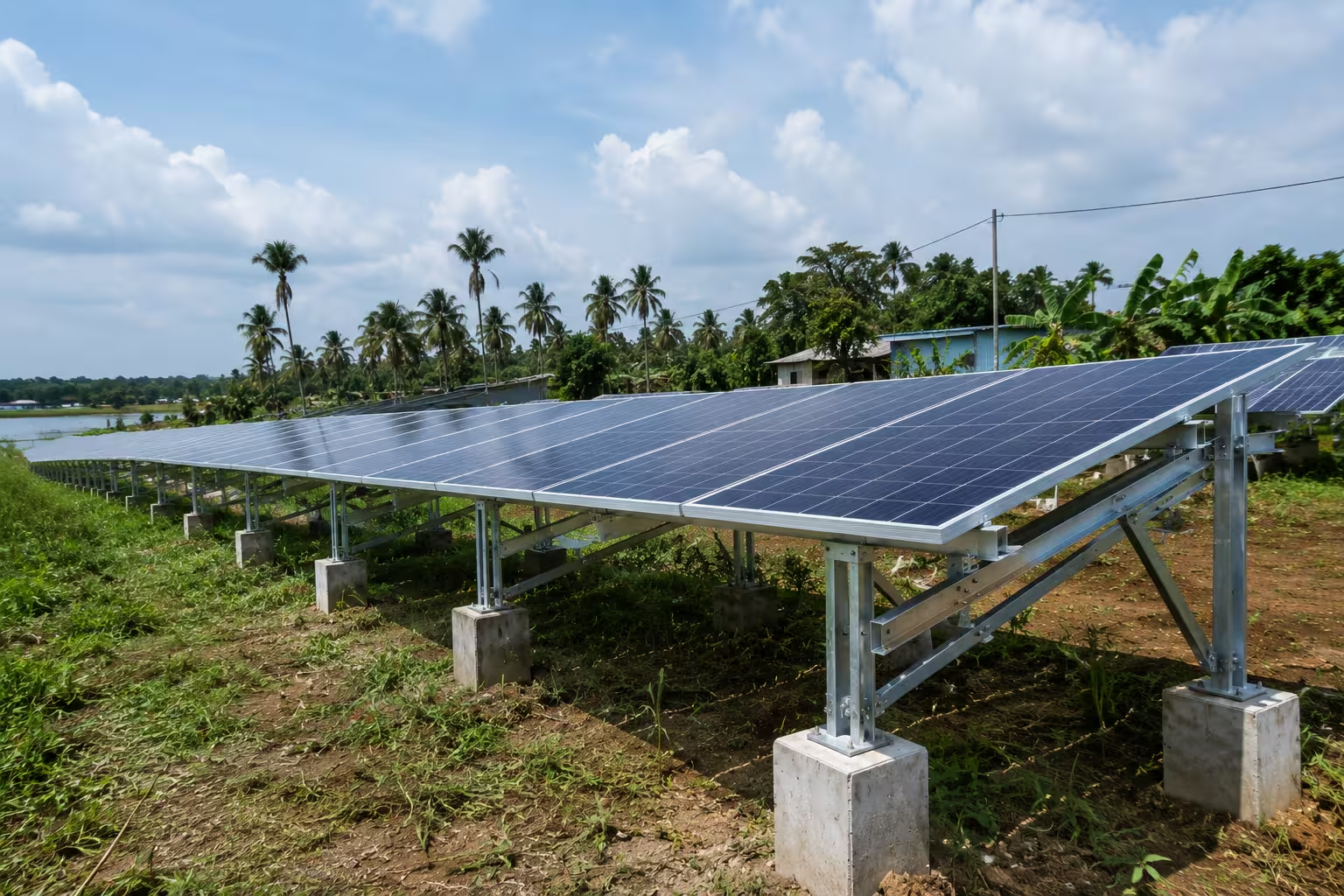
Hot-dip galvanized (HDG) steel is the default choice for ground-mounted and utility-scale plants here, and for good reason — it’s strong, it’s available locally, and it’s the most cost-effective option for large structural spans. A zinc coating of 120–150 microns is the usual specification, but in coastal and estuarine zones — anywhere near saline groundwater or brackish air — that coating gets tested harder and faster than it would inland. Salt-laden air accelerates zinc degradation, so projects near the coast often need a heavier coating spec or a Galvalume finish rather than standard HDG to hit the same service life.
Aluminum shows up more in rooftop and smaller commercial installations, particularly where weight matters — older tin-roof or lightweight RCC rooftops common in urban Bangladesh often can’t take the dead load of a full steel racking system. Aluminum’s natural corrosion resistance is also a genuine advantage in humid, high-rainfall conditions. The trade-off is cost and lower load capacity per member, which is why you rarely see it on large ground-mount arrays.
A detail that rarely makes it into vendor literature: mixing steel and aluminum components — say, an aluminum rail bolted directly to a galvanized steel frame — creates galvanic corrosion at the contact point. In Bangladesh’s humidity, that reaction happens faster than in drier climates. Isolating dissimilar metals with proper washers or coatings isn’t a nice-to-have here; skip it and you’ll see localized corrosion failures well before the rest of the structure shows wear.
| Material | Best fit in Bangladesh | Watch out for |
| HDG Steel | Utility-scale ground-mount, large commercial | Coastal salinity reduces coating life — spec heavier zinc near the coast |
| Aluminum | Rooftop, lightweight commercial | Higher cost per structural span, avoid direct steel contact |
| Galvalume | Coastal, high-humidity, saline zones | Confirm supplier certification — quality varies by source |
Foundations — Why Soil Matters More Than the Structure Above It
Bangladesh’s geography works against easy foundation design. Much of the country sits on soft alluvial soil from the Ganges-Brahmaputra delta system, with a high water table in many regions, especially close to rivers and during monsoon season. That changes the foundation conversation significantly compared to, say, a rocky or firm-soil site elsewhere in South Asia.
Concrete footings remain common and reliable where soil bearing capacity is adequate and the water table isn’t a constant complication. Pile foundations — driven or bored — tend to perform better in soft delta soil because they transfer load to deeper, firmer strata rather than relying on shallow soil bearing that can shift seasonally with monsoon saturation. Ballasted foundations show up mostly on rooftop systems or sites where excavation isn’t practical, though they’re less common for large ground-mount plants given the wind uplift concerns already covered.
Here’s the part that gets missed: it’s the pile embedment, not the visible steel above ground, that’s usually the weak point when a ground-mount structure fails under high wind. Uplift forces at the pile head can run several times higher than the structure’s actual dead load, and a foundation designed only to carry compression — the panel’s weight pressing down — has none of the pull-out resistance needed to resist that uplift. This kind of failure doesn’t give a warning. A visual inspection won’t catch an undersized pile before a storm; it just fails suddenly when the wind event actually arrives. In monsoon-softened soil, that risk goes up further because saturated ground has less pull-out resistance than dry, compacted soil.
If you’re specifying a structure for a delta or coastal site, ask for project-specific geotechnical data before trusting a manufacturer’s generic allowable-load sheet. Those sheets are usually based on a firm-soil test condition that doesn’t reflect much of Bangladesh’s actual ground.
Fixed-Tilt, Seasonal, or Tracking — What Fits the Bangladeshi Market
Fixed-tilt structures are the default across nearly every ground-mount and rooftop project in the country, and for practical reasons — lower cost, simpler maintenance, and a tilt angle that can be optimized around Bangladesh’s latitude without adding moving parts that need servicing in a hot, humid, dusty environment.
Seasonal tilt structures, adjusted manually between monsoon and dry season, appear occasionally on larger commercial projects chasing a bit more annual yield, but they add labor and maintenance overhead that many operators here would rather avoid.
Solar trackers are still relatively rare in Bangladesh compared to markets like India or the Middle East. Single-axis tracking can lift yield by 15–25%, which sounds attractive, but the moving components need a level of maintenance discipline and technical support that isn’t always readily available outside major cities — and trackers introduce dynamic wind loading that makes the structural design more demanding, not less, in a country where wind is already the dominant design factor. For most Bangladeshi ground-mount and utility projects, fixed-tilt remains the more sensible choice unless the site, budget, and O&M setup genuinely support tracking.
What a Poorly Chosen Structure Actually Costs You
The consequences aren’t abstract. A misjudged tilt angle or a structure oriented without accounting for Bangladesh’s seasonal sun path quietly cuts energy generation for the plant’s entire operating life — a loss that compounds year after year but never shows up as a single dramatic failure.
Corrosion from underspecified coatings shows up faster near the coast, in the form of rusting fasteners, weakening welds, and rising maintenance costs that eat into the project’s returns long before the panels themselves degrade.
And the worst case — structural failure during a cyclone or severe monsoon storm — doesn’t just damage the array. It can damage neighboring equipment, create safety risks for site staff, and in some cases void manufacturer warranties that assume the racking met design-load requirements in the first place.
Quick-Reference Table
| Parameter | Typical Bangladesh Range | Why It Matters |
| Basic wind speed (BNBC) | ~130–260 km/h depending on zone | Coastal and cyclone-belt sites need significantly higher design margins |
| Tilt angle | Roughly 10°–24° depending on latitude and site goals | Balances energy yield against wind uplift exposure |
| Zinc coating (HDG steel) | 120–150 microns, heavier near coast | Salinity and humidity accelerate corrosion |
| Foundation type | Pile foundations favored in soft delta soil | Shallow footings underperform in seasonal high water table |
| Corner/edge uplift | 2–3x interior panel loading | Often the first failure point in undersized designs |
Frequently Asked Questions
What wind speed should a solar structure in Bangladesh be designed for?
It depends entirely on location. Under the BNBC, coastal and cyclone-exposed areas like Cox’s Bazar and Chattogram carry much higher basic wind speed requirements than inland regions like Dhaka or Rajshahi. Always design to the site-specific BNBC zone value, not a national average.
Is steel or aluminum better for solar mounting in Bangladesh?
HDG steel is the standard for ground-mount and large commercial projects because of its strength and cost efficiency. Aluminum suits lightweight rooftop installations, especially where the roof can’t carry a heavier steel racking system, and it resists humidity-driven corrosion well.
What foundation type works best in Bangladesh’s soil conditions?
Pile foundations generally perform better than shallow concrete footings in the country’s soft, alluvial delta soil, particularly in areas with a seasonally high water table. Site-specific geotechnical assessment matters more here than in firmer-soil regions.
Do rooftop and ground-mounted solar systems need different mounting approaches in Bangladesh?
Yes. Rooftop systems are constrained by the building’s load capacity and often favor lighter aluminum structures, while ground-mount systems have more design freedom but face greater wind and foundation challenges. For a closer look at how the two compare, see our guide on rooftop-vs-ground-mounted-solar.
Are solar trackers worth it for Bangladeshi projects?
For most sites, fixed-tilt structures remain the more practical choice given local O&M capacity and the added structural complexity trackers introduce under high wind conditions. Trackers can make sense for larger utility-scale projects with strong technical support in place.
A mounting structure is the part of a solar plant nobody photographs for the brochure, but it’s the part that decides whether the plant is still standing after its first real storm. Get the wind zone, the material, and the foundation right for the actual site — not a generic spec sheet — and the rest of the system gets 25 years to do its job.