A solar system doesn’t fail loudly. It fails quietly — a string that’s producing 15% less than it should, a fuse that’s been arcing for months, a layer of dust that’s been sitting on the panels since the last rain. By the time something is obviously broken, you’ve usually already lost weeks or months of generation.
That’s what operation and maintenance (O&M) is really for. Not emergency repairs — though it catches those too — but the routine attention that keeps a system performing the way it was designed to.
This guide covers what solar O&M actually involves, how it differs for a home rooftop system versus an industrial or utility-scale plant, and what’s worth knowing before you decide whether to handle it yourself or bring in a professional.
Why Solar O&M Actually Matters
Every solar system loses some performance over time — that’s normal. What O&M controls is how much you lose to things that are entirely preventable: dust buildup, loose connections, a fan that’s stopped cooling an inverter, a fuse nobody’s checked in a year.
Three things are at stake:
- Generation. A dirty or partially shaded array can lose meaningful output without any visible sign of damage.
- Safety. DC and AC circuits carry real risk. Loose or corroded connections are a common cause of arcing and, in rare cases, fire.
- Lifespan. Components that run hot or stay dirty degrade faster. Good maintenance is often the difference between an inverter lasting 10 years and one needing replacement in 6.
None of this requires obsessive attention. It requires consistency — the same handful of checks, done on a schedule, rather than only after something goes wrong.
Home Rooftop O&M vs. Industrial Plant O&M: What’s Actually Different
Most guides to solar maintenance are written for one audience and then applied loosely to the other. That’s a mistake, because the scope is genuinely different.
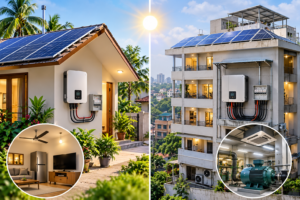
A home system in a Dhaka apartment building or a house in a smaller city typically has a few kilowatts of panels, one inverter, and no switchyard, transformer, or SCADA system to speak of. An industrial or utility-scale plant — a factory rooftop in Gazipur, a ground-mounted array serving a manufacturing facility — has combiner boxes, string-level monitoring, transformers, and often a dedicated electrical team.
| Home / Residential | Industrial / Commercial | |
| Typical system | Single inverter, rooftop-mounted | Multiple inverters, combiner boxes, possibly a transformer and switchyard |
| Who maintains it | Usually the installer’s after-sales service, or the owner for basic cleaning | In-house electrical staff, often paired with a contracted O&M vendor |
| Monitoring | Inverter app or display | SCADA data logging, string-level monitoring |
| What’s at stake | Household electricity savings, appliance/net-metering credit | Plant uptime, production continuity, ROI on a much larger capital investment |
| Maintenance frequency | Periodic visual checks, occasional cleaning | Structured daily/weekly/monthly/yearly schedule with documentation |
If you own a rooftop system, most of what follows in the “yearly” and “fortnightly” sections below is more than you’ll ever need to do yourself — that’s the professional/industrial layer. If you’re managing a commercial or industrial plant, all of it applies.
Daily and Weekly Visual Inspection
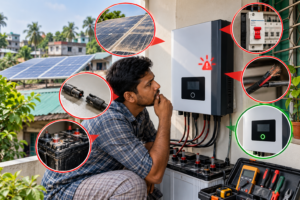
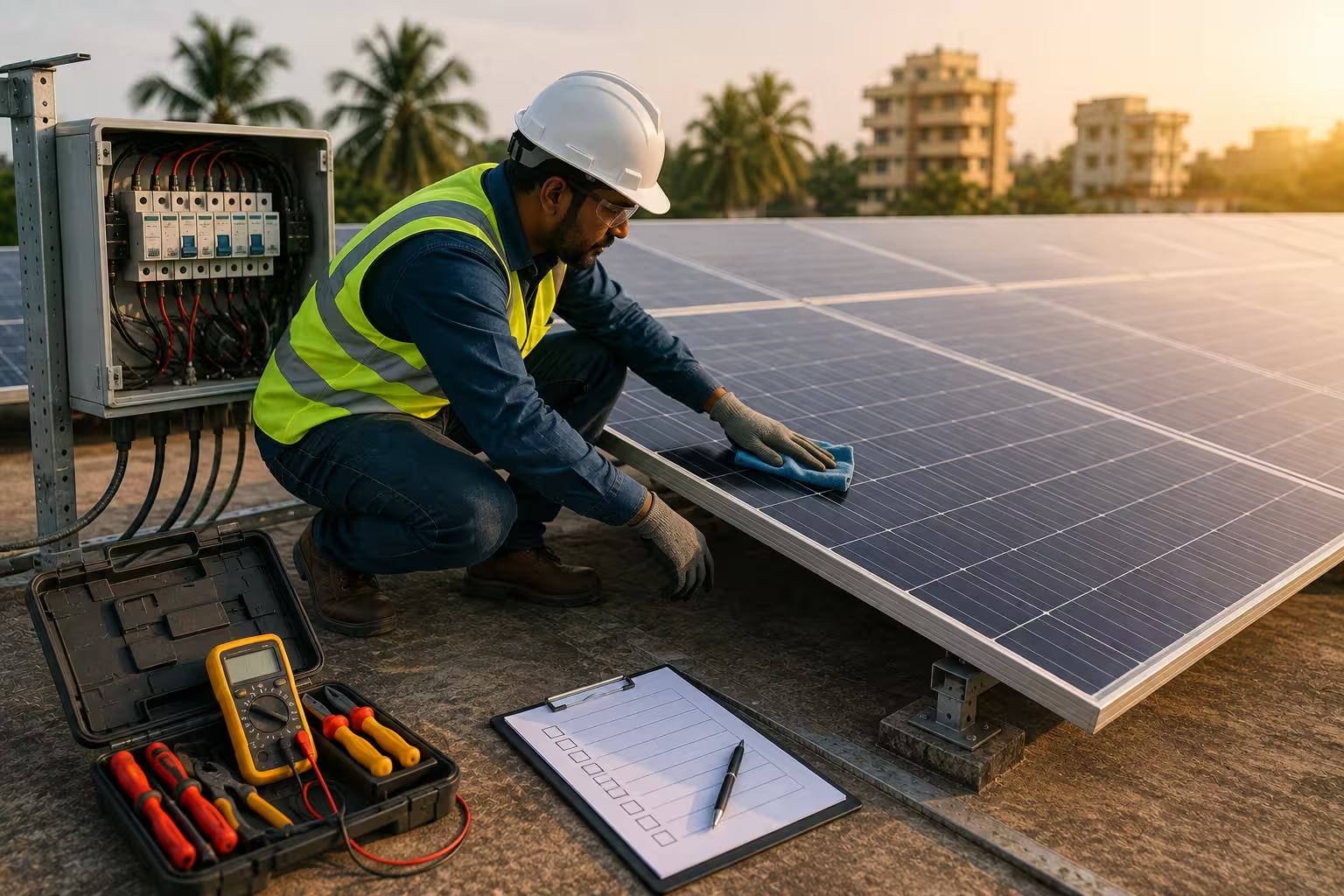
This is the simplest layer of O&M, and it catches more problems than people expect. A visual walkthrough — for a home system, this might just mean glancing at the panels and the inverter display — should look for:
- Cracks, delamination, or heavy dirt accumulation on the panels
- Discoloration or rust around cable junctions and terminals
- Overheating signs or water intrusion at string fuses, connectors, and junction boxes
- Loose or corroded mounting structure
- Missing or damaged warning labels and earthing connections
For an industrial site, this is usually a technician’s daily walk-through. For a home system, a weekly glance is generally enough — you’re looking for anything that visibly changed since last time.
Inverter Maintenance
The inverter converts the DC power your panels produce into the AC power your building actually uses, and it’s the component most likely to need attention. Keeping it clean and monitored matters more than almost anything else on this list, because a struggling inverter drags down the output of an otherwise healthy array.
What this typically involves:
- Cleaning filters and air vents so the unit doesn’t overheat
- Checking the display or app for fault codes and alerts
- Measuring voltage, current, and power factor at input and output
- Confirming DC and AC terminal connections are tight
- Keeping firmware updated per the manufacturer’s guidance
- For larger inverters, inspecting DC link capacitors and cooling fans for wear
A home inverter mostly needs its vents kept clear and its app checked occasionally for alerts. An industrial inverter — often larger, with active cooling and higher throughput — needs the fuller checklist, usually as part of a technician’s routine visit.
Fortnightly Checks (Industrial/Larger Systems)
For larger systems, a deeper check every two weeks catches issues that daily visual inspection misses:
- Verifying string current with a clamp meter
- Checking tracker systems, if the plant uses solar tracking
- Inspecting surge protection devices and replacing any that are faulty
- Cleaning modules if dust or bird droppings have accumulated
- Comparing inverter yield against projected generation
This layer is mostly relevant to commercial and industrial sites with enough capacity — and enough at stake — to justify the more frequent attention. A small rooftop system generally doesn’t need this level of scrutiny.
Monthly Checks
Monthly maintenance is where system-wide health gets assessed rather than just individual components:
- Testing insulation resistance on DC strings and AC feeders
- Calibrating sunlight and temperature sensors, if the site has them
- Cleaning switchyard and inverter rooms
- Inspecting cable terminations at panels and transformer bushings (industrial sites)
- Checking transformer oil level, silica gel color, and temperature rise (industrial sites)
- Downloading and reviewing SCADA data logs for trends
For home systems, the monthly layer is lighter — mainly reviewing generation data through the inverter app to spot any unexplained drop, and cleaning the panels if the dry season has left visible dust.
Yearly Checks
The annual inspection is the most thorough, and it’s where compliance and long-term reliability get confirmed:
- Calibrating all measurement devices and sensors
- Thermographic scanning of panels, cables, and joints to catch hotspots before they become failures
- Earth resistance and continuity testing
- Testing surge arrestors, relays, and control panel operation
- Verifying grid synchronization and metering accuracy
- Compiling a full annual performance report with any corrective actions taken
This is generally a professional job, for both home and industrial systems — thermographic scanning and insulation resistance testing require equipment and training most owners don’t have.
A Note on Safety
Some of what’s listed above — particularly anything involving isolating circuits, opening a combiner box, or testing live connections — isn’t a DIY task. A field combiner box, for instance, has to be properly isolated (AC and DC isolators off, voltage confirmed absent with a multimeter) before anyone opens it. This is standard practice for a trained technician and genuinely risky for someone without that training.
The practical takeaway: cleaning panels and doing a visual walkthrough is reasonable for most owners. Anything involving live electrical testing, isolation procedures, or working at height on a large array is worth leaving to someone qualified.
DIY vs. Professional O&M: The Honest Trade-off
For a small rooftop system, doing your own basic cleaning and visual checks is entirely reasonable — it’s low-risk and saves the cost of a service call for something simple. Where it stops making sense is anything involving the inverter’s internals, electrical testing, or a system large enough that you’d need to work at height or handle multiple strings.
For industrial and commercial plants, the calculation is different. The generation at stake, the complexity of the equipment, and the safety requirements around switchyards and transformers generally mean a structured O&M arrangement — whether that’s in-house staff, a contracted vendor, or a combination — pays for itself in avoided downtime alone.
Muspana works with both home and industrial clients on this exact question, and honestly, the right answer depends more on system size and complexity than on budget alone. A well-run O&M plan doesn’t need to be expensive to be effective — it needs to be consistent.
What This Looks Like in Bangladesh
A few local conditions genuinely change how O&M should be scheduled here, rather than just following a generic checklist:
Dry season dust. Roughly November through March, dust accumulation on panels happens noticeably faster than in wetter months. Cleaning frequency during this period is worth increasing rather than sticking to a fixed monthly rule — a system near a busy road or industrial area will collect dust faster than one on a quiet rooftop.
Monsoon conditions. From around June to September, heavy rain, high humidity, and lightning activity raise the importance of surge protection checks and confirming that mounting structures and cable entries are properly sealed against moisture.
Grid stability. Voltage fluctuations and periodic load-shedding in parts of the grid make inverter fault-code monitoring and grid synchronization checks more relevant here than in markets with a consistently stable grid — an inverter that keeps tripping and resetting is often responding to grid conditions, not a fault of its own.
Net metering. If your system is grid-connected, it’s worth understanding that Bangladesh’s net metering framework, overseen by the Bangladesh Energy Regulatory Commission (BERC), has specific requirements for metering accuracy — which is part of why the annual metering check matters, not just as a formality.
Who actually does the maintenance. In practice, most residential systems here rely on the installer’s after-sales service rather than the homeowner doing technical work themselves. Industrial sites more often combine an in-house electrical team with a contracted O&M provider for the specialized checks.
Frequently Asked Questions
How often should solar panels be cleaned in Bangladesh?
It depends on location and season more than a fixed schedule. During the dry season (roughly November–March), dust builds up faster, so more frequent cleaning is worth it — especially near roads or industrial areas. During the monsoon, rain does a lot of the cleaning naturally.
Is solar O&M expensive?
Costs vary widely by system size, whether it’s rooftop or ground-mounted, and how much of the work is DIY versus professional. Rather than a fixed number, think of it as a range that scales with system complexity — a small rooftop system’s basic upkeep costs far less than a structured O&M contract for an industrial plant. Ask any provider for a clear breakdown before committing.
Can I maintain my solar system myself?
For a home rooftop system, basic cleaning and visual inspection are reasonable to do yourself. Anything involving the inverter’s internals, live electrical testing, or isolation procedures is better left to a trained technician — the risk isn’t worth the savings.
What happens if I skip maintenance?
Generation drops gradually rather than all at once, so it’s easy not to notice for months. Left long enough, minor issues like a dirty array or a loose connection can develop into bigger problems — reduced inverter lifespan, or in worse cases, safety hazards from overheating connections.