The panels are up. That doesn’t mean the job is done.
A solar system can look completely finished — panels mounted, wiring tucked away, inverter blinking a friendly green light — and still be carrying problems that won’t show up for months. A loose ground connection doesn’t announce itself. Neither does a string that was sized wrong, or an insulation fault that’s slowly getting worse under monsoon humidity. These things surface later, usually as a fire risk, a stubborn inverter fault, or a system that quietly produces 15% less than it should and nobody notices until the electricity bill doesn’t drop the way it was supposed to.
That gap — between “looks finished” and “actually verified” — is where solar installation quality checks matter. Most buyers never see this part of the process. They see the panels going up and the handshake at the end. The testing, measuring, and documentation that happens in between is usually invisible, which is exactly why so many people search for this topic after something’s already gone wrong.
This isn’t a compliance checklist written for engineers. It’s what those checks actually catch, why skipping them costs more than doing them, and what you — whether you’re signing off on a rooftop system for your house or auditing a contractor’s work on a factory roof — should actually be asking for.
Quick answer: what gets checked before a solar system is considered “done”
A proper solar installation quality check covers four areas:
- Structural integrity — is the mounting solid enough to survive wind, weight, and years of thermal expansion?
- Electrical safety — is the wiring insulated, grounded, and connected with correct polarity, so it won’t shock anyone or start a fire?
- Performance verification — is the system actually producing what it was designed to produce?
- Compliance and documentation — is there a paper trail proving all of the above, in case something goes wrong later?
Skip any one of these, and you’re trusting the installer’s word instead of having proof. That’s fine if the installer is genuinely reliable. It’s a problem if they’re not — and most buyers have no way to tell the difference until it’s too late.
Structural checks: what happens when mounting is rushed
Structural checks confirm that the racking, clamps, and roof or ground attachments can actually hold up over the system’s working life — typically 20-25 years for the panels themselves.
What this covers in practice:
- Rail alignment and clamp placement — panels held at the wrong points stress the frame and can crack cells over time.
- Torque values on bolts and clamps — under-tightened hardware works loose under vibration and wind; over-tightened hardware can crack mounting points. This should be checked with a calibrated tool, not “tightened until it feels right.”
- Roof or foundation load — the structure needs to be rated for the actual weight and wind load of the array, not just eyeballed as “probably fine.”
Why this matters more in Bangladesh than the checklist implies: most Western commissioning guides assume RCC (reinforced concrete) roofs and moderate wind conditions. A lot of residential and light-industrial rooftops here are tin-shed or CI sheet roofing, which needs different attachment methods entirely. Add monsoon-season water pooling and, in coastal or exposed areas, cyclone-level wind loads, and structural shortcuts that might survive a mild climate elsewhere can fail here. If your site is in a wind-exposed location, it’s worth asking directly what wind-load rating the mounting structure was designed for — see our guide to mounting structure selection for how that decision should be made in the first place, and how torque is actually verified during installation.
Electrical checks: the part that decides whether the system is safe
This is the section where corners get cut most often, because most of it is invisible once the wiring is covered and the covers are back on.
On the DC side (before the inverter):
- String sizing — panels are wired in “strings” whose combined voltage has to sit inside the inverter’s accepted range. Get this wrong and the inverter either underperforms or refuses to start.
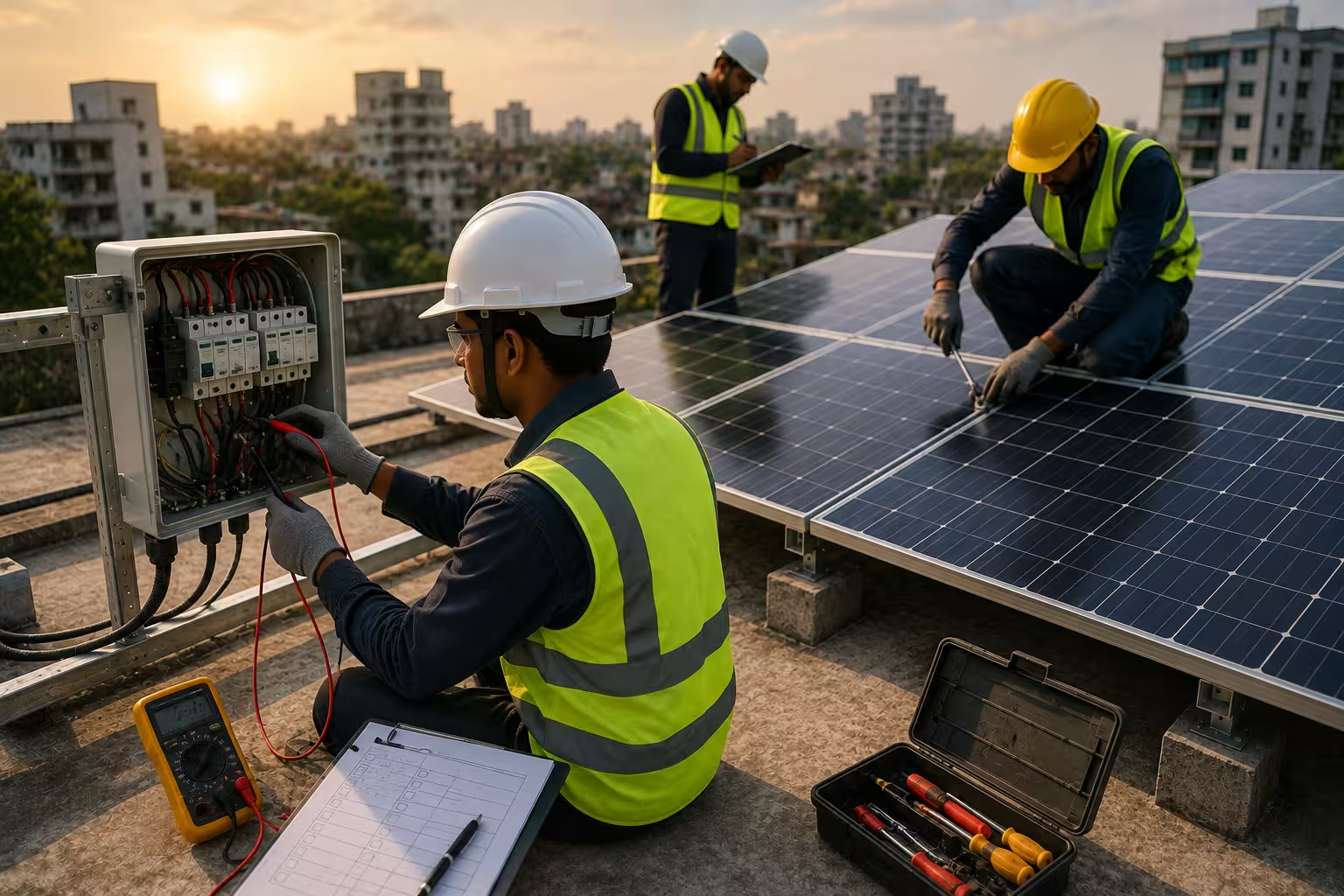
- Insulation resistance testing (megger test) — this measures whether the wiring’s insulation is intact. A failed insulation test isn’t a paperwork technicality — it means current can leak somewhere it shouldn’t, which is a genuine fire and shock risk, especially in humid conditions where insulation degrades faster.
- Polarity and grounding continuity — reversed polarity can damage the inverter on first power-up. Poor grounding continuity means a fault won’t trip safely — it’ll just sit there live.
On the AC side (after the inverter, feeding the building or grid):
- Breaker coordination — breakers need to be rated correctly for the actual current, not just “a breaker that fits.”
- Grid protection settings — anti-islanding, and over/under-voltage and frequency protection, control how the inverter reacts to grid problems. This isn’t a formality here. Bangladesh’s grid experiences more voltage fluctuation and load-shedding events than a stable Western grid, so an inverter with poorly configured protection settings will nuisance-trip constantly — or worse, fail to disconnect safely during an actual grid fault.
If you want the deeper version of this — how earthing is actually done and why it’s non-negotiable — see our breakdown of solar earthing and installation safety practices. Lightning is also a real consideration on taller rooftop or ground-mount arrays; that’s covered separately in our lightning protection guide.
Performance verification: proving the system actually works, not just that it’s wired correctly
A system can pass every electrical safety check and still underperform. That’s what this stage catches.
- IV curve tracing compares the system’s actual electrical output curve against what the panel manufacturer specifies. It’s the clearest way to catch underperforming panels, bad connections, or partial shading issues that aren’t obvious just by looking.
- Performance ratio (PR) testing compares expected output (based on the site’s sunlight and system design) against what the system is actually producing. A healthy system typically runs in a high-70s to mid-80s percentage range, though this varies by system design, shading, and local conditions — treat any specific number you’re quoted as an estimate tied to your site, not a universal figure.
- Shading verification confirms that the shading assumptions made during design (from nearby buildings, water tanks, or trees) match reality on the ground.
A fair trade-off to know about: full IV curve tracing is standard practice on commercial and industrial systems, where the scale justifies the extra time and equipment. On a small residential rooftop system, some installers will do a simpler output check instead. That’s not automatically a red flag — but it’s worth asking which one you’re getting, and why. If you want to understand these tests before you ask, our explainers on IV curve tracing and performance ratio and CUF go into more depth.
Compliance and documentation: the part that protects you later
This is the stage most buyers skip thinking about entirely — right up until they need it.
What you should expect to receive:
- As-built drawings showing what was actually installed (which sometimes differs from the original design).
- Test reports — insulation resistance, IV curve, PR test, whatever was performed — with actual numbers, not just a signature saying “tested, OK.”
- Warranty documentation for panels, inverter, and workmanship, with the terms actually spelled out.
- An O&M (operation and maintenance) manual explaining how the system should be maintained going forward.
Internationally, this kind of documentation is often required under standards like IEC 62446-1. Bangladesh doesn’t have that exact framework enforced the same way — grid-connected systems instead go through net-metering approval and connection sign-off with the local distribution company (DISCO), under guidelines set by SREDA and BERC. Requirements can shift, so if your installer tells you something is “not required here,” it’s worth confirming that against the current guidance rather than taking it as settled. Our pages on the net metering application process and DISCO approval walk through what that process typically involves.
Whatever the exact regulatory path, the practical rule doesn’t change: a reputable installer hands you a written record, not just a verbal assurance that everything checked out. That paper trail is what protects you if something fails under warranty later, or if there’s ever a dispute about what was actually promised.
What happens after handover: the follow-up checks nobody mentions
A quality installation doesn’t end the day the system is switched on.
- Punch-list review — a final walk-through catching small issues like loose bolts, minor misalignment, or untidy wiring before sign-off.
- 1-week and 1-month performance reviews — early operation is when failures that weren’t obvious at commissioning tend to surface. A connection that seemed fine can loosen under the first real heat cycle; an inverter setting that seemed correct can start tripping under real grid conditions.
If your installer doesn’t mention a follow-up check at all, ask for one. It costs little and catches the failures that only show up once the system has actually been running.
What to actually ask your installer (if you can’t run these tests yourself)
Most homeowners will never run a megger test or trace an IV curve themselves, and that’s fine — that’s not the point. The point is knowing what to ask for:
- “Can I see the insulation resistance and grounding test results, with actual readings?”
- “What performance ratio are you targeting for this site, and how will I know if it’s not being met?”
- “Will I get as-built drawings and a written O&M manual, or just the physical system?”
- “What’s your process for a 1-month follow-up check?”
- “If a test fails during commissioning, what happens next?”
A reputable installer answers these without hesitation, usually because these documents already exist as standard practice — not because you asked for something unusual. If you’re still comparing installers, it’s worth reading through how to evaluate solar quotes and what to look for when choosing an installer before signing anything.
Home vs. industrial: how the rigor scales
| Home / Residential | Industrial / Commercial | |
| Typical checks performed | Structural, electrical safety, basic output verification | Full suite including IV curve tracing, detailed PR testing |
| Documentation expected | Warranty papers, basic test summary | As-built drawings, full test reports, O&M manual, often insurance documentation |
| Follow-up | 1-month informal check is reasonable | Ongoing monitoring, sometimes via SCADA or remote monitoring systems |
| Who’s asking the questions | The homeowner, usually unassisted | A facility manager, procurement team, or hired consultant |
| Main risk if skipped | Safety hazard, underperformance, voided warranty claims | Safety hazard, downtime cost, contract/liability exposure |
The underlying checks are the same. What scales with system size is how formally they’re documented and how much independent verification is worth the cost. A factory in Gazipur running a large rooftop array has a business case for third-party inspection that a household system usually doesn’t — the potential downtime and liability cost more than the inspection itself. For a closer look at what ongoing monitoring looks like once the system is live, see solar monitoring systems and operation and maintenance practices.
Is a third-party inspection worth it?
It depends on what’s at stake. For a small residential system, a thorough handover with proper documentation from a trustworthy installer is usually enough. For larger residential systems, apartment buildings, or any commercial and industrial installation, an independent inspection adds real value — it costs extra time and money, but it creates a record that isn’t dependent on the installer marking their own work.
If a dispute ever comes up over warranty or performance, that independent record is what settles it. Muspana can walk buyers through what documentation to expect at each stage of a project, which is often the simplest way to know what “properly checked” should actually look like before signing off.
FAQs
How long does solar commissioning take?
It varies by system size. A typical residential rooftop system can usually be tested and commissioned within a day once installation is physically complete. Larger commercial or industrial systems take longer, since there’s more wiring to test and often a full IV curve trace across multiple strings.
What happens if an insulation resistance test fails?
The installer needs to locate and fix the fault — usually damaged wiring, a bad connection, or moisture ingress — before the system is safe to energize. A failed test should never be waved off or worked around; it should be documented and resolved, and you should ask to see the retest result once it’s fixed.
Do I need a third-party inspection for a home solar system?
Not always. For a smaller residential system installed by a reputable installer with proper documentation, it’s often unnecessary. For larger residential systems, apartment buildings, or any commercial and industrial project, an independent inspection adds a level of verification that’s usually worth the extra cost.
What does it cost if quality checks are skipped and something fails later?
This varies too much by system size and failure type to put a specific number on, but the general pattern holds: fixing a problem after the fact — re-opening finished wiring, replacing a damaged panel, or losing warranty coverage because required tests were never done — almost always costs more than the checks would have.
Is a written test report standard practice, or something I have to request?
It should be standard. If an installer treats a written report as an unusual request, that’s worth noting as you compare options.
Do these checks differ for a system on a tin roof versus a concrete roof?
Yes. Mounting and attachment methods differ meaningfully between tin-shed/CI sheet roofing and RCC roofs, particularly around load distribution and water sealing at attachment points. This is worth asking about directly if your roof isn’t standard concrete.