
Two Ways to Handle a Solar System, and Nobody Tells You Which One You’ve Picked
Most people who install solar panels never actually decide how they’ll maintain the system. It just sort of happens by default — usually reactive, because nobody signed anything and nobody scheduled anything. Then one day the output drops, or an inverter throws an error, and the question finally shows up: should this have been caught earlier?
There are two real approaches here. Preventive maintenance means scheduled checks and upkeep before anything visibly breaks. Reactive maintenance means you deal with problems as they appear, and not before. Neither one is automatically the “correct” choice — it depends on what you’re running, what a failure would cost you, and how much risk you’re comfortable carrying.
What Preventive Solar Maintenance Actually Involves
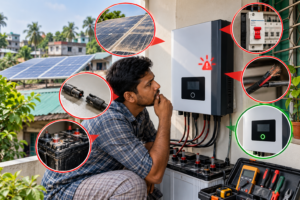
Preventive solar maintenance is scheduled servicing carried out before a fault shows up, aimed at catching small issues while they’re still cheap to fix. It typically includes panel cleaning, a visual check of the modules and mounting hardware, inverter servicing, performance testing, and an inspection of wiring, disconnects, conduit, and the roof area around the array.
None of this is glamorous work. It’s closer to servicing a car before the engine light comes on than to any kind of high-tech intervention. A technician looks for the things that quietly get worse over time: a connector that’s started to corrode, a mounting bolt that’s loosened, a panel that’s underperforming its neighbours for no obvious reason, an inverter fan that’s noisier than it should be.
The value of catching these early is that small problems tend to compound. A loose connection left alone doesn’t stay a loose connection — it eventually becomes a burnt connection, or a fault that trips the inverter, or a fire risk. Preventive maintenance is really just an attempt to stop that chain reaction before it starts.
Timing matters too. Seasonal changes affect solar equipment differently — humidity, dust build-up, and temperature swings don’t hit a system the same way year-round, so a check that lines up with those shifts tends to catch more than one done at a random point in the calendar.
What Reactive Solar Maintenance Actually Involves
Reactive solar maintenance is the opposite philosophy: you fix things when they fail, not before. There’s no inspection calendar and no ongoing servicing cost — you simply call someone out when the system stops performing the way it should.
It’s a genuinely simpler approach, and for some situations it’s a rational one. If a system is small, still under manufacturer warranty, and a short outage wouldn’t cost the owner much beyond some lost generation for a few days, paying for ongoing preventive visits can be money spent solving a problem that hasn’t happened yet.
The trade-off is that reactive maintenance tends to be more expensive over the life of the system, not less. Problems caught late are usually more expensive to fix than problems caught early, and the losses from reduced output often go unnoticed for weeks or months before anyone investigates — which means the real cost of “waiting until it breaks” is often higher than it looks from the outside.
Preventive vs Reactive Solar Maintenance: Side by Side
| Preventive Maintenance | Reactive Maintenance | |
| When work happens | Scheduled, before a fault appears | After something has already failed |
| Ongoing cost | Regular servicing cost | No cost until a failure occurs |
| Downtime risk | Lower — issues caught early | Higher — depends on repair turnaround |
| Repair cost per incident | Usually smaller | Often larger, since faults are caught later |
| Best suited for | Larger systems, business-critical loads, systems past warranty | Small systems, systems still under warranty, low-risk-tolerance budgets |
| Predictability | Easier to budget for | Unpredictable — repair costs and timing vary |
The Real Trade-Off: Cost vs Certainty
The comparison usually comes down to one question: would you rather pay a smaller, predictable amount regularly, or risk an occasional larger, unpredictable bill? There’s no universally right answer — it depends on how much a period of downtime would actually cost you.
For a home in Bogura or Rajshahi running a modest rooftop system that mostly offsets a household electricity bill, a few days of reduced output isn’t a financial emergency. For a factory in Gazipur or Narayanganj running production off a solar-assisted supply, or a commercial building in Dhaka or Chattogram where downtime affects tenants or operations, the calculation is different — lost output has a direct cost attached to it, and that cost adds up faster than a maintenance contract ever would.
This is also where Bangladesh’s own conditions genuinely change the picture, rather than just being mentioned for the sake of it. Dust build-up and monsoon-season moisture affect panels and enclosures here more than they would in a drier, less humid climate, which is part of why the “seasonal changes” point in preventive maintenance isn’t just generic advice — it’s practically relevant. Voltage fluctuations on parts of the local grid can also put more stress on inverters over time, which is one reason electrical checks tend to matter more here than in markets with a consistently stable supply. And depending on where a system is installed, getting a qualified technician out quickly after something fails isn’t always instant — which matters more the further a site is from where solar servicing is easy to find.
None of that means preventive maintenance is automatically the right call everywhere. It means the case for it tends to get stronger as system size, business dependence on the output, and distance from reliable technical support increase.
Home vs Industrial: Different Systems, Different Logic
For residential rooftop owners, reactive maintenance is often a defensible choice for a small system, especially while it’s still under manufacturer warranty. The financial exposure is limited, and a short dip in generation is inconvenient rather than costly. That said, even homeowners who lean reactive benefit from an occasional visual check — mainly to catch obvious things like loose mounting hardware or a build-up of dust and debris before they turn into a bigger issue.
For industrial and commercial operators, the case for preventive maintenance is usually stronger. A larger array represents a bigger investment, an outage has a real production or revenue impact, and the cost of a scheduled inspection is small relative to what an unplanned shutdown could cost. Facility managers and procurement teams also tend to need a predictable maintenance budget line, which reactive maintenance — by definition — can’t really offer.
Does Skipping Maintenance Void Your Warranty?
This varies by manufacturer, so it’s worth checking your specific warranty terms rather than assuming either way. Some manufacturers require evidence of basic upkeep to honour a warranty claim; others don’t. It’s a five-minute check that’s easy to skip and genuinely worth doing before deciding to go fully reactive.
Choosing Between the Two
A rough way to think about it: preventive maintenance earns its cost back when a failure would be expensive, hard to predict the timing of, or slow to get repaired. Reactive maintenance holds up fine when the system is small, the downside of downtime is limited, and repairs are easy to arrange quickly if something does go wrong.
If you’re not sure which side of that line your system falls on, it’s worth having someone assess the specific setup rather than guessing. Muspana can walk through a system’s size, location, and usage pattern with an owner to work out whether a scheduled maintenance plan is worth the cost, or whether a reactive approach is genuinely the more sensible option for that particular case.
FAQs
How often should preventive solar maintenance be done?
There’s no single fixed schedule that fits every system — it depends on the installation, local conditions, and system size. Many owners align checks with seasonal changes, since dust, humidity, and temperature swings affect equipment differently through the year. A local installer or maintenance provider can recommend a schedule suited to your specific setup.
Does reactive maintenance void my solar warranty?
It depends on the manufacturer. Some require proof of basic upkeep to honour a warranty claim, others don’t specify this at all. Check your system’s warranty documentation directly rather than assuming either way.
Can homeowners do preventive maintenance themselves?
Basic tasks like clearing visible debris or a simple visual check are usually manageable for a homeowner. Anything involving the inverter, wiring, disconnects, or electrical testing should be left to a qualified technician, both for safety and to avoid accidentally affecting the warranty.
Is preventive maintenance worth it for a small home system?
Not always. For a small residential system still under warranty, where a short outage isn’t financially significant, reactive maintenance can be a reasonable choice. The case for preventive maintenance gets stronger as the system gets larger or the cost of downtime increases.
What’s the difference between preventive and predictive maintenance?
Preventive maintenance is scheduled servicing done at set intervals, regardless of whether anything looks wrong. Predictive maintenance uses ongoing monitoring or sensor data to flag developing issues based on actual system behaviour, rather than a fixed calendar. Most residential and small commercial systems in Bangladesh rely on preventive rather than predictive maintenance, since the latter typically requires more advanced monitoring infrastructure.
Why does maintenance matter more for larger or industrial solar systems?
Because the financial exposure is larger. A short outage on a small rooftop system is a minor inconvenience; the same outage on an industrial array tied to production or a commercial building’s operations has a direct, measurable cost — which is why preventive maintenance tends to make more financial sense as system size and business dependence increase.