A solar string can lose a third of its output and, on paper, nothing looks wrong. The inverter is still running. The plant is still generating. It’s only when someone finally pulls the monthly report and asks why yield dropped that anyone notices — and by then, whatever caused it (a loose MC4 connector, a shaded module, a failing bypass diode) has usually been quietly costing money for weeks.
That’s the exact problem string monitoring devices exist to solve.
What Is a String Monitoring Device?
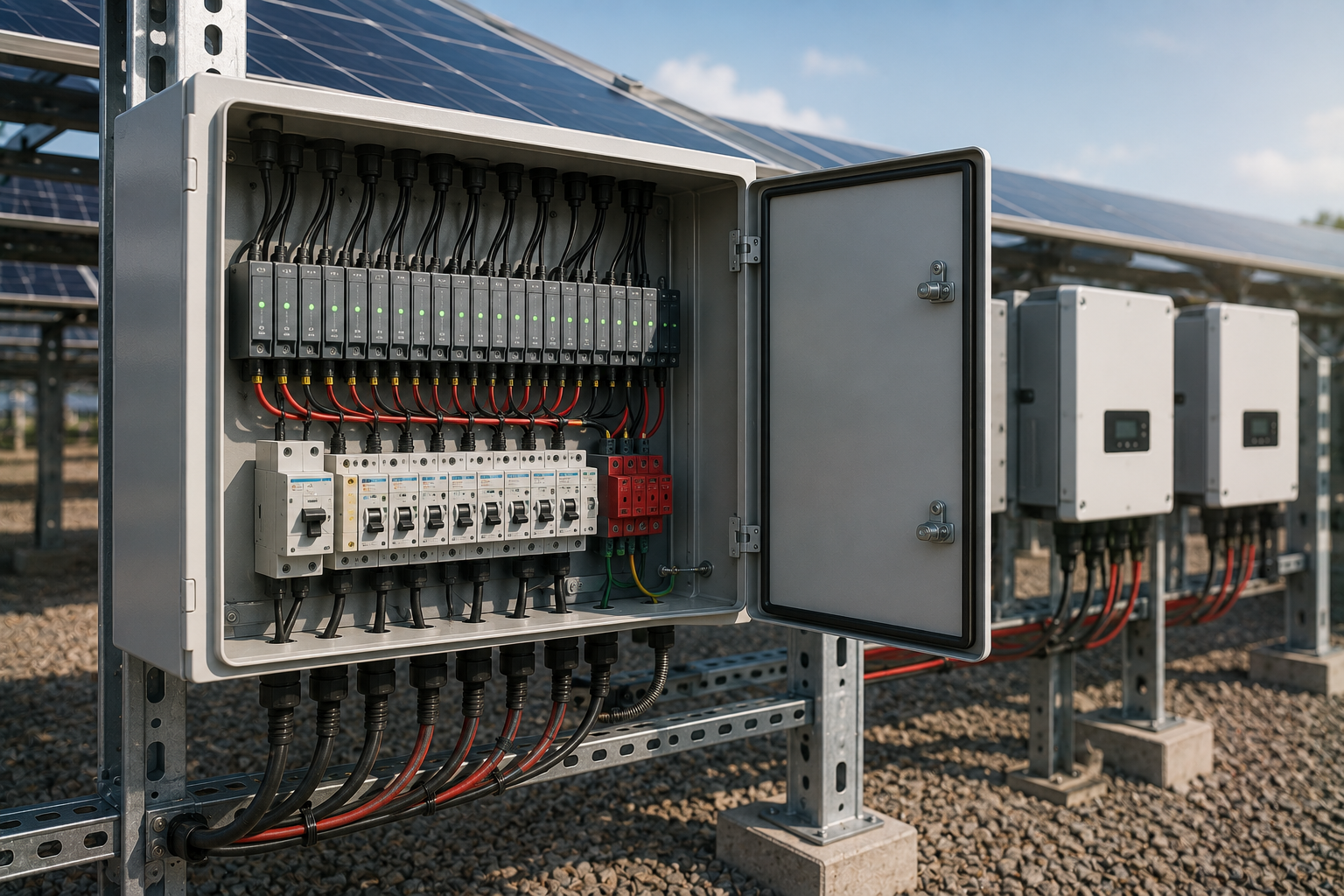
A string monitoring device — sometimes called a string monitoring box (SMB) or string monitoring unit (SMU) — is a piece of hardware that sits between your solar strings and your inverter, and reports on each string individually rather than lumping them together. It tracks current, voltage, and often temperature at the string level, and sends that data to a central monitoring or SCADA system.
The important word there is individually. A standard combiner box just merges the current from several strings into one output — it has no idea if String 4 is underperforming while Strings 1, 2, and 3 are fine. A string monitoring device does.
String Monitoring Box vs. Combiner Box: What’s Actually Different
| Traditional Combiner Box | String Monitoring Device | |
| Function | Aggregates current from multiple strings | Aggregates current AND monitors each string separately |
| Visibility | Array-level only | String-level (current, voltage, sometimes temperature) |
| Fault detection | You find out when total output drops | You find out which specific string dropped, and often why |
| Typical extras | DC disconnect only | DC disconnect, surge protection, communication module |
| Best suited to | Small systems, low string count | Larger C&I plants where individual string variation matters |
A combiner box isn’t a bad piece of equipment — it does exactly what it’s designed to do. It’s just designed to answer a simpler question (“is current flowing?”) than the one most plant operators actually need answered (“which part of my array is underperforming, and why?”).
How String Monitoring Actually Works
Inside an SMD, current sensing happens one of two ways, and the choice matters more than most spec sheets let on.
Shunt-based sensors measure current by placing a precision resistor directly in the circuit and reading the voltage drop across it. It’s a well-understood, accurate method — but because the current physically passes through the shunt, it generates some heat, and it requires direct electrical contact with the circuit.
Hall effect sensors measure the magnetic field created by current flow, without touching the conductor itself. Because there’s no direct contact, they generate less heat and tend to simplify installation. They’re a common choice in modern SMDs for exactly that reason — less heat inside an enclosure that’s often mounted outdoors in direct sun is a genuinely practical advantage, not just a marketing point.
Neither approach is universally “better” — shunt sensors are a mature, reliable technology; Hall effect sensors trade a small amount of complexity in the sensor itself for simpler, cooler installation. What matters is that the device you’re specifying uses one that’s appropriate for your string count and enclosure conditions.
What’s Actually Inside One
Beyond the current sensor itself, a well-built string monitoring device typically bundles in a handful of protective and communication features:
- Surge Protection Devices (SPDs) to absorb voltage spikes from lightning strikes or grid disturbances before they reach sensitive equipment
- DC disconnect switches, so a technician can safely isolate a string for maintenance without shutting down the whole array
- A communication module, usually Modbus RTU over RS-485 for wired setups, or a wireless mesh network where running new cable isn’t practical
- A weatherproof enclosure, commonly rated IP65 or IP67, meaning it’s built to resist dust ingress and withstand water jets or temporary immersion
None of this is exotic. It’s the same category of hardware you’d expect in any outdoor industrial electrical enclosure — the difference is that it’s built specifically around the job of watching your strings.
Why String-Level Monitoring Actually Matters
Here’s the practical case, stripped of the marketing language.
Without string-level visibility, your inverter’s MPPT (maximum power point tracking) data gives you a rough sense that something changed, but not what or where. With string monitoring, a maintenance team can look at a dashboard and see, specifically, that String 7 has dropped 15% below its neighbours — which narrows the troubleshooting from “walk the entire array” to “check one string.”
That distinction is where the real value sits: not in some abstract efficiency percentage, but in how fast a fault gets found and fixed. A loose connection caught in week one is a five-minute repair. The same fault left undiagnosed for two months, because nobody could see it, is two months of lost generation on top of the same five-minute repair.
This is also where predictive maintenance becomes possible rather than theoretical. Gradual current decline on one string over several weeks is often a warning sign — a degrading connection, a failing bypass diode, early-stage module mismatch — long before it becomes an outright failure. String-level data is what makes that pattern visible at all.
Is It Worth It for Your Plant?
This is the question most articles on this topic skip, and it’s the one that actually matters for a buying decision.
String monitoring adds cost and a small amount of additional complexity — it’s another component, another communication link, another thing that can technically fail. For a small system with only two or three strings, an operator can often reasonably spot an obvious problem by eye or from basic inverter data, and the added cost of full string monitoring may not earn its keep.
As string count grows, that changes quickly. On a larger rooftop or ground-mount commercial installation with a dozen or more strings feeding into a shared inverter, manually isolating a fault becomes genuinely difficult — and the generation lost while you search for it adds up. Roughly speaking, the more strings you have, and the more that a lost percentage of output translates into real business cost, the stronger the case for specifying string-level monitoring becomes. There’s no single string-count threshold that applies to every plant — it depends on your inverter setup, how critical continuous output is to your operation, and how quickly your O&M team can otherwise diagnose issues. It’s a conversation worth having at the design stage rather than retrofitting in frustration later.
One objection worth addressing directly: “doesn’t my inverter already show me string data?” Many modern inverters do show some string-level current through their own MPPT channels. But that data is typically coarser, refreshed less frequently, and doesn’t usually include the same voltage, temperature, or fault-flagging detail a dedicated SMD provides. Inverter-level data is a reasonable starting point for a small system — it’s not usually a substitute for dedicated monitoring on a larger one.
Bangladesh-Specific Considerations
A few things about operating in Bangladesh make string monitoring a genuinely more relevant investment than it might be elsewhere, rather than a nice-to-have.
Grid disturbance and surge protection. Bangladesh’s distribution grid — across BPDB, BREB, DESCO, DPDC, WZPDCL, and NESCO service areas — is prone to voltage fluctuations, and lightning-related surges are a real seasonal risk during the monsoon. The SPD built into most string monitoring devices isn’t a generic checkbox feature here; it’s genuinely relevant protection against a real local risk.
Heat and humidity. Enclosure ratings like IP65 and IP67 aren’t just numbers on a spec sheet in a climate like Bangladesh’s. High humidity and heavy monsoon rainfall mean any outdoor electrical enclosure needs a real, tested seal against moisture ingress — this is one area worth checking carefully rather than taking on faith.
Plant scale. Most commercial and industrial solar installations in Bangladesh are rooftop systems on factories and commercial buildings, generally smaller in scale than the utility plants string monitoring is most commonly discussed for internationally. That doesn’t make string monitoring irrelevant — it just means the “is it worth it” question in the section above deserves an honest answer rather than a blanket yes, scaled to your actual string count.
Sourcing and support. String monitoring devices are imported components. Availability, warranty support, and technical backup depend heavily on your EPC or equipment partner’s supply relationships — it’s worth asking directly about local support and lead times before committing, rather than assuming it.
Limitations and Trade-Offs
To be fair to the full picture: string monitoring isn’t free of downsides.
- It adds upfront hardware cost on top of a standard combiner box
- It’s one more component in the system, which means one more thing that can technically fail or need replacing
- Retrofitting an existing system isn’t as simple as bolting a new box on — it typically involves some downtime, rewiring at the combiner point, and confirming compatibility with your existing inverter and any SCADA or monitoring platform already in place
- Communication protocol mismatches with older or legacy SCADA systems can create integration headaches if not checked in advance
None of these are reasons to avoid string monitoring on a plant where it makes sense — they’re reasons to plan for it properly at the design stage, with a clear understanding of what you’re adding and why, rather than treating it as an automatic upgrade.
For plant owners weighing this decision, working through it as part of the overall system design — rather than bolting it on as an afterthought — tends to produce a cleaner result. That’s the kind of evaluation Muspana works through with C&I clients when scoping monitoring requirements for a new or upgraded system, alongside the rest of the electrical design.
FAQs
Do I need string monitoring for a small solar system?
Probably not, if your system only has two or three strings. At that scale, an operator can usually spot an obvious drop in output without dedicated string-level data. String monitoring earns its cost more clearly as string count and plant size grow.
What’s the actual difference between a combiner box and a string monitoring device?
A combiner box simply merges current from multiple strings into one feed. A string monitoring device does that too, but also tracks each string’s current, voltage, and often temperature individually, so a fault on one string shows up clearly instead of being buried in the total.
Does string monitoring really reduce maintenance costs?
Indirectly, yes — not by lowering the cost of any single repair, but by shortening how long a fault goes unnoticed. Catching a degrading connection or an underperforming string early generally means a smaller, cheaper fix than letting it run for weeks before anyone spots it in a generation report.
Can string monitoring be added to an existing solar plant?
Generally yes — most SMDs are designed to be retrofittable. In practice, expect some downtime for installation, rewiring at the combiner point, and a compatibility check against your existing inverter and monitoring platform before assuming a straightforward drop-in.
Is string monitoring worth it for a factory rooftop system in Bangladesh?
It depends mainly on how many strings your system has and how much a period of undetected underperformance would actually cost your operation. For larger rooftop or ground-mount C&I systems, particularly given Bangladesh’s grid disturbance and monsoon conditions, it’s usually worth evaluating seriously at the design stage rather than deciding after the fact.
How much does a string monitoring device cost?
There’s no reliable published Bangladesh market price to quote here, since it depends on string count, sensor type, communication protocol, and your supplier. It’s best treated as one line item to evaluate against your overall system design and expected O&M savings, rather than a fixed number — your EPC or equipment partner can price it against your specific plant layout.