So, Which One Do You Actually Need?
If you’ve been getting solar quotes and one installer specs a single-MPPT inverter while another insists on dual or multi-MPPT, you’re probably wondering if someone’s trying to upsell you. Sometimes they are. Sometimes they’re not. The honest answer depends entirely on your roof — not on which option sounds more advanced.
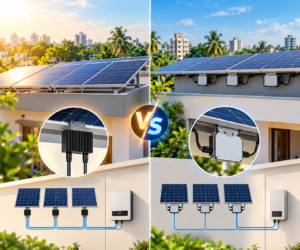
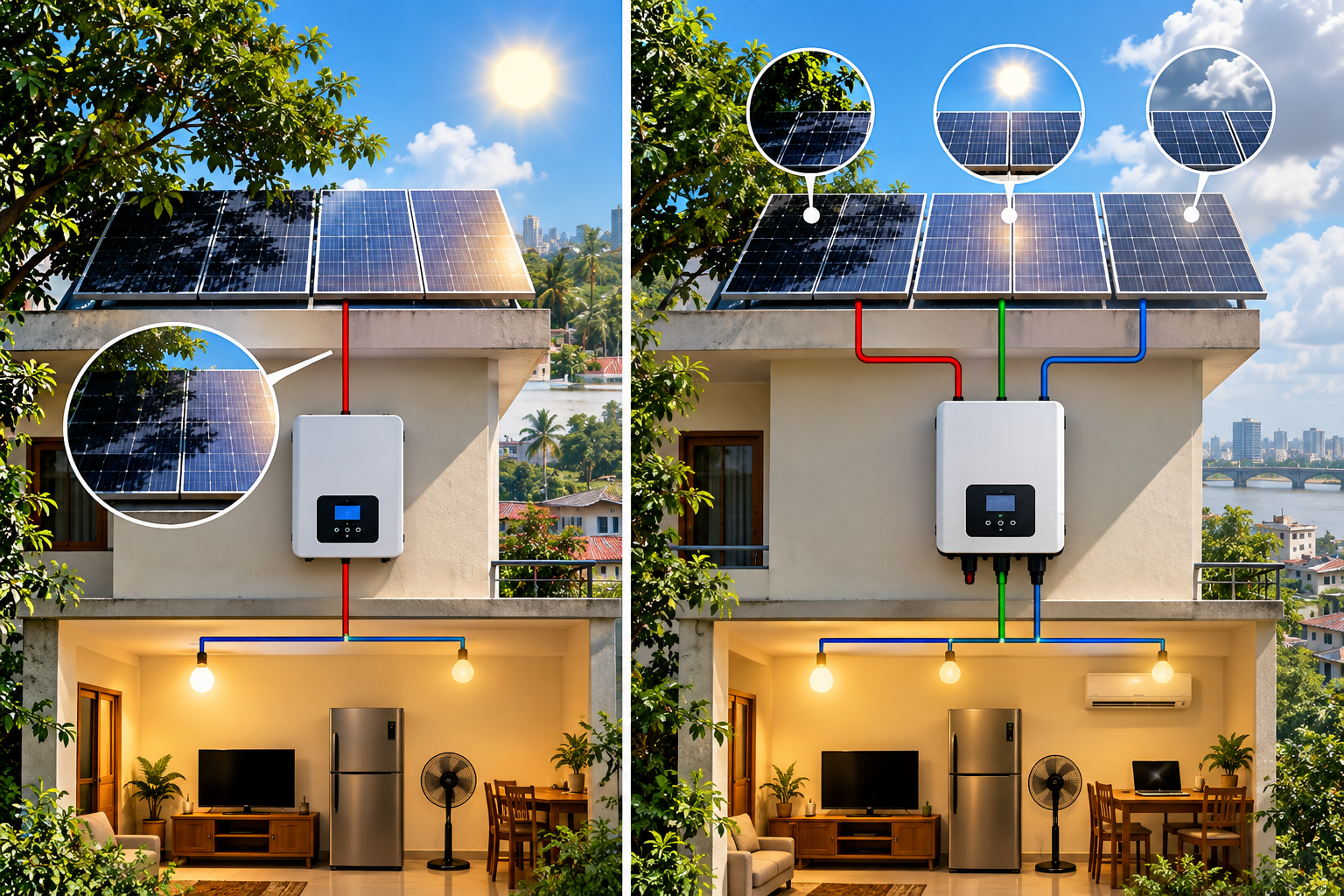
Here’s the short version: a single MPPT inverter uses one tracker to find the best operating point for your entire solar array. A multi-MPPT inverter uses separate, independent trackers for different strings of panels, so each group can be optimized on its own. If your roof faces one direction with no shade, single MPPT is usually all you need. If your roof has two orientations, partial shading, or panels split across sections, multi-MPPT starts to earn its keep.
The rest of this comes down to your specific rooftop, so let’s get into it properly.
What MPPT Actually Does (Quickly)
Every solar panel’s voltage and current shift constantly with sunlight and temperature. MPPT — Maximum Power Point Tracking — is the part of the inverter that continuously adjusts to squeeze the most usable power out of whatever the panels are producing at that moment.
A single-MPPT inverter treats every panel connected to it as one group, hunting for one “best” voltage across the whole array. A multi-MPPT inverter splits your panels into separate strings, each with its own tracker, so one string doesn’t have to compromise for the sake of another.
That’s really the whole concept. Everything else is about when that separation actually matters.
Single vs. Multi-MPPT: The Real Differences
| Single MPPT | Multiple MPPT | |
| Design flexibility | Needs uniform strings — same orientation, same tilt, similar panel count | Can mix orientations, tilt angles, even panel types across strings |
| Shading behaviour | One shaded string drags down the output of the whole array | Each string is tracked independently, so shading on one string doesn’t punish the others |
| Monitoring | You see array-level output only | You can see performance per string, which makes troubleshooting much easier |
| Upfront cost | Lower | Higher |
| Best suited to | Simple, single-facing, unshaded roofs | Complex roofs — multiple orientations, partial shade, split sections |
That comparison table covers most of what competing spec sheets tell you. What they usually leave out is the next part.
The Nuance Most Guides Skip
Here’s something worth knowing before you assume multi-MPPT is automatically the “better” choice: on large, uniform, completely unshaded arrays, some studies suggest single-MPPT inverters can actually achieve slightly higher overall conversion efficiency, simply because there are fewer internal conversion stages for the electricity to pass through.
That doesn’t mean single MPPT is secretly superior — it means that when your roof genuinely doesn’t need the flexibility of separate trackers, you might be paying extra for a feature that provides no real benefit and could, in rare well-documented cases, extract marginally less overall efficiency than a well-matched single-tracker design.
This is a general industry pattern, not a guaranteed outcome for every inverter model — treat it as one more reason to match the inverter to the roof rather than defaulting to “more trackers = more power.”
On the multi-MPPT side, the commonly cited energy gain in shaded or mixed-orientation conditions is in the range of 10–20% more usable energy compared to single MPPT. That figure comes from general industry data, not a Bangladesh-specific study, so think of it as a reasonable ballpark rather than a number you can plug into a savings calculation.
Does Your Roof Actually Need Multi-MPPT?
Run through this quickly:
- Does your roof face one direction only, with nothing casting shade on it at any point in the day? Single MPPT is probably fine, and you’ll save money without giving anything up.
- Do you have panels split across two roof sections facing different directions — say, part of the array facing east and part facing west, which is common when roof space is limited? Multi-MPPT lets each section run at its own optimum instead of forcing a compromise.
- Is any part of your array regularly shaded — by a water tank, a parapet wall, a satellite dish, or an adjacent building? A single shaded string on a single-MPPT system doesn’t just lose its own output; it can drag down the healthy strings too. Multi-MPPT isolates the damage.
- Do you need to monitor performance at a granular level — for troubleshooting, fault detection, or simply peace of mind that every part of the system is pulling its weight? Multi-MPPT gives you that visibility. Single MPPT only shows you the array as a whole.
If you answered “yes” to the shading or split-orientation questions, the extra upfront cost of multi-MPPT is usually money well spent. If your roof is simple and clean, you may be paying for flexibility you’ll never use.
Why This Matters More on Bangladeshi Rooftops Than You’d Think
This isn’t a topic where forcing in a city name adds anything — but the underlying issue is genuinely common here. A lot of rooftops in dense urban areas like Dhaka and Chattogram aren’t the clean, open, single-facing roofs you see in solar marketing photos. They’re flat roofs shared with water tanks, satellite dishes, and stairwell structures, often overshadowed on one side by a taller neighbouring building for part of the day.
Add to that the fact that usable roof space is frequently limited, so installers end up splitting an array across two differently oriented sections just to fit enough panels on. Neither of these situations is unusual, and both are exactly the scenario multi-MPPT was designed to handle well. If your roof looks like this, it’s worth asking your installer directly whether they’re quoting single or multi-MPPT, and why.
A Note on Hybrid Inverters
If you’re comparing hybrid inverters (grid-tied with battery backup) rather than pure grid-tie units, the same single-vs-multi-MPPT logic still applies — the tracker design doesn’t change just because a battery is involved. What does change is that hybrid systems are often sized and split for future expansion or partial backup loads, which can make multi-MPPT flexibility even more useful down the line. If you’re leaning hybrid, it’s worth reading through what a hybrid solar system actually involves before locking in an inverter spec.
Choose Single MPPT If…
- Your roof faces one direction with no meaningful shading, at any time of day
- You want to keep upfront cost as low as possible
- Your system is small and straightforward — one string, one orientation
- You don’t need per-string monitoring for troubleshooting
Choose Multi-MPPT If…
- Your panels are split across two or more orientations (e.g. east-west)
- Any part of your roof experiences regular partial shading
- You want granular, per-string performance monitoring
- You’re designing a commercial or industrial array with mixed roof sections or panel groups
- You expect to expand the system later and want the flexibility to add a differently-angled string
What This Looks Like for Larger Commercial and Industrial Sites
For a factory or commercial building with multiple roof sections — a common layout in industrial parks around Gazipur or Narayanganj — multi-MPPT isn’t really optional in most designs. Facility managers and EPC contractors are usually working with mixed orientations, staggered tilt angles, or arrays spread across several buildings, and per-string fault detection becomes genuinely useful for operations and maintenance rather than a nice-to-have. Diagnosing a single underperforming string quickly, without shutting down or inspecting the whole array, saves real time during routine O&M.
For that reason, most industrial-scale arrays lean multi-MPPT by default, and the decision tends to come down to how the strings are grouped and monitored rather than whether multiple trackers are worth having at all.
The Bottom Line
Neither option is universally “better” — they’re built for different roofs. A single-MPPT inverter is a perfectly sound, cost-effective choice for a simple, unshaded, single-orientation roof. A multi-MPPT inverter earns its higher price tag the moment your roof gets more complicated, whether that’s shading, split orientations, or a need for granular monitoring.
If you’re not sure which category your roof falls into, that’s a reasonable thing to ask an installer to assess properly rather than guess at from a spec sheet. A good installer — Muspana included — should be looking at your actual roof layout, shading pattern, and orientation before recommending either type, not defaulting to whichever inverter happens to be in stock.
FAQs
Do I need multi-MPPT for a small home solar system?
Not necessarily. If your roof faces one direction and has no shading, a single-MPPT inverter is usually sufficient and more cost-effective. Multi-MPPT becomes worthwhile when your roof has split orientations or partial shade.
Can a single-MPPT inverter handle shading at all?
It can operate under shading, but not well. Because a single-MPPT inverter tracks one voltage point for the entire array, a shaded string can pull down the output of the unshaded strings too. Multi-MPPT isolates each string so shading on one doesn’t penalize the rest.
Is multi-MPPT worth the extra cost?
It depends on your roof. For a simple, unshaded, single-orientation roof, the extra cost may not translate into meaningfully more energy. For a roof with shading or split orientations, the efficiency gain from independent tracking generally justifies the higher upfront price.
Does the number of MPPT trackers affect hybrid inverter systems too?
Yes. The single-vs-multi-MPPT trade-off applies to hybrid (battery-backed) inverters the same way it does to pure grid-tie inverters — the battery doesn’t change how the DC input trackers work.
Is single MPPT ever actually better than multi-MPPT?
On large, completely uniform, unshaded arrays, some studies suggest single-MPPT designs can be marginally more efficient overall, since the electricity passes through fewer internal conversion stages. This isn’t true for every system, but it’s a reasonable counterpoint to the assumption that more trackers always means more power.
How do I know if my roof is “complex” enough to need multi-MPPT?
If your panels are split across more than one orientation, or if any part of the array is shaded at any point during the day by things like water tanks, parapets, or nearby buildings, your roof likely qualifies. A straightforward, single-facing, shade-free roof usually doesn’t need it.