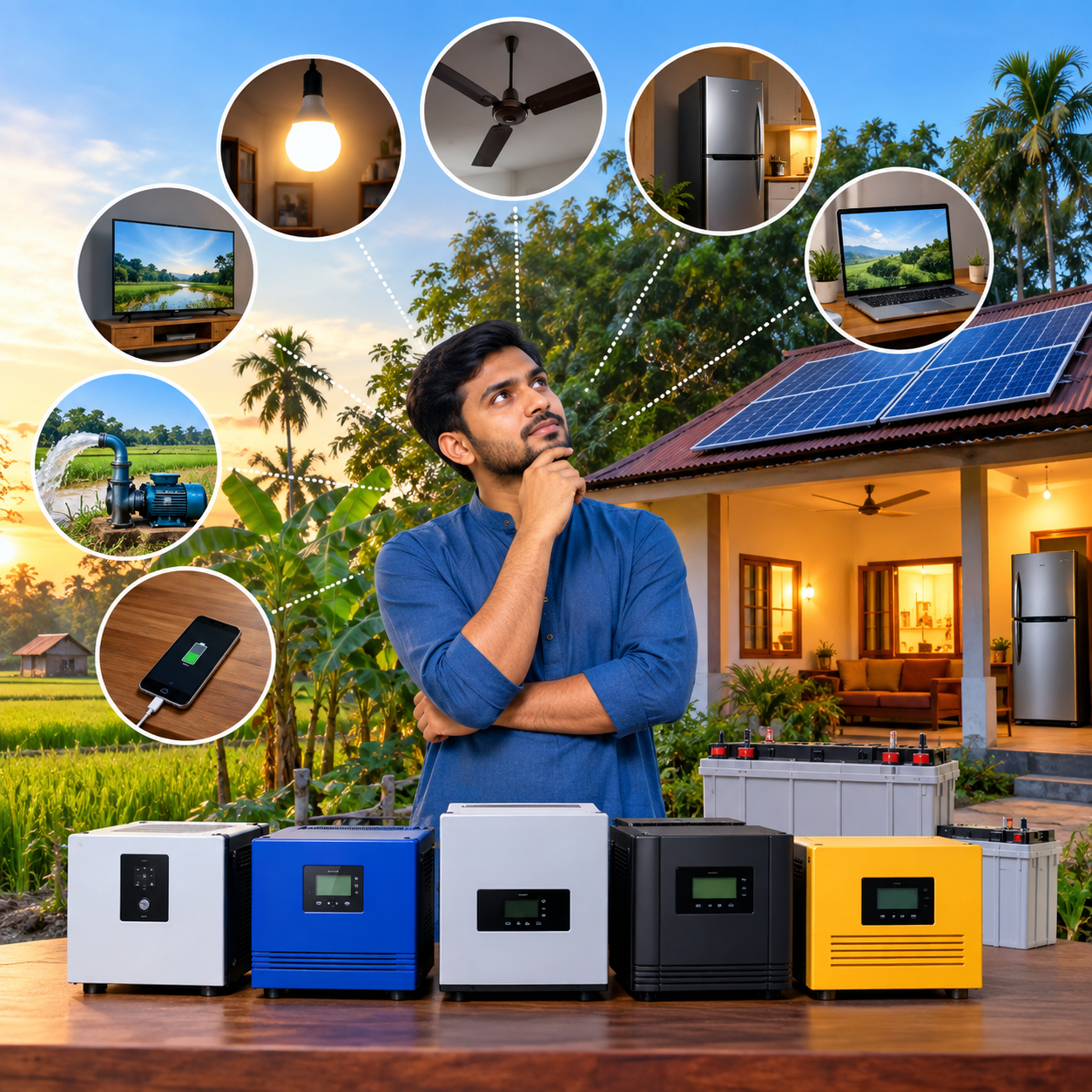
Why Most Off-Grid Inverter Purchases Go Wrong
Somebody buys an inverter rated for their “average” household load, feels good about the number on the box, and then the moment the refrigerator compressor or the water pump kicks in, the whole system trips and shuts down. It’s not a faulty inverter — it’s the wrong inverter for the job.
An off-grid inverter doesn’t just need to handle what your home or facility uses normally. It needs to survive the split-second spike when a motor starts, match the voltage of your battery bank, and keep running efficiently for years without draining your batteries just sitting idle. Get any one of those wrong, and you’ll either overpay for capacity you never use, or underbuy and watch your system fail exactly when load-shedding hits hardest.
This guide walks through the five things that actually determine whether an inverter is right for your setup, and gives you a real method to size one — not just a rule of thumb to guess with.
What an Off-Grid Inverter Actually Does
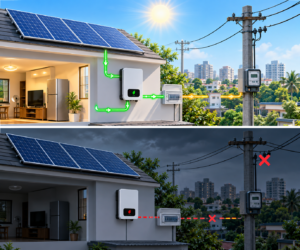
An off-grid inverter converts DC power stored in your batteries into the AC power your appliances use, and it does this entirely independent of the national grid. Unlike a grid-tied system, there’s no utility connection to fall back on — the inverter, battery bank, and (usually) solar input have to cover everything on their own, sometimes with a generator as backup.
That independence is exactly why sizing matters so much more here than with a grid-tied setup. If you undersize a grid-tied inverter, the grid quietly picks up the slack. Undersize an off-grid inverter, and there’s nothing behind it — the system just fails.
The 5 Things That Actually Determine the Right Inverter
| Factor | What It Means | Why It Matters |
| Continuous output | The steady wattage the inverter can supply indefinitely | Must comfortably exceed your normal running load, not just match it |
| Surge (peak) rating | Short-burst power for motor start-up | Refrigerators, pumps, and AC units can demand 2–3x their running wattage for a second or two |
| System voltage | 12V, 24V, or 48V DC input matching your battery bank | Wrong voltage means the inverter simply can’t connect to your batteries |
| Waveform | Pure sine wave vs modified sine wave | Modified sine can overheat motors and damage sensitive electronics over time |
| MPPT charge controller | Built-in solar charge tracking | Improves how much of your solar generation actually reaches the battery, especially useful given Bangladesh’s inconsistent grid voltage |
Continuous Output: Don’t Size to the Edge
As a general industry guideline, it’s common practice to size continuous output at around 125% of your expected peak load — enough headroom to avoid the inverter running flat-out and overheating. For a typical Bangladeshi household, that often lands somewhere in the 3kW–8kW range, though this varies a lot depending on whether you’re running ceiling fans and lights only, or a full kitchen plus air conditioning. Treat that range as a starting estimate, not a fixed number — your actual load list is what should decide it.
Surge Rating: The Part Most Buyers Skip
This is where most sizing mistakes happen. A refrigerator might run on 150W normally, but its compressor can briefly pull 450–600W the instant it starts. A water pump can spike even higher. If your inverter’s surge rating doesn’t comfortably clear the highest single starting load in your home — not the average, the highest — it’ll trip the moment that appliance kicks in, even if your continuous sizing was perfect.
System Voltage: Match It or It Won’t Work
Your inverter’s DC input voltage has to match your battery bank — 12V, 24V, or 48V. As a general pattern, 48V systems tend to be more efficient for anything above roughly 3kW, since higher voltage means lower current and thinner, cheaper cabling for the same power delivery. For smaller setups, 12V or 24V is usually simpler and less expensive to build out. There’s no universally “better” voltage — it depends on your system size.
Waveform: Why “Pure Sine Wave” Isn’t Just Marketing
A pure sine wave inverter produces power that closely mimics grid electricity. A modified sine wave inverter produces a rougher, stepped approximation. The difference matters because motors — in fridges, pumps, fans — are built to run on smooth AC. Feed them a modified sine wave for years, and they run hotter, less efficiently, and wear out faster. Sensitive electronics can behave erratically or get damaged outright. For anything beyond the most basic setup, pure sine wave is worth the extra cost.
MPPT: Getting More Out of the Same Solar Panels
An inverter with a built-in MPPT (Maximum Power Point Tracking) charge controller — ideally with multiple trackers if your panels face different directions — actively adjusts to pull the most usable power out of your solar array as conditions change through the day. In a market where grid voltage isn’t always stable, having efficient, well-regulated charging matters even more for protecting your battery bank long-term.
How to Actually Size Your Inverter: A Worked Example
Here’s a simplified sizing walkthrough. Treat the numbers below as an illustrative example — your own load list will differ.
Step 1 — List every device that might run at the same time, and its running wattage:
- Lights & fans: 300W
- Refrigerator: 150W running
- TV & router: 150W
- Water pump: 750W running
Total running load: 1,350W
Step 2 — Add a 15–20% safety margin for measurement error and future load growth. 1,350W × 1.2 ≈ 1,620W continuous requirement
Step 3 — Identify the highest single surge load. Here, the water pump’s start-up surge (roughly 2–3x its running wattage) is the largest — around 1,500–2,250W on its own, layered on top of whatever else is already running. Your inverter’s surge rating needs comfortable headroom above that combined figure, not just above the pump alone.
Step 4 — Match voltage to your battery bank. If you’re running a 24V battery bank, the inverter’s DC input must be 24V — no adapting around it.
Step 5 — Check efficiency and standby draw. Look for inverters rated above roughly 90% efficiency, with low standby (idle) consumption — ideally under 50W. During Bangladesh’s longer load-shedding stretches, an inverter that quietly drains your battery just sitting on standby adds up fast over hours.
This is roughly the process a system designer works through when sizing an inverter against a specific load list rather than a generic household average — and it’s worth doing properly before you buy, not after the first appliance trips it.
Home vs Industrial: The Surge Calculation Changes Everything
For a home, your biggest surge risk is usually the refrigerator or a small water pump. For a factory or commercial facility, it’s a different scale entirely — a 5HP irrigation or process pump, an air compressor, or multiple motors that could start in close succession. Industrial sizing needs a much wider surge margin and often benefits from staggered-start planning (not switching every motor on at once) rather than just buying a bigger inverter to brute-force the problem.
Bangladesh-Specific Considerations
Load-shedding is the real reason this matters. In markets with stable grids, off-grid sizing is mostly a rural or remote-property concern. In Bangladesh, it’s a daily reality for a huge share of homes and businesses — which is exactly why undersizing isn’t a minor inconvenience, it’s the system failing during the hours you need it most.
“IPS,” “UPS,” and “off-grid inverter” often get used interchangeably, but they’re not the same thing. An IPS is typically a simpler battery-backup unit without solar charging or the sizing flexibility of a proper off-grid inverter system. If you’re comparing quotes, make sure you’re actually comparing like-for-like equipment.
Grid voltage instability makes MPPT and surge headroom more valuable here than in markets with a consistently clean supply — your charging efficiency and your safety margin both matter more when the input conditions aren’t perfectly steady.
Apartment living adds its own constraints — shared meters, limited space for a battery bank, and sometimes building restrictions on where equipment can be installed. If that’s your situation, sizing conservatively and prioritizing a compact, efficient unit matters more than chasing maximum capacity.
Most off-grid inverters sold in Bangladesh are imported, so after-sales support and spare-part availability can vary meaningfully between suppliers — worth checking before you commit, independent of the spec sheet.
Common Mistakes to Avoid
- Sizing to average load, not peak surge — the average is almost never what trips the system
- Ignoring voltage matching — a mismatched inverter simply won’t function with your battery bank, no matter how good its specs are
- Choosing modified sine wave to save money — the long-term cost shows up in shortened appliance and motor lifespan
- Trusting nameplate specs exactly — manufacturer continuous/surge ratings can run optimistic; building in your own margin is safer than sizing right to the edge
- Overlooking standby consumption — a unit that’s efficient under load but wasteful at idle can quietly shorten your battery’s usable life over a load-shedding cycle
FAQs
What size off-grid inverter do I need for my home?
Most Bangladeshi households fall somewhere in the 3kW–8kW continuous range, but this depends entirely on what you run simultaneously. Add up your simultaneous running loads, add a 15–20% safety margin, and size to that — not to a generic average.
What’s the difference between an off-grid inverter and an IPS?
An IPS is generally a simpler battery-backup device, while an off-grid inverter is typically designed with more flexible sizing, solar charging integration, and higher surge handling for a wider range of appliances. Always confirm exactly what a quoted unit includes before comparing prices.
Why does my inverter trip when the fridge or pump starts?
This almost always means the inverter’s surge (peak) rating isn’t high enough for that appliance’s starting wattage, even if its continuous rating looked sufficient on paper. Refrigerators and pumps can briefly draw 2–3x their running wattage at start-up.
Is pure sine wave really necessary, or is modified sine wave good enough?
For basic lighting-only loads, modified sine wave can work. But for motors, refrigerators, and most modern electronics, pure sine wave prevents excess heat build-up and equipment wear over time — it’s generally worth the extra cost for anything beyond the simplest setup.
Should I choose a 12V, 24V, or 48V inverter?
It depends on your battery bank and system size. Smaller setups are often simpler on 12V or 24V, while systems above roughly 3kW tend to run more efficiently on 48V due to lower current and thinner cabling requirements. The inverter’s voltage must match your battery bank exactly.
Does an off-grid inverter help during load-shedding specifically?
Yes — a correctly sized off-grid inverter paired with a battery bank (and ideally solar charging) is one of the most direct ways to keep power running through load-shedding hours, since it doesn’t depend on the grid being available at all.