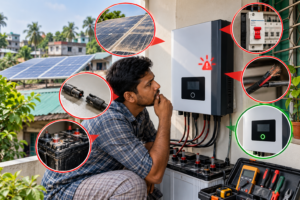
A panel on a rooftop in Narayanganj starts producing noticeably less power in year six. No cracks, no visible damage — it’s just quietly underperforming. The homeowner calls the installer. The installer says it’s a manufacturer issue. The manufacturer’s regional office says the installer should have flagged it during commissioning. Two months later, nobody has fixed anything, and the homeowner still doesn’t know who’s actually supposed to pay.
This is the exact situation a solar warranty is supposed to prevent — and it’s also exactly where most warranty explanations fall short. They tell you the warranty exists. They rarely tell you who to call, what you’re actually owed, or what happens when the company that sold you the system isn’t around anymore.
There isn’t one solar warranty. There are three, and they come from two different parties.
The Three Warranties, at a Glance
| Warranty type | Who provides it | What it actually covers | Typical duration |
| Product warranty | Panel manufacturer | Manufacturing defects — glass, frame, delamination, faulty cells | 10–25 years |
| Performance warranty | Panel manufacturer | Minimum power output over time (degradation) | 25–30 years |
| Workmanship warranty | Your local installer | Installation quality — mounting, wiring, roof penetrations | 1–25 years (installer’s choice) |
Two of these three come from the manufacturer. Only one comes from whoever physically put the system on your roof. That distinction matters more than almost anything else in this article, so it’s worth sitting with before you go further.
Product Warranty: What Happens if a Panel Itself Is Faulty
A product warranty is the manufacturer standing behind the physical panel — the glass, the frame, the internal wiring, the junction box. If a panel arrives with a manufacturing flaw, or develops one from a defect rather than wear, this is the warranty that applies.
Industry-standard ranges here run roughly 10 to 15 years on standard panels, with premium tier-1 modules increasingly offering 20 to 25 years. These are figures reported broadly across manufacturers rather than a single universal number — the actual term depends entirely on the brand and model you buy, so it’s worth asking your installer to show you the manufacturer’s warranty document itself rather than taking a verbal estimate.
One detail that gets lost in most explanations: the product warranty usually covers the part, not the labour to remove, ship, and reinstall it. In Bangladesh specifically, most panel manufacturers are based overseas without a local branch office, which means a defective-panel claim typically has to go through your installer or a regional distributor rather than the manufacturer directly. That’s not necessarily a problem — but it’s a reason the reputation and responsiveness of your local installer matters even for a warranty that technically comes from someone else entirely.
Performance Warranty: The Promise About Output, Not the Panel Itself
Every solar panel loses a small amount of output capacity every year — that’s normal degradation, not a defect. A performance warranty guarantees that the loss won’t happen faster than a stated rate.
Standard industry figures guarantee something in the range of 80–92% of original output at the 25 to 30-year mark, with premium panels holding degradation as low as 0.25–0.5% per year. As an example only: a panel starting at 400 watts, degrading at roughly 0.5% a year, would still be producing somewhere around 350 watts after 25 years. That’s an illustrative calculation, not a promise for any specific product — actual degradation curves vary by manufacturer, panel technology, and local operating conditions like heat and humidity.
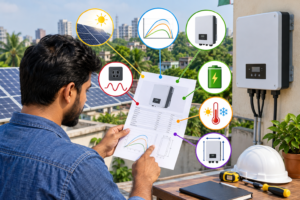
This is also where monitoring matters in practice. A performance warranty is only useful if you can actually prove your system is underperforming, which means having some way to track output over time rather than only noticing a problem once your electricity bill looks unusually high.
Workmanship Warranty: The One That’s Genuinely Different
This is the warranty that comes from your installer, not the manufacturer, and it’s the one most quote comparisons skip over too quickly.
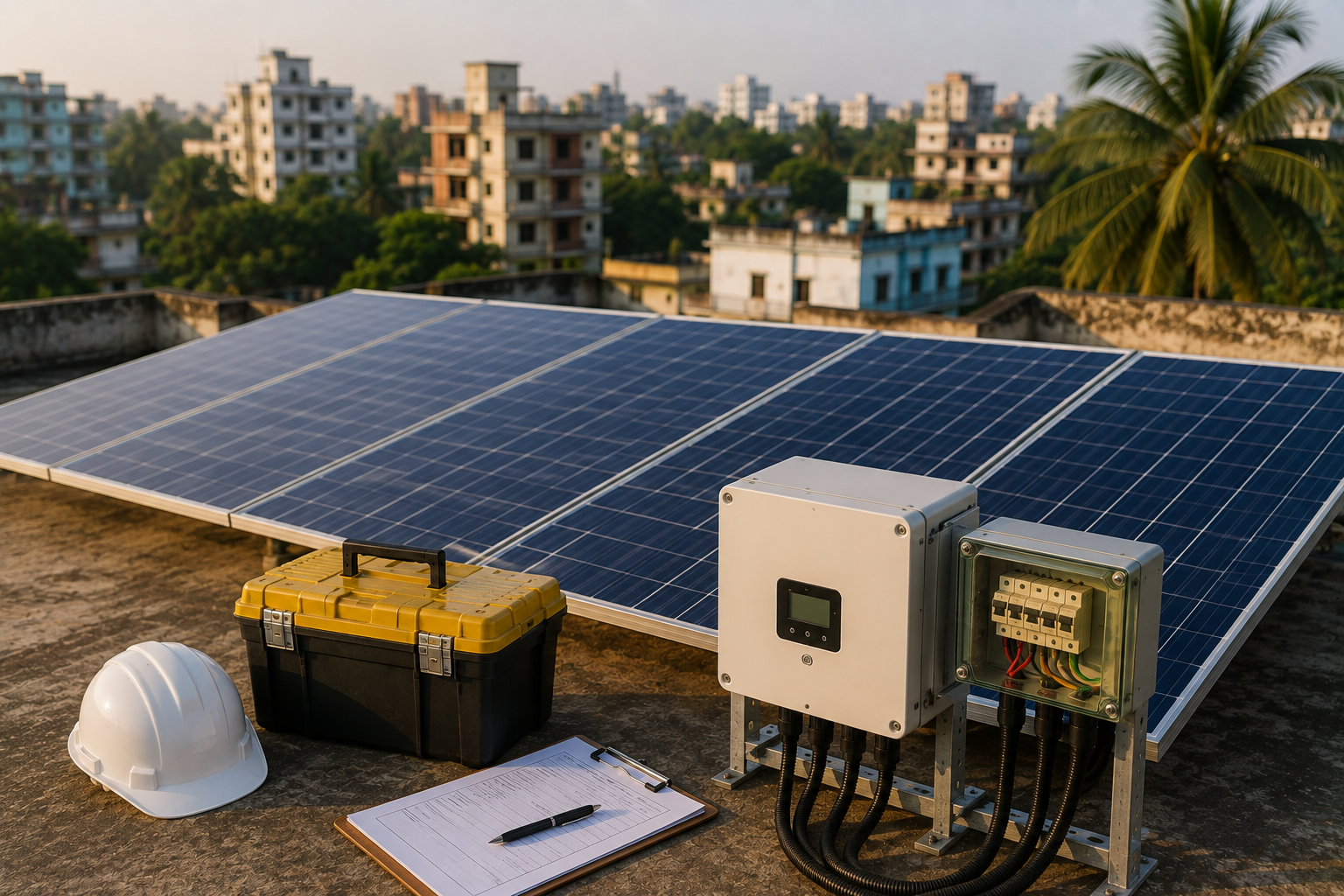
A workmanship warranty covers installation quality — how the panels were mounted, how the wiring was run, whether roof penetrations were properly sealed. Roof leaks, loose connections, and mounting failures generally trace back to workmanship, not the panel itself, and they tend to show up in the first few years: a poorly sealed penetration often reveals itself in the first heavy monsoon season, not immediately at handover.
Here’s the part worth taking seriously: unlike the product and performance warranties, a workmanship warranty dies if the installer’s business does. If a manufacturer goes out of business, the panel itself may still be covered by a successor or industry program in some cases. If your installer closes down, their workmanship warranty simply stops existing — there’s no equivalent industry-wide backstop.
In markets with dozens of large, decades-old solar installers, this “orphaned warranty” risk gets mentioned as one consideration among several. In Bangladesh, where the rooftop solar installation sector is newer and considerably more fragmented, it deserves to be treated as one of the most important things you evaluate before signing anything — arguably more important than squeezing out a slightly longer warranty term on paper. A 15-year workmanship warranty from a company likely to still exist in 15 years is worth more than a 25-year warranty from one that might not survive the next five.
What a Longer Workmanship Warranty Term Doesn’t Guarantee
It’s worth being blunt about this trade-off: term length and reliability are two different things. A written 20-year workmanship warranty is only as good as the installer’s ability to still be operating, staffed, and reachable when you need them. There’s no way to fully de-risk this, but there are things you can check.
What to Ask Before You Sign
Before signing a solar quote in Bangladesh, it’s worth asking for these in writing — not verbally promised, actually written into the contract or a separate warranty document:
- How many years is the workmanship warranty, specifically, separate from the panel warranty?
- Does the workmanship warranty cover labour costs for manufacturer-side claims, or only the installation itself?
- How long has the installer been operating, and are they an authorised distributor for the panel brand they’re quoting?
- What happens to warranty support if the installer stops trading — is there any third party or manufacturer-backed program that takes over?
- Is the inverter warranty the same length as the panel warranty, or shorter? (It’s almost always shorter, and inverters fail more often than panels do.)
- Is the warranty transferable if you sell the property?
This is the kind of documentation a reputable installer — including Muspana — should be willing to hand over without hesitation. If a company is reluctant to put warranty terms in writing, that reluctance is itself useful information.
If Something Actually Goes Wrong
When a panel underperforms or an installation issue shows up, the practical steps are the same regardless of which warranty applies:
- Document it first. Photos of the issue, a note of when it started, and — if you have one — output data from a monitoring system.
- Contact your installer, not the manufacturer, first. Even for a product-warranty issue, your installer is usually the one who files the claim on your behalf, especially where the manufacturer has no local office.
- Have your paperwork ready. Keep the original installation contract, the warranty documents, and — critically — a record of the panel model and serial numbers. If one panel among many fails years later, the serial number is what lets anyone identify which one it actually is.
- Ask for a timeline in writing. A reasonable installer will tell you roughly how long a claim takes to process rather than leaving it open-ended.
None of this guarantees a fast resolution — claims in any market can take weeks — but it puts you in a position to actually push the process along instead of waiting and hoping.
Home vs Industrial: Does the Warranty Structure Change?
The three-warranty structure itself is the same for a home rooftop system and a factory installation. What changes is what’s at stake. For a household, a warranty dispute is inconvenient and can mean weeks of lost savings on your electricity bill. For a factory or commercial facility relying on solar for part of its captive power, downtime has a direct cost, which makes the “what happens if my installer disappears” question even more relevant during procurement — it’s worth treating installer stability as a genuine risk-assessment line item, not just a comfort factor, when the system is powering business operations.
Solar warranties aren’t complicated once you separate who’s promising what. The manufacturer stands behind the panel and its output. Your installer stands behind the job they did putting it on your roof — and that promise is only as durable as the company making it.
FAQs
What are the three types of solar panel warranty?
Product warranty (covers manufacturing defects, from the panel maker), performance warranty (guarantees minimum power output over time, also from the panel maker), and workmanship warranty (covers installation quality, from your local installer).
How long should a solar workmanship warranty be?
There’s no fixed rule, but many installers offer somewhere between 5 and 10 years at minimum, with some offering longer. The term matters less than whether the installer is likely to still be operating when you’d need to use it.
What happens if my solar installer goes out of business?
The workmanship warranty typically ends with the company, since there’s no manufacturer or third party backing it. Product and performance warranties on the panels themselves may still be valid if the manufacturer is still operating, though you may need to find a different installer to help file the claim.
Does a solar warranty cover labour costs?
Often not automatically. Manufacturer warranties on the panel usually cover the part, not the cost of a technician removing and reinstalling it. It’s worth asking your installer directly whether labour is included for warranty-related repairs.
Is a solar panel warranty transferable to a new property owner?
In many cases, yes, but this varies by manufacturer and installer. Confirm transferability in writing before you sign if you think you might sell the property later.
Is the inverter covered under the same warranty as the panels?
Usually not. Inverters typically carry a separate, shorter warranty than the panels themselves, and they’re one of the more common points of failure in a solar system, so it’s worth checking this term specifically rather than assuming it matches the panel warranty.