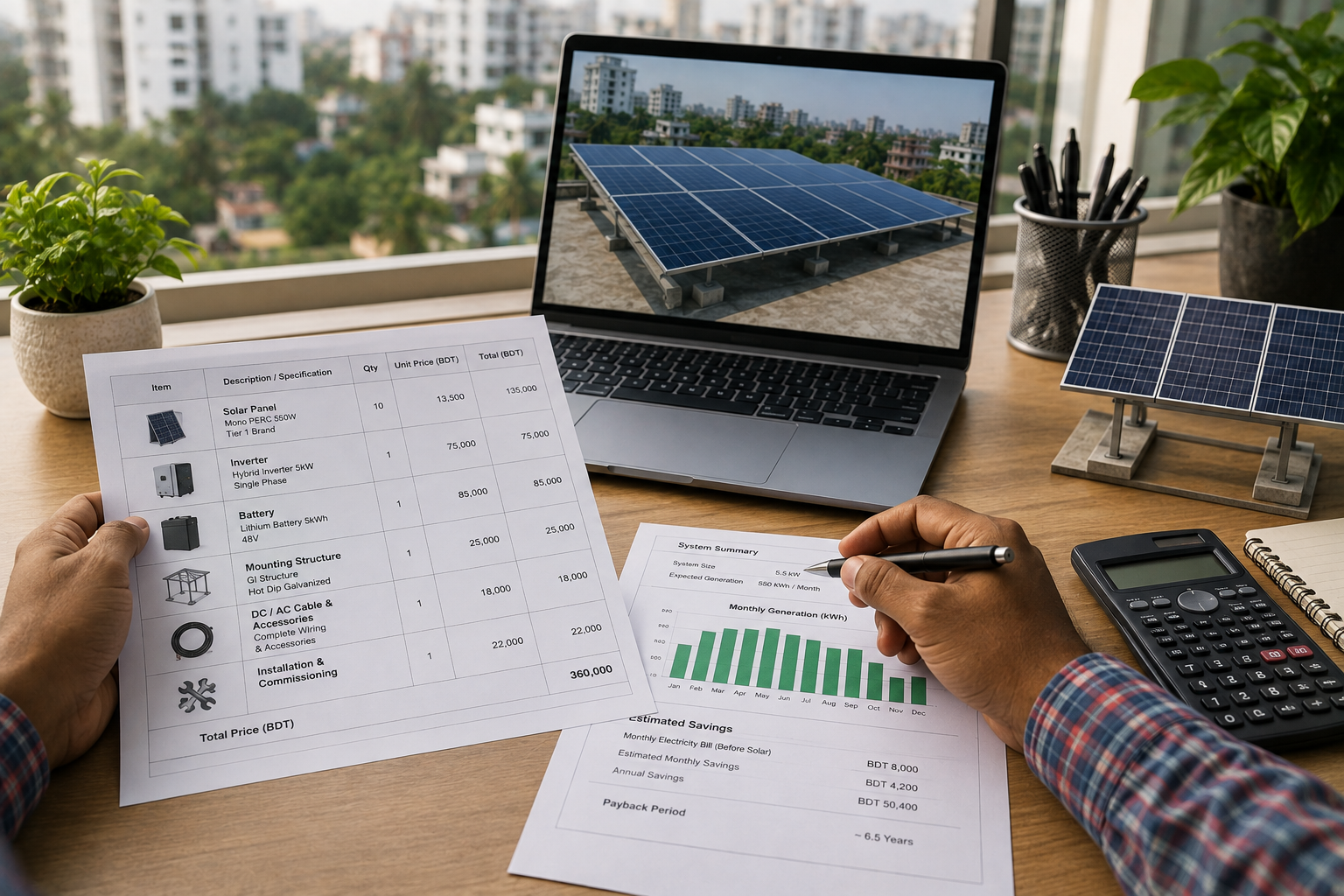
You Have a Solar Quote in Hand. Now What?
Somebody has just handed you a number — maybe ৳1,40,000 for a 1kW system, maybe ৳3,50,000 for something bigger with battery backup — and you’re supposed to decide whether it’s fair. Most people getting a solar quote for the first time have no real way to check it. You’re not an electrician. You don’t know what a “tier-1 panel” actually means, or whether the inverter brand they mentioned is any good. You just know it’s a lot of money, and you don’t want to find out in two years that you paid for something you didn’t get.
That’s the position this article is written for. Not “should you go solar” — you’re past that. This is about reading a specific quote sitting in front of you and knowing which parts deserve a second look.
What a Trustworthy Quote Actually Looks Like
Before getting into what’s wrong, it helps to know what right looks like. A solid solar quote in Bangladesh should tell you, in writing:
- The exact panel brand and model, along with its rated wattage
- The inverter brand, model, and whether it’s a standard grid-tied unit or a hybrid inverter with battery support
- Battery brand and capacity, if backup is included
- Total system size in kW, and how many panels that translates to
- A full price breakdown — panels, inverter, battery, mounting structure, cabling, labour, and any net-metering or approval-related fees, listed separately rather than lumped into one number
- Warranty terms for each component individually, not just “warranty included”
- Whether the price is cash price, and if EMI is offered, what the total repayment comes to
If a quote is missing more than one or two of these, that’s already worth asking about. Not necessarily a scam — some smaller installers are just sloppy with paperwork — but worth a direct question before you pay anything.
Vague Equipment Specs Are the First Warning Sign
“High-efficiency panels” and “premium inverter” are not specifications. They’re marketing language sitting where a model number should be.
A legitimate installer will name the actual panel manufacturer — names like Jinko, Trina, JA Solar, Longi, REC, or Canadian Solar show up regularly in the Bangladeshi market as recognised tier-1 brands — along with the wattage rating (for example, a 450W monocrystalline panel) and the inverter’s brand and model. If a quote just says “quality panels” without naming a brand, ask directly which brand and model they’re quoting. If the answer is vague or keeps changing, that’s your answer.
This matters more in Bangladesh than it might elsewhere, because the market has a real problem with unbranded or relabeled panels being sold as premium tier-1 product. A panel with no verifiable brand behind it might work fine for a while, but if it fails early, there’s no manufacturer to actually honour a warranty claim against.
If the Savings Numbers Look Too Good, They Probably Are
Watch closely how an installer calculates your projected monthly savings. A few things inflate that number without you noticing:
- Assuming your electricity rate will keep rising every year at a rate that makes the long-term savings look dramatic
- Ignoring shade from a neighbouring building, a water tank, or trees on your roof
- Using your total roof area rather than the usable, unshaded portion
Ask the installer to show you the assumptions behind the savings figure, not just the final number. If they can’t explain how they got there, that’s worth pausing on.
Pressure to Sign Today Is Not Normal Here Either
“This price is only good if you sign today” is a sales tactic wherever it shows up, and Bangladesh is no exception. A serious installer can hold a quoted price for at least a couple of weeks — there’s no legitimate reason a fair price needs to expire by tomorrow evening. If someone’s pushing hard for an immediate signature, or dangling a “free upgrade” that disappears the moment you ask for time to compare quotes, slow down. The installer who’s still there next week is usually the one you want anyway.
EMI Offers That Don’t Show You the Real Total
Solar in Bangladesh is mostly paid for in cash, through an installer’s own instalment arrangement, or through a personal bank loan — there isn’t a standardised consumer solar loan product the way there is in some other markets. That actually makes this red flag more important to check, not less, because the terms vary so much from one installer to the next.
If someone offers “easy EMI at ৳X per month,” ask for the total amount you’ll repay over the full term, not just the monthly figure. Compare that total against the cash price. If the gap is large, the difference is the actual cost of that “easy” financing, and you’re entitled to know it before agreeing to anything.
No One Has Actually Seen Your Roof
A quote built entirely from a phone call or a satellite image, with no one visiting your home, is missing something important. Roof condition, structural strength, shading from nearby buildings, and the distance from your roof to your meter box all affect both the price and how well the system will actually perform. None of that can be judged from a photo.
If an installer is willing to give you a final price without ever seeing your roof in person, ask yourself what else they might be guessing at.
Subsidy and “Government Scheme” Claims That Don’t Hold Up
There’s no blanket national tax credit for residential solar buyers in Bangladesh the way some other countries have run in the past. If a salesperson tells you that a big chunk of your system cost will come back through a government subsidy or a special scheme, ask them to show you exactly which scheme, in writing, and what you need to qualify. Genuine incentive programmes do appear from time to time — sometimes tied to specific lenders or development programmes — but they’re specific, documented, and don’t apply to every buyer automatically. A vague reference to “government support” with no name attached to it is not something to base your decision on.
Net Metering Paperwork That’s Missing or Vague
This is one of the most Bangladesh-specific things to check, and it’s the one most red-flag checklists written for other markets miss entirely. If you want to feed excess power back to the grid, your system needs approval through your local utility — DESCO if you’re in their coverage area, BPDB or your regional PBS elsewhere. That approval takes real time, and it’s a separate process from the installation itself.
A quote that promises “instant grid connection” or doesn’t mention net-metering approval at all is skipping over a step that could delay when you actually start seeing savings. Ask directly: who handles the net-metering application, how long does it typically take, and is that cost included in the quoted price or separate?
A Quick Way to Compare Quotes
| What a trustworthy quote includes | What a red-flag quote looks like |
| Named panel brand, model, and wattage | “High-efficiency panels” with no brand |
| Named inverter brand and type (grid-tied or hybrid) | Inverter not specified or “premium inverter” |
| Itemised price by component | One lump-sum number |
| Clear cash price vs. EMI total | EMI monthly figure with no total shown |
| Physical site visit before final pricing | Quote based only on a call or satellite image |
| Net-metering process and timeline explained | No mention of grid approval at all |
| Warranty listed per component | “Full warranty included” with no detail |
| Time to consider and compare | Pressure to sign the same day |
If You’re Evaluating a Quote for a Factory or Commercial Building
Everything above still applies, but a commercial or industrial quote carries a few additional things worth checking. Per-watt pricing usually drops as system size increases, so a large rooftop quote should reflect that scale rather than simply multiplying a residential per-watt rate. Ask whether the quote includes a structural assessment for the additional roof load a larger array adds, since factory roofs weren’t necessarily designed with that in mind. And ask specifically what’s covered under an operations and maintenance (O&M) arrangement — cleaning schedule, response time for faults, and who’s responsible for monitoring performance over the system’s life. A commercial quote with no O&M terms at all is leaving out something you’ll want answered before, not after, installation.
What to Do Once You’ve Spotted a Red Flag
Finding one red flag doesn’t automatically mean an installer is dishonest — sometimes it just means the quote was put together quickly and needs a follow-up question. What matters is asking directly, in writing, and seeing how they respond. A legitimate installer will answer specifics — brand names, total EMI cost, who handles net-metering — without getting defensive or vague. If you get evasive answers, or the story changes when you ask twice, get a second quote from someone else and compare.
Muspana puts together itemised quotes with named components and a physical site visit before finalising pricing, and can walk through net-metering requirements as part of that process — worth keeping in mind as a comparison point if you’re weighing multiple quotes side by side.
FAQs
Is a cheap solar quote always a scam in Bangladesh?
Not necessarily. A lower price can come from bulk sourcing, a promotional period, or a smaller markup — but it can also mean unbranded components or a missing item like mounting structure or cabling. Ask what’s included before assuming either way.
Do I need government approval to install solar at home in Bangladesh?
Off-grid systems generally don’t require utility approval. If you want to connect to the grid and feed excess power back (net metering), you’ll need approval through DESCO, BPDB, or your regional PBS, depending on where you live.
What warranty should a solar quote include?
Look for separate warranty terms for the panels (often the longest), the inverter, and the battery if one is included, rather than a single blanket “warranty included” statement with no component breakdown.
Does solar still work during load shedding?
A standard grid-tied system typically shuts off during a grid outage for safety reasons. If backup power during load shedding matters to you, you need a hybrid inverter paired with a battery — make sure the quote specifies which type of system you’re actually getting.
How long does net-metering approval take in Bangladesh?
It varies by utility and case load, and can take a few weeks. Ask your installer for their typical timeline and whether they handle the application on your behalf.