Solar Project Timeline in Bangladesh: From Site Survey to Commissioning
Most people assume the panels are the slow part. They’re not. Mounting a rooftop system on an average home takes an installer two to three days. What actually stretches a solar project out — sometimes by months — is everything around the panels: the survey, the design sign-off, the equipment lead times, and above all, the paperwork with your electricity utility.
If you’ve been quoted a suspiciously fast timeline, or you’re trying to figure out why your neighbor’s system took six months when the salesman promised six weeks, this is the part nobody explains clearly. So let’s go through it stage by stage, with the Bangladesh-specific detail that actually determines how long you’ll wait.
One more thing before we start: this is written for rooftop residential and commercial/industrial solar — the kind most Bangladeshi homes, factories, and institutions install. Utility-scale solar farms follow a completely different, much longer process, and if that’s what you’re researching, most of the numbers below won’t apply to you.
The short answer
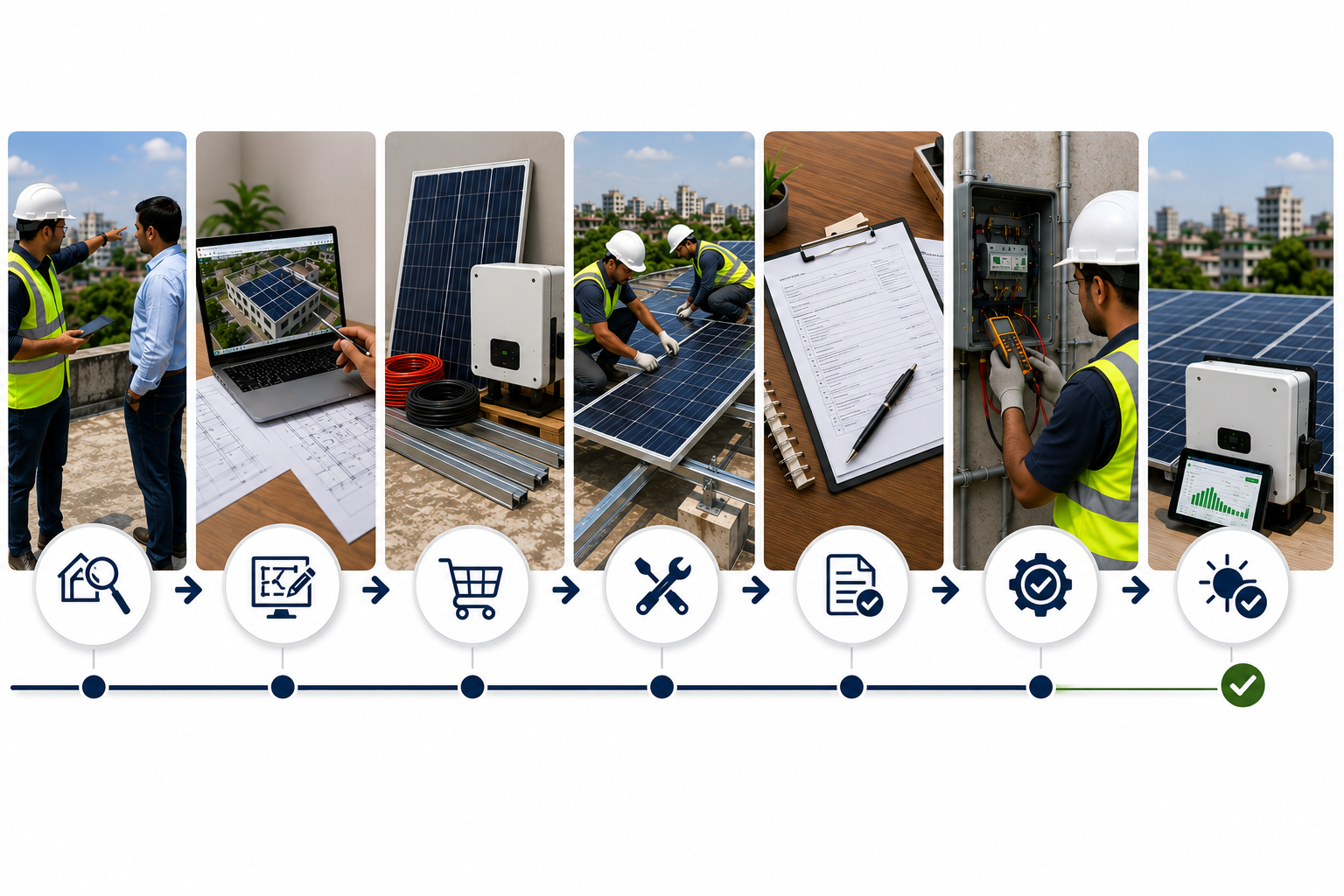
For a typical home, expect roughly 6 to 10 weeks from your first site visit to a working, grid-connected system — assuming no major delays with your distribution utility. For a commercial or industrial system, plan for 3 to 6 months, mostly because of larger equipment orders, more detailed engineering, and a longer utility inspection process. Both estimates assume the net metering application goes smoothly. It doesn’t always.
Site survey and feasibility: 1–2 weeks
This is where an engineer visits your roof, your factory floor, or your compound and actually looks at what you have to work with. They’re checking:
- Roof condition, orientation, and shading (a neighboring building or water tank can quietly cut your output)
- Available roof area against your electricity consumption and sanctioned load
- Structural capacity — can the roof carry the mounting weight, and does it meet Bangladesh National Building Code (BNBC) 2020 wind load provisions, which matter more than most homeowners realize in cyclone-exposed areas
- Your existing electrical setup, including your meter type and connection
For a home, this is usually a single visit. For a factory or commercial building, it can take a couple of visits, particularly if there’s existing rooftop equipment (water tanks, AC condensers, satellite dishes) that needs to be worked around.
What you can do to speed this up: have your latest electricity bill ready, know your sanctioned load, and mention any planned roof work (waterproofing, tank installation) before the survey, not after the design is finalized.
Design and engineering: 1–2 weeks
Once the survey is done, the installer designs the actual system — panel layout, inverter selection, wiring, and mounting structure. In Bangladesh, this stage also produces the single line diagram (SLD), which is the document your electricity utility will demand before approving anything.
The SLD has to show the full electrical path — from the panel array, through the inverter, to the AC panel and the bidirectional meter, then to the grid — and it has to match your actual sanctioned load. This sounds like a formality. It isn’t. A significant share of net metering application delays trace back to a sizing mismatch or an incomplete SLD that gets bounced back for revision. Getting this right the first time is one of the more overlooked ways an installer actually earns their fee.
Procurement: 2–6 weeks
Once the design is approved internally, equipment gets ordered: panels, inverter, mounting rails, cabling, and the bidirectional meter. Two things matter here that are easy to miss:
- Every panel and inverter must appear on SREDA’s approved product list (checkable at solar.sreda.gov.bd) and meet Bangladesh Standards or equivalent IEC standards. Using an unlisted brand — even a perfectly good one — is a fast way to get your net metering application rejected outright.
- Most solar equipment in Bangladesh is imported, so procurement time depends heavily on what’s already in-country stock versus what needs to be brought in. This is one reason installers who manufacture or assemble components domestically — Muspana, for instance, builds its own charge controllers, inverters, battery chargers, and solar water pumping systems in-country rather than relying entirely on imports — can sometimes move faster on this stage than installers waiting on a shipment from abroad.
Residential systems, being smaller, usually source faster. Larger commercial and industrial orders take longer simply because of quantity and, occasionally, custom mounting requirements.
Installation: 2–3 days (residential), 1–3 weeks (commercial/industrial)
This is the part everyone pictures, and it’s genuinely the fastest stage. For a home, a trained crew can typically complete mounting, wiring, and inverter setup in two to three days. Larger commercial or industrial installations take longer purely because of scale — more panels, more strings, more electrical work — not because the process itself is more complicated per panel.
Earthing and lightning protection get installed at this stage too, and they matter more than they sound like they would. Panel frames and the inverter’s protective earth conductor need separate earthing from your building’s existing system — another detail utility inspectors specifically check for, and another common point of rejection when it’s skipped or done incorrectly.
Net metering application and utility approval: this is where the real waiting happens
Here’s the stage that most solar articles — written for the US, UK, or Australia — simply can’t help you with, because Bangladesh’s process is genuinely different. Under the Net Metering Guidelines 2025, which replaced the older 2018 framework, this is roughly how it plays out:
- You apply to your distribution utility — one of six: BPDB, BREB, DESCO, DPDC, WZPDCL, or NESCO, depending on where you’re connected. You’ll need the SLD, system capacity calculations, and confirmation that you have no outstanding electricity dues.
- The utility reviews and approves your application against your sanctioned load.
- You install the system — you’re generally given up to 8 months from approval to complete installation, which is a generous window meant to account for procurement delays, not an invitation to drag your feet.
- The utility inspects and tests the completed system against technical standards.
- You sign the final Net Metering Agreement, which happens within 15 working days of a successful inspection. That signing date becomes your Commercial Operation Date (COD) — officially, the day your system starts counting.
Two 2025 changes worth knowing about, because they change who this applies to. First, the eligible sanctioned-load allowance for net metering rose from 70% to a full 100%, meaning you can size a system closer to your actual usage. Second, and more significant: for many new residential, commercial, industrial, educational, and healthcare buildings — particularly those with more than roughly 92.2 square metres of roof area, and for load increases above about 10 kW on a three-phase connection — net-metered solar isn’t optional anymore. It’s a condition of getting the grid connection or the load increase approved in the first place. If you’re planning to expand your factory’s electricity load, this is worth knowing before you assume solar is a nice-to-have.
A caveat worth being upfront about: these figures are drawn from how solar installers and industry publications are currently describing the 2025 guideline, not from the original government gazette directly. The broad strokes — mandatory solar for larger new connections, the 8-month installation window, the 15-working-day signing period — are consistent across multiple sources, but if you’re making a firm business decision around a specific threshold, it’s worth confirming the exact figure with your distribution utility or SREDA directly, since local implementation can vary.
What usually causes delays
Almost none of the common delays come from the physical installation. They come from paperwork and sequencing:
- SLD errors or omissions — the single most cited reason utility engineers send applications back for revision
- System sizing that exceeds your sanctioned load — caught during utility review, requiring a redesign
- Non-SREDA-approved equipment — an easy mistake if you’re price-shopping without checking the approved list
- Outstanding electricity bills — applications are effectively frozen until dues are cleared
- Incomplete earthing documentation — a small paperwork gap that can hold up final inspection
Notice what’s not on that list: the panels themselves. If your project is running late, it’s almost never because installation is slow. It’s because one of the five items above wasn’t handled correctly the first time.
Residential vs. commercial/industrial: how the timeline differs
| Stage | Residential | Commercial/Industrial |
| Site survey | 1 visit, ~1 week | 1–2 visits, 1–2 weeks |
| Design & SLD | 3–7 days | 1–2 weeks |
| Procurement | 2–3 weeks | 3–6 weeks |
| Installation | 2–3 days | 1–3 weeks |
| Utility approval to COD | Weeks to a few months, utility-dependent | Often longer — larger systems draw more scrutiny during inspection |
| Realistic total | ~6–10 weeks | ~3–6 months |
These are typical ranges, not guarantees — your actual timeline depends on your specific utility’s current processing load, how complete your application is the first time, and whether your equipment is in local stock.
Where an experienced installer actually changes the outcome
A lot of what determines your total timeline isn’t the installer’s speed with a wrench — it’s whether they get the SLD and sizing right the first time, whether they’re sourcing SREDA-listed equipment that’s actually available, and whether they know your specific utility’s inspection quirks. Muspana has handled net-metered rooftop projects for institutional clients, including hospitals and government facilities, where the approval process tends to be more layered than a straightforward residential application — the kind of experience that mostly shows up as “the paperwork didn’t bounce back twice,” which isn’t glamorous, but it’s the whole game.
FAQs
Do I need government approval to install solar in Bangladesh?
Yes, if you want to connect your system to the grid through net metering — which most homeowners and businesses do. You’ll need approval from your distribution utility (BPDB, BREB, DESCO, DPDC, WZPDCL, or NESCO) before and after installation, plus equipment that’s on SREDA’s approved product list.
Is solar mandatory for my building now?
Under the Net Metering Guidelines 2025, net-metered solar is required for many new residential, commercial, industrial, educational, and healthcare buildings — particularly those with larger roof areas or those increasing their sanctioned load above certain thresholds on a three-phase connection. Whether it applies to your specific building is worth confirming directly with your utility, since the requirement depends on your exact load and roof size.
Which utility do I apply to for net metering?
Whichever distribution utility currently supplies your electricity connection: BPDB, BREB, DESCO, DPDC, WZPDCL, or NESCO. You can’t choose a different one.
What usually causes net metering application delays?
The most common causes are an incomplete or incorrect single line diagram, a system sized larger than your sanctioned load, equipment that isn’t on SREDA’s approved list, outstanding electricity bills, and incomplete earthing documentation. Installation speed itself is rarely the bottleneck.
What is the Commercial Operation Date (COD)?
It’s the official date your net-metered solar system starts operating under your agreement with the utility — set on the day you sign the final Net Metering Agreement, which happens within 15 working days of a successful post-installation inspection.
How long does the whole process take from start to finish?
For a typical home, roughly 6 to 10 weeks if everything goes smoothly. For a commercial or industrial system, plan for 3 to 6 months, mainly due to larger procurement orders and a more involved utility inspection process. Both figures assume no rejections or resubmissions along the way.