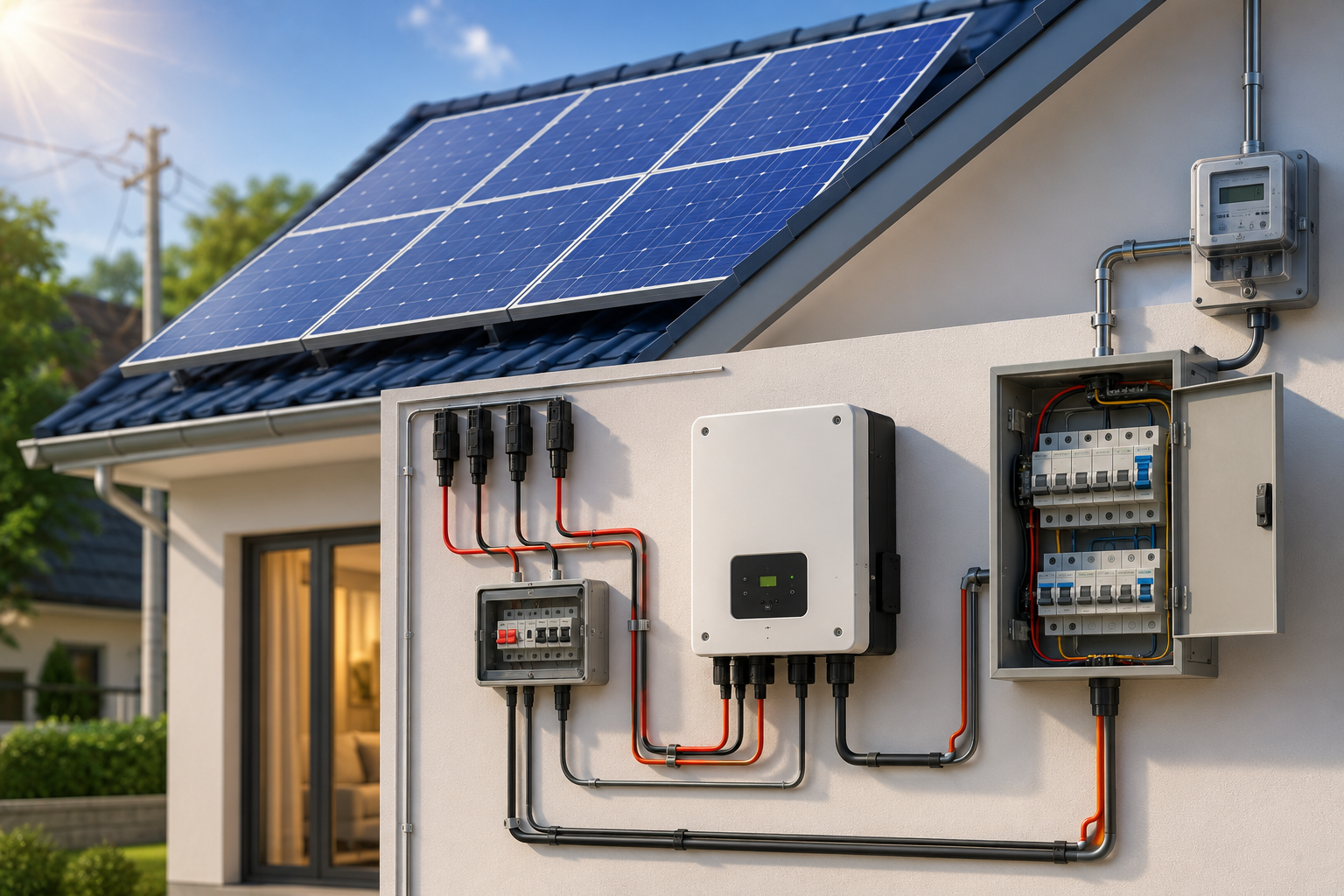
Your solar panels don’t actually produce the kind of electricity your fridge, fan, or factory motor runs on. They produce DC — direct current, the same type a car battery stores. Everything in your home or office runs on AC, alternating current, the type that comes out of a wall socket. Somewhere between the roof and the switchboard, one has to become the other.
That conversion point, and the wiring on either side of it, is where most of the real engineering decisions in a solar system happen. It’s also the part almost nobody explains to the person actually paying for the system. Installers talk about panel brands and wattage. Sales pitches talk about savings. Very few people walk a homeowner or a facility manager through why the wiring matters, what “correctly sized” even means, or what a rushed or underspecified job actually looks like.
That’s what this article is for — not a wiring manual for electricians, but a clear explanation of what’s happening in your system and what’s worth checking before you sign off on an installation.
Why solar can’t skip the AC conversion
A solar panel is essentially a stack of photovoltaic cells that push electrons in one direction when sunlight hits them — that’s DC, current flowing one way. Bangladesh’s grid, and every appliance built for it, runs on AC, current that reverses direction dozens of times a second. An inverter sits between the two, taking the panels’ DC output and converting it into grid-compatible AC.
This isn’t a formality. Without that conversion, a solar system simply can’t power a normal building or feed electricity back to the grid under net metering. The inverter is the single most important piece of equipment in the system for that reason — get its sizing or wiring wrong, and everything downstream suffers, even if the panels themselves are excellent.
The DC side: from panel to inverter
This is the stretch of wiring that carries raw panel output — usually a few hundred volts on a residential string, sometimes higher on commercial arrays — down to the inverter. Two things matter here more than anything else: how much power you lose along the way, and how safely a fault gets shut down.
Voltage drop is simply the energy lost to resistance as current travels through a cable. Longer runs and thinner cables lose more. As a general engineering guideline, installers try to keep DC-side voltage drop under roughly 1.5–2%, though the exact figure depends on the system’s size, the cable run length, and the specific design — it isn’t a single fixed number that applies to every roof. A 2.5 mm² conductor is a commonly used size for smaller residential runs because it balances safety margins with cost, but larger systems or longer cable runs often need a thicker conductor to stay within that loss target.
Why does a percentage or two actually matter? Because it compounds. A system losing 3–4% instead of 1.5% on the DC side is quietly giving away real production, day after day, for the life of the system — production the homeowner already paid for in panel cost.
Protection is the other half. DC faults behave differently from AC faults — a DC arc doesn’t naturally extinguish the way an AC one often does, which is part of why every current-carrying DC conductor needs proper overcurrent protection, and why it becomes especially important once you’re paralleling three or more strings together. This is a detail worth asking about directly if you’re reviewing a quote, because it’s easy to skip and hard to notice from the ground.
If you want the fuller technical breakdown of how installers actually arrive at a cable size for a given system, our guide to solar cable sizing goes into the calculations in more depth.
The AC side: from inverter to your building
Once the inverter has done its job, AC power travels from the inverter to your distribution board — and, for grid-tied and net-metered systems, eventually to the bidirectional meter that tracks what you send back to the utility.
AC cable sizing follows the same underlying logic as DC — minimize resistive loss, stay within safe current-carrying limits — but the numbers look different because AC systems, especially three-phase commercial installations, involve their own voltage-drop calculation that accounts for both resistance and reactance in the cable. On larger three-phase commercial systems, a 70 mm² copper conductor is a commonly referenced size, though again, the correct size for any specific project depends on the system’s capacity and cable run.
Two practical points matter here for a non-technical reader:
- Every current-carrying AC conductor still needs its own overcurrent protection, sized for that circuit specifically — not shared casually across circuits.
- Good practice keeps AC and DC cabling in separate conduits or clearly separated runs, partly for cable management and partly so a fault on one side doesn’t create confusion (or danger) for whoever has to troubleshoot the system later.
Grounding — the part nobody notices until it’s missing
Grounding, or earthing, doesn’t affect how much power your system produces. It affects what happens when something goes wrong — a lightning strike nearby, an insulation fault, a stray current from a damaged cable. Every panel frame should be grounded, typically using WEEB-style clips or dedicated grounding lugs on the mounting structure, tied back to a proper earthing system.
It’s the least visible part of an installation and, unfortunately, one of the easiest corners to cut, because a poorly grounded system will usually work just fine right up until the day it doesn’t. If you’re reviewing a completed installation, this is worth asking about specifically, not assuming.
DC side vs. AC side, at a glance
| DC side (panels → inverter) | AC side (inverter → building/grid) | |
| Typical voltage | Higher DC voltage, varies by string configuration | Standard grid voltage (single or three-phase) |
| Main risk | Non-self-extinguishing arc faults | Standard AC fault behavior, still hazardous |
| Cable sizing driver | Voltage drop + ampacity for the string current | Voltage drop + ampacity, three-phase formula for commercial systems |
| Protection requirement | Overcurrent protection on every conductor, critical with 3+ parallel strings | Dedicated overcurrent protection per circuit |
| Common example size | ~2.5 mm² for smaller residential runs (illustrative, not universal) | ~70 mm² copper for larger three-phase commercial runs (illustrative, not universal) |
What Bangladesh’s net metering rules mean for your wiring
This is the part most articles on this topic — almost all written for the US or UK market — never touch, and it’s directly relevant if you’re installing solar in Bangladesh today.
Under the country’s net metering framework, rooftop solar has become mandatory for many new grid connections on buildings with substantial roof space, and utilities have also increased how much system capacity they’ll allow relative to a property’s sanctioned load. That’s a meaningful shift from a few years ago, and it changes the conversation from “should I install solar” to “how do I make sure this installation actually passes.”
A few things worth knowing:
- Equipment — modules and inverters — is expected to be approved by SREDA (the Sustainable and Renewable Energy Development Authority) and meet Bangladesh Standards or equivalent IEC standards. This is worth confirming with any installer or supplier upfront, not after installation.
- Depending on where you’re connected — DESCO or DPDC in much of Dhaka, BREB in rural areas, NESCO or WZPDCL in other divisions — the utility engineer reviewing your application will check the technical documentation, particularly the Single Line Diagram showing how the PV array, inverter, AC panel, and bidirectional meter connect through to the grid. A poorly prepared SLD is one of the more common reasons applications get sent back for revision.
- The official guideline documents use specific terms — the connection point at your DB, MSB, or SDB (distribution board, main switchboard, or sub-distribution board) — and a competent installer should be able to talk you through exactly where your system ties into that board, not just gesture vaguely at “the panel.”
None of this changes the underlying electrical principles above. It just means that in Bangladesh, correct wiring isn’t only a safety and performance question — it’s also what determines whether your installation clears utility inspection the first time or gets bounced back for rework.
If you’re at the early planning stage, it’s worth reading up separately on how net metering applications actually work and what utility approval involves before you get a quote, so you know what documentation to expect from your installer.
What to actually check before you sign off
Most homeowners and even many facility managers aren’t going to inspect cable gauges themselves — and they shouldn’t need to. What’s reasonable is asking pointed questions and expecting clear answers. Before accepting a completed installation, or comparing quotes from different installers, it’s worth asking:
- What cable sizes are being used on the DC and AC sides, and how were they calculated for this specific system size and roof layout?
- What’s the expected voltage drop on each side, and is it within standard limits?
- Is every string properly protected, especially if three or more strings are combined?
- Is the panel array — and the racking structure itself — properly grounded?
- Are DC and AC cabling kept separated, and are conduits and connections labeled?
- Has a Single Line Diagram been prepared, and does it match what’s actually installed on the roof?
- Is the inverter SREDA-approved and rated appropriately for the system’s capacity?
None of these questions require an electrical engineering background to ask. They just require knowing that they’re worth asking — which is, honestly, the point of this whole article.
Where equipment manufacturing experience actually helps
Muspana has spent time on both sides of this — as a manufacturer of solar charge controllers and inverters in Bangladesh, and through rooftop solar installations for institutional and government sites around the country, including hospitals, universities, and public buildings. That combination matters here specifically because equipment specification and wiring design aren’t separate problems — an inverter’s rated input and output directly shape what cable sizing and protection a system needs in the first place.
That’s not a reason to take any single company’s word for a wiring job, including ours. It’s a reason to ask the questions above of whoever you’re working with, and to expect a straight technical answer rather than a reassurance.
FAQs
What’s the actual difference between DC and AC wiring in a solar system?
DC wiring carries the raw electricity your panels produce, before conversion. AC wiring carries electricity after the inverter has converted it into the form your building and the grid actually use. They’re sized, protected, and treated differently because DC and AC faults behave differently.
How much voltage drop is acceptable in solar wiring?
As a general engineering guideline, installers aim to keep DC-side voltage drop under roughly 1.5–2%, with AC-side targets calculated separately for the specific system. The exact acceptable figure depends on system size, cable length, and design — it’s not a single universal number, and a competent installer should be able to explain the target for your specific system.
What cable size do I need for my solar system?
It depends entirely on your system’s capacity, the distance between components, and your local voltage-drop target — there’s no single correct answer without a calculation specific to your installation. Smaller residential DC runs sometimes use conductors around 2.5 mm² as a starting reference point, and larger three-phase commercial AC runs sometimes reference conductors around 70 mm², but these are illustrative examples, not fixed specifications.
Can DC and AC cables run in the same conduit?
Good practice keeps them separated in different conduits or clearly separated runs, both for cable management and to avoid confusion or hazard during future maintenance. If they must share a route, they should be clearly labeled and kept properly isolated.
Is copper or aluminum better for solar wiring?
Copper is more conductive for a given cross-section and is the more commonly used and recommended choice in solar wiring, particularly for smaller residential and commercial runs. Aluminum can be used in some larger installations but generally requires a larger conductor size to carry the same current safely.
Does Bangladesh have specific rules for solar wiring and net metering?
Yes. Under the current net metering framework, equipment is expected to be SREDA-approved and meet Bangladesh Standards or equivalent IEC standards, and utilities (DESCO, DPDC, BREB, NESCO, WZPDCL depending on your area) review technical documentation, including a Single Line Diagram, as part of the connection approval process.