
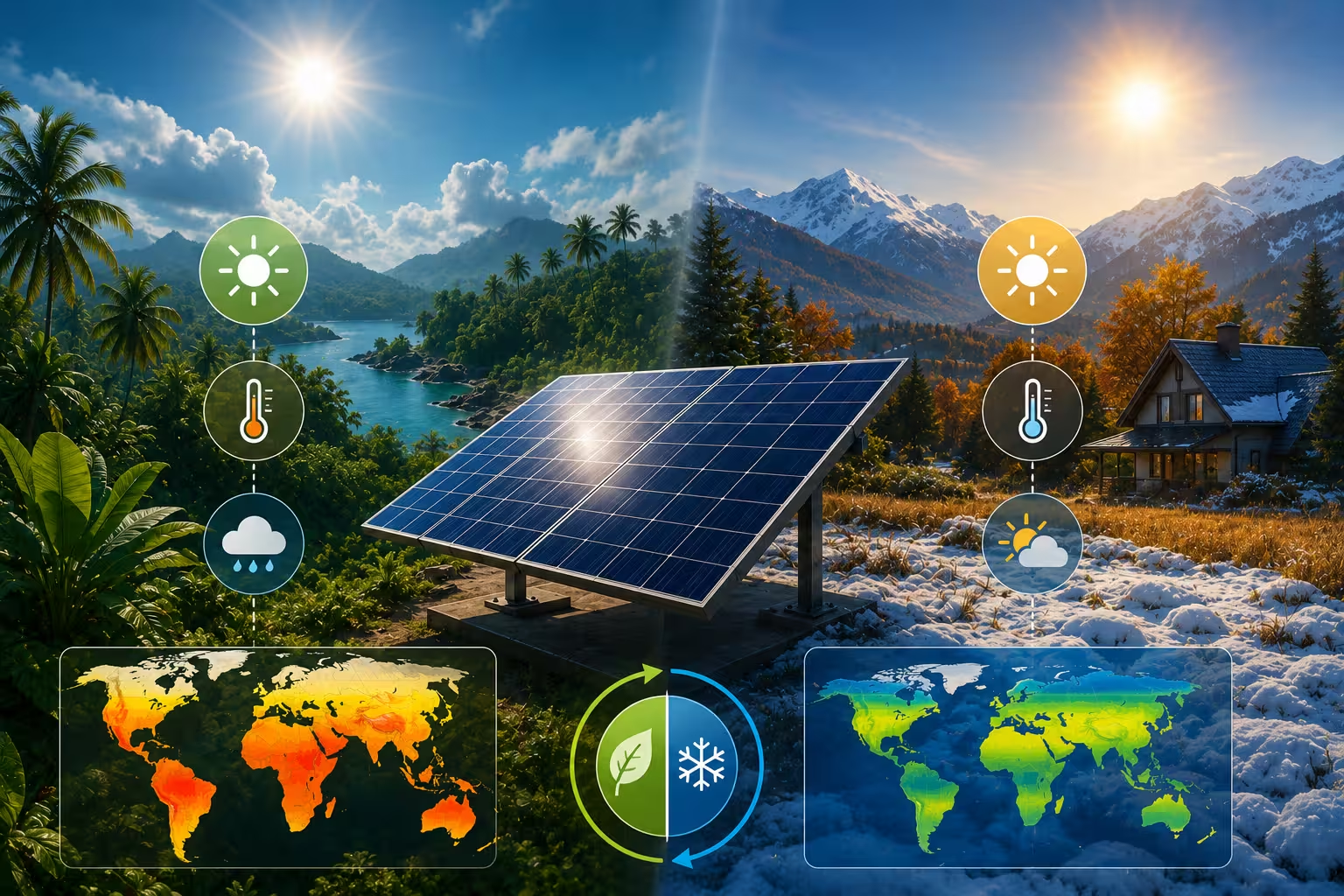
Ask most people where solar panels work best, and they’ll point straight at the equator. More sun, more heat, more power — seems obvious, right?
It’s actually more complicated than that. And once you understand why, you’ll look at solar maps completely differently.
The truth is, tropical regions and temperate regions each have real advantages when it comes to solar resource — they just show up in different ways. One wins on consistency. The other wins on raw output during peak months. Neither one is simply “better,” and if you’re trying to understand solar potential anywhere in the world, you need to know how these two climate types actually behave.
The Quick Answer
Tropical climates get more consistent sunlight year-round because they sit close to the equator and don’t experience real seasons. Temperate climates get less consistent daylight, but their cooler air often lets panels convert sunlight into electricity more efficiently, and long summer days can produce serious output for a few months at a time.
Here’s the side-by-side version:
| Tropical Climate | Temperate Climate | |
| Location | Between Tropic of Cancer & Tropic of Capricorn (23.5°N–23.5°S) | Mid-latitudes, roughly 30°–60° N and S |
| Average temps | Above 18°C (64.4°F) year-round | 0°C to 22°C (32°F to 72°F), swinging by season |
| Daylight pattern | Roughly 12 hours year-round | Long summer days, short winter days |
| Cloud cover | Often heavy, especially in rainforest zones | Variable, generally clearer in continental interiors |
| Annual rainfall | 800–2,500 mm (31–98 in) | 600–2,000 mm (24–79 in) |
| Panel efficiency | Lower — heat reduces output | Higher — cool air helps panels convert light better |
| Seasonal solar swing | Minimal | Significant, especially in higher latitudes |
That table alone probably rearranged a few assumptions. Let’s get into why.
Why Tropical Climates Aren’t the Slam-Dunk You’d Expect
Tropical zones — the rainforest belts of Indonesia, the Amazon basin, most of equatorial Africa — sit almost directly under the sun’s most intense rays. Solar radiation there is genuinely strong. There’s no argument about that.
But two things work against solar output in these regions.
Heat actually hurts solar panels. This trips people up constantly. Solar cells don’t like being hot. Once panel temperatures climb past around 25°C, efficiency starts dropping, and in a region where ambient air is already sitting near 30°C or higher most of the year, panels can lose a noticeable chunk of their rated output just from thermal stress. If you want the deeper mechanics of how sunlight actually converts into electricity, the photovoltaic effect explains why heat interferes with that process at a cellular level.
Cloud cover and humidity get in the way. Tropical rainforest climates in particular deal with dense, near-daily cloud formation and heavy rainfall — up to 2,500 mm annually in the wettest zones. That moisture scatters and blocks direct sunlight before it ever reaches a panel. Tropical monsoon and savanna climates fare a bit better here since they have defined dry seasons where sunlight comes through cleaner, but rainforest regions genuinely struggle with consistent irradiance despite their equatorial position.
What tropical regions do have going for them is stability. Daylight length barely shifts month to month, and temperatures don’t swing wildly, so solar output tends to stay fairly steady across the calendar. There’s no brutal winter slump like you’d see further from the equator. If you’re designing a system meant to produce a predictable, even amount of power every single month, that consistency has real value — it’s a big part of what makes peak sun hours calculations more straightforward in equatorial zones than almost anywhere else on Earth.
Where Temperate Climates Quietly Win
Temperate zones — think most of Europe, the northern and central United States, southern Australia — don’t get the same intensity of direct sunlight tropical regions do. But several factors work in their favor that people tend to overlook.
Cooler air means better panel efficiency. This is the big one. Because temperate regions spend large chunks of the year below 22°C, and often well below that, panels run cooler and simply convert sunlight more efficiently than they would in tropical heat. A clear, cold day in a temperate climate can genuinely outperform a hot, hazy day near the equator on a per-panel-watt basis.
Longer summer days stack the deck. In the higher-latitude parts of the temperate band — Germany, the UK, the northern U.S. — summer daylight can stretch to 15 or 16 hours. That extended window, combined with clearer atmospheric conditions in continental climates, can produce a genuinely strong solar season for four or five months straight.
Seasonality is the real trade-off. The catch is winter. Short days, low sun angles, and in some regions, snow cover all combine to crater solar output for a few months. This is where the solar angles topic becomes genuinely important — in temperate zones, the sun sits much lower on the horizon in winter, which spreads the same amount of sunlight over a wider area and weakens intensity per square meter. It’s a completely different situation from the tropics, where the sun stays high overhead almost year-round.
Mediterranean climates — hot dry summers, mild wet winters — actually split the difference nicely. They avoid the harshest winter solar slump while still getting cooler nights than true tropical zones, which is part of why regions like southern Spain and parts of California consistently rank among the best solar markets in the world.
The Air Mass Factor Nobody Talks About
Here’s something that rarely comes up in casual comparisons: how much atmosphere sunlight has to pass through before it hits a panel.
Near the equator, the sun sits close to directly overhead most of the year, so sunlight travels through a relatively short, direct path of atmosphere. Further from the equator — deeper into temperate zones — sunlight comes in at a steeper angle, especially in winter, passing through more atmosphere and losing intensity along the way. This is exactly what air mass measures, and it’s one of the clearest technical reasons tropical regions can have an edge in raw irradiance even with heavier cloud cover working against them.
Real-World Examples Worth Knowing
- Singapore (tropical): Consistent year-round sunlight, but frequent cloud cover and high humidity keep peak sun hours moderate rather than exceptional.
- Phoenix, Arizona (closer to subtropical/arid): Clear skies and strong direct sun most of the year — one of the best solar resource profiles in the world, though summer heat does cut into efficiency.
- Munich, Germany (temperate/continental): Strong summer output thanks to long days and cool, clear conditions, but a real seasonal dip come December and January.
- Nairobi, Kenya (tropical highland): High elevation cools the air even at a tropical latitude, which is part of why highland tropical zones sometimes perform better than lowland rainforest ones.
Notice that elevation, cloud patterns, and local geography end up mattering just as much as which broad climate band a location falls into. That’s worth remembering any time someone tells you solar potential is purely a matter of latitude.
What This Actually Means If You’re Comparing Locations
If you’re sizing a solar system or just trying to understand a region’s solar potential, don’t stop at “tropical or temperate.” Ask three follow-up questions instead:
- How much cloud cover does this specific location see, and does that shift seasonally?
- What’s the average daytime temperature during peak sun months? Cooler is generally better for output, even if it seems counterintuitive.
- How much does day length swing across the year here? A location closer to the equator gives you consistency; higher latitudes give you a stronger seasonal peak but a rougher off-season.
Understanding these factors is really an extension of understanding how solar radiation behaves differently depending on atmospheric path, cloud interference, and surface temperature — the climate zone is just the starting point, not the full picture.
If you’re weighing solar against other renewable options for a specific region, it’s also worth looking at how these same climate variables affect solar vs. wind energy potential, since wind resource often follows a completely different geographic logic than solar does.
FAQs
Do tropical climates get more sunlight than temperate climates?
Tropical climates get more consistent sunlight year-round since day length and sun angle barely change by season. Temperate climates get less consistent sunlight overall, but can outperform tropical regions during summer months thanks to longer days and cooler, more efficient panel conditions.
Why does heat reduce solar panel efficiency?
Solar cells lose efficiency as their temperature rises above roughly 25°C, because heat increases resistance within the cell and reduces voltage output. This is why hot tropical regions don’t always produce as much electricity per panel as their sunlight intensity would suggest.
Which climate is better for solar energy overall?
It depends on the goal. Tropical climates offer steady, predictable output all year. Temperate climates, especially Mediterranean and continental types, often produce stronger peak output during summer but need to account for a weaker winter season in system planning.
Does cloud cover matter more in tropical or temperate zones?
Tropical rainforest regions typically deal with heavier and more frequent cloud cover than temperate zones, which can meaningfully reduce solar output despite their equatorial position. Tropical savanna and monsoon climates, with defined dry seasons, see much clearer skies for part of the year.
Is latitude the main factor in solar potential?
Latitude matters, but it’s not the whole story. Elevation, local cloud patterns, humidity, and average temperature all affect actual solar output as much as, or more than, latitude alone.