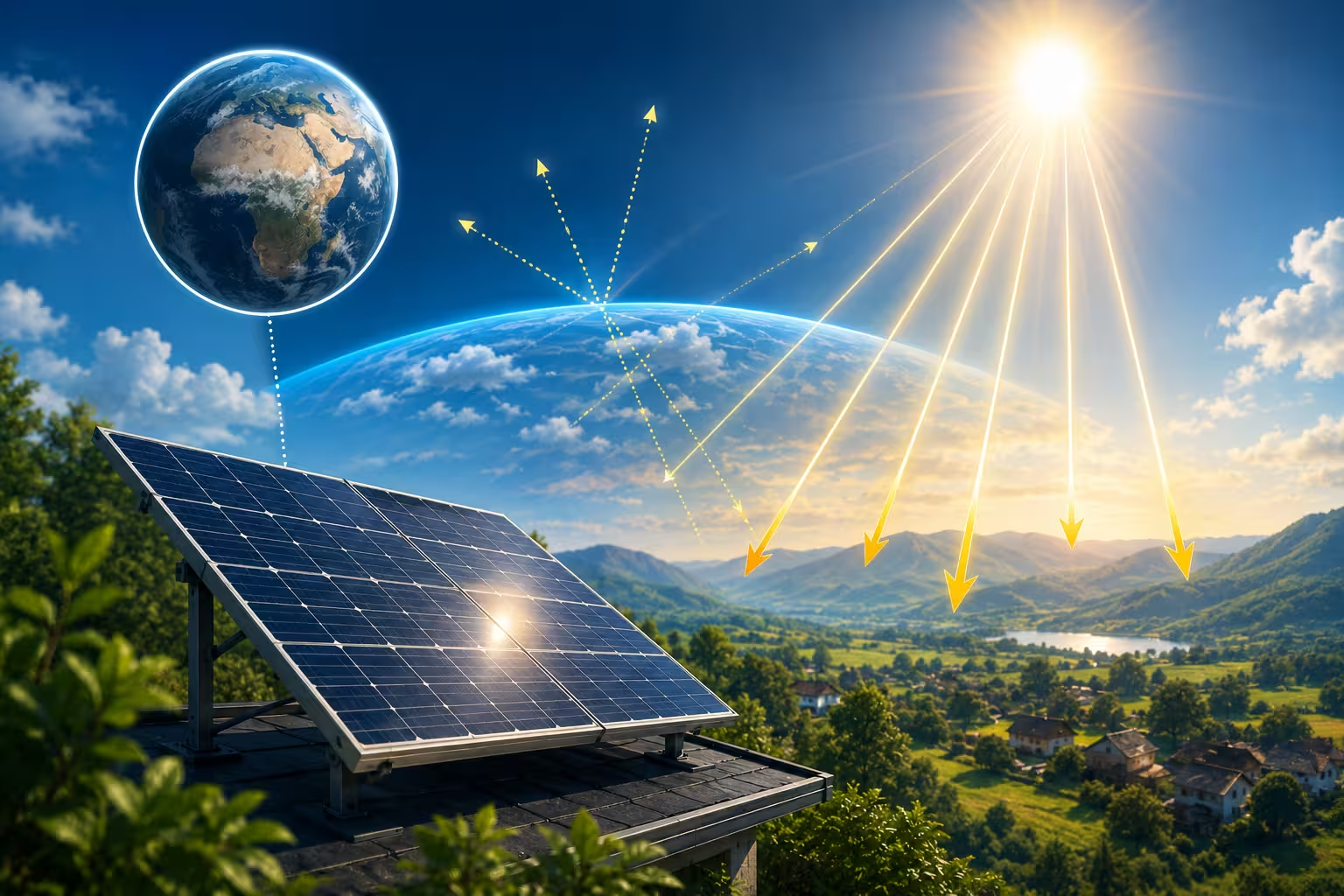
You’re staring at a solar panel spec sheet, or maybe a homework problem, and there it is — three terms that all seem to mean “sunlight,” used interchangeably by three different sources. Solar radiation. Irradiance. Insolation. If you’ve come away thinking they’re basically synonyms with fancier syllables, you’re not alone. Most explanations online don’t actually explain anything — they just swap one term into the definition of another and call it a day.
So let’s fix that properly.
Here’s the fast version, then we’ll unpack each one.
| Term | What It Measures | Unit | Instantaneous or Cumulative? |
| Solar Radiation | The full electromagnetic energy coming from the sun | N/A (a general term, not a single measurement) | Neither — it’s the source itself |
| Irradiance | The rate at which solar energy hits a surface right now | Watts per square meter (W/m²) | Instantaneous |
| Insolation | The total solar energy a surface receives over time | Watt-hours per square meter (Wh/m²), often kWh/m² | Cumulative |
If you only remember one thing, remember this: irradiance is a rate, insolation is a total. That distinction alone clears up 90% of the confusion.
The Analogy That Actually Makes This Click
Think about rain.
Irradiance is like checking how hard it’s raining right now — inches per hour. It changes minute to minute depending on clouds, time of day, angle of the sun.
Insolation is like the total rainfall collected in a bucket by the end of the day. You don’t care how intense any single moment was — you care about the sum total.
Solar radiation, then, isn’t really a measurement at all. It’s the whole category — every wavelength of energy the sun throws at us, from the visible light you’re reading this by to the UV that gives you sunburn, all the way through infrared and beyond. Irradiance and insolation are both just different ways of measuring pieces of that radiation once it hits a surface.
What Is Solar Radiation?
Solar radiation is the umbrella term. It refers to the entire spectrum of electromagnetic energy the sun emits — not just the light you can see, but ultraviolet, infrared, X-rays, the works. When people say “solar radiation,” they’re usually talking about the source and nature of the energy, not a specific number you’d plug into a formula.
This is the term you’ll see most in physics contexts and in discussions about how sunlight eventually becomes usable electricity. It’s the broad category everything else falls under.
What Is Solar Irradiance?
Irradiance is where things get measurable. It’s the power — not energy, power — hitting a given area at a specific moment, expressed in watts per square meter (W/m²).
A useful reference point: at the top of Earth’s atmosphere, incoming solar irradiance averages around 1,361 W/m², a figure often called the solar constant (it’s not perfectly constant, but it’s close enough to treat as one for most practical purposes). By the time that energy fights through the atmosphere and reaches the ground on a clear day around solar noon, it typically drops to somewhere near 1,000 W/m², depending on your location, the season, and how much atmosphere and air mass the light had to pass through.
Irradiance is measured with an instrument called a pyranometer — a small, unglamorous-looking device that’s doing a lot of quiet work in solar farm design and weather stations. If you’ve ever seen a solar irradiance map showing color-coded intensity across a region, that’s irradiance data, captured moment by moment and then averaged or mapped out.
Because it’s instantaneous, irradiance is what tells you: how strong is the sun right now, at this exact spot?
What Is Insolation?
Insolation takes that same energy and adds the missing ingredient: time.
Instead of asking “how intense is the sunlight right now,” insolation asks “how much total solar energy landed on this surface over a day, a month, a year?” It’s expressed in watt-hours per square meter, though for solar energy planning you’ll almost always see it in kilowatt-hours per square meter (kWh/m²) — same idea, just scaled up.
This is the number that actually determines how much energy a solar installation will realistically produce, because it accounts for daylight length, cloud cover, seasonal sun angle, and everything else that irradiance alone can’t capture in a single snapshot. It’s closely tied to the idea of peak sun hours — a simplified way installers use insolation data to estimate output, by figuring out how many hours of “ideal” 1,000 W/m² sunlight would be equivalent to what a location actually gets spread across a full day.
Why the Difference Actually Matters
If you’re comparing solar quotes, the salesperson isn’t lying to you by using kWh/m² — but if you don’t know that’s an insolation figure (a total), you might mistake it for the instantaneous strength of the sun, which would make no sense next to a wattage rating on your panels.
Engineers sizing a photovoltaic system care about both, for different reasons. Irradiance tells them the peak load a panel needs to handle. Insolation tells them the total energy yield they can expect — the number that actually determines your electricity bill savings. This is also why the same solar panel produces very different amounts of power in, say, a tropical region versus a temperate one — the irradiance might peak similarly, but the accumulated insolation over a year can differ substantially because of day length and sun angle.
If you’re just trying to understand a textbook problem, the distinction is simpler but no less important: mixing up a rate with a total is the kind of error that throws off an entire calculation.
A Quick Gut-Check
Next time you see one of these terms, ask yourself: is this describing right now, or over time? If it’s a snapshot — irradiance. If it’s an accumulated amount — insolation. And if it’s just describing the sun’s energy output in general, without pinning down a specific measurement — that’s solar radiation, the broad term the other two live under.
None of this requires memorizing formulas. It just requires remembering the rain bucket.
FAQs
Is insolation the same as irradiance?
No. Irradiance is the instantaneous rate of solar energy hitting a surface (W/m²), while insolation is the cumulative total received over a period of time (kWh/m²). Irradiance is a snapshot; insolation is a sum.
What are the units of solar irradiance?
Solar irradiance is measured in watts per square meter (W/m²), since it’s a measure of power, not accumulated energy.
What instrument measures solar irradiance?
A pyranometer is the standard instrument used to measure solar irradiance at ground level, commonly used at weather stations and solar farms.
How does insolation affect solar panel efficiency?
Insolation doesn’t change a panel’s efficiency rating, but it directly determines how much total energy that panel will actually produce over a day or year, since it accounts for daylight hours, weather, and seasonal sun angle rather than a single moment of sunlight intensity.
What is the solar constant?
The solar constant is the average solar irradiance received at the top of Earth’s atmosphere, roughly 1,361 W/m². It’s a useful reference point, though actual surface irradiance is typically lower due to atmospheric absorption and scattering.