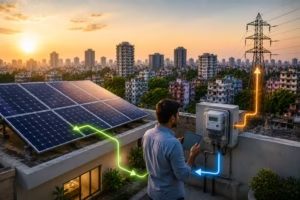

Stand on a rooftop on a bright afternoon and you’ll feel the sun doing something obvious — warming your skin, making you squint. What you won’t feel is the much stranger thing happening a few feet away, inside a solar panel: sunlight quietly getting converted into electricity, one photon at a time.
That conversion has a name. It’s called the photovoltaic effect — the process where certain semiconductor materials absorb light and turn it directly into an electric current. No moving parts, no burning anything, no steam turbines. Just physics happening at the atomic level.
If you’ve ever wondered how a flat, silent panel on a roof can power a refrigerator, this is the answer. Let’s get into it.
How the Photovoltaic Effect Actually Works

Solar cells are made from semiconductor material — almost always silicon, because it’s abundant and has just the right electrical properties for the job. Sunlight is made of photons, tiny packets of energy, and when those photons hit the silicon, some of them get absorbed.
Here’s where it gets interesting. Each absorbed photon transfers its energy to an electron in the silicon. If that energy is enough, it knocks the electron loose from its atomic bond. Suddenly you’ve got a free electron wandering around, plus a “hole” left behind where it used to be — basically an empty spot with a positive charge, ready to be filled.
Physicists call this an electron-hole pair, and it’s the starting point for everything that follows. But on its own, a bunch of loose electrons bouncing around randomly wouldn’t produce any usable electricity. They need direction. That’s the job of the p-n junction.
The P-N Junction: Solar’s Traffic Director
A solar cell isn’t just one uniform slab of silicon. It’s actually two layers, each treated (“doped”) with different trace elements. One layer, the p-type, has a slight positive character. The other, the n-type, has a slight negative character. Where these two layers meet is called the p-n junction, and it’s arguably the most important few micrometers in the entire cell.
At that junction, an internal electric field forms naturally. Think of it like a one-way valve: it doesn’t let charges flow freely in both directions. Instead, it pushes freed electrons toward the n-type side and pushes the holes toward the p-type side. Without that field, the electrons and holes would just recombine and cancel each other out almost as fast as they’re created — and you’d get no current at all.
This is really the heart of the photovoltaic effect. The photon does the initial work of freeing the electron, but it’s the p-n junction that turns that chaos into something organized enough to actually use.
From Loose Electrons to Power in Your Outlet
Once the electric field has sorted the charges, metal contacts on the front and back of the cell collect them. Connect the cell to an external circuit, and those electrons start flowing — that’s your electric current, generated as direct current (DC).
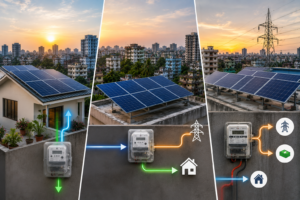
The problem is, most of what we plug into our walls runs on alternating current (AC). So the DC electricity from your panels travels to a device called an inverter, which flips it into AC that’s compatible with your home’s wiring or the grid.
A single solar cell doesn’t produce much power on its own, which is why cells are wired together into modules (what most people just call “panels”), and panels are grouped into arrays to scale up the output for a house, a business, or a solar farm.
Why Silicon — and What Else Is Out There
Silicon dominates the solar industry for a good reason: it has a band gap of roughly 1.1 electron-volts, which happens to sit close to the sweet spot for absorbing the range of light in sunlight. It’s also one of the most abundant elements on Earth, which keeps manufacturing costs manageable.
That said, silicon isn’t the only option, and it’s not perfect for every application.
| Material | Typical Efficiency Range | Common Use |
| Silicon (crystalline) | 15–22% | Residential and commercial rooftop panels |
| Gallium arsenide (GaAs) | 28–30%+ | Satellites, aerospace (high cost limits wider use) |
| Cadmium telluride (CdTe) | 10–19% | Utility-scale thin-film installations |
| CIGS (copper indium gallium selenide) | 12–20% | Flexible or lightweight panel applications |
Gallium arsenide, for instance, is more efficient than silicon but far more expensive to produce, which is why you’ll find it on satellites rather than suburban roofs. Cadmium telluride and CIGS trade some efficiency for lower material costs and flexibility, which suits large-scale or specialized installations. There’s no single “best” material — just tradeoffs depending on the application.
Why Panels Never Hit 100% Efficiency

This is the part a lot of explainers gloss over, and it’s honestly one of the more useful things to understand if you’re evaluating solar for your own home.
Even a well-designed silicon panel typically converts somewhere between 15% and 22% of the sunlight hitting it into usable electricity. That’s not a flaw in the technology — it’s physics. Some photons don’t carry enough energy to free an electron at all. Others carry too much, and the excess just turns into heat instead of electricity. Reflection off the panel surface, resistance in the wiring, and the angle of sunlight all chip away at the total too.
None of that makes solar a bad investment — it just means the “how efficient is a solar panel” number you see quoted is a real ceiling, not a marketing gimmick, and it’s worth knowing before you compare quotes.
Does the Photovoltaic Effect Work on Cloudy Days?
Yes, though at reduced output. Panels still generate electricity from diffuse sunlight on overcast days — usually somewhere around 10–25% of their clear-sky output, depending on cloud density. What they don’t do is generate power at night, since the effect depends entirely on photons hitting the semiconductor. If you’re weighing a solar setup, this is exactly the kind of practical detail worth factoring into your expectations, alongside your local peak sun hours and seasonal solar angles.
Understanding the mechanism also makes it easier to make sense of broader concepts like solar radiation and insolation, or how this compares to solar thermal technology, which captures heat rather than converting light directly into electricity.
Quick-Answer FAQ
What is the photovoltaic effect in simple terms?
It’s the process by which sunlight hitting a semiconductor material — typically silicon — knocks electrons loose and generates an electric current, without any moving parts or combustion involved.
How efficient is the photovoltaic effect?
Most residential silicon panels convert 15–22% of sunlight into electricity. Some specialized materials like gallium arsenide reach higher efficiencies but at much greater cost.
Does the photovoltaic effect work without direct sunlight?
Yes — panels still produce power from diffuse light on cloudy days, just at reduced output compared to full sun.
Why is silicon the most common material in solar panels?
Its band gap (~1.1 eV) closely matches the energy range in sunlight, and it’s abundant and relatively cheap to manufacture at scale.
What’s the difference between DC and AC in a solar system?
Solar cells generate direct current (DC). An inverter converts that into alternating current (AC), which is the form of electricity used in homes and the grid.
The photovoltaic effect isn’t magic, even though it can feel that way watching a silent panel power a house. It’s a fairly elegant chain of events — a photon, a freed electron, a junction that knows which way to push things, and a wire carrying the result to wherever you need it. Once you’ve seen the mechanism laid out, that panel on the roof stops looking mysterious and starts looking like exactly what it is: solid, well-understood physics quietly doing its job.