Ever notice how you don’t cast a shadow on a heavily overcast day? Stand outside in the middle of a grey, drizzly afternoon and look down. Nothing there. Now do the same thing on a clear sunny day and you get a crisp outline of yourself on the pavement.
That difference isn’t random. It’s actually the easiest way to understand one of the most misunderstood parts of solar energy — the fact that not all sunlight behaves the same way once it enters our atmosphere.
If you’re researching solar panels, or you’ve been staring at your own system’s output data wondering why it’s still producing power on a cloudy day, this is the explanation that actually clears things up.
The Three Types of Solar Radiation
Sunlight reaching the ground isn’t one uniform thing. It shows up in three distinct forms, and each one behaves differently depending on weather, location, and even the angle of your roof.
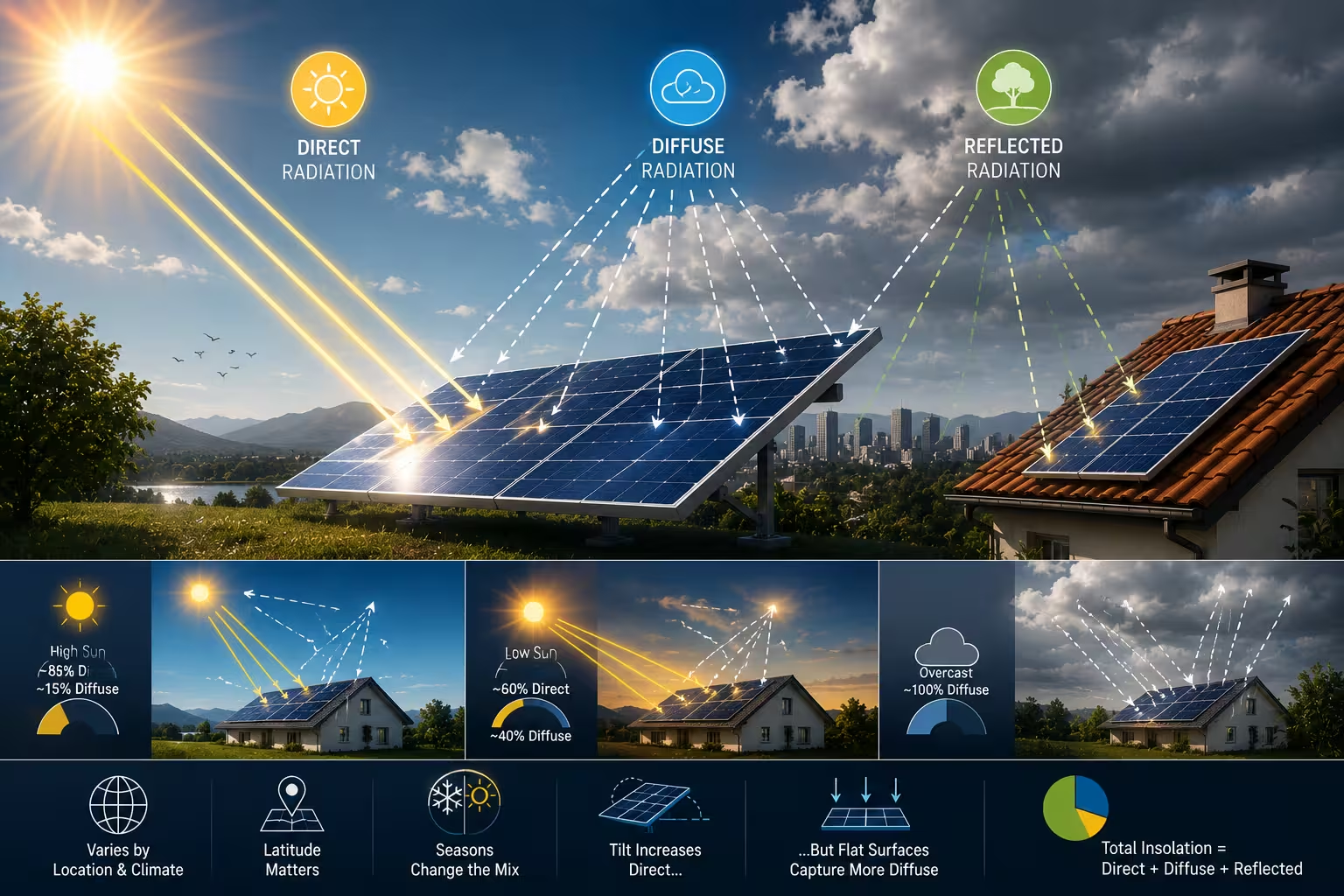
Direct radiation (sometimes called beam radiation) is sunlight that travels in a straight, unbroken line from the sun to the ground. Nothing scatters it along the way.
Diffuse radiation is sunlight that’s been bounced around by clouds, dust, and molecules in the atmosphere before it reaches you. It still gets here — it just arrives from every direction instead of one.
Reflected radiation is light that’s bounced off something on the ground — snow, water, pavement, grass — before hitting your panel.
Add all three together and you get what’s called global insolation, or total insolation: the full amount of solar energy actually hitting a surface.
Direct vs. Diffuse: What’s the Real Difference
Here’s where the shadow trick actually explains the physics. Direct radiation travels in one consistent direction, so when something blocks it — you, a tree, your roofline — it creates a clean shadow. All the light rays get stopped at once, from the same angle.
Diffuse radiation doesn’t work that way. It’s coming from all over the sky at once, scattered by clouds and atmospheric particles, so blocking it from one direction does almost nothing. That’s why heavy cloud cover kills your shadow but doesn’t kill your solar output completely — you’re still getting energy, just not the “beam” kind.
This is genuinely useful to know if you’ve ever wondered whether solar panels are a waste of money in a cloudy region. They’re not useless — they’re just working with a different mix of light.
How Much of the Sky Is Diffuse?
The ratio between direct and diffuse radiation shifts constantly, and it’s tied directly to how high the sun sits in the sky.
On a clear day with the sun near its highest point, roughly 85% of the radiation hitting the ground is direct, and about 15% is diffuse. That’s a strong, beam-dominated mix — good conditions for straightforward solar collection.
But as the sun drops lower toward the horizon, that ratio flips fast. By the time the sun is only about 10 degrees above the horizon, diffuse radiation can make up around 40% of the total. Early morning and late afternoon light is scattering a lot more than midday light does.
Then there’s cloud cover and pollution, which push the diffuse percentage even higher. On a properly overcast day, essentially all the radiation reaching the ground is diffuse. There’s no beam left to speak of — it’s all scattered light. And in general, the more diffuse the sky gets, the lower the total amount of solar energy reaching the ground, since scattering loses some intensity along the way.
Location Matters: Cloudy vs. Sunny Climates
This is where things get genuinely interesting, and where a lot of generic solar content falls flat. The diffuse-to-direct ratio isn’t just about weather on a given day — it’s baked into a region’s latitude and climate.
Higher-latitude, cloudier places carry a much bigger diffuse share of their total radiation than lower-latitude, sunnier places do. And in those cloudier regions, the seasonal swing is dramatic — diffuse radiation makes up a much larger share of total sunlight in winter than in summer. Sunnier, drier climates don’t see nearly as much seasonal variation.
A comparison makes this concrete. Take London, sitting at roughly 51° North with its famously wet, mild climate, against Aden in Yemen, at about 19.5° North with a hot, dry climate.
| London (51°N) | Aden (19.5°N) | |
| Sunniest month | ~5.5 kWh/m²/day, ~50% diffuse | ~7 kWh/m²/day, under 30% diffuse |
| Winter month (Dec) | Under 1 kWh/m²/day, mostly diffuse | ~5.25 kWh/m²/day, ~35% diffuse |
Look at that winter gap. London basically loses most of its usable direct radiation by December, while Aden barely notices the season change. That’s the kind of real, location-specific number that actually matters if you’re trying to size a system or set expectations for a cloudy-climate installation.
Why Tilted Solar Panels Lose Some Diffuse Radiation
Here’s a detail that rarely gets explained clearly, and it’s a genuinely useful one if you’re thinking about installation angles.
When you tilt a panel so it faces the sun directly at a 90° angle, you’re maximizing direct radiation capture. That part’s intuitive — you’re pointing straight at the source.
But diffuse radiation isn’t coming from one point. It’s spread fairly evenly across the whole sky. So the panel that captures the most diffuse radiation is actually one laying flat, facing the entire dome of the sky equally.
The steeper you tilt a panel, the more of the sky it turns away from — and the more diffuse light it misses. A panel tilted at 45°, for example, is facing away from roughly a quarter of the sky, which means it only picks up about three-quarters of the available diffuse radiation.
That sounds like a downside, and technically it is one. But it’s usually not a dealbreaker. Direct radiation is far more intense than diffuse radiation, so the extra direct energy gained from a well-tilted, sun-tracking angle generally outweighs what’s lost on the diffuse side. It’s a real tradeoff, just one that tends to favor tilting in most practical setups.
Not All Solar Tech Needs Direct Light
This is where the technology you’re using actually changes the calculation. Standard photovoltaic panels and solar hot water systems can make productive use of both direct and diffuse radiation — which is exactly why they still generate power under cloud cover.
Concentrated solar power is a different story. CSP systems rely on focusing sunlight to generate heat, and that only works with a strong, consistent beam of direct radiation. Cloudy days are much harder on this type of system. If you want the deeper technical breakdown between these approaches, it’s worth reading through solar thermal vs. PV systems and the photovoltaic effect explained.
Reflected Radiation and the Snow Effect
Reflected radiation is usually the smallest piece of the puzzle. Sunlight bounces off the ground — asphalt reflects only about 4% of what hits it, a grassy lawn reflects around 25% — and most of that reflected light never even reaches a tilted panel, since panels are typically angled away from the ground.
Snow changes the equation completely. Fresh snow reflects somewhere between 80 and 90% of the light striking it, which is an enormous amount compared to almost anything else on the ground. In places like Fairbanks, Alaska, sitting at about 64.5° North, snow can still be on the ground well into April and May. During that stretch, reflected radiation can account for as much as 25% of the total radiation hitting a surface — a meaningful contribution that most people never think about.
Putting It Together: What Is Global Insolation?
Once you add direct, diffuse, and reflected radiation together, you get global insolation — the full picture of solar energy actually reaching a surface. Most of the time, this is measured on a horizontal surface, though you’ll also see it referenced for a specific tilt, like “insolation on a 30° tilt.”
There’s also a related term, normal radiation, which refers to sunlight striking a surface held at a perfect 90° angle to the sun’s rays. Keeping a collector at that constant angle throughout the day maximizes the direct radiation it captures — which is the whole idea behind sun-tracking systems. If you’re curious how sun position affects this throughout the day, solar angles explained and peak sun hours both dig into that further.
Understanding this mix — direct, diffuse, reflected — isn’t just a physics exercise. It’s genuinely the difference between assuming solar “won’t work” in a cloudy region and actually understanding what kind of output to expect there. For a broader look at how all this connects to the underlying science, solar radiation and insolation is a solid next read, and if you’re just getting oriented with the basics of how sunlight becomes electricity, sunlight to electricity fills in that gap nicely.
FAQs
What’s the difference between direct and diffuse solar radiation?
Direct radiation travels in a straight line from the sun and casts shadows. Diffuse radiation has been scattered by clouds and particles in the atmosphere, so it arrives from all directions and doesn’t cast a shadow.
Can solar panels work without direct sunlight?
Yes. Standard photovoltaic and solar hot water systems can use diffuse radiation too, which is why they still generate power under cloud cover — just at a reduced level compared to direct sun.
Does cloud cover reduce solar output to zero?
No. On a fully overcast day, nearly all radiation becomes diffuse rather than direct, but panels still capture that scattered light, so output drops rather than disappearing entirely.
Why is diffuse radiation higher in winter?
The sun sits lower in the sky during winter, and lower sun angles naturally scatter more light through the atmosphere, increasing the diffuse share — especially in higher-latitude, cloudier regions.
Does snow help or hurt solar panel output?
It can help, somewhat counterintuitively. Fresh snow reflects 80-90% of the light hitting it, which can meaningfully boost reflected radiation reaching nearby panels, though snow covering the panels themselves obviously blocks output.
What angle loses the most diffuse radiation?
Steeper tilt angles lose more diffuse radiation because they face away from a larger portion of the sky. A 45° tilt, for instance, only captures around three-quarters of available diffuse light.