You’re reading through a solar panel spec sheet, or maybe a climate article, and you hit the phrase “solar constant.” It sounds like it should be one of those simple, self-explanatory science terms. Then you notice it’s described as varying slightly, and suddenly it doesn’t sound very constant at all.
Here’s the short version: the solar constant is the average amount of solar energy that hits a square meter at the top of Earth’s atmosphere, and it’s about 1,361 watts per square meter. That’s roughly the output of thirteen 100-watt light bulbs, packed into a space the size of a card table, arriving nonstop from 93 million miles away.
That’s the definition. The more interesting part is what it actually means, why scientists still call it “constant” when it isn’t, and — if you’re the kind of person who’s been eyeing solar panels for your roof — why this number matters a lot less to your electric bill than you’d think.
What Is the Solar Constant, In Plain Terms
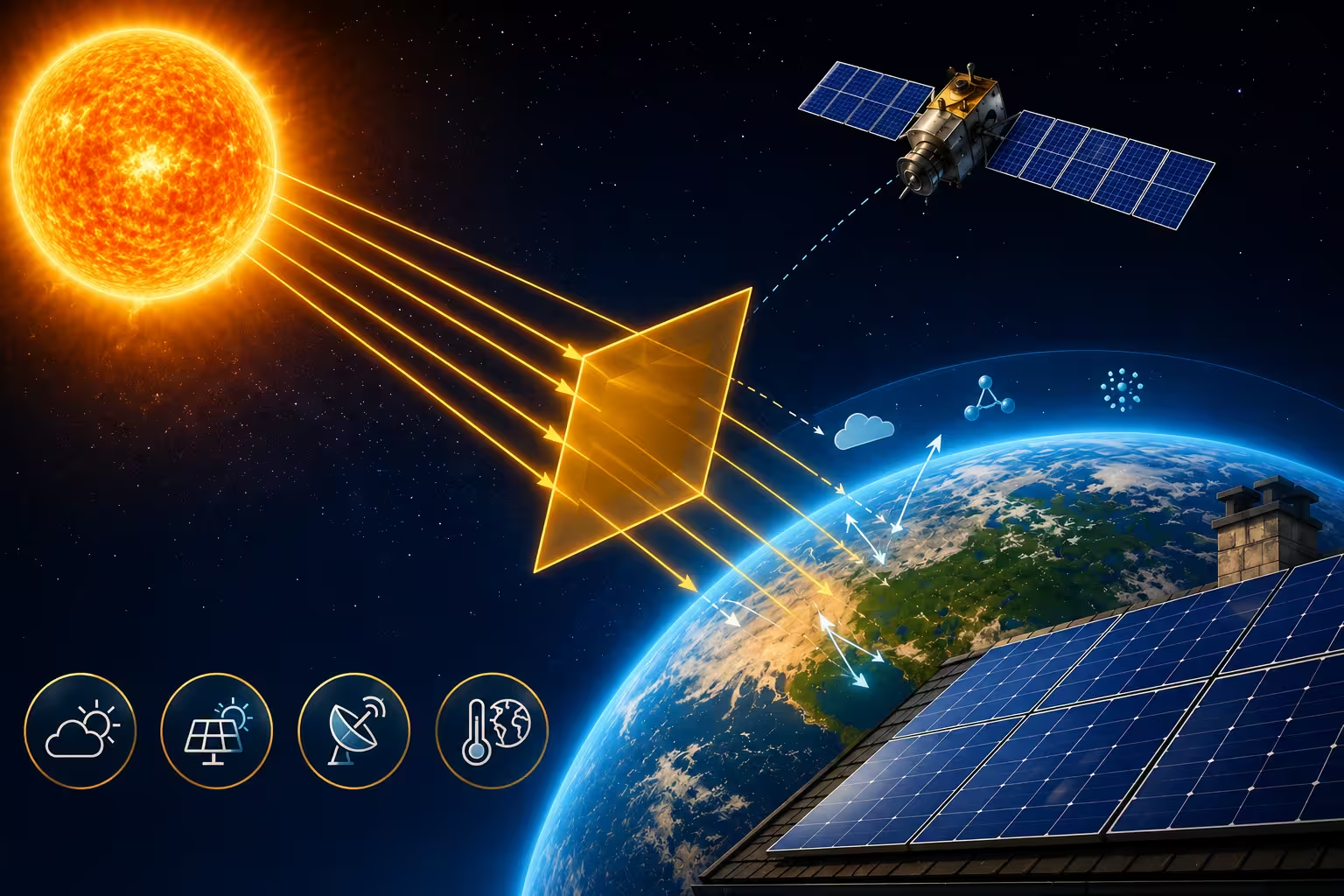
Picture a single square meter of space, positioned exactly where Earth orbits the sun, held perfectly perpendicular to the sun’s rays, with no atmosphere in the way. The solar constant is how much energy lands on that square meter, averaged over time.
It’s measured at one Astronomical Unit — the average Earth-sun distance, about 149.6 million kilometers — and it accounts for the entire spectrum of sunlight, not just the visible part. Ultraviolet, visible light, infrared, all of it gets counted.
Why does this number matter at all? Because it’s the starting point for almost every calculation involving how much energy the sun sends our way. Climate scientists use it to model Earth’s energy budget. Solar engineers use it to calculate theoretical maximum output for photovoltaic systems. Aerospace engineers use it to figure out how much power a satellite’s solar arrays can generate once they clear the atmosphere. It’s one number, but it shows up in a surprising number of very different jobs.
Why Is It Called a “Constant” If It Changes?
This is the part that trips people up, and honestly, it’s a fair complaint. The name suggests something fixed, like the speed of light. But the solar constant isn’t that kind of constant — it’s more like a well-behaved average.
The sun goes through an 11-year cycle of rising and falling activity, driven by sunspots and bright regions called faculae. During that cycle, the sun’s actual output drifts by around 0.1%. That’s a tiny swing. It won’t change your life. But it’s enough that scientists don’t pretend the number is frozen in stone — they just treat it as remarkably stable rather than perfectly fixed.
Think of it less like a mathematical constant and more like your average morning commute time. It’s 22 minutes, give or take a couple minutes depending on traffic that day. Nobody’s shocked that it’s not exactly 22 minutes every single time — the average is still useful.
How Scientists Actually Measure It
You can’t just point a thermometer at the sky and get this number. For a long time, ground-based measurements were the best available, and they came with real problems — the atmosphere itself absorbs and scatters sunlight, so anything measured at ground level has already been filtered before it reaches your instrument.
The real breakthrough came with satellites. Instruments like pyrheliometers and Total Irradiance Monitors sit above the atmosphere, catch the sun’s radiation directly, and convert the heat it generates into a precise power reading. Because these instruments orbit above the atmospheric noise, their readings are far more reliable than anything measured from the ground ever could be.
There’s one more adjustment involved: Earth’s orbit isn’t a perfect circle, so the raw satellite readings get normalized to account for Earth’s distance from the sun at the moment of measurement. That normalization is what turns a raw satellite reading into “the solar constant” as scientists define it.
The Real Number: 1,361 vs. 1,367 W/m² — What Changed?
If you’ve done any reading on this topic already, you’ve probably run into both numbers. Older textbooks and some still-active reference pages cite 1,367 W/m². More recent sources, particularly ones drawing on newer satellite data, land closer to 1,361 W/m².
This isn’t two competing theories — it’s measurement getting better over time. Early satellite instruments had small calibration differences that nudged the accepted value slightly higher than what more refined instruments later confirmed. The 1,361 W/m² figure reflects the current scientific consensus, built on decades of improved satellite instrumentation.
Here’s a quick reference if you want the numbers side by side:
| Value | Context |
| ~1,361 W/m² | Current accepted average (modern satellite data) |
| ~1,367 W/m² | Older commonly-cited figure (earlier instrumentation) |
| ~1,362 W/m² | Value at solar maximum (peak of the 11-year cycle) |
| ~1,360 W/m² | Value at solar minimum (low point of the cycle) |
None of these differences are dramatic. But if you’re citing a source and want to sound like you actually know the subject rather than just repeating a decades-old textbook line, 1,361 W/m² is the number to use.
Why the Solar Constant Actually Matters
It’s easy to file this under “trivia,” but the solar constant does real work in several fields.
In climate science, it’s the input side of Earth’s energy budget — the balance between incoming solar radiation and the heat Earth radiates back into space. That balance drives everything from ocean currents to long-term temperature trends. Scientists also use the stability of the solar constant to separate natural solar variation from human-driven climate change — if the sun’s output barely moves, but global temperatures are climbing, that tells researchers something important about where the change is actually coming from.
In space exploration, spacecraft designers rely on this figure because, above the atmosphere, sunlight arrives at full, undiluted intensity. There’s no cloud cover, no atmospheric scattering, none of the losses you’d get on the ground. That makes the solar constant directly useful for calculating how much power a satellite’s solar panels can realistically generate.
And in solar energy specifically, it’s the theoretical ceiling — the absolute best-case number before anything gets in the way. Which brings us to the part most articles skip over entirely.
What This Means If You’re Considering Home Solar Panels
Here’s the honest reality check nobody puts front and center: 1,361 W/m² is not what your roof gets. Not even close, most of the time. That number describes conditions above the atmosphere, with the sun directly overhead and nothing blocking the light. Your roof deals with a very different set of circumstances.
Atmospheric loss. By the time sunlight actually reaches ground level, the atmosphere has already absorbed and scattered a meaningful chunk of it. On a clear day at sea level, you’re typically looking at somewhere around 1,000 W/m² hitting a surface directly facing the sun — already a solid drop from the theoretical maximum.
Weather and cloud cover. Clouds, haze, and seasonal weather patterns cut into that further, sometimes dramatically. A hazy afternoon or an overcast week can knock output down substantially compared to a clear blue-sky day.
Panel angle and orientation. Sunlight rarely hits your roof at a perfect perpendicular angle. The sun moves across the sky throughout the day and across the seasons, and unless your panels can track it, you’re capturing sunlight at an angle for most of the day rather than head-on.
Panel efficiency. Even with strong sunlight hitting the panel surface, today’s residential solar panels convert somewhere around 15–22% of that incoming energy into usable electricity. The rest is lost as heat or reflected away — this is simply the current limit of photovoltaic technology, not a design flaw.
Stack all of that together, and it’s clear why solar installers talk in terms of “peak sun hours” and average daily output rather than quoting the solar constant directly. The 1,361 W/m² figure is the honest starting point for the physics — but your actual system’s output depends on your latitude, roof angle, local weather, and equipment quality, not the number you’ll find in a science glossary.
If you’re weighing solar for your home, that’s really the more useful question to chase down next: not “what’s the theoretical maximum,” but “what will my specific roof, in my specific climate, actually produce.” That’s where a proper conversation with an installer, or a good guide to solar panel efficiency and how many panels your home actually needs, becomes far more useful than the solar constant itself.
A Number Worth Knowing, Even If It’s Not the Whole Story
The solar constant is a genuinely useful baseline — it’s precise, well-measured, and it underpins fields as different as climate modeling and satellite engineering. But like a lot of foundational numbers in science, it’s easy to mistake the starting point for the finish line.
If you’re curious about the sun’s energy purely from a science standpoint, 1,361 W/m² is your answer, and now you know exactly why it isn’t perfectly fixed and where the number actually comes from. If you’re weighing solar panels for your own home, treat this figure as context rather than a promise — the real number that matters is what your roof, your climate, and your equipment can actually deliver. For a deeper look at how that gap between theoretical and real-world output plays out, solar radiation and insolation and air mass and its effect on solar intensity are both worth a read next.
FAQs
What is the solar constant in simple terms?
It’s the average amount of solar energy — about 1,361 watts per square meter — that reaches a square meter of space at the top of Earth’s atmosphere, measured at Earth’s average distance from the sun.
Why isn’t the solar constant actually constant?
The sun’s output shifts slightly, by about 0.1%, over its roughly 11-year activity cycle due to sunspots and faculae. It’s remarkably stable, just not perfectly fixed.
What is the current accepted value of the solar constant?
Most current sources cite approximately 1,361 W/m², though older references often use 1,367 W/m² based on earlier, less refined satellite measurements.
Does the solar constant affect how much power my solar panels produce?
Only indirectly. It represents the theoretical maximum before atmospheric loss, weather, panel angle, and equipment efficiency all reduce the number your panels actually receive and convert.
How is the solar constant measured?
It’s measured by satellites positioned above Earth’s atmosphere, using instruments like pyrheliometers and Total Irradiance Monitors, with readings normalized to account for Earth’s elliptical orbit.