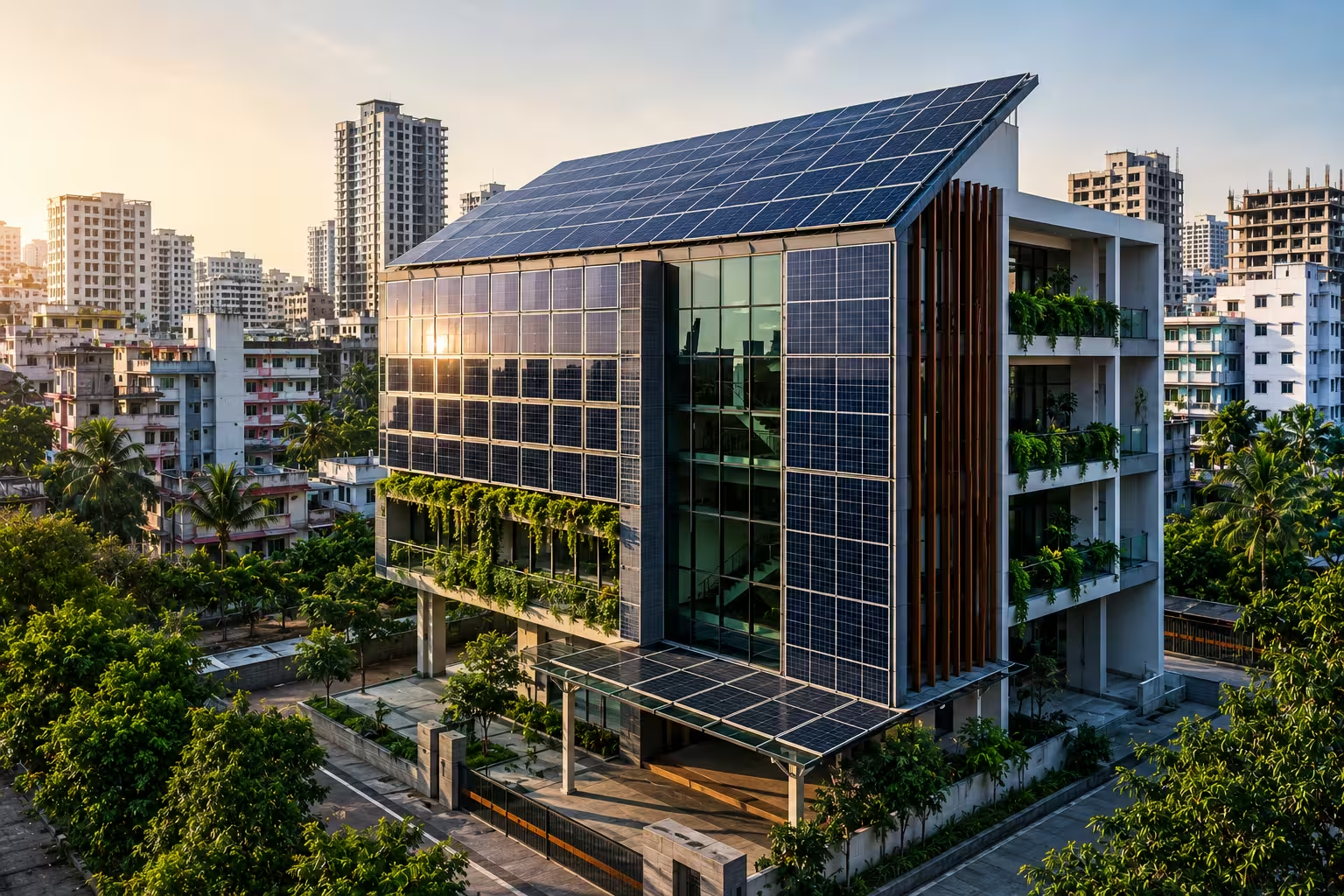
A rooftop solar array is now about as controversial as double-glazed windows. Everyone’s seen one, most people know roughly what it costs, and the technology has been de-risked to the point where a homeowner can get one installed in a weekend. So why would anyone choose something more expensive, harder to install, and less understood?
That’s the question building-integrated photovoltaics keeps getting asked. And it’s a fair one.
The short answer is that BIPV isn’t trying to be a cheaper or easier version of rooftop solar. It’s solving a different problem — one where the building material and the power generation are the same thing, not two separate systems stacked on top of each other. Once you understand that distinction, a lot of the confusion around BIPV clears up fast.
I want to walk through what BIPV actually is, how it differs from the panels most people picture, where it earns its cost premium, and — just as importantly — where it doesn’t.
What Is BIPV, Exactly?
Building-integrated photovoltaics (BIPV) refers to solar cells that are built directly into a building’s envelope — its roof, façade, windows, or shading elements — instead of being mounted on top of it. The photovoltaic layer is the roof tile, the window glass, or the cladding panel. It’s not an accessory bolted to the building; it’s a structural or functional part of it.
That’s the whole concept in one paragraph, and it’s worth sitting with for a second, because almost every source you’ll find online buries this definition under three paragraphs of market statistics before getting to the point.
If you’ve walked past office buildings with faintly tinted, mirror-like glass panels, or seen roof tiles that look suspiciously uniform and dark, there’s a decent chance you were looking at BIPV without realizing it. The whole design goal is for the solar function to disappear into the architecture rather than announce itself.
BIPV vs. BAPV: What’s Actually Different
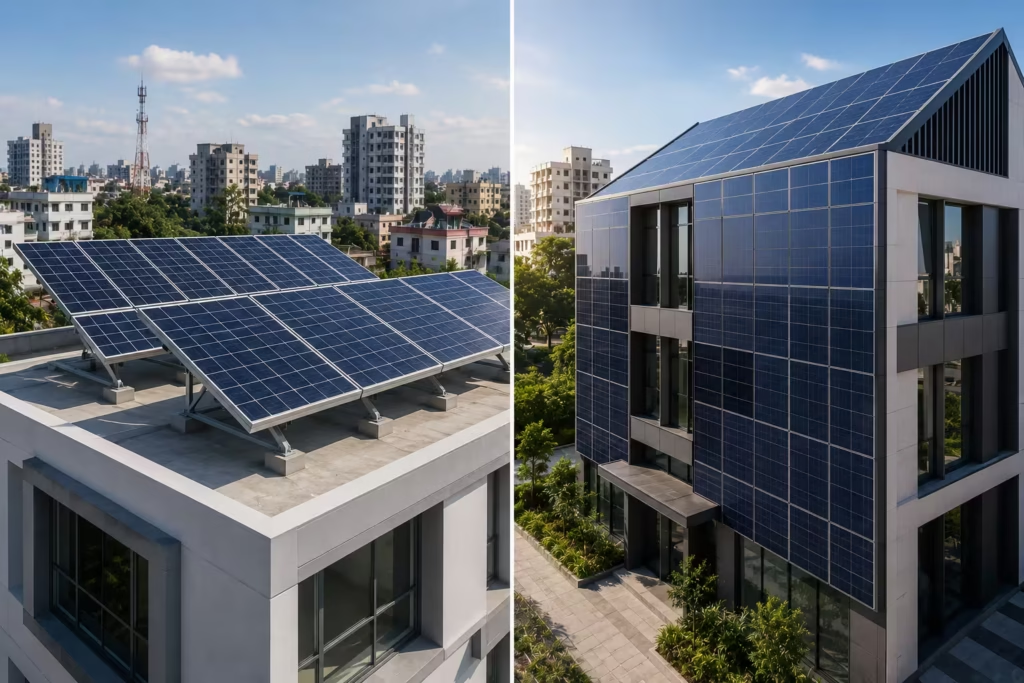
Almost every conversation about BIPV eventually runs into its counterpart: BAPV, or building-applied photovoltaics — the standard rooftop panels most people already know. The distinction matters more than it sounds like it should, because it changes how you evaluate cost, permitting, and even long-term maintenance.
| BIPV | BAPV (standard rooftop solar) | |
| Installation | Replaces a building material during construction or major renovation | Mounted on top of an existing structure |
| Cost structure | Offsets against material you’d have bought anyway (roofing, glazing, cladding) | Pure additional cost on top of the building |
| Aesthetics | Custom colors, patterns, and transparency; blends into design | Fixed panel look, visible racking |
| Permitting | Often folded into building envelope approval; can help in heritage or restricted zones | Standalone solar permit, sometimes flagged in historic districts |
| Best fit | New construction, major retrofits, architecturally sensitive projects | Existing buildings with unused roof space and a straightforward budget |
If you’re new to how solar electricity gets generated in the first place, it’s worth a quick detour through how the photovoltaic effect actually works — the underlying physics is identical for BIPV and BAPV. What changes is everything around the cell: how it’s packaged, mounted, and integrated into the structure it sits on.
Where BIPV Actually Gets Used
BIPV isn’t one product. It’s a category that shows up in five fairly distinct forms, and the “right” one depends entirely on what part of the building you’re trying to solve for.
| Application | What it replaces | Best for |
| Roof-integrated PV | Standard shingles, tiles, or standing-seam metal | New residential construction, roof replacements |
| Ventilated/rainscreen façades | Standard exterior cladding | Commercial buildings wanting thermal management + power |
| Curtain walls & spandrels | Structural glazing | High-rise towers, glass-heavy commercial buildings |
| Skylights & shading devices | Standard or laminated glass | Atriums, daylighting-focused designs |
| Balustrades & balconies | Railings, barriers | Multi-unit residential, vertical surface optimization |
The roof and façade categories get most of the attention, and for good reason — they cover the most surface area and generate the most usable power. But the skylight and balustrade applications are quietly some of the smartest uses of BIPV, precisely because they’re claiming surface area that had zero energy value before. You weren’t going to put rooftop panels on a balcony railing.
The Two Technologies Behind BIPV
Underneath all five of those applications, there are really just two families of solar technology doing the work.
Crystalline silicon (c-Si) is the same technology behind most rooftop panels — it has that familiar grid-line appearance, delivers higher efficiency per square foot, and is the go-to choice when power output matters more than visual subtlety.
Thin-film modules are vacuum-deposited onto glass or a flexible substrate. They’re lighter, more visually uniform (no grid lines), and can be made semi-transparent — which is why almost all BIPV glazing and skylight products use thin-film rather than c-Si.
| Crystalline Silicon (c-Si) | Thin-Film | |
| Efficiency | Higher (roughly 18–22%) | Lower (roughly 8–14%) |
| Appearance | Visible grid pattern | Uniform, glass-like |
| Transparency | Not achievable | Achievable via cell spacing or laser drilling |
| Best for | Roofs, opaque façades | Windows, skylights, semi-transparent glazing |
Emerging technologies like perovskite and dye-sensitized cells (DSSC) are pushing efficiency and color options further, but they’re not yet the default choice for most commercial BIPV projects — worth knowing about, not worth over-indexing on if you’re specifying something today.
Is BIPV Worth It? The Honest Pros and Cons
This is where most guides get vague, and it’s usually because the people writing them are trying to sell you something. Here’s the version without the sales pitch.
Where BIPV genuinely wins:
- No added footprint. You’re not competing for land or roof space you don’t have — this matters enormously in dense urban sites.
- Dual functionality offsets cost. Because the BIPV material replaces something you were buying anyway (glazing, roofing, cladding), the effective premium is smaller than the sticker price suggests.
- Design control. Color, pattern, and transparency options that standard panels simply don’t offer.
- Passive energy benefits. Integrated into windows or ventilated façades, BIPV can actually reduce a building’s cooling and heating load — a benefit rooftop panels don’t provide.
Where it genuinely struggles:
- Higher upfront cost. Custom BIPV materials and the specialized integration work cost more than a standard curtain wall or a conventional solar array, even after accounting for the material offset.
- Retrofitting is genuinely hard — here’s why. It’s not just “more complex” in the abstract. Retrofitting BIPV into an existing envelope usually means dealing with structural load calculations that weren’t designed for it, maintaining waterproofing continuity through a system the building wasn’t built around, and routing electrical infrastructure through walls or roofing that were never meant to carry it. That’s why BIPV overwhelmingly favors new construction or gut renovations.
- Vertical surfaces underperform angled ones. A façade doesn’t catch sunlight the way an angled roof does. If peak power generation is the priority, a vertical BIPV wall will never out-produce a well-oriented BAPV roof array of the same area.
- Heat is the quiet killer of output. Solar cells lose efficiency as they heat up, and BIPV modules — especially façade and curtain wall installations — are more prone to running hot than a rooftop array with open air on both sides. Ventilation behind the modules isn’t optional; it’s the difference between a system that performs and one that quietly underdelivers for years.
If you’re weighing BIPV against a straightforward rooftop install, it’s worth reading up on the practical differences between rooftop and ground-mounted solar first — sometimes the honest answer is that a conventional system solves your problem more cheaply, and BIPV is solving a different problem entirely (architecture, land constraints, aesthetics) rather than a purely financial one.
Design Considerations That Actually Affect Performance
Why South-Facing Still Isn’t Guaranteed to Win
The standard advice is “orient south-facing surfaces (in the Northern Hemisphere) toward maximum sun exposure.” True, but incomplete. Orientation matters less in isolation and more in combination with your local peak sun hours and the specific solar angles your site experiences through the year. A south-facing façade in a climate with long, low-angle winter sun behaves very differently from the same orientation somewhere closer to the equator.
The Transparency-Efficiency Trade-Off, Explained Simply
Every semi-transparent BIPV product is making a trade you should understand before you spec it: more light passing through means fewer active solar cells doing the work, which means less electricity. Transparency gets achieved either by spacing individual cells further apart or by laser-drilling tiny holes into the cell surface. Neither approach is “better” — it’s a dial you turn based on whether you’re prioritizing daylighting or power output for that specific surface.
Why Ventilation Isn’t a Nice-to-Have
Ventilated rainscreen façades and skylight systems need airflow behind the modules, not just for comfort but for output. An unventilated, sun-baked façade panel can lose a meaningful chunk of its rated efficiency simply from operating hot. This is one of the few places in BIPV design where cutting a corner shows up directly on the energy bill.
New Construction vs. Retrofit: Which One You’re Actually Deciding
Here’s the decision that actually matters more than most of the technical specs above: are you building new, or are you trying to add BIPV to something that already exists?
If you’re planning new construction or a major gut renovation, BIPV is a legitimate option worth serious consideration — you’re already buying roofing, glazing, or cladding, and swapping in a BIPV version means you’re not paying for two systems (the building material and the power system) separately.
If you’re looking at retrofitting an existing building, the calculus shifts hard. Unless you’re already planning a full envelope replacement, the structural, waterproofing, and electrical complications usually mean a straightforward BAPV rooftop or ground-mounted system will get you to your energy goals faster and cheaper. BIPV retrofits aren’t impossible, but they’re rarely the pragmatic choice unless the building’s architecture or a heritage restriction rules out visible bolt-on panels entirely.
That single question — new build or retrofit — will steer more of your decision than any efficiency number in this article.
If you’re earlier in the research process and want the fundamentals first, it’s worth starting with what solar energy actually is and how sunlight becomes usable electricity before diving deeper into BIPV specifics — the building-integration side of things makes a lot more sense once the basic PV mechanics click.
FAQs
Is BIPV more expensive than regular solar panels?
Yes, on a per-watt basis BIPV usually carries a real premium over standard rooftop panels. But because BIPV materials replace conventional building components you’d be purchasing anyway — roofing, glazing, cladding — the effective added cost is smaller than comparing the two systems as standalone products.
Can BIPV be added to an existing building?
It can, but retrofitting is significantly harder than installing it during new construction. Structural load, waterproofing continuity, and electrical routing all get more complicated when you’re working around an existing envelope rather than designing for BIPV from the start.
How efficient is BIPV compared to traditional solar?
Crystalline silicon BIPV modules land close to standard rooftop panel efficiency, roughly 18–22%. Thin-film BIPV, used for semi-transparent glazing and windows, runs lower — typically 8–14% — because transparency and efficiency work against each other.
What is the difference between BIPV and BAPV?
BIPV replaces a building material and generates power as part of the structure itself. BAPV — the racking-mounted panels most people picture — is added on top of an existing, already-complete building surface.
Does BIPV work on north-facing walls?
It can generate some power, but a north-facing (Northern Hemisphere) vertical surface receives far less direct sunlight than a south-facing one, which meaningfully limits output. North-facing BIPV is more often chosen for its building-envelope function — insulation, aesthetics — than for peak energy generation.