Ask five different people in Dhaka whether solar panels are worth it, and you’ll get five different answers. One will tell you it’s still too expensive to bother. Another will insist it only pays off if you’re wealthy enough not to care about the upfront cost. A third will swear their neighbour’s panels stopped working after a year of monsoon grime.
Some of that is true. Most of it isn’t — or at least, it isn’t the full picture. A lot of what circulates online about solar economics comes from the UK, the US, or India, where the subsidies, tariffs, and climate are different enough that the numbers simply don’t translate. Bangladesh has its own cost structure, its own utility pricing, and — as of 2025 — a genuinely new set of net metering rules that most homeowners haven’t caught up on yet.
Here’s what’s actually true for a rooftop system in Bangladesh right now, myth by myth.
| Myth | Reality in Bangladesh | Worth keeping in mind |
| Solar is unaffordable for average homeowners | A 1kW installed system runs roughly ৳60,000–৳1,70,000 | Wide range — brand, inverter, and battery choice move the price a lot |
| Panels never pay for themselves | Payback depends entirely on your electricity usage, not a fixed number of years | A low-usage flat pays back far slower than an AC-heavy household |
| Solar is only for the wealthy | Financing exists through bank loans, not government subsidies | Loan interest (roughly 5–6% under green refinancing) still has to be budgeted for |
| Maintenance costs are too high | Routine cleaning is cheap; the real cost is climate-driven soiling | Dust and monsoon grime affect Bangladesh panels more than temperate-climate panels |
| Solar isn’t a smart financial investment | Rising BPDB/REB tariffs and mandatory net metering rules make the math better than a few years ago | It’s still a multi-year commitment, not a guaranteed short-term win |
Myth 1: Solar panels are too expensive for the average homeowner
This one isn’t entirely wrong — it’s just incomplete. Solar in Bangladesh is genuinely more expensive per kilowatt than in markets like the UK or Australia, mainly because almost every component is imported. Panels, inverters, batteries, and even a lot of the mounting hardware carry import duty, and that cost gets passed straight to the buyer.
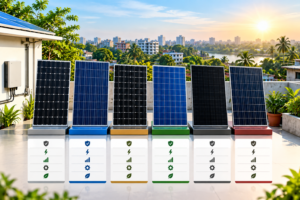
A realistic starting point: a fully installed 1kW rooftop system — panels, inverter, wiring, and labour — typically costs somewhere between ৳60,000 and ৳1,70,000. That’s a wide range, and the reason it’s wide is worth understanding rather than glossing over. A budget unbranded panel setup with a basic inverter sits at the low end. A tier-1 brand system (names like Jinko, Trina, or REC) with a hybrid inverter and battery backup sits much closer to the top.
Most homes don’t run on 1kW, though. A small flat with lights, fans, and a fridge might get by on 2–3kW. A household that wants to run an air conditioner off solar comfortably usually needs closer to 5kW. Multiply the per-kW range accordingly, and you can see why quotes from different installers can look wildly different for what sounds like “the same system” — they often aren’t the same system at all.
This is one area where getting an itemized quote matters more than the headline price. A quote that breaks down panel brand, inverter type, and battery capacity separately is far easier to compare honestly than one lump number — it’s a habit Muspana encourages customers to insist on before signing anything, precisely because “affordable” and “cheap” aren’t the same thing when a panel brand’s warranty support disappears after two years.
Myth 2: Solar panels never really pay for themselves
The honest answer is: it depends on how much electricity you use, and nobody should tell you otherwise with a single fixed number.
Here’s the baseline math. BPDB electricity currently runs around ৳4.71 per unit (kWh). A household using roughly 400 units a month is paying somewhere near ৳1,880 a month, or a little over ৳22,000 a year, just on the grid connection. That’s the number solar has to compete against.
If your usage is close to that and your system is sized to match it, the payback period can be meaningful — often landing somewhere in the range most homeowners would consider reasonable. But if you’re a low-usage flat with a small system, or your system is oversized for what you actually consume, payback drags out. And if load-shedding means you’re relying on your inverter battery more than the panels themselves, the calculation changes again.
The point isn’t that solar doesn’t pay off — it’s that “12 years” or any other single number thrown around online is only true for one specific household size, one specific system, and one specific tariff. Ask any installer quoting you a payback period what usage figure they’re assuming, and if they can’t answer that, treat the number with some skepticism.
Myth 3: Solar is only for wealthy people
This myth made more sense a few years ago than it does now, but it’s not entirely gone either.
Bangladesh doesn’t offer the kind of cash subsidy or feed-in tariff that makes headlines in other countries. What exists instead is financing — mainly through Bangladesh Bank’s green refinancing scheme, which lets banks lend for solar projects at roughly 5–6% interest. That’s a meaningfully lower rate than typical consumer borrowing, and it’s opened solar up to households who couldn’t pay the full upfront cost in cash. It’s not free money, though — loan interest is a real cost that should be factored into any payback calculation, not treated as an afterthought.
It’s also worth being straightforward about where adoption actually stands. So far, uptake has been driven far more by industrial and commercial users than by households — factories responding to mandatory rules and rising operating costs, not homeowners chasing a trend. Residential solar in Bangladesh is growing, but it isn’t yet the mainstream default the way it might sound in more optimistic marketing copy. That’s not a reason to avoid it — it’s just a more honest starting point than “everyone’s doing it now.”
Myth 4: Maintenance costs are too high
Compared to almost anything else you’d install in a house, solar panels are low-maintenance. There are no moving parts to wear out, and the electronics are generally covered by manufacturer warranties that vary by brand and component — check the specific terms before assuming coverage, since they’re not identical across every product.
Where this myth gets Bangladesh wrong is the climate assumption baked into it. Advice written for the UK or the US tends to say “just hose it down once in a while.” That undersells what Dhaka’s dust, Chattogram’s humidity, and a full monsoon season actually do to panel output over a year. Soiling — the layer of dust and grime that builds up on a panel’s surface — genuinely reduces output here more than it does in drier, cooler climates, and it builds up faster than most first-time solar owners expect.
The fix isn’t expensive. Regular cleaning, done a few times a year or more depending on your rooftop’s exposure, keeps output close to what it should be. The mistake is assuming “low maintenance” means “no maintenance” — in Bangladesh’s climate, that gap is where a lot of quiet performance loss happens.
Myth 5: Solar isn’t a smart financial investment
If this were still true, the mandatory net metering rules introduced in 2025 wouldn’t exist — regulators don’t usually make something mandatory that doesn’t make financial sense for the people required to install it.
Two things have shifted the math since older, more skeptical articles were written. First, grid electricity tariffs have been trending upward, which improves solar’s relative value every time BPDB or REB rates increase. Second, the policy environment around net metering has genuinely changed — which deserves its own explanation, because most existing coverage of this topic hasn’t caught up to it.
What actually changed with net metering in 2025
In August 2025, the government approved updated Net Metering Guidelines that reshaped who can install rooftop solar and at what scale. A few changes matter directly to someone reading this as a homeowner or small business owner:
- The old cap limiting a single site to 10MW of capacity was removed, opening the door for larger commercial and industrial installations.
- The self-consumption ceiling was raised to 100% of a building’s sanctioned electrical load, giving installers more room to size a system properly instead of working around an artificial limit.
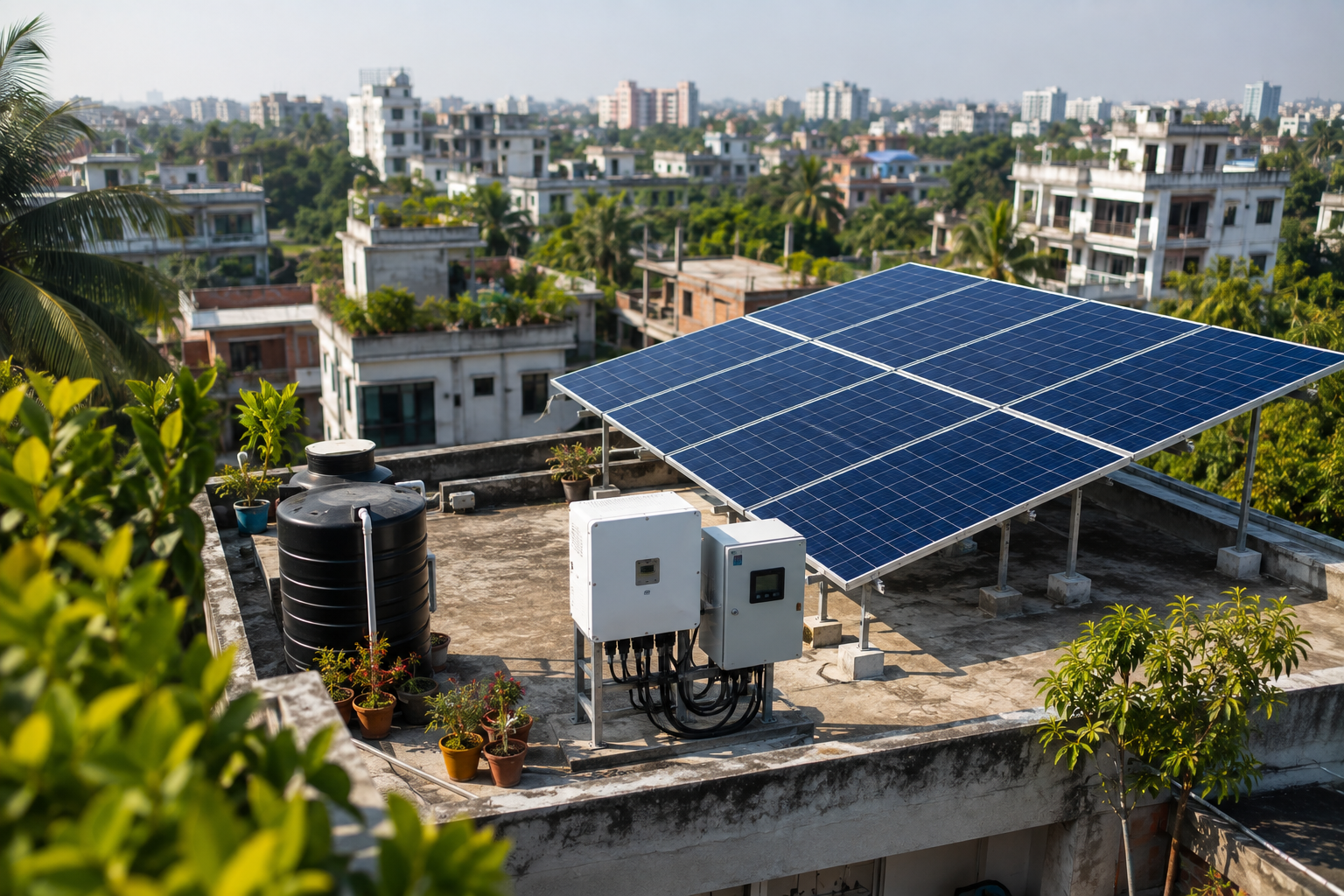
- Net metering became mandatory for buildings with roughly 92.2 square metres or more of rooftop space applying for a new grid connection — meaning solar isn’t purely optional anymore for a growing category of new construction.
For a homeowner, the practical takeaway is this: if you’re building new or upgrading your grid connection and your rooftop clears that threshold, solar isn’t a “nice to have” you can quietly skip — it’s part of the approval process. For a factory or commercial building owner, the removed capacity cap is the bigger story, since it changes what’s realistically achievable on a larger roof.
None of this is a guarantee that solar pays off for every single building. But it’s a clear signal that regulators see rooftop solar as infrastructure now, not a lifestyle purchase — and that’s a different starting point than the “solar is a nice-to-have” framing a lot of older content still leans on.
Getting a number you can actually trust
Every myth above collapses into the same underlying issue: generic numbers don’t hold up against a specific rooftop, a specific usage pattern, and a specific budget. The most useful thing a homeowner or business owner can do before deciding anything is get a quote that breaks down panel brand, inverter type, battery inclusion, and installation labour as separate line items — not a single bundled price that’s hard to compare against anything else. That’s the kind of itemized breakdown Muspana provides when assessing a rooftop, precisely because “is this a fair price” is usually the real question hiding underneath “is solar worth it.”
FAQs
Is solar really cheaper than paying BPDB or REB electricity bills in Bangladesh?
It depends on your usage. For a household paying a meaningful monthly bill (roughly ৳1,800+ for average usage), a correctly sized system can reduce that cost significantly over time. For very low usage, the payback period stretches out and may not make financial sense.
How much does a basic solar system cost in Bangladesh?
A fully installed 1kW system typically costs roughly ৳60,000–৳1,70,000, depending on panel brand, inverter type, and whether battery backup is included. Larger systems scale up from there, and per-kW cost often drops slightly at larger sizes.
Is net metering mandatory in Bangladesh now?
For new grid connections on buildings with roughly 92.2 square metres or more of rooftop space, yes — under the Net Metering Guidelines approved in August 2025. Smaller residential rooftops aren’t automatically required to install it, but net metering remains available and worth considering.
How long do solar panels last in Bangladesh’s climate?
Panel lifespan is generally similar to global norms, but consistent output depends on managing dust and monsoon-season soiling — a panel that isn’t cleaned regularly will underperform its rated output well before it physically fails.
Do I need a battery for solar to be worth it in Bangladesh?
Not necessarily. Many grid-tied systems run without batteries, relying on net metering to offset costs. A battery becomes more valuable if load-shedding in your area is frequent and you want backup power rather than just bill reduction.
Is solar only worth it for large houses or businesses?
No, but system sizing matters more than property size. A small flat with modest usage can still benefit from a correctly sized 2–3kW system — the mistake is assuming a bigger system is automatically better rather than sizing to actual consumption.