Your solar panel’s cable has a small plug on the end — that’s the MC4 connector. At some point, it cracks, gets chewed by a rat in the ceiling void, or just wears out after a few monsoons on the roof. You go to replace it, and the shop hands you something that looks the same but isn’t the same brand as what’s already on your system. Is that actually a problem, or is it just marketing hype about “official” parts?
It’s a real problem. Not because of brand loyalty, but because of what happens inside the connector when two slightly different designs are forced together.
Can You Mix MC4 Connector Brands?
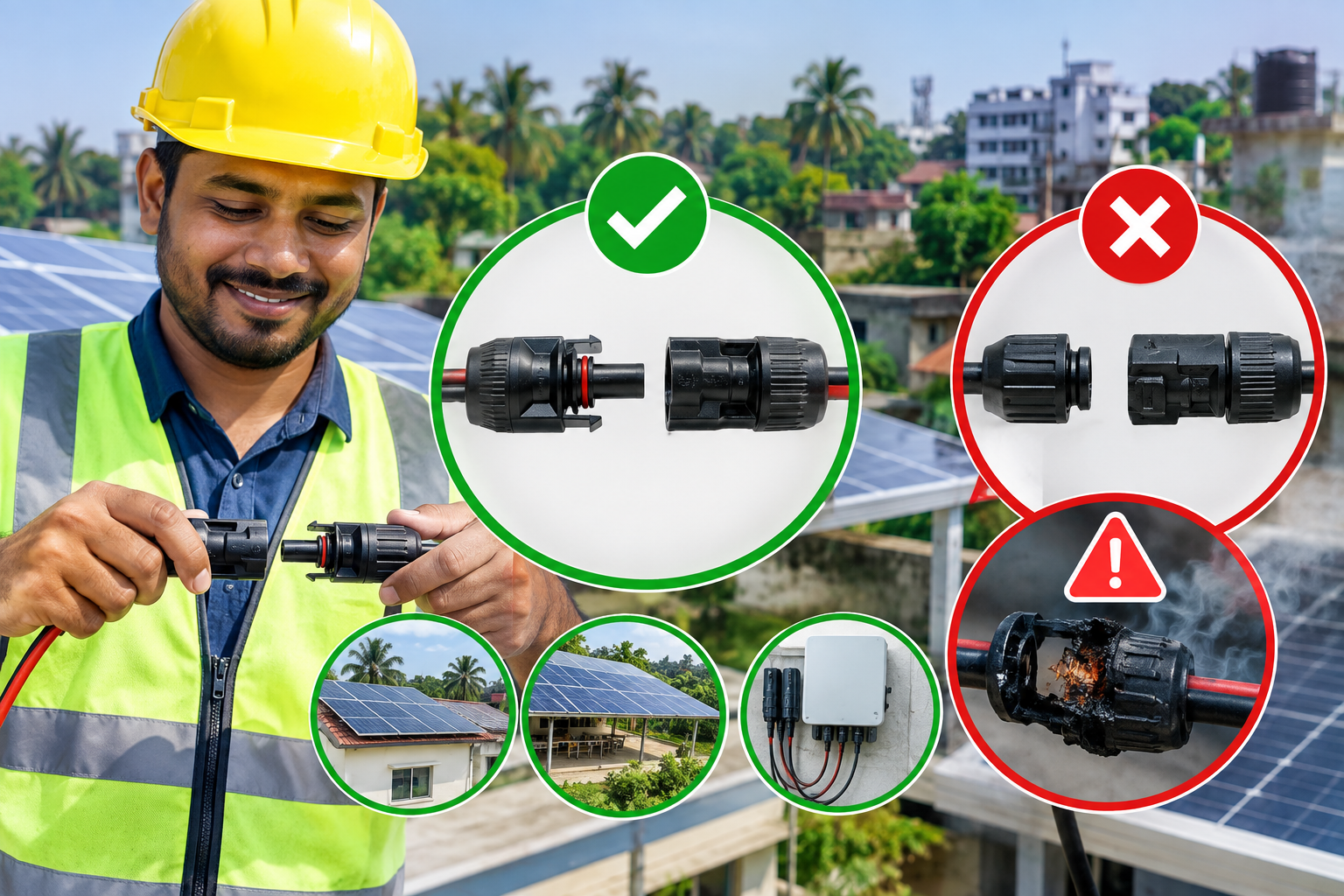
No — you shouldn’t mix MC4 connector brands within the same string, even though many of them are built to the same rough shape. Different manufacturers use slightly different contact materials, spring tension, and locking mechanisms. When a male connector from one brand mates with a female connector from another, the fit is often loose enough to raise electrical resistance at the contact point. That resistance turns into heat. Over months of sun exposure and current cycling, that heat causes the metal contacts to darken and pit — a process called carbonization — which can eventually lead to arcing inside the connector housing.
An arc fault at a rooftop connector isn’t a minor fault code on an inverter screen. It’s a source of ignition sitting a few centimeters from a metal roof, wiring insulation, and — on most Bangladeshi homes — a rooftop water tank or laundry line the family walks past every day.
Why “MC4-Compatible” Doesn’t Mean Safe
Here’s the part that trips people up. “MC4” isn’t a single company’s product — it’s a connector shape that Stäubli originally developed, and it’s now made by dozens of manufacturers worldwide, often labeled “MC4-compatible” or “MC4-style.”
That label is describing geometry, not electrical safety. A connector can slide into another brand’s housing and click into place — satisfying you that it “fits” — while still having the wrong pin diameter, a different plating thickness, or a spring contact rated for a different mating force. None of that shows up when you’re standing on a roof pushing two plugs together. It only shows up months later, as heat.
This is really the core confusion behind the whole topic: fitting together and being electrically compatible are two different claims, and connector packaging rarely makes that distinction obvious.
What the Standards Actually Say
Industry testing bodies and electrical codes are specific about this, and it’s worth knowing the names even if you never read the full documents yourself.
| Standard | What it covers | Relevant requirement |
| IEC 62852 | International standard for PV connectors | Requires matched connectors from the same manufacturer for a certified, safe mating |
| UL 6703 | North American connector standard | Same principle — connectors are only certified as a matched pair, not interchangeably |
| NEC 2020 (Article 690) | US National Electrical Code | Requires connectors of the same type and manufacturer be used for mating, when field-mating is required at all |
TÜV Rheinland’s testing work on connector failures is frequently cited as the basis for these rules — their analysis links mismatched connectors directly to the heat-buildup and arc-fault pattern described above. Bangladesh doesn’t currently enforce a domestic connector standard, so these international benchmarks are the closest thing to an objective safety line, even though local regulation hasn’t formally adopted them.
How to Check If Your Own Connectors Are Already Mismatched
Most homeowners don’t know their connectors are mismatched until something goes wrong — but there are a few things worth checking before that happens:
- The male and female halves don’t “click” firmly — there’s a slight wobble or looser resistance when you push them together
- The locking clip doesn’t seat the same way on both ends, or requires noticeably more force on one side
- The connector bodies are a slightly different shade of the same color, or have different textured grips — often a sign of a different manufacturer even when both are labeled MC4
- Any visible browning, discoloration, or a faint burnt smell near the connector — this is a warning sign regardless of brand and should be treated as urgent, not just a compatibility question
If you notice heat, discoloration, or a burning smell at any connector, that’s not a “monitor it” situation — get it inspected and, if needed, isolated before it’s used again.
What to Do When the Original Brand Isn’t Available
This is the situation most people are actually in, and it’s worth being honest about it rather than just repeating “use one brand.” Panel-specific OEM connectors — especially from Chinese panel manufacturers — often aren’t stocked separately in Bangladeshi electronics markets. What’s available locally is frequently a generic MC4-style connector of uncertain origin.
A few practical points:
- Ask specifically for connectors certified to IEC 62852 or UL 6703, and check for an IP67 (or higher) rating — this at least confirms the part meets a recognized bar, even if it’s not the exact original brand.
- Match the rated voltage (typically 1000V or 1500V DC, depending on your system), rated current (commonly around 30A), and cable cross-section (often 4mm² or 6mm²) to your system’s specifications — these figures are typical industry ranges, not universal, so check your panel’s datasheet rather than assuming.
- If you can’t find a certified match, replace the connector on both ends of that cable run with the same new brand, rather than pairing one new connector with the existing old one from a different manufacturer.
- For a full string replacement, it’s more cost-effective and safer to standardize the whole run on one certified brand than to patch it piece by piece.
A certified branded connector pair typically costs more than an uncertified generic pair — treat that as a general estimate rather than a fixed price, since it depends heavily on the supplier and system size.
Home Systems vs. Commercial and Industrial Systems
For a typical home rooftop system — a few kilowatts feeding a family’s daytime load and maybe a net-metering connection — the risk is concentrated but personal: it’s your roof, your home, and usually nobody checking connector temperatures regularly.
For commercial and industrial installations, the exposure is different. More strings mean more connection points, and a single mismatched connector is harder to spot visually across a large array. This is where scheduled thermal imaging earns its keep — an annual thermal scan can catch a connector running hotter than its neighbors long before it becomes a visible fault. Facility managers running larger arrays are generally better positioned to catch this early, provided inspection is actually built into the maintenance schedule rather than left until something trips.
What Happens If an Investigation Finds Mixed Connectors
It’s worth knowing this before it becomes relevant: if a rooftop fire or electrical fault is investigated and mismatched connectors are found, that detail can affect both the panel manufacturer’s warranty and any insurance claim tied to the system. Warranty terms from most manufacturers assume components were installed and maintained per their guidelines — and connector matching is typically part of that. This isn’t a scare tactic, just a practical reason to get it right the first time rather than treat it as a minor detail.
If you’re not sure whether your system’s connectors are properly matched, an inspection before an issue occurs is a lot cheaper than dealing with one after. As a solar provider working across rooftop and industrial installations in Bangladesh, connector mismatch is one of the more common preventable issues we see raised — usually traced back to a field repair where the exact original part just wasn’t on hand.
FAQs
Are all MC4 connectors the same?
No. Many are built to the same general shape, but contact materials, spring tension, and locking mechanisms vary by manufacturer — which is why mixing brands is discouraged even when the parts appear identical.
What happens if you mix MC4 connector brands?
Mismatched fit can raise electrical resistance at the contact point, leading to heat buildup over time. In the worst case, this progresses to carbonization and arc faults — a fire risk, not just a compliance issue.
How do I know if my MC4 connectors are certified?
Check for IEC 62852 or UL 6703 certification markings and an IP67 or higher rating on the connector housing or packaging. If the seller can’t confirm certification, treat it as unverified.
Is it safe to use a generic “MC4-compatible” connector?
“Compatible” typically describes shape only, not certified electrical performance. It’s not automatically unsafe, but it hasn’t been proven safe either — certification is the more reliable indicator.
What should I do if my exact connector brand isn’t sold in Bangladesh?
Replace both ends of the affected cable with a single certified brand rather than pairing a new connector with the old mismatched one. Matching specifications (voltage, current, cable size) matters more than matching the original brand name exactly.