Touch a loose wire behind a wall socket and you’ll understand instantly why junction boxes exist. That little metal or plastic enclosure isn’t just a formality — it’s the thing standing between a normal wire splice and a fire hazard.
A junction box is a protective enclosure that houses wire splices, terminals, and branch connections. It keeps live conductors away from accidental contact, contains sparks or heat from a loose connection before they spread, and keeps your wiring organized enough that an electrician can actually find and fix something later without tearing open a wall.
If you’ve ever had an electrician mention needing to “access the junction box” or seen one poking out of a ceiling near a fan, this is what they mean — and it matters more than most people realize, especially in a country where monsoon humidity and inconsistent wiring practices are common realities.
Junction Box vs. Pull Box vs. Outlet Box — Why People Mix These Up
These three get confused constantly because they all look like “a box with wires in it.” The difference comes down to purpose.
- Junction box: houses wire splices and branch connections — this is where wires are actually joined together.
- Pull box: a larger enclosure used purely to help route cable through long conduit runs. No splicing happens inside; it just gives an installer room to pull wire through without kinking it.
- Switch or outlet box: houses a device — a switch, socket, or outlet — rather than just a splice.
If your electrician says “we need a junction box here” versus “we need a pull box here,” they’re describing two different jobs, not the same thing with a different name.
Types by Material
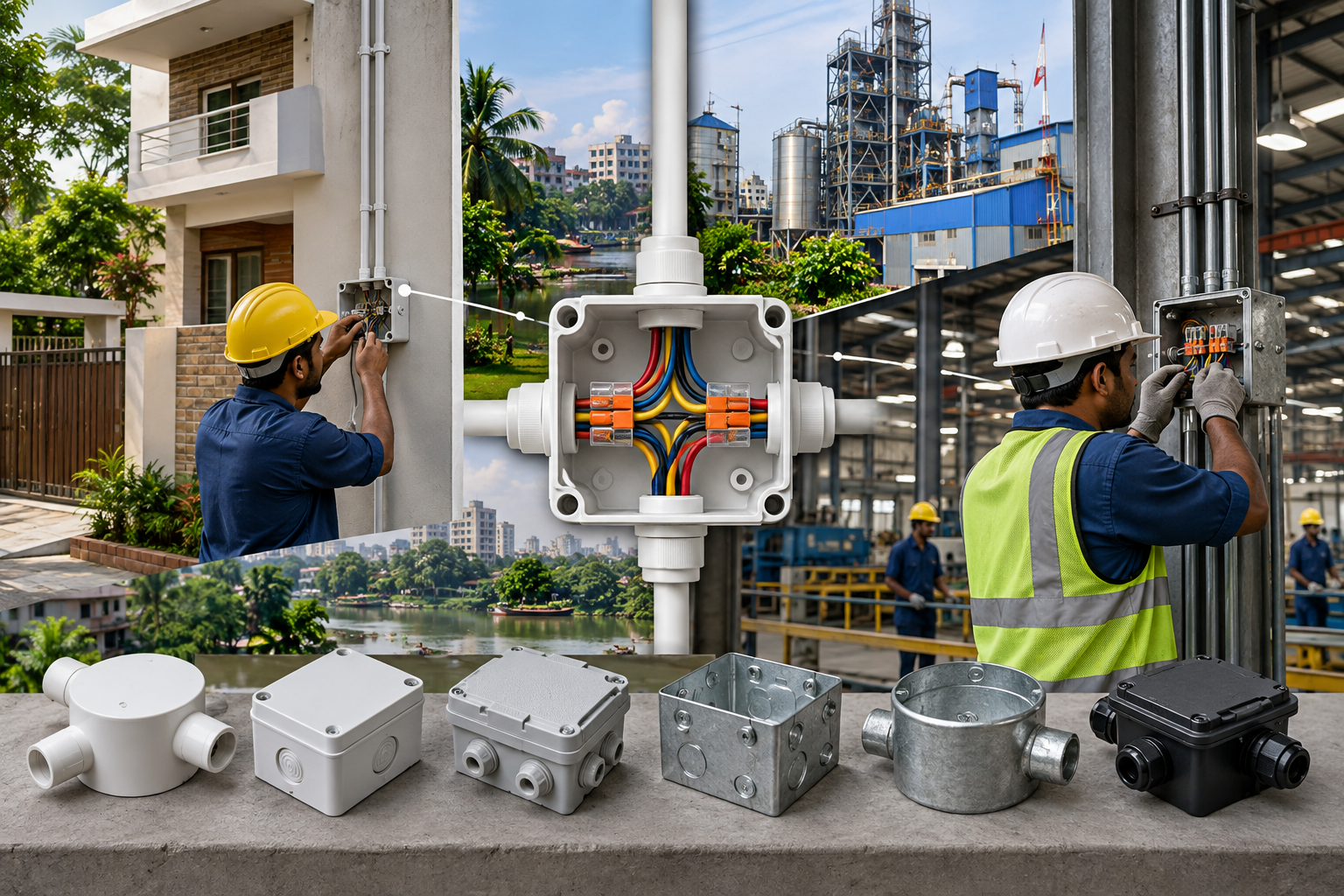
Metal boxes (steel or aluminum) are the standard for industrial settings. They’re durable, and because metal conducts, they support proper grounding — an important safety factor in facilities with heavier electrical loads, like a factory floor.
Plastic or PVC boxes are lightweight, don’t corrode, and are the common choice for ordinary indoor residential wiring — the kind you’d find in a typical Dhaka or Rajshahi apartment.
Fiberglass or stainless steel boxes resist corrosion far better than either of the above, which matters near the coast or in harsh industrial environments — think humid, salty air in Chattogram, or a chemical-heavy manufacturing plant.
There’s a genuine trade-off here worth being honest about: plastic is cheap and corrosion-resistant, but it isn’t suited to high-heat or hazardous locations. Metal grounds well but needs corrosion protection in a humid climate. Neither option is universally “better” — it depends on where the box is going.
Types by Shape
- Square and rectangular boxes — the standard choice for multiple wire connections, switches, or outlets.
- Round and octagonal boxes — typically used for ceiling light fixtures.
- Deep boxes — used when you’ve got a larger wire fill or bulkier devices that need more room inside.
Environmental Ratings: NEMA and IP Explained
This is where a lot of people get lost, and it’s also where getting it wrong actually causes problems — a box rated for indoor use won’t hold up on an exposed rooftop through a full monsoon season.
| Rating Type | Examples | Best Use Case |
| Standard indoor | — | Dust and accidental contact protection only; dry indoor spaces |
| NEMA 3R / 4 / 12 | Weatherproof/washdown | Outdoor exposure, rain, dust, occasional water jets |
| IP65 / IP67 | Ingress Protection | Seals against dust and water; common for outdoor and rooftop installations |
| Explosion-proof | — | Hazardous industrial settings where internal sparks must be contained |
For Bangladesh specifically, this matters more than in drier climates. Anything installed outdoors — a rooftop junction box, an exterior industrial connection — is dealing with sustained monsoon rainfall and high humidity for months at a time. A box that’s merely “dust-resistant” isn’t the same as one that’s actually weatherproof, and the difference shows up the first time it rains hard.
Specialized Types Worth Knowing
- Pull boxes — again, for routing wire through long conduit runs, not splicing.
- Ceiling fan boxes — reinforced specifically to support the rotating load and vibration of a fan, unlike a standard light fixture box.
- Instrumentation junction boxes — used to aggregate signals from multiple sensors, such as load cells in an industrial weighing system.
The Solar Connection: Combiner Boxes
If you’ve looked into rooftop or ground-mounted solar, you’ve likely come across the term “combiner box” or “PV junction box.” It’s the same underlying idea — a protective enclosure for wire connections — applied to a specific job: combining the output of multiple solar panel strings into a single feed before it reaches the inverter.
Because these sit outdoors, often facing direct sun and monsoon rain for years, they generally need a weatherproof rating (commonly IP65 or higher) and sometimes fire-rated components, given the heat exposure on a rooftop. It’s a detail that’s easy to overlook when people focus on panel wattage and inverter specs, but a poorly rated combiner box is a real point of failure in a solar system’s long-term reliability. This is one of the smaller decisions in a solar installation that quietly matters a lot — something to ask about directly when getting quotes.
How to Actually Choose the Right One
Four questions cut through most of the confusion:
- Where is it going? Indoor, dry location → standard box is fine. Outdoor, rooftop, or industrial washdown area → you need a NEMA or IP-rated weatherproof box.
- How many wires, and how big? More conductors or larger gauge wire need a bigger box — this is what “wire fill capacity” refers to, and it’s not just a suggestion; overcrowding a box is a real fire risk.
- What’s the environment like? Coastal air, chemical exposure, or a hazardous industrial setting each call for a different material — stainless steel or fiberglass over plain steel or plastic.
- What does local code require? The Bangladesh National Building Code (BNBC) covers electrical safety provisions, and compliance isn’t optional even if enforcement varies. When in doubt, this is a question for a licensed electrician rather than a guess.
One requirement that surprises a lot of first-time renovators: a junction box generally needs to remain accessible after installation. It shouldn’t be buried inside a finished wall or sealed permanently under drywall — if a connection ever needs to be checked or repaired, someone has to be able to actually reach it.
A Quick Note on Availability
Plastic and PVC junction boxes are generally easy to find through local electrical suppliers across Bangladesh. Explosion-proof and specialty fiberglass boxes tend to be less common locally and are more often imported — worth confirming with your supplier or contractor rather than assuming availability, since this varies by region and vendor.
Home vs. Industrial: The Practical Difference
For a homeowner, this usually comes down to picking a plastic box for indoor sockets and switches, and making sure anything outdoor-facing — an exterior light, a rooftop connection — is properly weatherproof rated.
For an industrial facility or contractor, the stakes are higher: grounding requirements, hazardous location classifications, and code compliance carry real safety and liability weight, and getting the wrong enclosure isn’t just inconvenient — it can mean a failed inspection or a genuine fire risk on a factory floor.
FAQs
What’s the difference between a junction box and a pull box?
A junction box houses actual wire splices and connections. A pull box is just a larger, empty enclosure used to help route cable through long conduit runs — no splicing happens inside it.
Is a junction box required by code?
Generally yes — wire splices need to be enclosed rather than left exposed, and the box needs to stay accessible after installation. Specific requirements should be confirmed with a licensed electrician familiar with the Bangladesh National Building Code.
What rating do I need for an outdoor junction box?
Look for a NEMA 3R/4/12 or IP65/IP67 rating at minimum. In Bangladesh’s climate, monsoon rain and humidity make a properly weatherproof rating important for anything installed outdoors, including rooftop solar connections.
Can a junction box be covered by drywall?
No — it needs to remain accessible so it can be inspected or repaired later. Sealing it permanently behind drywall is a common mistake during renovations.
Do solar systems use junction boxes?
Yes — solar installations use combiner boxes, which work on the same principle, to combine multiple panel string outputs before they reach the inverter. Since these are usually outdoors, they typically need a weatherproof rating.