
Why Two “Same Wattage” Solar Panels Aren’t Always Identical
Say you get two quotes for the same solar project. Both list “400W monocrystalline panels.” One supplier’s price is noticeably higher. You ask why, and the answer you get is vague — something about “better quality cells.” That’s not a satisfying answer, and it’s a fair thing to be suspicious about.
Part of the real answer usually has nothing to do with quality at all. It has to do with something called binning — a routine step in how solar panels are made and rated, one that most sales conversations skip entirely.
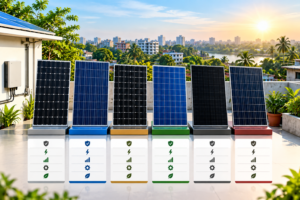
Solar panel binning is the process of sorting finished cells and modules into performance categories, based on their actual measured power output, before they’re packaged and sold under a single wattage label. Every “400W” panel in a batch didn’t come off the line producing exactly 400.0 watts. Manufacturing has natural variance, so the factory tests each unit and groups similar performers together — into “bins” — so a string of panels wired together behaves predictably.
That’s the short version. Here’s the part that actually matters for you as a buyer.
Why Isn’t Every Panel Identical in the First Place?
Solar cells are cut from silicon wafers and go through dozens of processing steps — doping, coating, screen printing, soldering. Even on a well-controlled production line, tiny differences creep in: a slightly thinner anti-reflective coating here, a marginally different contact resistance there. None of it is a defect. It’s just the reality of manufacturing something at the scale of millions of cells a day.
The result is that cells — and later, assembled modules — don’t all produce exactly the same power under identical test conditions. Some come out a bit stronger, some a bit weaker.
How Binning Solves the Mismatch Problem
Here’s why this matters more than it sounds like it should: when panels are wired together in a series string, they all have to carry the same current. If you connect a strong panel and a weak panel in the same string, the weak one drags the whole string down to its level. You don’t get an average — you get a bottleneck.
So manufacturers flash-test every module under Standard Test Conditions (STC) — a fixed, standardized set of light, temperature, and spectrum conditions used industry-wide — and measure its actual output, along with its maximum power current (Imp) and maximum power voltage (Vmp). Modules with closely matching current values get grouped into the same bin and sold under the same nameplate rating, typically in 5-watt steps (335W, 340W, 345W, and so on).
This isn’t a marketing trick. It’s quality control that protects you: it’s what keeps a whole array from underperforming because of a handful of weaker units buried in the batch.
What Does the Power Tolerance on a Datasheet Actually Mean?
This is where the “am I getting less than I paid for” worry usually starts. Every module datasheet lists a power tolerance — something like +3%/-0% or ±3%. That figure tells you how far the actual output is allowed to sit above or below the stated wattage.
A panel labeled 350W with a +3%/-0% tolerance can only ever measure between 350W and about 360.5W at STC. It can never legally be sold as “350W” if it tested below that. A panel with a ±3% tolerance, by contrast, could measure anywhere from about 339.5W to 360.5W.
That distinction is worth pausing on: positive-only tolerance (+X%/-0%) is generally the better spec from a buyer’s perspective, because every unit is guaranteed to meet or exceed the number on the label. A wider, two-sided tolerance means some units in the batch could legitimately test a little under the stated wattage.
| Bin Label | Typical Tolerance | Real Output Range (example) |
| 330W | +3%/-0% | 330W – 339.9W |
| 335W | +3%/-0% | 335W – 345.05W |
| 340W | +3%/-0% | 340W – 350.2W |
| 345W | +3%/-0% | 345W – 355.35W |
| 350W | +3%/-0% | 350W – 360.5W |
These figures are illustrative, based on a commonly used +3%/-0% tolerance. Actual tolerance and bin steps vary by manufacturer and model — always confirm the exact figure on the specific datasheet you’re buying against, not a general example like this one.
One important distinction that gets blurred a lot: power tolerance is not the same thing as long-term degradation. Tolerance is a one-time factory measurement taken before the panel ever leaves the production line. Degradation is how much output a panel loses over years of real-world use, which is covered separately by the performance warranty. A panel can have an excellent tolerance spec and still degrade at a normal rate over 25 years — the two numbers answer completely different questions.
Does Binning Actually Affect You?
It depends on which side of the purchase you’re on.
If you’re a homeowner buying a small residential system — say, a 5–8 panel rooftop array in an apartment building or house — binning mostly just explains why the datasheet has a tolerance line at all. Reputable suppliers sell panels in matched bins for exactly this reason, so a small residential string is unlikely to have a meaningful mismatch problem if it’s assembled correctly.
If you’re an EPC, procurement lead, or business owner sourcing panels for a commercial or industrial project — a factory rooftop in Gazipur, a warehouse system in Narayanganj, a larger commercial installation — bin consistency matters more, for a very practical reason: you’re buying in bulk, often across multiple containers, and possibly from more than one batch or even more than one factory run. A shipment that mixes bins inconsistently, or pairs modules with mismatched current ratings into the same string, can quietly shave a few percent off your system’s real-world yield. On a large array, a few percent is real money.
This is also where module-level power electronics — power optimizers or microinverters — come into the conversation. They let each panel operate independently rather than being locked to the weakest panel in its string, which reduces (though doesn’t eliminate) the practical impact of any mismatch. It’s not something every project needs, but it’s worth asking about if bin consistency is a genuine concern for your installation.
What to Check Before You Buy
A little datasheet literacy goes a long way here. Before signing off on a panel order, it’s worth checking:
- The exact tolerance figure stated on the datasheet — not a verbal assurance, the actual printed spec (e.g., +3%/-0% vs. ±3%)
- Whether the tolerance is positive-only or two-sided — positive-only is the stronger guarantee
- The Imp and Vmp values, especially if you’re mixing panels from different batches or suppliers in the same string
- Flash test reports for the specific batch, if you’re procuring at container scale — a reputable supplier should be able to provide these
- Whether the “quality difference” between two quoted prices is actually about binning, cell technology, or something else entirely — ask directly rather than accepting a vague answer
None of this requires an engineering degree. It just requires actually reading the datasheet instead of trusting the label on its own.
The Bangladesh Angle: Why This Matters More at the Import Stage
Bangladesh doesn’t have significant domestic solar cell or module manufacturing at scale — the overwhelming majority of panels sold here are imported, mainly from Chinese manufacturers. That changes where binning consistency actually becomes a practical concern for local buyers: it’s less about “which factory has better binning practices” and more about quality control at the point of import.
For smaller residential purchases, this rarely needs much thought — established suppliers and installers in Bangladesh generally source pre-binned, matched panels as a matter of course. But for larger commercial and industrial buyers importing container loads, it’s a legitimate part of due diligence: confirming that a shipment’s flash test data matches what’s on the datasheet, and that panels within the same string haven’t been mixed across inconsistent batches, is a reasonable thing to ask your supplier for — not an unusual or distrustful request.
This is also, honestly, a spec sheet most Bangladeshi buyers — residential and commercial alike — simply haven’t been trained to look for. Datasheet literacy is a genuine, quiet gap in the local market, and closing it is one of the more useful things a buyer can do before committing to a large order.
At Muspana, evaluating tolerance specs and bin consistency is part of how we vet the products we recommend — not because it’s unusual, but because it’s exactly the kind of unglamorous quality check that prevents underperformance complaints months after installation.
Common Questions
Does power tolerance mean I’m getting less than advertised?
Not if the tolerance is positive-only (e.g., +3%/-0%) — every unit in that bin is guaranteed to meet or exceed the stated wattage. A two-sided tolerance (±3%) means some units could legitimately test slightly below the label, so it’s worth knowing which type your datasheet specifies.
Is a 5W difference in binning noticeable in real output?
On its own, a 5W difference between adjacent bins (say, 340W vs. 345W) is small — roughly 1–1.5% of total output. It becomes more relevant when panels from different bins are mixed within the same series string, since the string’s output is limited by its weakest member.
Does binning affect panel lifespan or warranty?
No. Binning is a one-time factory measurement of initial power output. It has no direct bearing on how the panel degrades over time or what its performance warranty covers — those are separate specifications and should be checked independently.
How do I check a panel’s actual tolerance before buying?
Ask your supplier for the specific product datasheet (not a generic brochure) and look for the “power tolerance” line, usually expressed as a plus/minus percentage or wattage figure. For larger orders, you can also request batch-specific flash test reports.
FAQs
Q: Does power tolerance mean I’m getting less than advertised?
A: Not if the tolerance is positive-only (e.g., +3%/-0%) — every unit meets or exceeds the stated wattage. A two-sided tolerance (±3%) allows some units to test slightly below the label.
Q: Is a 5W difference in binning noticeable in real output?
A: On its own, it’s small (roughly 1–1.5%). It matters more when mismatched bins are combined within the same series string, since the string is limited by its weakest panel.
Q: Does binning affect panel lifespan or warranty?
A: No — binning measures initial output at the factory. Degradation and warranty coverage are separate specifications.
Q: How do I check a panel’s actual tolerance before buying?
A: Request the specific product datasheet and look for the power tolerance line; for bulk orders, ask for batch-specific flash test reports.