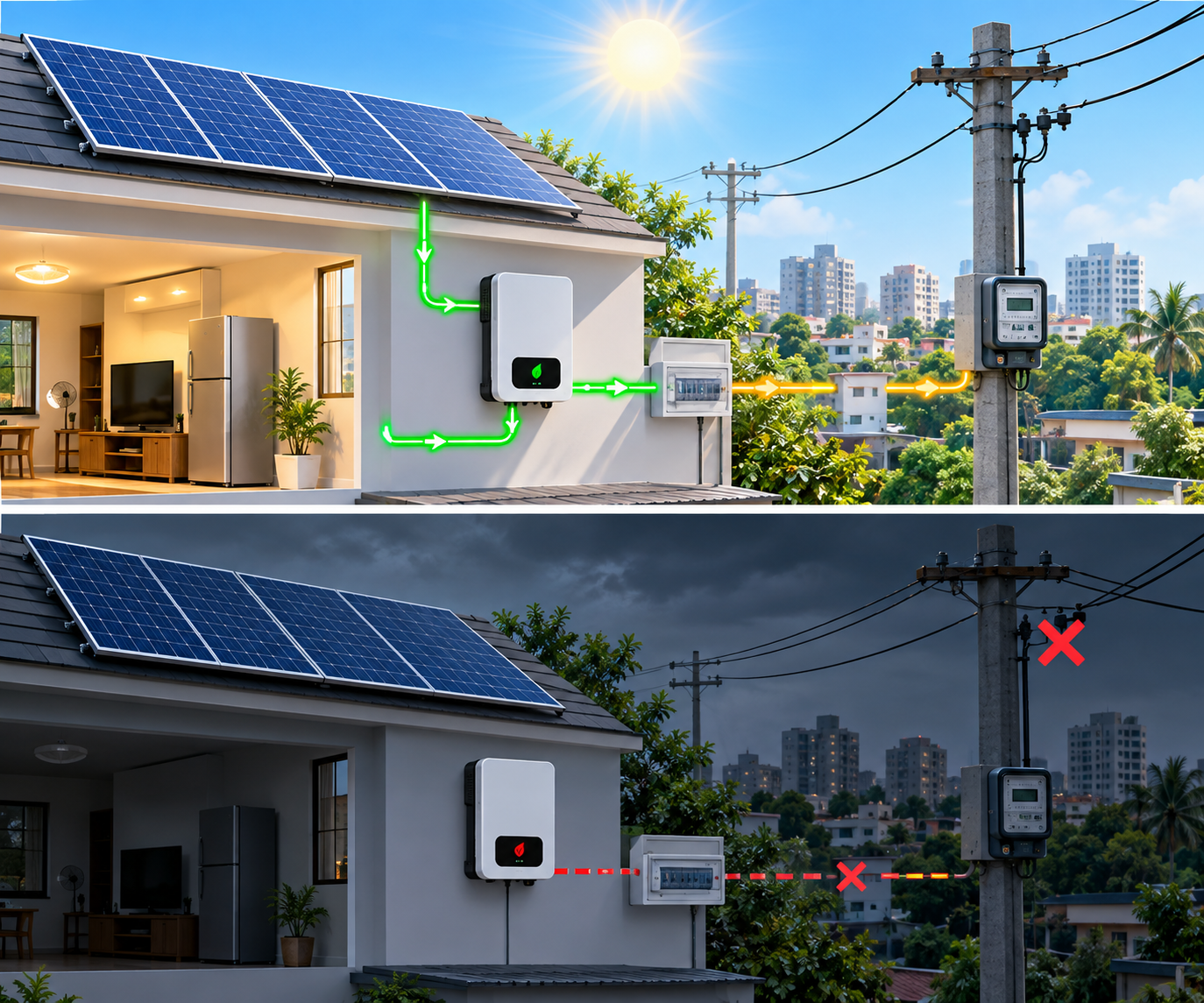
The power goes out. Load-shedding again. But your rooftop panels are sitting there in full sun, clearly generating something — and yet the lights inside stay off. If you’ve ever stood in your kitchen wondering whether your solar system is broken, it isn’t. It’s doing exactly what it’s designed to do.
What Is Anti-Islanding Protection?
Anti-islanding protection is a safety mechanism built into every grid-tied solar inverter that automatically shuts down solar power production the moment it detects the utility grid has gone down. Its job is to stop your system from continuing to feed electricity into a line that utility workers may believe is dead. Without it, a “grid-tied” system would keep exporting power during an outage — creating an “island” of live electricity on a supposedly disconnected line.
That’s the whole idea in one sentence, but it’s worth sitting with for a moment, because it explains almost everything else in this article.
Why This Happens: It’s a Safety Requirement, Not a Flaw
When there’s a blackout — whether it’s scheduled load-shedding or an unplanned fault — the utility assumes the line is completely de-energized. Linemen may be out repairing a fault on that exact section of the network, sometimes with bare hands on what they expect to be a dead wire.
If your grid-tied inverter kept pushing power into the grid during that outage, it would keep the line “live” without the utility’s knowledge. That’s a direct electrocution risk to repair crews, and it’s why grid-interconnection standards worldwide require inverters to disconnect within a short window once grid loss is detected — commonly cited as around two seconds, though the exact figure depends on the specific standard and inverter certification rather than being a single universal number.
This isn’t a Muspana design choice, and it isn’t something any manufacturer can legally skip. It’s a mandatory feature on essentially every grid-tied inverter sold anywhere, built to comply with grid interconnection standards such as IEEE 1547, which is the widely referenced international benchmark for this kind of protection.
How Inverters Actually Detect an Outage
Inverters don’t “know” the grid is down the way a person would notice a blackout. They’re constantly watching a handful of electrical signals and reacting the instant those signals move outside a normal range.
- Passive detection — The inverter continuously monitors voltage and frequency on the line. If either drifts outside the expected band (under/over-voltage or under/over-frequency protection), it assumes grid loss and shuts down. This is simple and fast, but can occasionally miss very small mismatches between generation and local load.
- Active detection — The inverter deliberately introduces a tiny disturbance into its own output — a slight frequency or current perturbation — and watches how the grid responds. A stable grid absorbs the disturbance; a disconnected “island” reacts more strongly, giving the inverter a clearer signal to shut down.
- RoCoF (Rate of Change of Frequency) — Rather than watching frequency alone, this method tracks how fast frequency is changing. A real grid disconnection tends to cause a sharp, sudden shift, which RoCoF-based detection can catch even in edge cases where basic voltage/frequency monitoring might hesitate.
Most modern grid-tied inverters combine more than one of these methods, layering them so that detection stays reliable even in borderline cases where load and generation happen to be closely matched at the moment the grid trips.
Grid-Tied vs Hybrid: What Actually Changes During an Outage
This is where the practical difference between system types becomes obvious — and where a lot of buyers get caught off guard after installation, rather than before.
| Grid-Tied Only | Hybrid (with Battery) | |
| Power during an outage | None — inverter shuts down completely | Continues supplying stored battery power to selected loads |
| Anti-islanding still active? | Yes | Yes, but only affects grid export, not battery backup |
| Upfront cost | Lower | Higher — battery and hybrid inverter add significant cost |
| Complexity | Simpler installation and maintenance | Requires battery sizing, maintenance, and eventual replacement |
| Best suited for | Areas with a stable grid and infrequent outages | Areas with frequent outages or load-shedding |
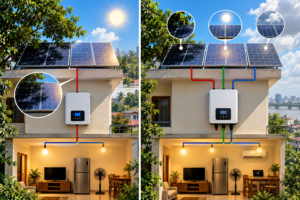
A grid-tied-only system isn’t malfunctioning when it goes silent during an outage — it’s structurally incapable of powering your home independently, because it has no stored energy source to draw from once it disconnects from the grid.
Why This Matters More in Bangladesh Than in Many Other Markets
A lot of the technical material on this topic is written for grids where outages are rare and mostly unplanned. In Bangladesh, load-shedding is frequent enough, and predictable enough, that this isn’t a rare edge case — it’s a regular part of daily electricity use in many areas. That changes the calculus considerably compared to a market where a blackout might happen once or twice a year.
If your household or business experiences load-shedding on a near-daily basis, a grid-tied-only system means solar effectively contributes nothing during exactly the hours you’d want backup power most. That’s not a defect in the system — it’s a mismatch between what grid-tied solar is designed to do (offset your daytime grid bill and export surplus) and what many buyers actually want it to do (keep the lights on during a cut).
It’s also worth noting, as general guidance rather than a specific citation, that rooftop solar systems seeking net metering approval are generally expected to meet grid-interconnection safety requirements — anti-islanding being a core part of that. If compliance details matter for your project, it’s worth confirming the current requirement directly with your installer or the relevant utility, since exact documentation and standards references can be updated over time.
What to Do If You Want Power During Load-Shedding
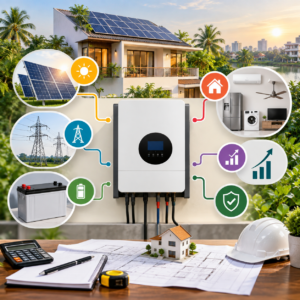
If backup power during outages is the actual goal, the fix isn’t to disable anti-islanding — that’s not possible, and wouldn’t be legal even if it were, since it’s a mandatory safety feature, not an optional setting. The realistic path is a hybrid inverter paired with battery storage, which keeps critical loads (lights, fans, a refrigerator, routers) running from stored energy even while the inverter has correctly disconnected from the grid.
This does mean a higher upfront cost and some added maintenance responsibility for the battery over its lifespan, so it’s genuinely worth weighing against how often outages actually affect you before committing. If you’re at the stage of comparing options, Muspana’s guide on choosing a hybrid solar inverter walks through sizing and selection factors specific to backup-power use cases, which is a more useful starting point than assuming any grid-tied system will “just work” during a cut.
Common Questions People Ask About This
Is anti-islanding a fault or is my system working correctly?
It’s working correctly. Shutting down during a grid outage is the intended, required behavior of every grid-tied inverter — not a sign of a broken component.
Can I disable anti-islanding to get power during an outage?
No. It’s a mandatory safety feature tied to grid-interconnection standards, and disabling it would risk feeding electricity into a line utility workers may be treating as dead. It’s also not something installers or inverters are built to allow you to switch off.
How do I get solar power during load-shedding?
You need battery storage paired with a hybrid inverter. A grid-tied-only system has no way to store or supply power once it disconnects, no matter how sunny the day is.
Does anti-islanding affect how my system performs on a normal day?
No. It has zero impact on daily generation, export, or efficiency. It only activates when the inverter detects that the grid itself has gone down.
Is a hybrid system worth it if load-shedding isn’t frequent where I live?
That depends on how much outage frequency actually affects you. In areas with infrequent, short outages, a grid-tied-only system paired with grid power is often the more cost-effective choice; the added battery expense makes more sense where outages are frequent or where specific loads (medical equipment, business operations) genuinely can’t tolerate downtime.
FAQs
Is anti-islanding a fault or is my system working correctly?
It’s working correctly — shutting down during an outage is the required, intended behavior of every grid-tied inverter.
Can I disable anti-islanding to get power during an outage?
No. It’s a mandatory grid-safety feature and isn’t something inverters or installers allow you to switch off.
How do I get solar power during load-shedding?
You need a hybrid inverter with battery storage. A grid-tied-only system has no way to supply power once it disconnects from the grid.
Does anti-islanding affect normal daily performance?
No — it has no impact on generation or efficiency and only activates when the grid itself goes down.
Is a hybrid system worth the extra cost if outages are rare where I live?
Often not — grid-tied-only tends to make more financial sense with infrequent outages, while hybrid becomes more worthwhile the more frequently or critically you rely on backup power.