Why Your Solar Panels Are Almost Always Bigger Than Your Inverter
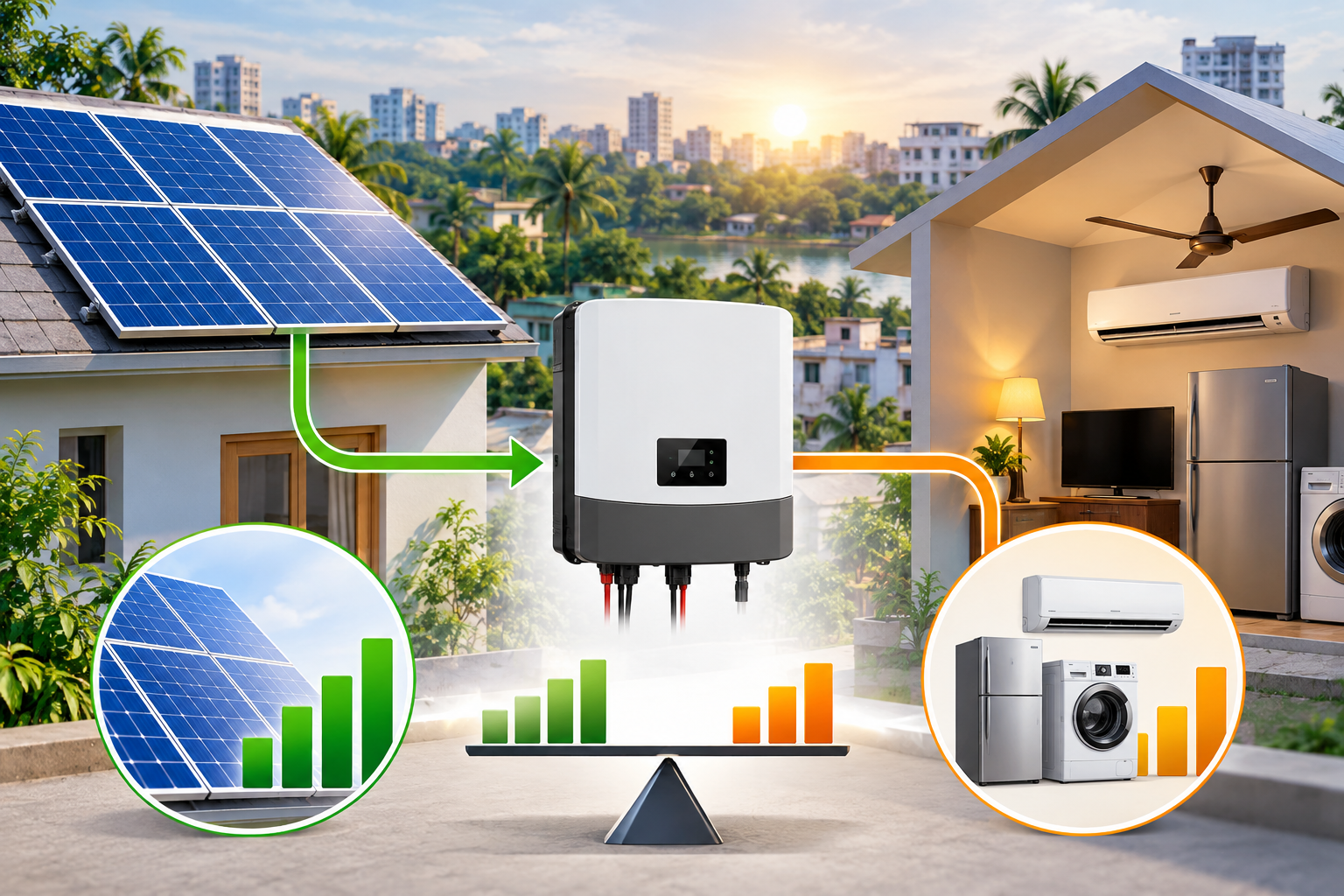
If you’ve looked at a solar quote and noticed the panels add up to more capacity than the inverter is rated for, that’s not a mistake. It’s standard practice, and there’s a name for it: the DC-to-AC ratio, or Inverter Loading Ratio (ILR).
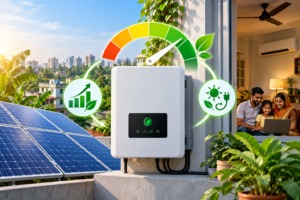
Here’s the direct answer: for most solar installations, a good DC-to-AC ratio falls between 1.1 and 1.3 — meaning the solar array’s DC output capacity is 10% to 30% larger than what the inverter can convert to AC at once. It sounds like waste. It isn’t.
Solar panels rarely hit their rated capacity in real-world conditions. Heat reduces output. Morning haze, afternoon clouds, dust on the panels, and the sun sitting at an angle instead of dead overhead all chip away at what the panels actually produce compared to their lab-tested rating. An inverter sized to exactly match the panels’ rated capacity spends most of the day running below its own potential — and the few minutes it could theoretically hit 100% barely matter to your annual output.
Oversizing the array slightly means the inverter spends more hours of the day running near its efficient operating range, instead of loafing along under a system that was sized for a peak it rarely sees.
How Much Oversizing Is Right? It Depends on the System
There isn’t one universal ratio — the right number shifts depending on the type of installation, the climate, and whether batteries are involved.
| System type | Typical DC:AC ratio | Why |
| Residential rooftop | 1.15 – 1.25 (up to 1.3 in cloudier regions) | Balances yield gains against clipping risk on a small, simple system |
| Commercial rooftop | 1.20 – 1.30 | Daytime load profiles justify more oversizing |
| Utility-scale, fixed-tilt | 1.25 – 1.34 | Larger systems can absorb more clipping economically |
| Utility-scale, single-axis tracker | 1.35 – 1.45 | Trackers extend the hours of lower-angle sun, so more DC capacity gets used |
| Hot, high-irradiance climates | 1.1 – 1.2 | Heat lowers panel output enough that aggressive oversizing risks real clipping losses |
| Hybrid systems with DC-coupled batteries | 1.4 – 1.8 | Power that would otherwise be clipped gets stored instead of lost |
Two things worth calling out. First, single-axis trackers are close to a non-issue for most Bangladeshi installations — they’re a utility-scale, open-land technology, and land-constrained rooftop or small ground-mount projects here won’t use them. If you’re designing for a factory roof in Gazipur or a commercial building in Dhaka, the tracker row of that table is background information, not a decision you’ll actually make.
Second — and this is the one that matters most locally — Bangladesh’s climate pulls you toward the lower end of these ranges, not the higher end.
Why Bangladesh’s Heat Changes the Calculation
Solar panels lose efficiency as they get hotter. That’s not a defect — it’s basic semiconductor physics, and every panel datasheet has a temperature coefficient that quantifies it. During Bangladesh’s hot months, especially April through September, panel surface temperatures on a rooftop can run well above the 25°C conditions panels are rated at in a lab.
The source guidance on this point is genuinely useful, not just a box to check for a Bangladesh-facing article: in high-irradiance, hot climates, a lower ratio — around 1.1 to 1.2 — is generally preferred. The reasoning is straightforward. If heat is already cutting into how much power your panels can put out, oversizing the array aggressively just increases how often you’re pushing more DC capacity at the inverter than it can use — and now you’re clipping more than you intended, without the yield benefit that oversizing is supposed to deliver.
This isn’t a hard rule etched into any Bangladeshi regulation — there’s no SREDA or DISCO mandate on ILR that we’re aware of. It’s an engineering judgment call your designer should be making with your local temperature and irradiance data, not a number pulled from a spec sheet written for a cooler market.
The Voltage Check Most Guides Skip
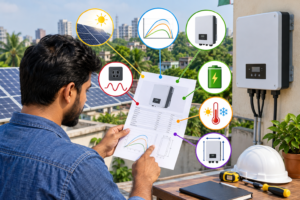
Sizing ratios get most of the attention, but there’s a second check that matters just as much, and it’s the one that gets glossed over in a lot of generic content: your inverter has voltage limits, and your array’s voltage shifts with temperature — in the opposite direction from what you might expect.
Two things need to hold true:
- On the coldest mornings, panel voltage rises. Your string’s open-circuit voltage (Voc) at the coldest expected temperature must stay under the inverter’s maximum DC input voltage. Exceed it, and you risk tripping the inverter or damaging it.
- On the hottest afternoons, panel voltage drops. Your string’s operating voltage (Vmp) at the hottest expected temperature must stay above the inverter’s minimum MPPT (Maximum Power Point Tracking) voltage. Drop below it, and the inverter can’t track the panel’s peak output efficiently — you lose production even though the panels are generating fine.
In a Bangladeshi context, the hot-side check deserves more attention than the cold-side one — a mild winter morning in Bogura or Rajshahi isn’t pushing string voltage anywhere near dangerous highs, but a scorching rooftop in June absolutely can pull operating voltage down toward the MPPT floor, especially on longer strings. Any designer sizing your system should be running both checks against your actual string length and your specific inverter’s datasheet — not assuming a ratio that works on paper also clears the voltage limits.
What Counts as Acceptable Clipping
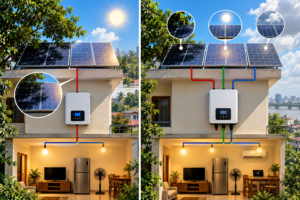
Some clipping is expected, not a sign something went wrong. When your array produces more DC power than the inverter can convert, the inverter simply caps its output at its rated AC capacity — the excess isn’t harvested, but nothing is damaged.
A common design tolerance in the solar industry treats 1% to 3% of annual production lost to clipping as economically reasonable — the extra energy harvested during the low-light hours of the day (morning, late afternoon, cloudy stretches) more than makes up for what’s lost during the brief midday peaks when the array outruns the inverter. Treat this as a general industry guideline your designer weighs against your specific site and load pattern, not a fixed target every system should hit exactly.
Where Batteries Change the Math
If your system includes a DC-coupled battery — increasingly relevant given how often the grid drops out in parts of Bangladesh — the sizing conversation shifts.
In a battery-less grid-tied system, clipped DC power is simply lost. In a DC-coupled hybrid system, that same clipped power can be routed to the battery instead of being thrown away. That changes the economics enough that ratios of 1.4 to 1.8 become reasonable, well above what you’d size for a straightforward grid-tied rooftop system. Some industry estimates put the annual yield gain from this kind of aggressive oversizing at up to 12% — worth noting as a general figure from the wider industry rather than a number specific to any single installation, since actual gains depend heavily on battery capacity, load-shedding patterns, and how the system is used day to day.
This is arguably where the calculation matters most in Bangladesh. If load-shedding means your battery is doing real work covering gaps in supply, DC power that would otherwise be clipped away on a grid-tied-only system has genuine value here — it’s the difference between lost generation and stored resilience.
One More Local Factor: Net Metering Export Limits
If your system is grid-connected and covered by Bangladesh’s net metering framework, there’s a second-order effect worth knowing about. An oversized DC array that clips reduces how much AC power actually reaches the export meter at any given moment — which interacts with whatever export cap applies under your net metering agreement. It’s not a reason to avoid oversizing, but it’s one more variable your designer should be accounting for when the ratio decision meets the export-limit rules of your specific connection.
Getting the Ratio Right Isn’t a DIY Spreadsheet Job
Between temperature derating, string voltage windows, clipping tolerance, and (if applicable) battery economics, the “right” ratio for a given roof isn’t something to eyeball from a table. It’s a calculation that needs your actual site data, your inverter’s real datasheet limits, and — ideally — your local temperature extremes, not just a rule of thumb copied from a cooler market. Muspana’s design process runs these voltage and clipping checks as a standard part of every quote, rather than defaulting to a generic ratio and hoping it holds up on-site.
FAQs
What is a good DC to AC ratio for solar panels?
Most systems perform well with a ratio between 1.1 and 1.3, meaning the panels’ rated DC capacity is 10–30% larger than the inverter’s AC output rating. The right number within that range depends on climate, system type, and whether batteries are involved.
Is a higher DC to AC ratio always better?
No. Beyond a certain point, a higher ratio just means more clipped power that never gets converted. In hot climates like Bangladesh’s, pushing the ratio too high increases clipping losses without a matching yield gain.
Does inverter clipping damage the inverter?
No. Clipping simply means the inverter caps its output at its rated capacity when the array produces more DC power than it can convert. It’s a normal, expected part of oversized-array design, not a fault condition.
Why does Bangladesh’s climate affect the ideal ratio?
High heat reduces panel output, which is the opposite of what aggressive oversizing assumes. In hot, high-irradiance conditions, a lower ratio (around 1.1–1.2) generally makes more sense than the higher ratios used in cooler climates.
Should hybrid systems with batteries use a different ratio?
Yes. Since clipped DC power can be stored in a DC-coupled battery instead of being wasted, hybrid systems can reasonably use much higher ratios — often 1.4 to 1.8 — especially where battery backup is doing real work covering grid outages.
Who should decide the exact ratio for my system?
A qualified solar designer, working from your actual roof conditions, inverter datasheet, and local temperature extremes — not a fixed number pulled from a generic table. Voltage limits and clipping tolerance both need checking against your specific hardware before the ratio is finalized.