
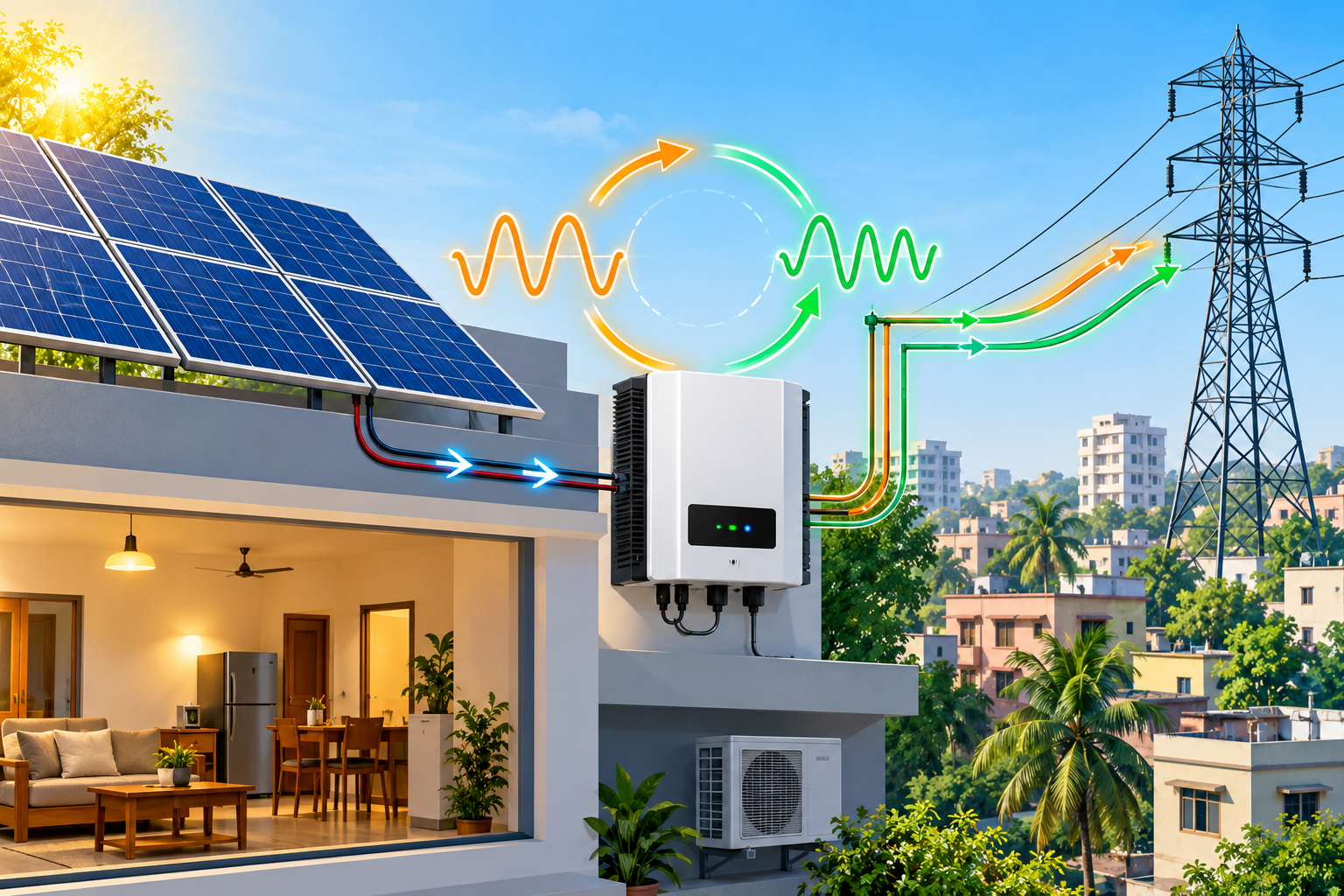
A solar plant doesn’t just push electricity onto the grid and walk away. Every inverter connected at the point of common coupling is also managing something less visible: reactive power. Get it wrong, and you end up with voltage swings, tripped interconnection agreements, or a utility that simply won’t sign off on your plant. Get it right, and the inverter is quietly doing work that used to require a room full of capacitor banks.
This matters more than most procurement checklists suggest, especially for anyone specifying equipment for a plant that will sit on a grid known for voltage instability — which, if you’ve worked on interconnected solar in Bangladesh, is a familiar problem.
What reactive power compensation actually means
Every AC electrical system carries two kinds of power: active power (measured in kW), which does real work — running motors, lighting, heating — and reactive power (measured in VAR), which doesn’t do work directly but keeps voltage where it needs to be. The two combine into apparent power (kVA), and the ratio between active and apparent power is your power factor (cosφ).
Reactive power compensation is simply the act of injecting or absorbing VARs to keep grid voltage within acceptable limits. Historically, utilities did this with capacitor banks — physical hardware installed at substations. Modern grid-tied inverters can do the same job electronically, adjusting their output in real time based on what the grid is doing at that exact moment.
Why this matters on Bangladesh’s grid specifically
Bangladesh’s distribution network is split across six utilities — BPDB, BREB, DESCO, DPDC, WZPDCL, and NESCO — each managing different service areas with varying degrees of infrastructure age and load density. Voltage fluctuation at the low- and medium-voltage distribution level is a known issue, particularly during peak demand periods or in areas with long feeder lines and mixed industrial-residential loads.
For a solar plant feeding into that kind of grid, reactive power support isn’t an abstract engineering nicety — it’s a practical hedge against voltage sag or overvoltage events that can trip protection systems or degrade equipment over time.
One caveat worth being upfront about: it’s not yet confirmed whether Bangladesh’s Net Metering Guidelines or individual DISCO interconnection standards specify a mandatory power factor or Volt-Var compliance threshold for grid-tied solar. If your project requires certainty on this, that’s a conversation to have directly with the relevant DISCO during the interconnection approval process — don’t assume a number without checking.
How inverters actually do this: three control modes
Modern grid-tie inverters typically support a few different reactive power control strategies. They’re not interchangeable — each suits a different situation.
| Mode | How it works | Best suited for |
| Volt-Var function | Continuously adjusts reactive power output based on real-time voltage readings, correcting over- or under-voltage automatically | Grids with fluctuating voltage conditions — dynamic, self-correcting |
| Power Factor Control | Holds a fixed power factor at the point of common coupling to meet a utility-specified target | Situations where the utility sets a firm compliance requirement |
| Constant Q Mode | Delivers or absorbs a set amount of reactive power regardless of what voltage is doing | Fixed, predictable reactive power needs — simpler but less responsive |
None of these is universally “better” — the right choice depends on what your interconnection agreement actually asks for, and what the grid conditions at your specific site look like.
Smart inverters vs. capacitor banks
This is usually where the practical decision gets made, so it’s worth laying out honestly rather than assuming smart inverters win by default.
| Factor | Smart inverter (Volt-Var/PF control) | Capacitor bank |
| Responsiveness | Dynamic — adjusts in real time | Static — fixed correction, doesn’t adapt |
| Operation at night | Can supply reactive power support even with zero solar generation | Works independently of solar output too, but with no adaptive control |
| Infrastructure stress | Reduces additional hardware at site | Adds physical equipment, switching gear, maintenance points |
| Simplicity | Requires correct inverter configuration and firmware support | Simple, well-understood technology, no software dependency |
| Best fit | Sites needing dynamic voltage regulation or variable renewable penetration | Sites with a stable, known, fixed reactive power correction need |
The source data doesn’t include cost figures for either option in a Bangladesh context, and it would be misleading to invent them — actual costs depend heavily on inverter brand, capacity, and whether capacitor bank infrastructure is already in place at a given substation. Treat any cost comparison you see elsewhere as a general estimate, not a local quote.
What to check before you specify an inverter
This is the part most competitor content skips entirely. If reactive power compensation matters for your project, here’s what to actually verify before signing off on equipment:
- Does the DISCO have a stated reactive power or power factor requirement for your interconnection point? Ask directly — don’t assume.
- Does the inverter’s datasheet confirm Volt-Var and Constant Q support, or only basic power factor correction?
- Is the reactive power capability rated separately from active power output, or does supplying VARs eat into your usable kW headroom near full capacity? This trade-off is real and worth asking your supplier to clarify.
- Can the inverter supply reactive power at night, if your site has a specific need for 24-hour voltage support?
- Is the firmware/configuration for these modes something your EPC or O&M team can adjust on-site, or does it require manufacturer involvement?
Getting clear answers to these before procurement avoids the awkward situation of discovering a compliance gap after the plant is already commissioned.
Reactive power support is one of several site-specific decisions worth working through with whoever is sizing and specifying your inverter — it’s easier to build into the design phase than to retrofit later.
FAQs
What is reactive power compensation in a solar inverter?
It’s the process of a grid-tied inverter injecting or absorbing reactive power (VARs) to help keep grid voltage within acceptable limits, using control modes like Volt-Var, power factor control, or Constant Q.
Can solar inverters provide reactive power support at night?
Many modern smart inverters can, since reactive power support doesn’t require active solar generation — it depends on the inverter’s design and configuration, not sunlight.
Is reactive power compensation mandatory for grid-tied solar in Bangladesh?
This varies by DISCO and interconnection agreement, and it isn’t something to assume — confirm the specific requirement with your utility during the approval process.
What’s the difference between kVA and kW?
kW is active power that does real work; kVA is apparent power, the combination of active and reactive power. The ratio between them is your power factor.
Do smart inverters replace capacitor banks entirely?
Not always. Smart inverters offer more dynamic, responsive control, but capacitor banks remain a straightforward option where a fixed, known reactive power correction is all that’s needed.