Battery Room Ventilation Requirements: What Your Batteries Actually Need
A common belief goes like this: lithium batteries need no ventilation, and lead-acid batteries just need a window nearby. Both halves are only partly true, and the gap between “partly” and “fully” is where most mistakes happen.
Battery room ventilation requirements depend on your battery type, your room and your climate. This guide separates the three risks people mix up: gas, heat and fire.
What is the short answer?
Flooded lead-acid batteries need real ventilation to the outdoors, because they release hydrogen while charging. Lithium (LiFePO4) batteries release almost no gas in normal use, so they need cooling and correct placement rather than gas ventilation. Always follow your battery manufacturer’s installation manual first.
| Flooded lead-acid | VRLA / sealed lead-acid | Lithium (LiFePO4) | |
| Hydrogen during normal charging | Yes, meaningful | Very little, but can vent under overcharge | Not significant |
| Main ventilation concern | Gas | Gas (limited) and heat | Heat |
| Typical solution | Fresh air in, exhaust to outdoors | Airflow, no sealed enclosure | Cool, shaded, ventilated space per datasheet |
| Biggest mistake | Sealed cupboard | Treating “sealed” as “no airflow needed” | Ignoring temperature limits |
Hydrogen, heat and fire are three different problems
Most articles treat “ventilation” as one thing. It is really three jobs.
- Hydrogen control matters for lead-acid. Hydrogen is flammable, and the aim is to keep it far below the level where it can ignite.
- Heat control matters for every battery. Hot batteries age faster and can behave badly.
- Fire safety is about what happens if something fails. It involves spacing, materials and location, and ventilation alone does not solve it.
A fan can help with the first two. It cannot fix the third. Keep that in mind, because a lot of confusion comes from expecting one measure to cover everything.
How much ventilation does a lead-acid battery room need?
Hydrogen becomes explosive at roughly 4% of air by volume. Safety design therefore aims to hold concentration well below that, commonly around 1%.
International practice usually offers two routes:
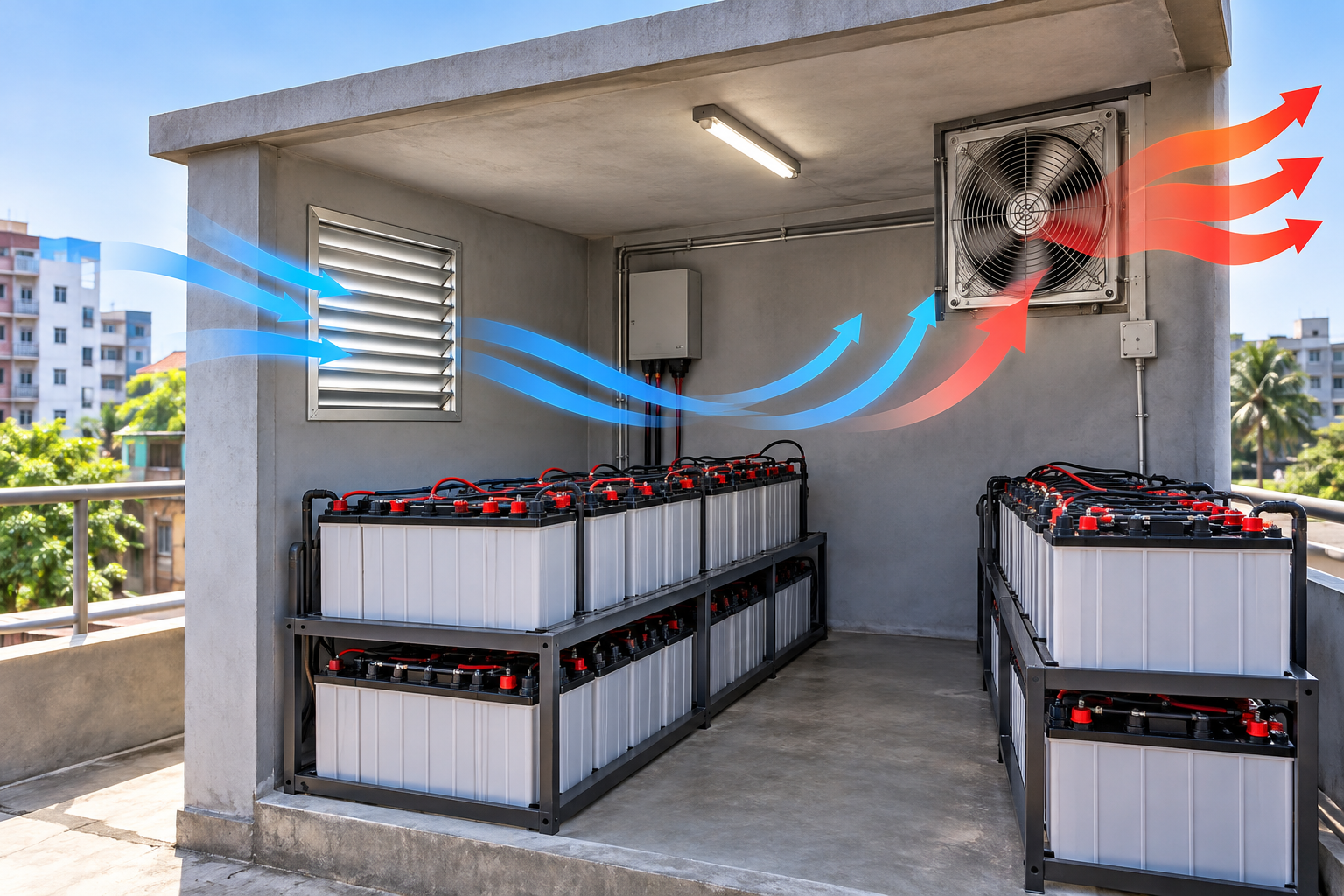
- Continuous ventilation: A commonly cited benchmark is about 1 cubic foot per minute for every square foot of floor area, exhausted directly outdoors. In metric terms that is roughly 18 cubic metres per hour for every square metre of floor.
- Monitored ventilation: A hydrogen detector starts the fan when gas reaches a set fraction of the explosive limit.
These figures come from US-based codes and guidance. They are a benchmark, not Bangladeshi law. Check the current text of the standard, or ask an engineer, before you design to them.
A worked example
This is an illustration, not a design. Suppose a small business has a dedicated battery room of 10 square metres with a flooded lead-acid bank.
- Benchmark airflow: 10 m² × about 18 m³/h per m² = about 180 m³/h
- That means a fan properly sized to move that much air, an inlet for fresh air, and a duct that discharges outdoors.
Larger banks, frequent heavy charging or a tight room may need a proper gas-evolution calculation. That is engineer territory.
What about sealed (VRLA) batteries?
They recombine most of the gas internally, so the risk is lower. But “sealed” does not mean “no gas ever.” Under overcharging or a failing charger, they can vent. Give them airflow and keep them out of airtight boxes.
Do lithium batteries need ventilation?
For gas, usually not in normal operation. For heat, yes.
Lithium (LiFePO4) batteries do not release meaningful hydrogen while working normally, so most manufacturers focus on temperature range and placement rather than exhaust fans. The manufacturer’s datasheet sets the limits, so use that number and not a generic one.
Two cautions:
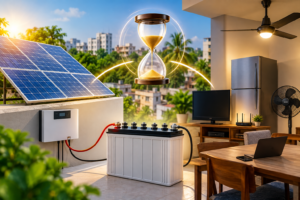
- Heat is the real issue in Bangladesh. A closed balcony store or top-floor utility room can get very hot in summer. Batteries in a hot enclosure lose performance and life.
- Failure is different from normal operation. If a lithium cell fails badly, it can release flammable and toxic gases. Ventilation will not stop that. Good placement, a quality BMS and correct installation are the defence.
For more on system-level protection, see how a battery management system (BMS) works.
Why Bangladesh makes this harder
The rules in foreign guides assume mild climates and purpose-built rooms. Local conditions change the picture.
- Heat and humidity: Ambient temperatures push battery rooms hot. As a rule of thumb often quoted for lead-acid, every 8 to 10°C above around 25°C can roughly halve battery life. Treat that as a rule of thumb, not a guarantee.
- Apartments: Batteries often end up on a balcony, under stairs or in a bedroom corner.
- Lead-acid is still common: Many homes and small businesses run tubular or flooded batteries with an IPS, so hydrogen is a live issue.
- Load-shedding: Frequent charging cycles mean more chances for gas release.
- Dust and monsoon: Fan filters clog, and humidity corrodes terminals and wiring.
- Sourcing: Spark-resistant fans and hydrogen detectors may be harder to find locally than standard fans.
As far as we know, there is no widely referenced Bangladesh standard written specifically for home battery room ventilation. Check the current Bangladesh National Building Code and ask your local fire service authority before finalising a commercial installation. Where local rules are silent, international codes are a reasonable benchmark, provided you say so and adapt them.
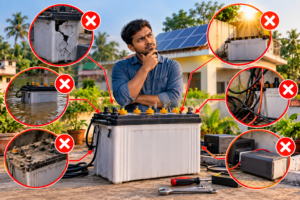
Where should you not put batteries?
A short list, easy to check against your own home:
- In a bedroom or a sleeping area
- In a sealed cupboard, box or closed cabinet (especially for lead-acid)
- Near a gas stove, LPG cylinder or any open flame
- Under a staircase or in any escape route
- In direct sun, or on a balcony with no shade
- Directly against a hot wall or beside a hot appliance
Better options: a ventilated utility space, a shaded outdoor-facing wall, or a dedicated battery room with a fire-resistant enclosure. Leave working space around the batteries for airflow and service access.
Fans, ducting and clearances
- Fans: For flooded lead-acid, choose a continuous-duty, spark-resistant type. Ordinary fans with exposed motors are not ideal in a hydrogen-prone space.
- Exhaust: Discharge outdoors, away from windows, air intakes and people.
- Ducting: Use non-combustible materials such as PVC or FRP where appropriate.
- Clearance: Some international codes call for about 3 feet (around 1 metre) around battery systems. This is a US-based figure. Use it as a guide, and follow your manufacturer’s spacing instructions first.
Home vs industrial: what changes?
At home, the priority is simple: pick the right location, keep batteries out of living spaces and give them airflow. For a small VRLA or lithium bank in a well-placed, shaded spot, this is usually manageable.
In a factory or commercial building, larger banks change the problem. You may need calculated airflow, hydrogen detection, fire-rated construction and approval from the relevant authority. Insurance may also ask for evidence. Large lithium installations can trigger additional fire-protection requirements that go beyond ventilation, so this is not a do-it-yourself job.
If you are planning storage for a factory, the guides on solar for industries and solar storage economics help frame the wider decision.
A quick placement check
Before installing, run through this:
- Identify your battery type (flooded, VRLA or lithium) and read the manufacturer’s manual.
- Choose a location away from bedrooms, kitchens, escape routes and flames.
- Check temperature: is the space shaded and within the datasheet range in summer?
- For lead-acid, confirm there is a path for fresh air in and exhaust out to the open air.
- Keep it open: no sealed boxes, no clutter stacked against the batteries.
- Plan for maintenance: can someone reach the terminals safely?
- Ask an engineer if the bank is large, the room is small, or you are unsure.
Muspana’s guides on battery bank sizing, solar installation safety and the site survey checklist can help you plan around this before any equipment arrives.
Frequently Asked Questions
Does a LiFePO4 battery need ventilation?
Usually not for gas, because it releases almost none in normal use. It does need a cool, ventilated space within the manufacturer’s temperature range.
Can I keep inverter batteries in my bedroom?
It is best not to. Lead-acid batteries can release hydrogen, and any battery is safer away from where people sleep.
Do sealed lead-acid batteries release gas?
Very little in normal use, but they can vent under overcharge or fault. Do not put them in an airtight enclosure.
Do I need an exhaust fan for my battery room?
For flooded lead-acid batteries, usually yes, discharging outdoors. For small lithium systems, cooling matters more than an exhaust fan.
What temperature is too hot for solar batteries?
It varies by chemistry and product. Use the datasheet limit for your battery. Heat above the recommended range shortens life.
Is there a Bangladesh code for battery room ventilation?
We are not aware of a widely used standard specific to this topic. Check the Bangladesh National Building Code and consult the local fire service authority for commercial projects.