You bought a second battery for your inverter. Now the technician asks, “Series or parallel?” and you’re not sure whether the answer matters.
It does. Wire the batteries the wrong way and your inverter may not start, or worse, you could damage equipment that costs far more than the battery.
The short version of the series vs parallel battery connection question:
- Series adds voltage. The capacity (Ah) stays the same.
- Parallel adds capacity (Ah). The voltage stays the same.
Which one you need depends on one thing: your inverter’s DC voltage. Start there.
Start With the Number on Your Inverter
Every inverter is built for a fixed battery voltage, usually 12V, 24V or 48V. You’ll find it on the label or in the manual. Your battery bank has to match that number.
Most batteries sold for IPS and solar backup are 12V. So the question is really this: how many 12V batteries do I have to put in a row to reach my inverter’s voltage?
| Inverter DC voltage | 12V batteries needed in series |
| 12V | 1 |
| 24V | 2 |
| 48V | 4 |
Fact: the arithmetic is simple, because voltages add up in series. Check your own inverter’s manual, though, since designs differ.
Once you have the right voltage, parallel connections are how you add more backup time.
What Is a Series Connection?
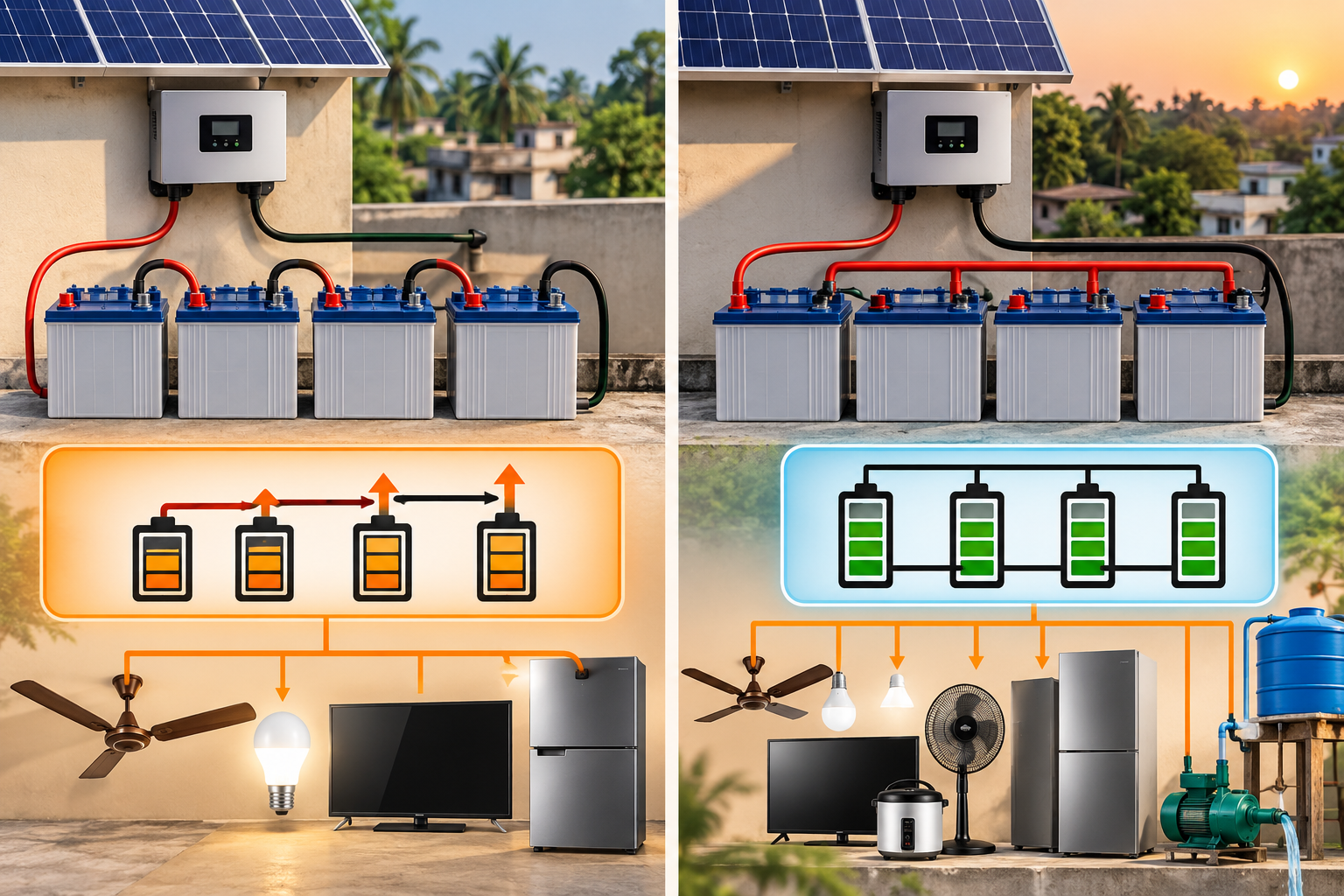
In a series connection, you link the positive terminal of one battery to the negative terminal of the next. The free negative terminal at one end and the free positive terminal at the other end go to the inverter.
Voltage adds up. Two 12V batteries become 24V. Four become 48V. The capacity stays exactly where it was, so two 12V 150Ah batteries in series give you 24V at 150Ah.
When to use it: when your inverter needs a higher voltage than a single battery provides.
Why bigger systems favour higher voltage: for the same power, higher voltage means lower current. Lower current puts less strain on cables, terminals and connections. That’s one reason larger inverters usually run at 24V or 48V instead of 12V.
The catch: every battery in the string carries the same current. If one battery fails open or has a bad connection, the whole string stops delivering power. A single weak battery also drags the group down.
What Is a Parallel Connection?
In a parallel connection, all the positive terminals are joined together and all the negative terminals are joined together. The voltage stays the same, and the capacity adds up. Two 12V 100Ah batteries in parallel give you 12V at 200Ah.
When to use it: when the voltage is already right and you want more backup time.
The catch: the batteries share the load, but they also share each other’s problems. A weak or damaged battery in a parallel bank can pull the others down, and a shorted battery can be dangerous. Wiring must be balanced, and each parallel branch needs proper protection.
One thing to correct, since many guides repeat it: parallel is not automatically “safer because of redundancy.” It keeps the voltage steady and lets the bank keep running if one battery is disconnected, but a faulty battery can still harm the rest.
The Point Most Guides Skip: The Energy Doesn’t Change
Take four 12V 100Ah batteries. Here is what each wiring layout gives you.
| Layout | Voltage | Capacity | Stored energy (V × Ah) |
| All four in parallel | 12V | 400Ah | 4,800Wh |
| Two in series, two strings in parallel | 24V | 200Ah | 4,800Wh |
| All four in series | 48V | 100Ah | 4,800Wh |
Example, using nominal ratings. Wiring changes the voltage and Ah, but the total energy stays the same. You don’t get more backup by choosing a different layout. Series versus parallel is about matching your inverter, not stretching your batteries.
A quick illustration, clearly labelled as an example: suppose a 24V bank stores about 4,800Wh and your load is 400W. On paper that’s around 12 hours. In real life you’ll get less, because inverter losses, battery age and how deeply you discharge all reduce the usable figure. Treat any backup-time calculation as a rough guide. Our battery bank sizing guide covers this properly.
Series-Parallel: When Your Bank Gets Bigger
Say your inverter is 24V and you want double the backup time. You wire two 12V batteries in series to make one 24V string, then add a second identical string and connect the two strings in parallel. Four batteries, 24V, twice the capacity of a single string.
This is how most larger banks are built: identical series strings, connected in parallel. Keep the strings identical in battery type, capacity, age and brand.
Bigger banks need more care with fusing, busbars and cable lengths. The solar wiring practices guide and the solar cable sizing guide go deeper.
Series vs Parallel at a Glance
| Series | Parallel | Series-parallel | |
| Voltage | Adds up | Stays the same | Set by strings |
| Capacity (Ah) | Stays the same | Adds up | Adds across strings |
| Use it to | Reach inverter voltage | Get longer backup | Do both |
| Main risk | One weak battery limits the whole string | A faulty battery can affect the others | Mismatched strings |
How to Connect Batteries in Series (Step by Step)
- Switch off the inverter and disconnect any loads and charging sources.
- Line up your batteries and confirm they are the same type, capacity and age.
- Connect the negative terminal of battery 1 to the positive terminal of battery 2.
- Repeat for each additional battery.
- You’ll be left with one free positive terminal and one free negative terminal. These go to the inverter (through a fuse or DC breaker).
- Before connecting, check the total voltage with a multimeter. It should match your inverter’s requirement.
How to Connect Batteries in Parallel (Step by Step)
- Switch everything off and disconnect the system.
- Confirm the batteries match, and that their voltages are close to each other before joining them.
- Connect all positive terminals together, and all negative terminals together.
- Keep the cables between batteries the same length and thickness. Uneven cables make some batteries work harder than others.
- For a balanced layout, take the positive lead for the inverter from one end of the bank and the negative lead from the opposite end, or use busbars.
- Add proper fuse or breaker protection, and check the total voltage before connecting to the inverter.
Rule of thumb: if you’re unsure about any connection, stop and get it checked before you power up.
Fuses, Cables and Safety
Batteries can deliver very high current in a short circuit, so a bank without protection is a fire risk.
- Use a fuse or DC breaker suited to the DC side of the system.
- Match cable thickness to the current, not just to the battery size. Manufacturer and installer guidance should decide the exact sizes.
- Use tight, clean terminals. Loose connections heat up.
- Never work on a live bank, and take off rings, watches and metal jewellery first.
- Don’t put a metal tool across the terminals.
We deliberately don’t list cable or fuse ratings here. They depend on your inverter, battery type and wiring distance. Follow the manufacturer’s instructions, and see the solar installation safety guide for the wider picture.
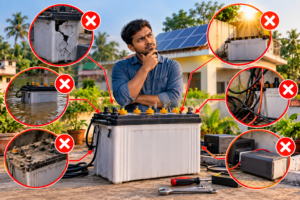
Mixing Old and New Batteries
This is a common mistake in Bangladesh. One battery dies, so someone buys a single replacement and connects it to the others.
The trouble is that batteries of different ages and capacities don’t behave the same way. The weaker battery charges and discharges differently and can pull the whole bank down. The newer battery ends up compensating for the old ones, so its life shortens as well.
In a series string, the weakest battery sets the pace. In parallel, the batteries with different internal resistance share current unevenly.
The safer approach is to keep every battery in a bank the same brand, type, capacity and roughly the same age. If one fails in an old bank, it’s often better to have the whole bank tested than to replace a single battery. A technician can advise, but ask them why they recommend what they do.
Heat, Humidity and Terminal Care
Practical tip, not a measured claim: Bangladesh’s hot, humid conditions are hard on batteries. Heat shortens battery life, and humidity encourages corrosion at terminals. Keep the bank in a ventilated space, away from direct heat, and look at the terminals from time to time for corrosion or looseness.
Lead-Acid vs Lithium (LiFePO4)
The wiring principles are the same, but the rules differ.
- Lead-acid (tubular, flooded, AGM/gel): the most common in IPS setups here. Matching batteries matters a lot.
- Lithium (LiFePO4): these have a built-in BMS, and manufacturers set limits on how many units can be connected in series or parallel. Never exceed those limits, and never mix lithium with lead-acid. Read more in our solar energy storage guide.
When to Call a Professional
Get a qualified technician involved if:
- You’re building a 48V or larger bank.
- You’re running multiple parallel strings.
- You’re mixing battery types or unsure about compatibility.
- The system is tied into a solar setup or grid connection.
If you’re choosing an installer, how to choose a solar installer covers what to ask.
Planning Your Bank
Before buying, work out your load, your inverter’s voltage and the backup time you want. Our guides on solar load calculation, inverter sizing and how to size a solar system will help. Muspana’s guides are there to help you plan the setup before you spend money on batteries.
FAQs
Does parallel connection increase voltage?
No. Parallel keeps the voltage the same and adds capacity (Ah). Series is the connection that adds voltage.
Can I connect two 12V batteries in series for a 24V inverter?
Yes, if the batteries are the same type and capacity. Connect the negative terminal of one to the positive terminal of the other, and take the remaining two terminals to the inverter.
Can I mix batteries of different Ah or age?
It’s not recommended. Unequal batteries charge and discharge unevenly, which shortens life and can cause damage. Use matching batteries in a bank.
Is series or parallel better for solar batteries?
Neither is better in general. Your inverter’s DC voltage decides how many batteries go in series. Parallel is then used to add capacity.
How many batteries can I connect in parallel?
It depends on the battery manufacturer and system design, especially with lithium. Check the datasheet and don’t exceed the stated limit.
Do I need a fuse in a battery bank?
Yes. A fuse or DC breaker is a basic safety measure against short-circuit current. The right size depends on your system, so follow the manufacturer’s guidance or ask an installer.
Can I mix lithium and lead-acid batteries?
No. They charge and behave differently, and mixing them in one bank is unsafe.
Does connecting more batteries increase backup time?
Only if you add capacity in parallel (or as extra parallel strings). Adding batteries in series raises voltage but not capacity.
If you’d like, I can also write the SEO title variations or tighten this to a specific word count.