If you’ve ever sat through a two-hour load shedding stretch in Mirpur or watched your inverter battery die halfway through a Rajshahi summer night, you already know why this matters. Most people who go looking for a solar or backup system in Bangladesh don’t start with panels. They start with frustration. And the very first number that decides whether your system actually works — or leaves you sweating in the dark at 1 AM — isn’t the panel wattage or the battery brand. It’s your daily load.
Get this number wrong, and everything downstream is wrong too. Undersize it, and your battery dies before sunrise. Oversize it by guessing high “just to be safe,” and you end up paying for a system that costs lakhs more than you needed. Load calculation is the one step almost every seller skips over quickly, because it’s less exciting than talking about panel brands — but it’s the one step you genuinely cannot afford to rush.
Why This Number Comes Before Everything Else
Every other calculation in a solar system — battery size, panel count, inverter rating — is built on top of your load figure. A dealer in Bogra or Dhaka can quote you a “5kW system,” but that number means nothing on its own. What matters is whether 5kW actually covers what you plan to run, for how long, and through how many cloudy or rainy days.
This is also where most inflated quotes come from. It’s easy for a salesperson to round your appliance list up “to be safe” and sell you a bigger system than you need. Knowing your own number means you walk into that conversation able to check their math instead of just trusting it.
What Actually Counts as Your Load
Your load is simply every electrical device you plan to run, added up. In a typical Bangladeshi household, that usually includes:
- Refrigerator (runs 24 hours, cycles on and off)
- Ceiling fans (often 2–4 per household, especially through the hot months)
- LED lights (bulbs and tube lights)
- Television
- Wi-Fi router (small, but it runs all day)
- Mobile and laptop charging
- Water pump motor (short bursts, but a heavy draw)
- Rice cooker or electric kettle (short use, high wattage)
- Air conditioner, if you have one — and this one changes your numbers dramatically
Notice that list isn’t just about big appliances. Small always-on devices like your router and phone chargers rarely get counted, and they quietly add up over a full day.
The Formula (And Why It’s So Simple)
Here’s the part that trips people up the least, once you actually see it written out:
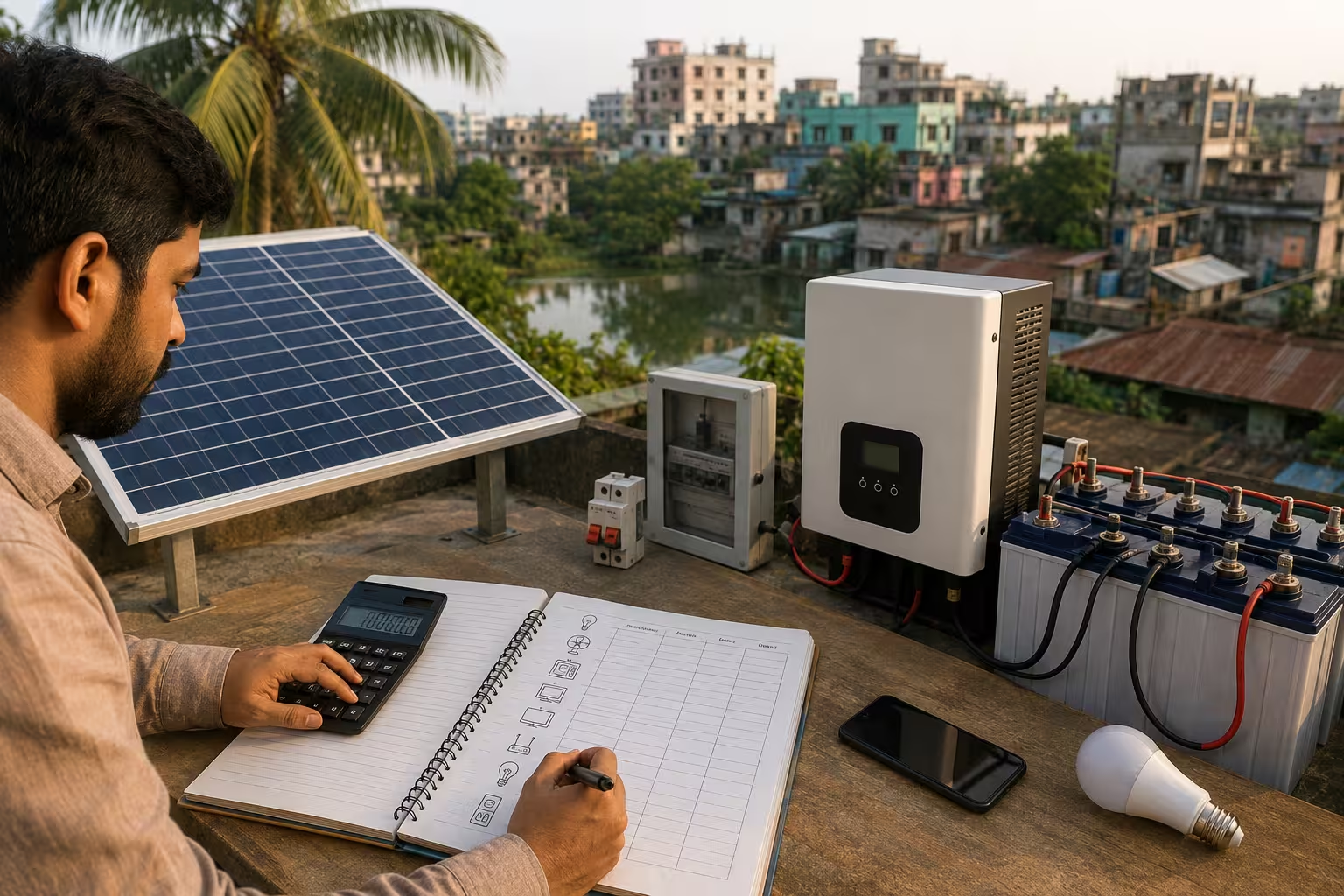
Watt-hours (Wh) = Power rating (W) × Hours used per day
Add up the watt-hours for every device, divide the total by 1,000, and you get kilowatt-hours (kWh) — the unit your solar company, your battery spec sheet, and your electricity bill all speak in.
That’s genuinely the whole formula. The skill isn’t in the math — it’s in being honest about how many hours you actually use each device, and not forgetting the small stuff.
A Real Worked Example: A Small Bogra Household
Let’s run actual numbers instead of talking in the abstract. Say you’re a family of four in Bogra, running a fairly typical home setup, and you want backup power that covers your essentials through a load shedding window or a full off-grid day.
| Appliance | Power (W) | Hours/day | Watt-hours (Wh) |
| Refrigerator | 150 | 24 | 3,600 |
| Ceiling fans (×3) | 75 each | 8 | 1,800 |
| LED bulbs (×8) | 9 each | 6 | 432 |
| Tube lights (×2) | 18 each | 5 | 180 |
| Television | 80 | 4 | 320 |
| Wi-Fi router | 10 | 24 | 240 |
| Mobile/laptop charging | 25 | 4 | 100 |
| Water pump motor | 750 | 0.5 | 375 |
| Rice cooker | 700 | 0.5 | 350 |
Add those up and you get 7,397 Wh, or roughly 7.4 kWh a day, before any buffer.
Now here’s the step almost everyone skips: add a 20–30% buffer. Why? Because this list never actually holds through every day of the year. A hotter week means the fridge cycles more. A guest staying over means an extra hour of fan use. Your inverter and wiring lose a bit of energy just moving power around — nothing converts at 100% efficiency, and pretending otherwise is how “correctly sized” systems end up falling short in practice.
Taking a 25% buffer on 7.4 kWh gives you a realistic design load of about 9.25 kWh per day. That’s the number you actually take into your battery and panel calculations — not the raw 7.4.
Deciding What’s “Essential” vs. “Everything”
Here’s a decision most guides skip entirely, and it matters a lot in Bangladesh specifically: are you sizing for full backup, or just critical load shedding coverage?
Full backup means every appliance on your list runs off solar/battery, all the time — including the AC if you have one, which changes your numbers by several kWh on its own.
Partial or critical backup means you only cover what actually matters during an outage — lights, fans, fridge, router, phone charging — and let heavier loads like the water pump, rice cooker, or AC run only when the grid is up.
Most homes going solar for load shedding relief (not full off-grid living) go with critical load coverage. It’s the difference between a system that costs what you budgeted and one that quietly doubles in price because the AC got added to the list without anyone doing the math on what that actually costs in battery capacity.
Where You Live Changes More Than You’d Think
Your load number stays the same whether you’re in Sylhet or Khulna — but what that load costs you in panels doesn’t. Bangladesh gets strong sun overall, but peak sun hours still shift by region and by season, and that number drives how many panels you need to cover the same load. A load calculated in the middle of monsoon season, when cloud cover cuts generation for days at a time, needs a bigger buffer than the same load calculated for a clear December week. If you want to go deeper on how sunlight availability actually varies across regions and seasons, our guide on peak sun hours breaks that down properly.
Common Mistakes That Throw the Whole Calculation Off
A few patterns show up again and again when people size their own systems for the first time:
Forgetting the “always-on” small stuff. Router, standby power on the TV, phone chargers left plugged in — none of these look significant individually, but across 24 hours they add up to a noticeable chunk of your daily load.
Guessing hours instead of checking them. People tend to underestimate fan usage and overestimate TV usage. Actually think through your day instead of assuming.
Skipping the buffer entirely. A load calculation with zero margin is a best-case number, not a realistic one — and Bangladesh’s monsoon season is not a best-case scenario for solar generation.
Sizing for the fridge you have now, not the one you’ll upgrade to. If you’re planning to buy a bigger refrigerator or add an AC in the next year or two, size for that now. Rebuilding a battery bank later costs far more than adding a bit of headroom upfront.
Not separating grid days from outage days. If you’re pairing solar with the grid (a hybrid setup) rather than going fully off-grid, your battery only needs to cover outage hours — not your entire daily load. Sizing for full off-grid load when you actually have grid backup most of the time means paying for capacity you’ll rarely use.
From Load Number to Actual System
Once you have your realistic daily load — buffer included — everything else follows from it. Your battery needs to store enough of that load to get you through the night or through an outage window. Your panels need to generate enough during the day to cover both your daytime use and recharge whatever the battery gave up overnight. Your inverter needs to handle your peak simultaneous draw, not just your daily total.
If you’re still deciding between a fully off-grid setup and one that works alongside the national grid, it’s worth understanding how those systems actually differ before you lock in your numbers — our comparisons of off-grid solar systems, hybrid solar systems, and a full solar system types comparison walk through which setup fits which situation. Because Bangladesh sits in a tropical solar belt with generally strong year-round insolation, the trade-offs between these system types play out a little differently here than in temperate climates — something we get into in our tropical vs. temperate solar breakdown.
A Quick Gut-Check Before You Buy
Before you take your number to a dealer, run this simple check: does your calculated daily load roughly match your last few electricity bills, divided across your appliance list? If your bill says you’re using 12 kWh a day and your appliance-by-appliance calculation says 6, one of those numbers is wrong — and it’s worth figuring out which before you spend money based on it. Bills won’t tell you which appliance is the culprit, but they’re a solid sanity check on your total.
FAQs
How do I calculate my daily electricity load for a solar system?
Multiply each appliance’s power rating in watts by the hours you use it daily, add up all devices to get total watt-hours, then divide by 1,000 to get kWh. Add a 20–30% buffer for real-world losses and variation before using that number for battery or panel sizing.
How much daily load does an average Bangladeshi household use?
It varies widely by home size and appliance use, but a typical household without AC often falls somewhere between 5–10 kWh per day. Homes with air conditioning or multiple heavy appliances can run well above that.
Should I include air conditioning in my load calculation?
Only if you actually plan to run it on solar/battery power. AC draws far more than most other household appliances combined, so including it (or leaving it out for grid-only use) changes your entire system size dramatically — decide this before you calculate anything else.
Why do I need a buffer if I’ve already listed every appliance?
Because real usage never matches a static list exactly. Hotter days, guests, inverter and wiring losses, and cloudy stretches during monsoon season all pull actual consumption above the “ideal” number. A 20–30% buffer accounts for that gap.
Do I need to size for full backup or just load shedding coverage?
That depends on whether you’re pairing solar with the grid or going fully off-grid. If the grid covers most of your needs and solar is just for outages, size your battery for critical loads during outage hours only — not your full daily total.
How often should I recalculate my load?
Anytime your appliance list changes meaningfully — a new AC, a bigger fridge, an added room — or roughly once a year, since usage habits shift more than people expect.