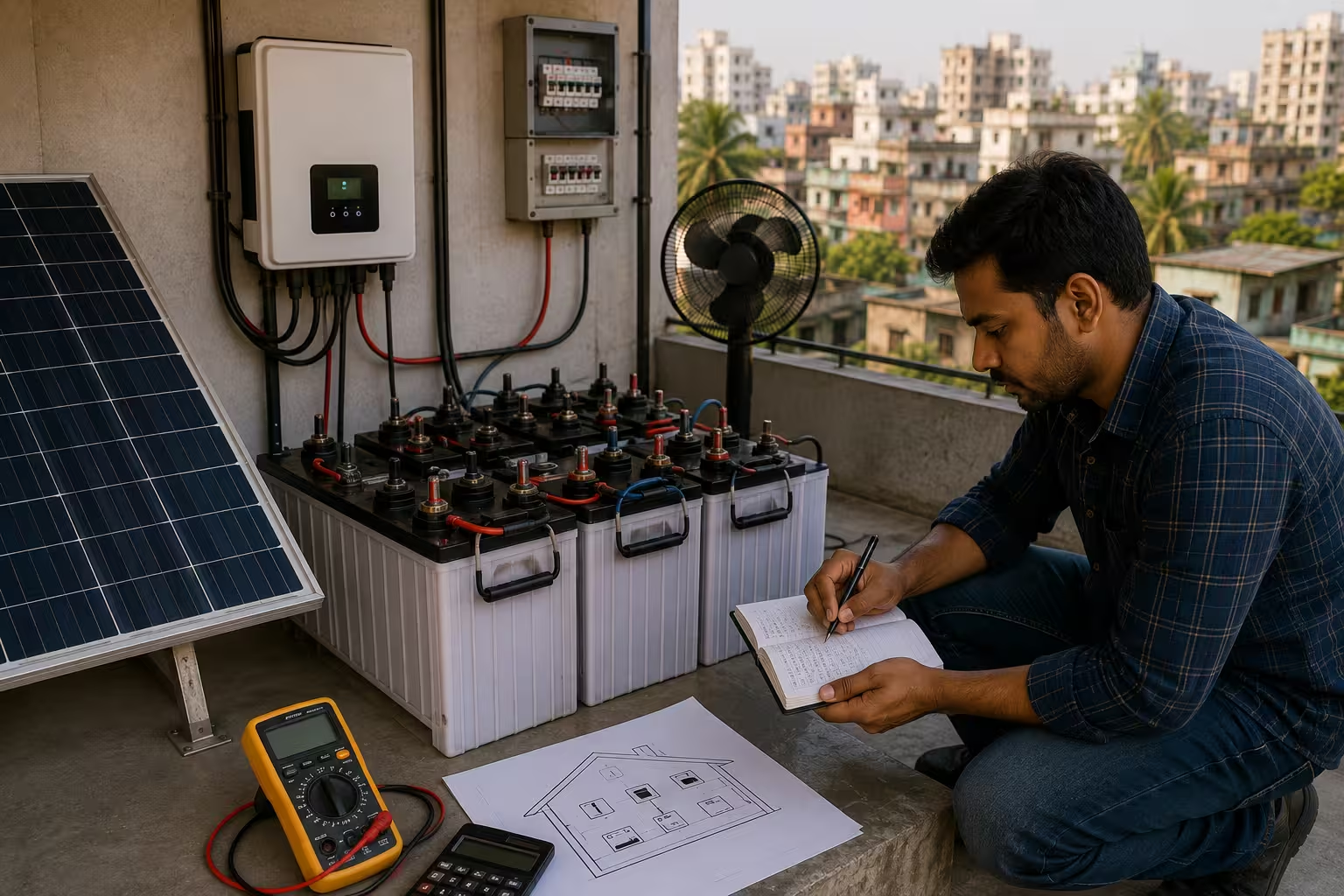
If you’ve ever sat through a two-hour load shedding stretch in Dhaka watching your IPS beep its low-battery warning, you already know why battery bank sizing matters. Get it wrong on the small side and you’re back in the dark before the grid comes back. Get it wrong on the big side and you’ve spent thirty or forty thousand extra taka on capacity you’ll never actually use.
This is the part nobody explains well. Most shop owners will just tell you “buy the 150Ah one, that’s what everyone gets.” That might be fine for your neighbor’s two-fan, one-fridge setup. It’s probably wrong for yours.
So here’s the formula, worked through properly, with numbers that actually mean something for a Bangladeshi household — whether you’re running an IPS through load shedding in Dhaka, building a rooftop solar system with battery backup, or setting up an off-grid Solar Home System in a char area with no grid connection at all.
Quick answer: Battery bank size roughly equals your daily energy use, multiplied by how many backup days you want, divided by how much of the battery you’re actually allowed to use (its usable depth of discharge). Everything below just fills in those numbers properly.
What Actually Decides Your Battery Bank Size
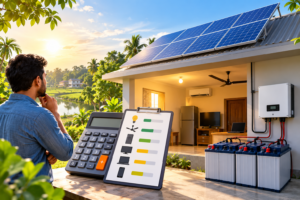
Before touching a calculator, it helps to know what you’re actually solving for. Five things decide the final number:
- Daily load — how much energy (in watt-hours) your fans, lights, fridge, router, and TV actually pull in a day
- Autonomy — how many days you want the battery to carry you without the grid or the sun
- System losses — your inverter and battery both waste a bit of energy converting and storing it
- Depth of discharge (DoD) — how much of the battery’s rated capacity you’re actually allowed to use without wrecking its lifespan
- System voltage — 12V, 24V, or 48V, which decides how the final number gets converted into amp-hours
Miss any one of these and your number will be off — sometimes badly.
The Battery Bank Sizing Formula, Step by Step
Step 1: Work out your daily energy use (Wh)
For every device, multiply its wattage by the hours you run it a day, then add everything up.
Energy (Wh) = Power (W) × Hours Used
A typical Dhaka apartment running four ceiling fans, a fridge, some LED lights, a router, and a TV usually lands somewhere around 1,800–2,200 Wh a day. If you’re not sure of your own number, check the wattage sticker on each device rather than guessing — guessing is where most sizing mistakes start.
Step 2: Decide your autonomy — how many days without power
In most of Bangladesh, load shedding rarely stretches past a day, so one day of autonomy is usually enough for a standard IPS backup. But if you’re in a flood-prone area, or running an off-grid Solar Home System where cloudy monsoon stretches can knock out solar charging for two or three days straight, you’ll want more buffer. Bangladesh’s tropical solar conditions generally mean strong, consistent peak sun hours for most of the year, but monsoon season is the exception worth planning around.
Total energy required = Daily load (Wh) × Autonomy days
Step 3: Add in system efficiency losses
Inverters and batteries both lose a bit of energy — usually around 10% each — during conversion and storage. Divide by both efficiencies to cover that loss.
Wh needed (adjusted) = Total energy required ÷ (Battery efficiency × Inverter efficiency)
Step 4: Adjust for depth of discharge
This is where most guides get sloppy, and it’s worth getting right. DoD is the percentage of a battery’s capacity you’re actually meant to use before recharging.
- Lead-acid batteries (the kind most Dhaka and Chattogram households already have from Rahimafrooz, Hamko, or similar local brands) are generally kept to around 50% DoD for a reasonable lifespan.
- Lithium (LiFePO4) batteries can usually handle 80–100% DoD without the same wear.
Here’s something worth clearing up: the 50% rule for lead-acid isn’t some hard physical cliff where the battery suddenly breaks if you cross it. It’s an economic trade-off — discharge it deeper and you get more usable energy per cycle, but you burn through cycle life faster. Plenty of people run lead-acid banks down to 60–70% in a pinch during long load shedding without instant damage. You’re just trading battery lifespan for capacity that day.
Required capacity (Wh) = Wh needed (adjusted) ÷ DoD
Step 5: Convert to amp-hours
Most battery specs in Bangladesh are sold in Ah, not Wh, so you’ll need this last conversion.
Ah = Wh ÷ System Voltage
Step 6: Add a margin for aging and real-world load spikes
A battery rated for 80% DoD when it’s brand new might only give you 60–65% of that after two or three years of regular cycling. On top of that, most households don’t actually use the same amount of power every single day — the day you’re ironing clothes, running the washing machine, and boiling water for tea all at once will pull noticeably more than your “average” day. Padding your final number by 15–20% covers both of these without requiring you to guess perfectly.
Step 7: Choose your battery configuration
Once you know your target voltage and Ah, you decide how many batteries to wire in series (to reach your voltage) and parallel (to reach your capacity). Never mix batteries of different ages, brands, or capacities in the same bank — even one older, weaker battery in a parallel string will drag the healthier ones down and shorten the life of the whole bank.
Worked Example 1: A Dhaka Apartment Running an IPS Through Load Shedding
Let’s say your household load — four fans, a fridge, lighting, router, and TV — comes to 2,000 Wh a day, and you want one full day of backup on a standard 12V lead-acid setup.
- Step 1: Daily load = 2,000 Wh
- Step 2: Total energy needed = 2,000 Wh × 1 day = 2,000 Wh
- Step 3: Adjusted for 90% battery and 90% inverter efficiency = 2,000 ÷ (0.9 × 0.9) ≈ 2,469 Wh
- Step 4: Adjusted for 50% DoD (lead-acid) = 2,469 ÷ 0.5 ≈ 4,938 Wh
- Step 5: Converted to Ah at 12V = 4,938 ÷ 12 ≈ 412 Ah
- Step 6: With a 15% margin for aging and load spikes ≈ 474 Ah
In practice, that means two 200Ah lead-acid batteries wired in parallel (12V, roughly 400Ah combined) would leave you slightly short, so most installers in this situation would recommend stepping up to around 450–500Ah total — either two larger batteries or three mid-sized ones, depending on what’s available locally and your budget.
Worked Example 2: An Off-Grid Solar Home System in Rural Bangladesh
Now picture a rural household off the grid entirely, running lighting, a small fridge, mobile charging, and a fan off solar — a common setup in areas served by IDCOL-backed Solar Home System programs. Daily load comes to 800 Wh, and because monsoon cloud cover can knock out charging for a couple of days at a stretch, they want two days of autonomy on a 24V lithium (LiFePO4) system.
- Step 1: Daily load = 800 Wh
- Step 2: Total energy needed = 800 × 2 = 1,600 Wh
- Step 3: Adjusted for 95% battery and 90% inverter efficiency = 1,600 ÷ (0.95 × 0.9) ≈ 1,871 Wh
- Step 4: Adjusted for 85% DoD (lithium) = 1,871 ÷ 0.85 ≈ 2,201 Wh
- Step 5: Converted to Ah at 24V = 2,201 ÷ 24 ≈ 92 Ah
- Step 6: With a 15% margin ≈ 106 Ah
That’s a noticeably smaller, lighter, and longer-lasting bank than the equivalent lead-acid setup would need — which is exactly why lithium is becoming more common in newer off-grid installations, even though the upfront cost per battery is higher. If you’re weighing between an on-grid, off-grid, or hybrid solar setup for a property like this, it’s worth reading through the differences between solar system types before locking in your battery plan.
Lead-Acid vs. Lithium: How Chemistry Changes Your Number
| Lead-Acid (Flooded/AGM) | Lithium (LiFePO4) | |
| Usable DoD | ~50% | ~80–100% |
| Typical cycle life | 300–600 cycles | 2,000–5,000+ cycles |
| Upfront cost | Lower | Higher |
| Weight for same usable capacity | Heavier | Roughly half |
| Availability in Bangladesh | Widely available (Rahimafrooz, Hamko, etc.) | Growing, mostly through solar/off-grid retailers |
| Best fit | Budget IPS backup, short autonomy | Off-grid systems, frequent daily cycling, long-term cost savings |
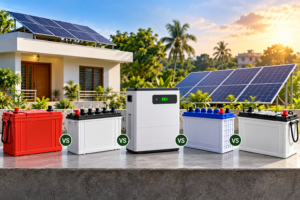
Neither one is simply “better.” Lead-acid is cheaper to get started with and every electrician in the country knows how to install it. Lithium costs more upfront but needs a smaller physical bank, lasts years longer, and ends up cheaper per cycle over its lifetime. If you’re cycling your battery daily — which is exactly what happens with solar — that lifetime cost difference adds up fast.
Mistakes That Throw Off Your Number
Sizing off your average day instead of your worst day. If your heaviest usage day includes the iron, the washing machine, and extra lighting because guests are visiting, that day pulls a lot more than your “typical” day. Size around your busiest realistic day, not the quiet ones.
Forgetting inverter self-consumption. Inverters draw a small amount of power just sitting idle, even with nothing running. It’s not huge, but ignore it across a full day of “always-on” fridge and router load, and it adds up.
Treating 50% DoD as an absolute limit for lead-acid. As covered above, it’s a lifespan trade-off, not a technical wall. Understanding that gives you flexibility during genuinely long outages.
Oversizing without thinking it through. A battery bank that’s too large for your solar array may never actually reach a full charge, especially during Bangladesh’s shorter winter daylight hours or a stretch of overcast monsoon days. A battery that rarely reaches 100% ages faster than one that’s properly matched to its charging source — so bigger isn’t automatically safer.
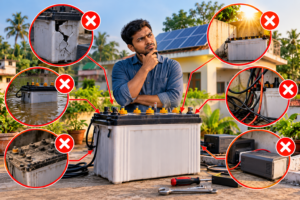
Mixing old and new batteries in parallel. Even one weaker battery in the string pulls the whole bank’s performance down and shortens everyone’s lifespan.
Series vs. Parallel Wiring, Quickly
Wiring batteries in series (positive to negative) increases voltage while keeping the amp-hour rating the same — this is how you go from a single 12V battery to a 24V or 48V bank. Wiring in parallel (positive to positive, negative to negative) keeps the voltage the same but increases total capacity in amp-hours. Most real systems combine both — a series-parallel configuration — to hit the target voltage and capacity together. Whichever combination you land on, match your battery voltage to your inverter and charge controller specifications first, since that’s what actually decides whether series, parallel, or both is the right move.
Frequently Asked Questions
What is battery bank sizing?
Battery bank sizing is the process of calculating how much storage capacity — in watt-hours or amp-hours — your battery bank needs to reliably power your daily loads for a set number of backup days, based on your equipment’s efficiency and your battery’s usable depth of discharge.
Is the 50% depth of discharge rule for lead-acid batteries a hard limit?
No. It’s a rule of thumb balancing usable capacity against battery lifespan, not a technical cliff at which damage suddenly occurs. Discharging deeper gives you more energy per cycle but shortens the battery’s overall life.
How many batteries do I need for my house in Bangladesh?
It depends entirely on your daily load, how many backup days you want, and your battery chemistry. A typical Dhaka apartment running fans, a fridge, and lighting for one day of load shedding backup usually needs somewhere around 400–500Ah at 12V on lead-acid, or roughly half that on lithium.
Why does lithium let you use a smaller battery bank than lead-acid?
Because lithium (LiFePO4) batteries can safely discharge to 80–100% of their rated capacity, while lead-acid is generally limited to around 50% for a reasonable lifespan. That means a lithium battery gives you nearly double the usable energy per rated amp-hour.
Does hot weather in Bangladesh affect battery performance?
Consistently high heat can shorten a lead-acid battery’s lifespan over time and increase water loss in flooded types, so ventilation and placement out of direct sun matter more here than cold-weather derating does — unlike in colder climates where the bigger concern is capacity loss near freezing.
Can I upgrade from lead-acid to lithium later without resizing everything?
Not directly — because the usable DoD is so different between the two, you’ll need to recalculate your required Ah for lithium rather than just swapping batteries one-for-one. It’s worth running the numbers fresh rather than assuming a straight swap.
Once you’ve got your number, the next real decision is what kind of system you’re building around it — a straightforward off-grid solar system, a hybrid setup that still leans on the grid, or a fully on-grid solar system with battery backup for outages. That choice also decides whether you need a DC-coupled or AC-coupled battery setup, and how many peak sun hours you can realistically bank on across the year — all of which loop back into whether your battery bank actually gets fully charged day to day, not just whether it’s big enough on paper.
And if you’re still weighing whether solar is worth the investment over running purely on grid power and diesel backup, it’s worth reading how solar stacks up against fossil fuels for a Bangladeshi household before you finalize your battery budget.