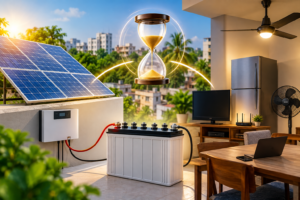
The way you use your battery today decides how many years it lasts. That’s really what this whole topic comes down to, even though it usually gets dressed up in technical language like “depth of discharge” and “cycle life.”
If you’ve been quoted a battery for your home or shop and the seller mentioned a number of cycles, or your installer asked what percentage to set the inverter to, this is the piece that explains what those numbers actually mean — and what to do with them.
What Is Depth of Discharge (DoD)?
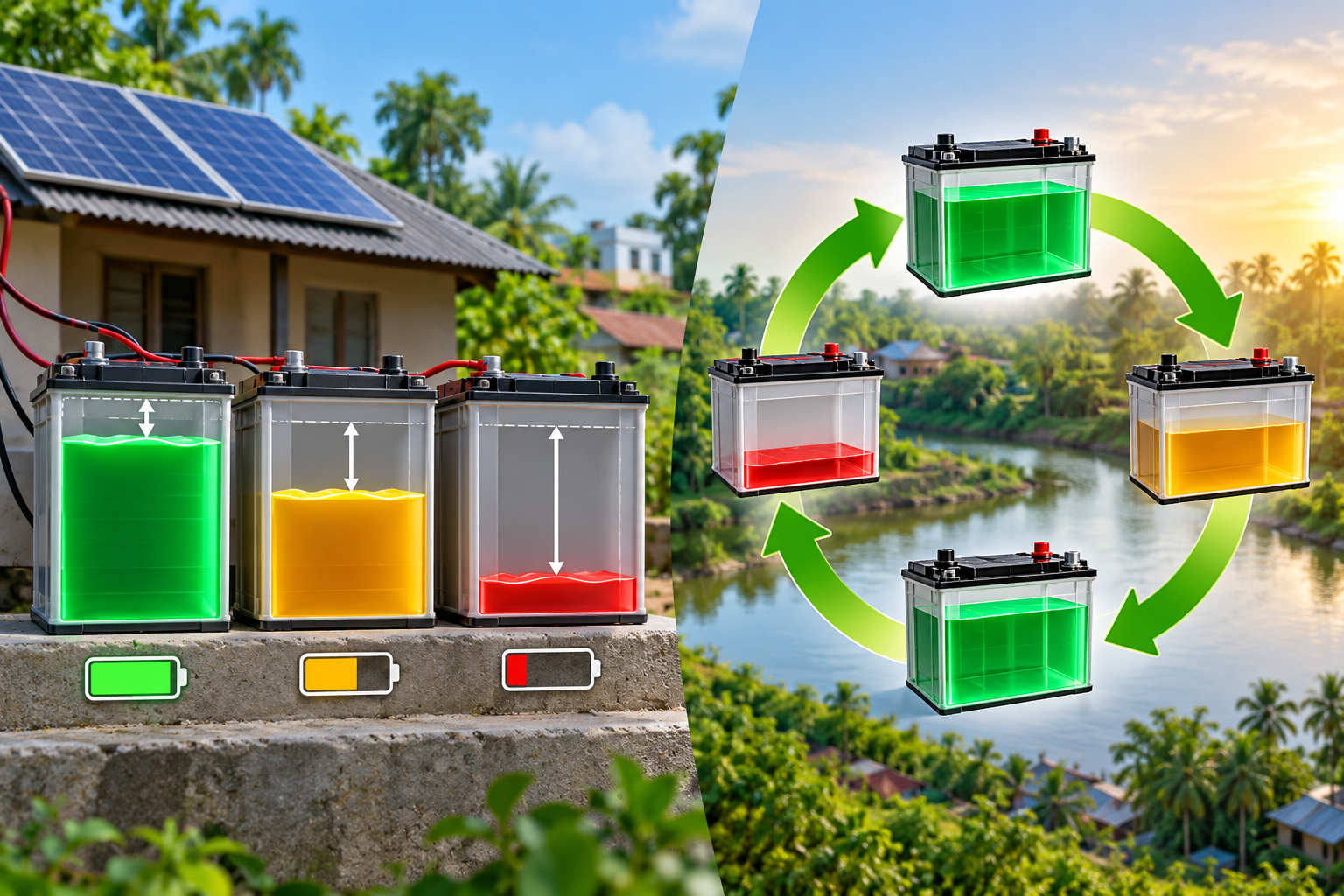
Depth of Discharge is simply how much of a battery’s total capacity you use up before recharging it, shown as a percentage. If you drain a 10 kWh battery down to 2 kWh remaining, you’ve used 80% of it — that’s an 80% DoD.
DoD formula:
DoD (%) = (Energy used ÷ Total battery capacity) × 100
So a shallow discharge — say, using 20% and recharging — is a low-DoD cycle. Draining it almost empty every time is a high-DoD habit.
What Is Cycle Life?
Cycle life is the number of charge-discharge cycles a battery can handle before its usable capacity drops to a defined point — usually 80% of what it started with. After that, the battery still works, but it holds noticeably less energy than it did on day one.
Here’s the part that trips people up: cycle life and DoD are joined at the hip. A battery rated for 4,000 cycles at 80% DoD won’t give you 4,000 cycles if you’re routinely draining it to 100% instead — and it’ll often outlast that rating if you keep discharges shallower. The relationship runs in opposite directions: push DoD higher, and cycle count drops; keep DoD lower, and the battery tends to go the distance for longer.
It’s worth saying plainly: going past the recommended DoD doesn’t damage the battery instantly or make it unsafe. A quality lithium battery with a proper BMS (battery management system) will simply cut off before over-discharge becomes dangerous. What changes is the pace of wear — capacity fades a bit faster over time, the way a car engine wears out sooner if you constantly redline it, without anything breaking on any single trip.
DoD and Cycle Life by Battery Chemistry
Different battery chemistries handle deep discharges very differently, which is why the “right” DoD setting depends on what’s actually installed.
| Chemistry | Recommended DoD | Typical Cycle Life (manufacturer-rated) |
| LiFePO4 (LFP) | 80–100% | 3,000–6,000+ cycles |
| NMC / NCA lithium | 80–90% | 1,500–3,000 cycles |
| Lead-acid (flooded/AGM) | 50% (max) | 200–500 cycles |
| Lead-acid (GEL) | 50–60% | 500–1,000 cycles |
A few honest caveats on that table. These figures come from manufacturer testing under controlled lab conditions — real-world results shift with ambient temperature, how fast you charge and discharge, and the quality of the specific cells used. Treat them as general industry ranges to compare products against, not as a guarantee stamped on your particular unit. And this is exactly why LiFePO4 has become the default recommendation for most home and small-commercial solar storage in Bangladesh — it tolerates deeper, more frequent discharges without the steep cycle-life penalty that lead-acid or NMC chemistries carry.
Manufacturer-Rated DoD vs. What You Can Actually Set
This is the gap most explanations skip. A spec sheet DoD is a lab figure — it tells you what the cell chemistry can theoretically handle. Your actual, day-to-day DoD is a setting inside your inverter or BMS configuration, and it’s something you (or your installer) can adjust.
In practice, this shows up as a “low battery cutoff” or “minimum SoC” setting during commissioning. If that number is left at a factory default, or set without thinking about how you actually use power, you end up with either a battery that wears out faster than expected, or one that’s needlessly conservative and gives you less usable backup than you’re paying for.
The Real Trade-Off: Runtime Now vs. Battery Life Later
Here’s the choice underneath all the numbers: a higher DoD setting gives you more usable backup power per cycle, right now. A lower DoD setting stretches the battery’s working life, but leaves more capacity “on the table” that you never touch.
There’s no universally correct answer — it depends on how you actually use the system:
- If backup runtime during outages matters more than squeezing out every possible year, a higher DoD (80–90% on LFP) is a reasonable, low-risk choice.
- If you’re running daily off-grid cycles and want to stretch the battery’s service life as long as possible, keeping DoD closer to 70–80% trades a bit of usable capacity for a longer-lasting bank.
- If your battery is lead-acid, staying near or under 50% DoD isn’t optional in the same way — it’s the difference between the battery lasting a couple of years or barely lasting one.
How Load-Shedding Patterns Change the Calculation in Bangladesh
Here’s a genuinely local wrinkle: how a battery cycles in Bangladesh often looks different from the textbook off-grid example.
A household backing up frequent, short load-shedding outages tends to see shallow, frequent cycles — draw down 15–30%, then the grid comes back and it recharges. That’s a comparatively gentle usage pattern. A household running a fully off-grid or heavily hybrid system, drawing the battery down every night and recharging from solar every day, sees deeper, more consistent daily cycling — closer to the pattern the manufacturer’s cycle-life rating was actually built around.
Neither pattern is “wrong,” but they call for different DoD thinking. A frequent-shallow-cycle household has more room to allow occasional deeper discharges without much lifespan impact. A daily-deep-cycle off-grid household benefits more from being deliberate about the DoD setting from day one, since that pattern accumulates cycles faster.
One thing that compounds either pattern: ambient heat. Bangladesh’s warm climate accelerates battery aging on its own, independent of how deep you discharge — a factor covered in more depth in our LFP vs. NMC battery comparison piece, so it’s worth reading alongside this one rather than repeating in full here.
Common Questions People Get Wrong
Does draining a lithium battery to 0% damage it?
A quality BMS will cut power before the cells reach a genuinely damaging voltage, so it’s not an instant-failure event. But making a habit of running it to empty accelerates capacity fade compared to stopping at 10–20% remaining.
Does DoD affect warranty?
Often, yes — many manufacturer warranties are written against a specific rated DoD (for example, “80% DoD, 6,000 cycles”). Consistently exceeding that during normal operation can be relevant if you ever need to make a warranty claim, so it’s worth knowing what DoD your battery’s warranty assumes.
Is a low DoD setting just wasted capacity?
Not exactly — think of it as capacity held in reserve for lifespan, the same way you wouldn’t redline a car engine on every drive even though it’s mechanically capable of it.
Getting this configuration right isn’t really something you should have to think about after installation — it’s a setting a qualified installer should establish correctly at commissioning, based on your actual usage pattern rather than a generic default. That’s the kind of detail Muspana treats as part of doing the job properly, not an afterthought.
FAQs
What is depth of discharge (DoD) in a solar battery?
DoD is the percentage of a battery’s total capacity that’s been used before recharging. An 80% DoD means only 20% of the battery’s capacity remains before it’s charged again.
What is cycle life?
Cycle life is the number of charge-discharge cycles a battery can handle before its capacity typically fades to around 80% of its original level. It’s a manufacturer-rated figure, not a fixed guarantee.
What DoD should I use for a lithium (LiFePO4) battery?
Most LiFePO4 batteries tolerate 80–100% DoD well. If you want to prioritize maximum lifespan over squeezing out every bit of capacity, keeping it closer to 70–80% is a reasonable middle ground.
Is it okay to fully discharge a lithium battery to 0%?
It won’t damage the battery instantly, since the BMS cuts off before that becomes dangerous — but doing it regularly speeds up capacity fade compared to stopping at 10–20% remaining.
Does DoD affect my battery’s warranty?
Often yes. Many warranties are written against a specific rated DoD, so it’s worth checking what DoD your warranty terms assume before you configure your system.
How does load-shedding affect battery cycle life in Bangladesh?
Frequent short outages tend to produce shallow, gentle cycles, while a fully off-grid daily-use pattern produces deeper, more frequent cycling closer to the manufacturer’s rated conditions — the right DoD setting depends on which pattern matches your actual usage.