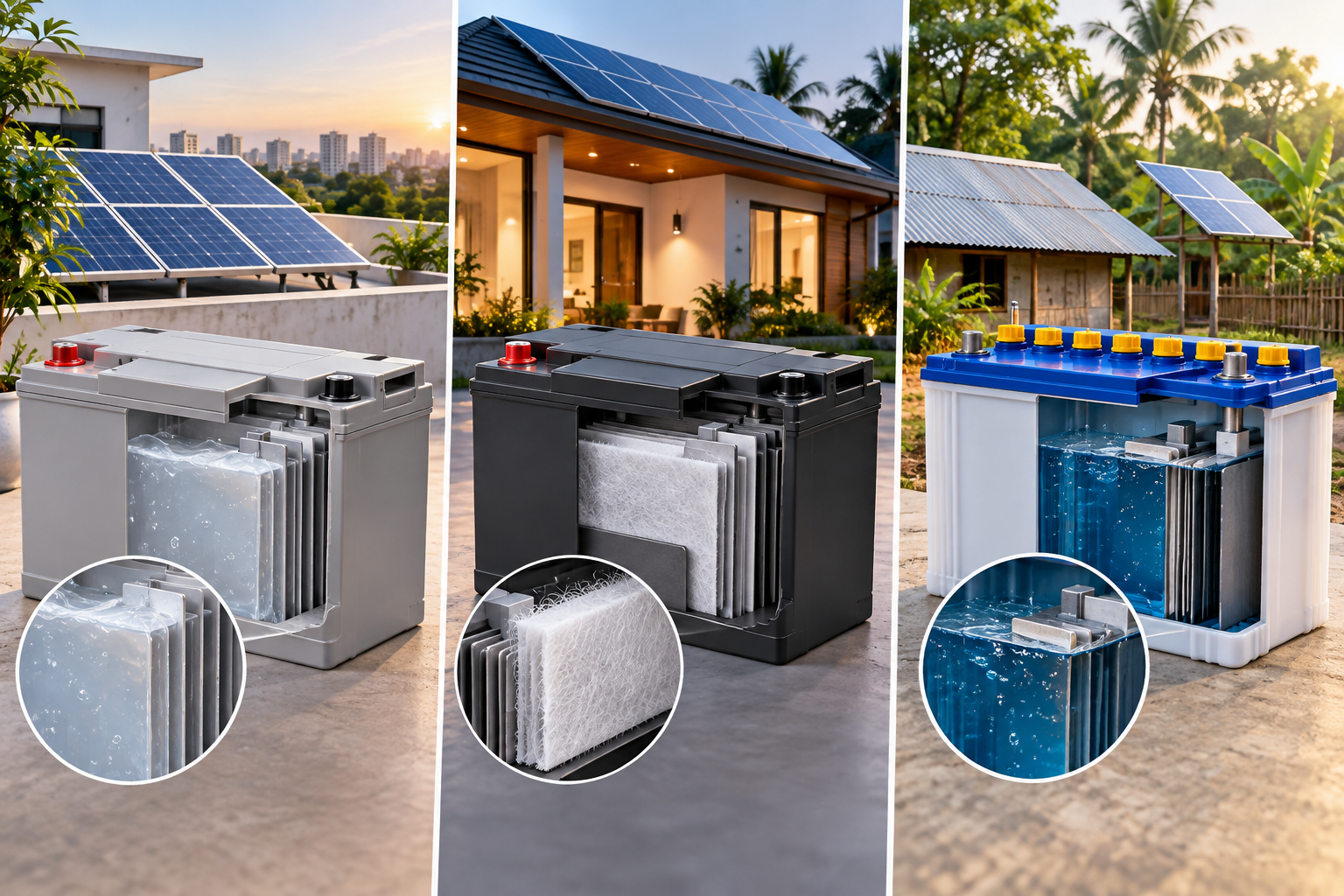
If you’ve been quoted three different prices for three different battery types and no one has explained why, you’re not alone. Flooded, AGM, and gel batteries all do the same basic job — storing energy for your solar system or backup power — but they get there in different ways, and that difference shows up in your maintenance routine, your upfront cost, and how many years you’ll actually get out of the battery.
Here’s the short version, then we’ll get into why it matters for your situation.
Quick answer: Flooded batteries are the cheapest but need regular water top-ups and upright installation. AGM batteries are sealed, maintenance-free, and charge faster, at a mid-range price. Gel batteries cost the most but handle heat best and last the longest under steady, deep-cycle use.
What Makes These Three Batteries Different
All three are lead-acid batteries at their core. What separates them is how the electrolyte — the acid that makes the chemical reaction happen — is held inside the battery.
Flooded (wet cell) batteries use liquid electrolyte that sloshes freely inside the case. This is the type most Bangladeshi households already know, even if they don’t call it “flooded” — it’s the standard battery sitting under most home IPS units, the one you occasionally top up with distilled water. It has to sit upright, needs ventilation, and the acid can spill if it’s tipped or damaged.
AGM (Absorbed Glass Mat) batteries trap the electrolyte inside a fiberglass mat instead of leaving it as free liquid. That’s what makes them sealed and spill-proof — you can mount them on their side if needed, and there’s no water to add, ever. AGM also tolerates vibration well and charges faster than flooded, which is why it’s become common in start-stop vehicles as well as deep-cycle setups.
Gel batteries go a step further by thickening the electrolyte with silica into a gel-like paste. This makes them extremely stable in heat and very durable through repeated deep discharges, but the trade-off is a slower charge rate and more sensitivity to overcharging — push a gel battery past its recommended charge voltage and you can damage it permanently.
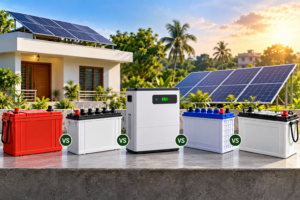
Comparing Them Side by Side
| Feature | Flooded | AGM | Gel |
| Maintenance | Needs regular water top-up | None — sealed | None — sealed |
| Upfront cost | Lowest | Mid-range | Highest |
| Typical cycle life | 300–500 cycles (deep-cycle use) | 500–800 cycles | 800–1,200 cycles |
| Typical float life | 3–5 years | 5–7 years | 7–10 years |
| Charge speed | Slow | Fast | Slow |
| Best suited for | Budget setups, high surge/starting loads | High-power, frequent cycling | Steady deep-cycle use, solar, heat-exposed installs |
A quick honest note here: those cycle-life and float-life numbers are manufacturer-typical ranges, not guarantees stamped on every unit. A flooded battery that’s badly maintained — low water, irregular charging — can die well before 300 cycles. A gel battery charged carelessly with the wrong controller settings won’t come close to 1,200 cycles either. How you use and charge the battery matters as much as which chemistry you buy.
The Maintenance and Safety Side Nobody Mentions
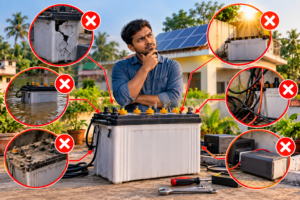
This is where the comparison table doesn’t tell the whole story. Flooded batteries need to be checked and topped up with distilled water every few months — skip this and the plates inside can dry out and get permanently damaged, well before their expected lifespan. They also release small amounts of hydrogen gas during charging, so they need to sit somewhere with airflow — not sealed inside a cupboard in a small flat with no ventilation. If you’re keeping one indoors in an apartment utility space, that ventilation detail matters more than the price tag.
AGM and gel batteries sidestep both problems. No water checks, no meaningful off-gassing, and no risk of acid spilling if the battery gets bumped or tipped during installation or a move. That’s a genuine convenience, and part of why sealed batteries are more common in tighter urban housing where there simply isn’t a well-ventilated space to spare.
Cost Versus Lifespan: The Real Trade-Off
It’s tempting to just look at the sticker price, but the more useful comparison is cost per year of service. A flooded battery is cheapest to buy but shortest-lived and requires ongoing maintenance effort. Spread its lower purchase cost over roughly 3–5 years of float life, and it may not be as dramatically cheaper as it first looks — especially once you account for a homeowner’s time spent on upkeep, or a facility’s maintenance labour.
AGM sits in the middle on both counts: a higher purchase price than flooded, but a longer typical life and zero maintenance overhead. Gel costs the most upfront, but if it’s genuinely used in a deep-cycle application — like a solar battery bank that discharges and recharges daily — its longer cycle life can make the higher initial cost worthwhile over time.
None of this means one chemistry is objectively “the best.” It means each one is the best fit for a different situation.
So Which One Should You Actually Choose?
Choose flooded if:
- Budget is your primary constraint
- You have a well-ventilated space to install it upright
- You’re comfortable checking water levels every few months
- The battery’s main job includes occasional high-surge demand (like starting a generator or motor) rather than pure deep-cycle solar use
Choose AGM if:
- You want zero maintenance without paying the highest price
- Your installation space is tight, indoors, or doesn’t allow for easy upright ventilation
- You need faster charging, such as in a system with limited daily sun hours
- You’re running a mixed-use setup — some high-power draw, some deep cycling
Choose gel if:
- Your system cycles daily and deeply, like a solar battery bank powering a home or facility through the night
- Heat exposure is a real concern — for example, a battery installed in a rooftop utility room or an industrial space without climate control
- You want the longest realistic lifespan and are willing to pay more upfront for it
- You can guarantee correct charge controller settings, since gel is unforgiving of overvoltage
A Bangladesh-Specific Reality Worth Knowing
Flooded batteries dominate the Bangladeshi household market largely because they’re what most IPS systems have used for years — they’re familiar, locally stocked, and easy to get serviced. AGM and gel batteries are less common here and more likely to be imported, which can mean a longer wait for replacements and more variability in after-sales support depending on the supplier.
That’s not a reason to avoid AGM or gel — for solar battery banks especially, where deep, daily cycling and heat exposure are the norm rather than the exception, their longer lifespan can genuinely outperform flooded over several years. It’s simply worth asking your installer or supplier directly about local stock availability and warranty support before committing, rather than assuming it will be as straightforward as replacing a flooded battery.
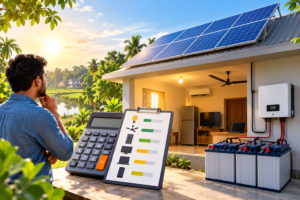
If you’re sizing a battery bank for a solar system rather than just picking a single unit, the chemistry choice is really only one part of the equation — capacity, depth of discharge, and how the bank is wired together matter just as much. That’s worth working through with whoever is designing your system, whether that’s Muspana or another qualified installer, before you commit to a specific battery type.
FAQs
Which battery lasts longest — flooded, AGM, or gel?
Gel batteries typically have the longest float life, often 7–10 years under proper charging conditions, compared to 3–5 years for flooded and 5–7 years for AGM. Actual lifespan still depends heavily on charge quality and how deeply the battery is discharged.
Can I install an AGM or gel battery on its side?
Yes — both are sealed, so they don’t need to sit upright the way flooded batteries do. This makes them easier to fit into tight or unconventional installation spaces.
Do AGM and gel batteries need any maintenance at all?
No regular maintenance like water top-ups is needed for either. Occasional voltage checks and following the manufacturer’s charging guidelines are still good practice, but there’s nothing to physically add or check inside the battery.
Is a flooded battery unsafe to keep indoors?
It’s not inherently unsafe, but it does need ventilation since it releases small amounts of hydrogen gas while charging. In a small, closed indoor space — common in flats — a sealed AGM or gel battery is generally the more practical and safer choice.
Which battery type is best for a solar system in Bangladesh?
It depends on your setup. If cost is the main constraint and you have proper ventilation, flooded works. For most home solar backup in tighter spaces, AGM offers a good balance of cost and convenience. For a solar battery bank that cycles daily and faces heat exposure, gel’s durability often justifies the higher price — though local availability and after-sales support are worth confirming with your supplier before deciding.