
A storm rolls through, the grid goes down, and half the street is sitting in the dark. Except a few houses down, the lights are still on — rooftop panels and a battery quietly doing their job while the neighborhood waits for the power company to show up. That contrast is basically the whole story of centralized vs decentralized solar in one scene: one model depends on a big, distant system working perfectly; the other keeps a little bit of power generation right where you live.
Quick answer, if you’re in a hurry: centralized solar means huge solar farms built out in open land, feeding electricity into the grid through long transmission lines. Decentralized solar means smaller systems — rooftop panels, community solar projects, small microgrids — generating power close to where it’s actually used. Neither one is “the winner.” They solve different problems, and honestly, most modern grids need both.
If you want the fuller picture — the cost differences, the outage question, the land-use tradeoffs, and which one actually suits your situation — let’s get into it.
What Is Centralized Solar, Really?

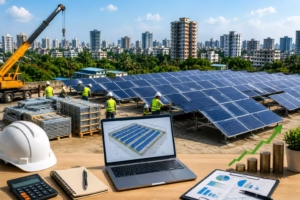
Centralized solar is the utility-scale stuff. Think rows and rows of panels stretched across hundreds of acres of desert or farmland, feeding a substation, which then pushes electricity down high-voltage lines to homes and businesses miles — sometimes hundreds of miles — away.
This is how most large solar capacity gets added to the grid these days. A utility or independent power producer builds a massive installation somewhere with excellent solar radiation and insolation, signs long-term contracts to sell that power, and the electricity gets blended into the regional grid mix along with everything else — gas, nuclear, wind, whatever’s on the system.
The appeal is straightforward: building one enormous solar farm is cheaper per watt than building thousands of small rooftop systems. You’re not paying for individual permitting, individual installation crews, or individual inverters over and over again. Economies of scale do real work here.
The catch is that the electricity has to travel. And travel isn’t free — you lose somewhere in the range of 5 to 10% of the generated power to resistance in the transmission lines before it ever reaches a home. That’s not a dealbreaker, but it’s a real cost that decentralized solar mostly sidesteps.
What Is Decentralized Solar, Really?
Decentralized (sometimes called distributed) solar flips the model. Instead of one giant plant, you’ve got generation happening in lots of small pockets — rooftop panels on a house, a community solar array shared by a neighborhood, or a microgrid serving a small campus or rural cluster of homes.
If you’ve ever seen a rooftop solar installation on a neighbor’s roof, you’ve seen decentralized solar in action. The power gets used right there, or close to it, which means almost none of it is lost to transmission.
The tradeoff is cost structure. Rooftop and small-scale systems carry higher “soft costs” per watt — permitting, design, individual installation labor, inspection — because you’re not spreading those costs across a massive project. But there’s a counterbalance: the electricity you generate offsets what you’d otherwise pay at the retail rate, not the wholesale rate a utility pays a solar farm. That distinction matters more than people usually realize, and it’s a big part of why rooftop solar can still pencil out even with higher installation costs.
Centralized vs. Decentralized Solar: The Side-by-Side
| Factor | Centralized Solar | Decentralized Solar |
| Scale | Large utility-scale farms, often 100+ acres | Small installations — rooftops, community arrays, microgrids |
| Location | Remote areas with strong sun exposure | On-site, near or at the point of use |
| Cost per watt (generation) | Lower, thanks to economies of scale | Higher upfront soft costs (permitting, install labor) |
| Transmission loss | Typically 5–10% lost over long-distance lines | Minimal to none |
| Grid resilience | Single points of failure can knock out large areas | Localized outages don’t necessarily affect neighboring systems |
| Land use | Requires large tracts of land; can compete with agriculture | Uses existing rooftops, parking structures, built environments |
| Who it typically suits | Utilities, large power buyers, regional grid planning | Homeowners, renters with community options, businesses wanting backup power |
A table like this is useful, but it flattens some nuance — so let’s actually walk through the parts that matter most when you’re trying to make a real decision.
Which One Actually Saves You Money?
This is where a lot of the online discourse gets muddy, so here’s the practical version.
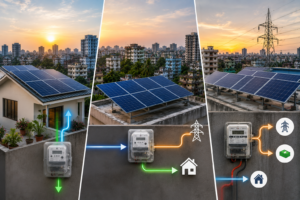
If you own your home and install rooftop panels, your savings come from offsetting your own electricity usage at the retail rate — the rate you’d otherwise pay your utility. Depending on your local net metering policy (this varies a lot by state and utility, so it’s genuinely worth a five-minute check before you get excited about payback numbers you saw in an ad), any excess power you generate can be credited back to you, sometimes at close to retail value, sometimes at a lower “avoided cost” rate.
Community solar — a decentralized model where you subscribe to a share of a local solar project without putting anything on your own roof — works similarly but is aimed at renters, apartment dwellers, or anyone whose roof isn’t a good candidate for panels (too much shade, wrong orientation, or you just don’t own it).
Centralized solar doesn’t directly save an individual consumer money the same way. Instead, it lowers the overall cost of electricity generation across the grid, which can show up as modestly lower or more stable rates over time — but it’s diffuse. You’re not going to see a line item on your bill that says “solar farm savings.” It’s more of a system-wide, long-term effect.
So if the question is “what saves me money right now,” decentralized solar — rooftop or community — is the more direct route. If the question is “what keeps electricity affordable for everyone at scale,” centralized solar is doing a lot of that heavy lifting quietly in the background.
What Happens During an Outage?
This is the part people care about most once they’ve lived through a blackout, and it’s also where the two models diverge the sharpest.
Centralized solar, for all its cost efficiency, still funnels power through the same transmission infrastructure as everything else. If a substation fails or a major line goes down — from a storm, a wildfire, equipment failure, whatever — everyone downstream loses power, solar-generated or not. The solar farm itself might be humming along perfectly fine; it just can’t get its electricity to you anymore.
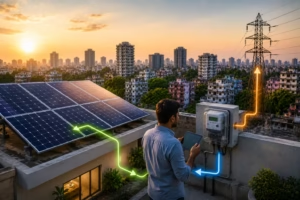
Decentralized solar, especially when it’s paired with battery storage, doesn’t have that dependency. A home with rooftop panels and a battery can often keep essential circuits running — refrigerator, some lights, maybe a router — during a regional outage, because the generation and consumption happen at the same physical location. A neighborhood microgrid can sometimes “island” itself off from the main grid entirely during an emergency and keep running independently until things are restored.
Worth being honest here: rooftop solar without battery storage usually shuts down automatically during a grid outage too, for safety reasons — utility workers need to know the lines are dead before they touch them. So “decentralized” alone doesn’t guarantee resilience; it’s really the combination of local generation plus local storage that delivers the outage-proofing people are picturing. For most homeowners, that resilience argument matters more than shaving a few cents off the sticker price, even if it doesn’t make for the flashiest return-on-investment spreadsheet.
Land, Environment, and the Space Question
Centralized solar needs land — a lot of it. A utility-scale farm producing meaningful power can stretch across hundreds or even thousands of acres, and siting decisions sometimes put that land in competition with farming or natural habitat. It’s a real tension, not a hypothetical one. Agro-photovoltaics — mounting panels high enough that crops or grazing animals can still use the land underneath — is one practical response, and it’s gaining traction as a way to let solar farms and agriculture coexist rather than compete.
Decentralized solar mostly sidesteps this problem by using space that’s already built up: rooftops, parking lot canopies, building-integrated systems. No new land has to be cleared or converted. That’s a genuine environmental advantage, even if decentralized solar alone can’t match the sheer output volume of a utility-scale farm.
Where you live changes how much this matters. If you’re evaluating land-use questions from a policy or regional-planning angle, the centralized-farm-vs-agriculture tension is a bigger deal than it is if you’re just wondering whether panels will fit on your own roof.
So Which Setup Actually Fits You?
Here’s the honest breakdown, since “it depends” isn’t very useful on its own:
- You own your home and get decent sun exposure: rooftop solar is probably the strongest direct-savings and resilience play, especially paired with a battery.
- You rent, or your roof isn’t a good candidate: community solar gets you decentralized-style savings without needing your own installation.
- You’re a business or facility that can’t tolerate downtime: a small on-site microgrid or hybrid system, blending local generation with grid backup, tends to make more sense than betting everything on one side.
- You’re thinking at a city, state, or utility level: centralized solar farms are still doing most of the work of decarbonizing the bulk electricity supply — that’s not something rooftop installs alone can replace at scale.
The Bottom Line
Neither model wins outright, and that’s not a cop-out answer — it’s how grids are actually being built now. Centralized solar farms generate the bulk of low-cost, large-scale renewable power that keeps the overall grid moving toward cleaner sources. Decentralized solar — rooftop systems, community projects, microgrids — adds resilience, cuts transmission losses, and gives individual households and businesses more control over their own electricity, especially when the grid has a bad day.
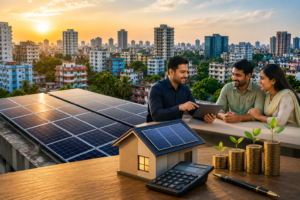
Most places are heading toward a hybrid setup: big solar farms doing the heavy lifting on volume, with rooftop and community systems filling in the resilience and localized-savings gaps. If you’re deciding for your own home, the more useful question isn’t “which one is better” — it’s “which one solves the problem I actually have,” whether that’s a lower bill, better outage protection, or just not wanting to deal with a roof installation at all.
FAQs
What is the main disadvantage of centralized solar power?
The biggest drawback is dependency on transmission infrastructure. Power generated at a remote solar farm has to travel long distances to reach consumers, which means 5–10% is typically lost along the way, and any failure in that transmission network can cut off electricity to large areas — even if the solar farm itself is working fine.
Is rooftop solar more efficient than solar farms?
In terms of transmission efficiency, yes — rooftop solar avoids the line losses that come with long-distance transmission. But in terms of cost-per-watt to generate electricity, utility-scale solar farms are typically more efficient thanks to economies of scale.
What is a hybrid solar grid?
A hybrid solar grid combines centralized, utility-scale generation with decentralized, local sources like rooftop panels, community solar, and microgrids. It’s the direction most modern grids are heading, since it balances low-cost bulk generation with localized resilience.
Does decentralized solar reduce electricity bills more than centralized solar?
Generally, yes, for the individual consumer. Rooftop and community solar offset your usage at the retail electricity rate, while centralized solar’s cost benefits are spread across the whole grid rather than showing up directly on your bill. Actual savings depend heavily on local net metering rules, so it’s worth checking those before assuming a specific number.
Can decentralized solar work during a power outage?
It can, but only when paired with battery storage or microgrid capability. Rooftop panels alone typically shut off automatically during a grid outage for safety reasons. Add a battery, and a home or small community can keep essential power running independent of the main grid.