
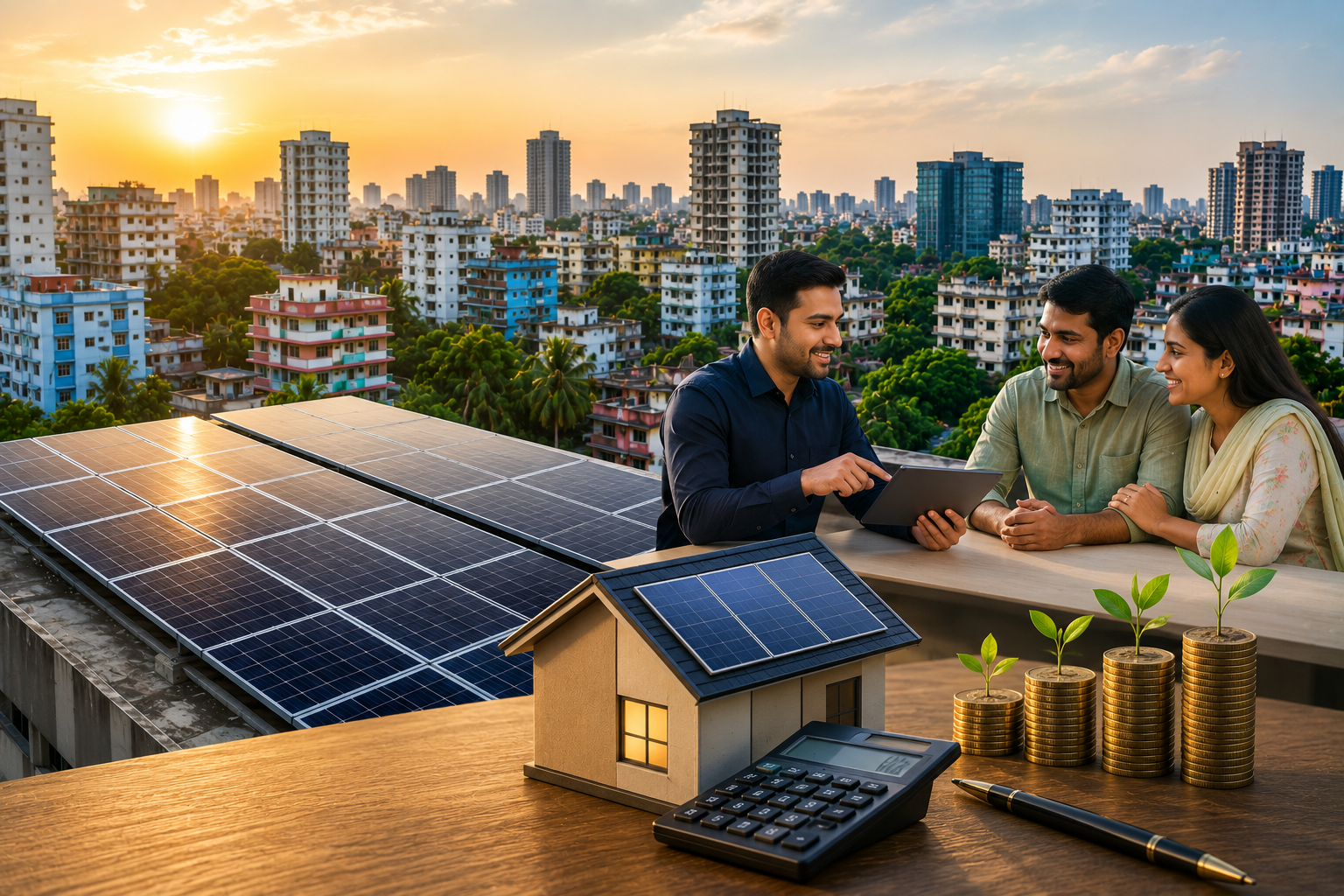
You know the moment. You’ve walked a homeowner through the whole pitch — the panels, the savings, the payback period — and they nod along, genuinely interested. Then you get to the number. And their face changes. “Let us think about it,” they say. Politely. Which usually means never.
Here’s the thing almost nobody tells new reps: that moment has almost nothing to do with whether solar is a good idea. It has to do with how the money gets talked about. Price kills deals. Financing saves them. And if you’re still leading with the total system cost instead of the monthly number, you’re leaving closes on the table that a five-minute reframe could have saved.
This isn’t a homeowner’s guide to comparing loan rates for fun on a Sunday afternoon. This is for reps who need to actually explain solar financing options — loan, lease, PPA, and a couple of others — clearly, confidently, and without turning a sales call into a finance seminar.
Why the Monthly Number Beats the Sticker Price Every Time
Nobody budgets in lump sums. People budget in monthly terms — rent, car payment, phone bill, electricity. So when you say “€18,000,” you’ve handed them a number with no context, and their brain files it under “expensive.” When you say “€89 a month,” you’ve handed them something they can compare to what they’re already paying Iberdrola or E.ON or whoever runs their grid. That’s a fair fight, and solar usually wins it.
This isn’t just a sales trick, either. If the loan payment is lower than what the customer’s saving on electricity, they’re cash-positive from month one. They’re not spending new money — they’re rerouting money they were already spending, into something they’ll eventually own outright. That’s a genuinely different pitch than “spend €18,000 on panels,” even though the underlying math is identical.
There’s a broader pattern here too, worth knowing even if you never say it out loud to a customer: every time a new financing product shows up in a market, the pool of people who can say yes to solar gets bigger. Zero-interest loans, government-backed rates, lease products with no credit-check hurdles — each one opens a door that was previously locked. In the US, something like seven in ten residential solar systems get financed rather than bought outright. Europe’s catching up — currently somewhere around four in ten, and climbing fast as electricity prices stay stubbornly high and better loan products roll out country by country.
None of this means cash is a bad option. It’s just not the only option, and for most households, it’s not even the realistic one.
Cash Purchase: Simple, But Not for Everyone
Let’s deal with cash first, because it’s the easiest to explain and honestly the best deal — for the right customer.
Paying outright means no interest, no lender, no monthly obligation hanging over the household. The customer owns the system the day it’s installed. For a typical 6 kWp residential setup in a country like Germany, you’re looking at a 25-year internal rate of return somewhere in the 8–12% range — genuinely better than parking that money in a savings account or a government bond, and it’s protected against inflation because it tracks electricity prices, not a stock index.
Who actually goes for this? Usually older homeowners with savings sitting around doing nothing, people who instinctively dislike debt, and higher-net-worth clients who think of solar as an investment first and an environmental choice second. If someone tells you “I just don’t want another monthly payment,” believe them — that’s a legitimate preference, not an objection to be argued out of.
The catch is obvious once you say it out loud: most people don’t have €15,000 to €25,000 sitting in a current account. That’s exactly why leading every conversation with the cash price shrinks your addressable market before you’ve even opened the financing conversation.
Solar Loans: The Workhorse of Residential Financing
In any market with decent green-lending infrastructure, the solar loan is the default. The customer borrows the cost of the system, pays it back over anywhere from 5 to 25 years, and keeps full ownership the whole time.
Loans come in two flavors — secured (tied to the property, usually a lower rate because the lender has collateral) and unsecured (a personal loan, faster to arrange, no property paperwork). Smaller residential jobs tend to lean unsecured simply because it’s less friction for everyone involved.
The number that actually matters to the customer isn’t the interest rate — it’s the gap between the loan payment and the electricity savings. If the payment’s €89 a month and the expected savings are €115, that customer is €26 a month ahead starting immediately. The loan is, in effect, paying for itself.
Watch out for: dealer fees. A lot of solar loan products carry a fee — often 10% to 30% of the loan amount — that the installer pays the lender, and which gets quietly rolled into the loan principal. A €15,000 system financed through a product with a 20% dealer fee becomes an €18,000 loan. The customer ends up paying more interest and a higher monthly payment than they’d expect from the sticker price alone. Disclose this upfront. Customers who find out about it later — usually from a friend, or worse, from the fine print — don’t come back, and they definitely don’t refer anyone.
What Europe’s Loan Market Actually Looks Like
Germany runs on KfW — specifically KfW 270 for renewable energy systems (effective rates around 3.9–4.2%) and KfW 442 if battery storage is part of the deal (roughly 4.0–4.5%). Here’s the part that trips up a lot of installers: the application has to go through a Hausbank, a local partner bank, not KfW directly, and it has to be approved before installation starts. Miss that window and the customer loses the subsidized rate — and loses trust in whoever sold them the system without mentioning it.
France has Eco-PTZ, a genuinely zero-interest loan backed by the state, available up to €30,000. Spain runs its ICO green loan network, typically 3–5%. The Netherlands has the Energiebespaarfonds, also in the 3–5% range. The UK’s picture is different — home improvement finance and green mortgage add-ons through lenders like Barclays or Zopa, running noticeably higher at 6–9%, reflecting a less subsidized lending environment. Italy sits somewhere in between, with eco-bonus schemes paired with bank green loans through players like Intesa Sanpaolo or Unicredit, in the 4–6% range.
Solar Leases: Lower Barrier, Different Trade-Offs
A lease is different from a loan in one crucial way: the customer doesn’t own the system. The installer or a finance company does. The customer just pays a fixed monthly rate to use it — typically €60 to €110 a month for a standard 5–8 kWp setup, over a 10–20 year term, often with a buyout option at the end.
Because the lender keeps the asset, the credit bar tends to be lower than for a loan. That makes leasing a real option for customers who might not clear a loan’s underwriting requirements — genuinely useful for reaching a segment of the market a loan-only pitch would miss entirely. It also means no maintenance responsibility for the customer, which some risk-averse homeowners genuinely value.
Watch out for: selling the house. If a leased system is on the roof when the homeowner decides to move, the lease either has to transfer to the buyer (who then has to qualify for it — extra friction in an already stressful transaction) or get bought out, which usually runs into the thousands of euros. Anyone who thinks there’s a real chance they’ll move within five to seven years should hear this clearly, before they sign, not after they’ve listed the house.
Leases are considerably less common in Europe than in the US. The UK has the most developed lease market, mostly through installers running their own in-house finance arms. Germany has some options, largely from the bigger national installers. France, Spain, and the Netherlands are still mostly cash-or-loan territory — lease products haven’t really taken hold there yet.
Power Purchase Agreements: Paying for the Electricity, Not the Panels
A PPA flips the whole model. The customer isn’t financing a purchase at all — they’re buying electricity, just from panels on their own roof instead of the grid. The installer puts up the system at no upfront cost, and the customer pays a fixed rate per kilowatt-hour for whatever the system produces, typically over 15 to 25 years.
The economics are genuinely attractive on paper. PPA rates across Europe generally run €0.10–€0.18 per kWh, against grid rates sitting at €0.28–€0.35 in most markets right now. For a household using around 4,000 kWh a year with 70% self-consumption, that gap can translate into €280–€400 in savings annually, starting immediately, with zero capital outlay. The reason this works for the provider is scale — they can access cheaper capital than an individual homeowner ever could, and they spread equipment and installation costs across a large portfolio of systems.
Watch out for: the contract length. Twenty-plus years is a serious commitment, and like leases, PPAs complicate a home sale — the agreement needs to transfer or be terminated, and not every buyer wants to inherit it. PPAs also aren’t available everywhere yet; in some countries the regulatory framework simply hasn’t caught up.
The UK leads on residential PPAs — Octopus Energy, E.ON, and a handful of specialist installers all offer them. Germany’s catching up quickly, with companies like Enviria and Zolar building out PPA portfolios. The Netherlands has players like Sungevity active in the space. France and Spain are earlier-stage but moving, and Italy’s seeing new entrants following the shift in its market after the Superbonus scheme wound down.
PACE Financing: A Property-Based Option (With a European Asterisk)
PACE — Property Assessed Clean Energy — ties repayment to the property itself rather than to the individual borrower. The lender pays the installer directly, and the homeowner repays through an addition to their property tax bill, often over 10 to 30 years. Because underwriting is based on property value and equity rather than personal income, it opens the door to customers who might not qualify for a standard loan.
Here’s the honest part: a fully developed PACE equivalent doesn’t really exist yet across most of Europe. It’s a mostly American structure, strongest in states like California, Florida, and Texas. The UK’s old Green Deal scheme had some similar bones but closed to new applicants back in 2019. France has municipal-level pilots that resemble PACE, still developing. Where PACE-style thinking is gaining real traction in Europe is on the commercial side — C-PACE, mostly for larger commercial and industrial solar projects, where off-balance-sheet treatment matters to a CFO deciding whether a project shows up as debt.
If you’re working commercial deals, it’s worth checking with your finance team whether C-PACE treatment is available in that jurisdiction. It can genuinely be the difference between a project a CFO signs off on and one they don’t.
How to Present These Options Without Losing the Customer
Here’s where a lot of otherwise-good reps talk themselves out of a sale: by presenting too much. Decision-making research is pretty consistent on this — hand someone more than two or three options and conversion rates drop, sometimes sharply. A rep who lays out five financing structures and a spreadsheet of comparison numbers isn’t being thorough. They’re creating paralysis.
The fix is simple: never present more than two options in a single conversation. Something like — “There are really two ways people usually go about this. Some prefer to own the system with a loan — your payment’s €89 a month, your savings are €115, so you’re ahead from day one. Others pay cash outright and skip financing altogether — better return over 25 years, but it needs €18,000 up front. Which one sounds more like how you think about money?”
That’s it. Two clear paths, framed around what the customer already cares about, with a question that invites them into the decision instead of leaving them staring at a menu.
A comparison card helps too — not a 25-year NPV table nobody reads on the spot, just month-one numbers. What they pay now for electricity. What they’d pay under Option A. What they’d pay under Option B. Ten seconds of reading, and the decision becomes obvious.
And give an actual recommendation. “Based on what you’ve told me, the loan makes more sense here — you’re cash-positive immediately, and you’re not tying up €18,000 that could be doing something else.” A recommendation feels like advice from someone who’s paying attention. A list of options feels like a menu, and menus produce “we’ll think about it,” not signatures.
Bring financing up early too — during qualification, not after someone’s already flinched at a sticker price. Something like: “People usually either pay upfront or finance it in a way where the monthly payment’s offset by the savings — is one of those more natural for how you approach this kind of thing?” That plants financing as normal, expected, part of the process — not a rescue attempt after the price has already landed badly. Once someone’s anchored to a sticker price, comparing it to a monthly payment feels like a trick instead of a fair comparison.
Include a monthly payment scenario in every proposal, even for customers who say they’re planning to pay cash. It’s common for cash-intending customers to switch once they see the numbers side by side — and just as common for the reverse to happen, with financing-minded customers deciding cash makes more sense once it’s laid out clearly. Either way, showing both builds trust rather than steering.
What to Do When Financing Falls Through
It happens more than anyone likes to admit. A loan application gets rejected. A KfW window gets missed because someone started installation too early. A customer’s credit doesn’t clear underwriting for the product you pitched. This is the part competing advice rarely covers, but it’s exactly the moment that decides whether you keep the deal or lose it.
The move here is to have a backup path ready before you need it, not scrambling in the moment. If a loan gets rejected, a lease with a lower credit bar might still work — that’s one of the genuine reasons leases exist in the product mix at all. If a KfW deadline gets missed, be upfront that the timeline’s shifted and walk through what a standard-rate loan looks like instead, rather than letting the customer discover the subsidy is gone on their own. The honesty costs you something in the moment. It buys you the referral later.
If you manage a team, this is worth building into training directly — not just “here are five financing types,” but a simple decision tree: what’s the backup if the first option doesn’t clear? New reps who’ve only ever pitched the happy path get caught flat when a deal hits friction, and that’s usually when a sale is lost for good.
A Quick Word on Rates and Tax Treatment
Every rate mentioned here reflects roughly where things stood in 2026 — and rates move. Always confirm current figures with your lender before quoting a customer a specific number; nothing damages trust faster than a rate that’s changed since the proposal went out.
Tax treatment is worth a mention too, even briefly, because it varies enormously by country and it’s not something to guess at. Whether loan interest is deductible, how VAT applies to installation costs, whether there are additional regional incentives layered on top of national ones — all of this differs country to country and sometimes region to region. The honest answer for a customer asking is usually “that depends on your local tax situation — worth a quick check with an accountant or your local energy office before you finalize anything.” That’s not a dodge. It’s accurate, and customers respect accuracy more than a confident guess.
For a deeper look at how financing interacts with overall system economics, our solar generation and financial modeling tool walks through the 25-year position for loan versus cash scenarios side by side, which is worth showing a customer who wants to see the long game, not just the monthly number.
If financing is the thing that turns interest into a signed contract, the rest of the pitch still matters just as much — understanding how solar panels actually convert sunlight into usable electricity or explaining the broader shift toward solar adoption can round out a conversation with a customer who’s asking bigger-picture questions before they commit to any financing structure at all.
FAQs
What is the best way to finance solar panels?
It depends entirely on the customer. Cash delivers the strongest long-term return — often an 8–15% IRR over 25 years — for anyone with capital sitting idle. Solar loans, especially government-backed products like KfW 270 in Germany or Eco-PTZ in France, work well for people who want ownership without a large upfront cost. The real test is simple: is the monthly loan payment lower than the monthly electricity savings? If yes, that customer is ahead from day one regardless of the total loan cost.
Is a solar loan or lease better?
For customers who qualify, a loan is usually the better structure. It means ownership, it keeps incentive and credit eligibility intact, and it avoids the transfer complications a lease creates if the home gets sold. Leases make more sense for people who can’t qualify for a loan or who specifically want to avoid maintenance responsibility. In most European markets, government-backed loans at low single-digit rates beat lease pricing outright wherever they’re available.
What is a solar PPA?
A Power Purchase Agreement means the installer puts up the system at no cost to the homeowner, then sells them the electricity it produces — usually 30–40% cheaper than the local grid rate. European PPA pricing typically runs €0.10–€0.18 per kWh against grid rates of €0.28–€0.35. Savings start immediately with zero capital required. The trade-offs are long contract terms, often 15–25 years, and added friction if the home gets sold during that period.
How does KfW solar financing work in Germany?
KfW 270 offers effective rates around 3.9–4.2%, covering up to 100% of eligible system costs, repayable over as long as 20 years. The application goes through a Hausbank — a local partner bank — not directly through KfW, and it has to be approved before installation begins. That timing rule catches more customers off guard than almost anything else in the German solar market. KfW 442 covers battery storage specifically, alongside the main system loan.
Is solar financing tax-deductible in Europe?
It varies significantly by country, and sometimes by region within a country — there’s no single European answer. Some markets allow interest deductions or offer VAT reductions on installation costs; others don’t, or apply different rules depending on whether the system is residential or commercial. The safe advice for any customer asking is to confirm with a local accountant or energy office before finalizing financing, rather than assuming a blanket rule applies.
What happens if a solar loan application gets rejected?
It’s not the end of the deal — it just means switching structures. A lease typically has a lower credit bar since the lender keeps the asset as collateral, which makes it a workable fallback for customers a loan doesn’t clear. The key is having that backup conversation ready before rejection happens, not scrambling afterward. Reps who walk a customer through “if this doesn’t work, here’s option two” upfront tend to keep the deal even when the first financing path falls through.
How do I explain solar financing to a customer without overwhelming them?
Keep it to month-one cash flow and no more than two options. Something like: “Your electricity bill’s €120 a month right now. Financed over 15 years, your payment’s €89 and your electricity bill drops to about €15 — you’re €16 a month ahead immediately, and once the loan’s paid off, you own the system and your savings jump to around €105 a month.” Give a clear recommendation based on their situation rather than a full list of every structure available — most hesitation comes from not seeing the month-one number clearly, not from genuine indecision.
![Government Subsidies for Solar in [CountryState]](https://muspana.com/wp-content/uploads/2026/07/Government-Subsidies-for-Solar-in-CountryState-300x200.avif)