
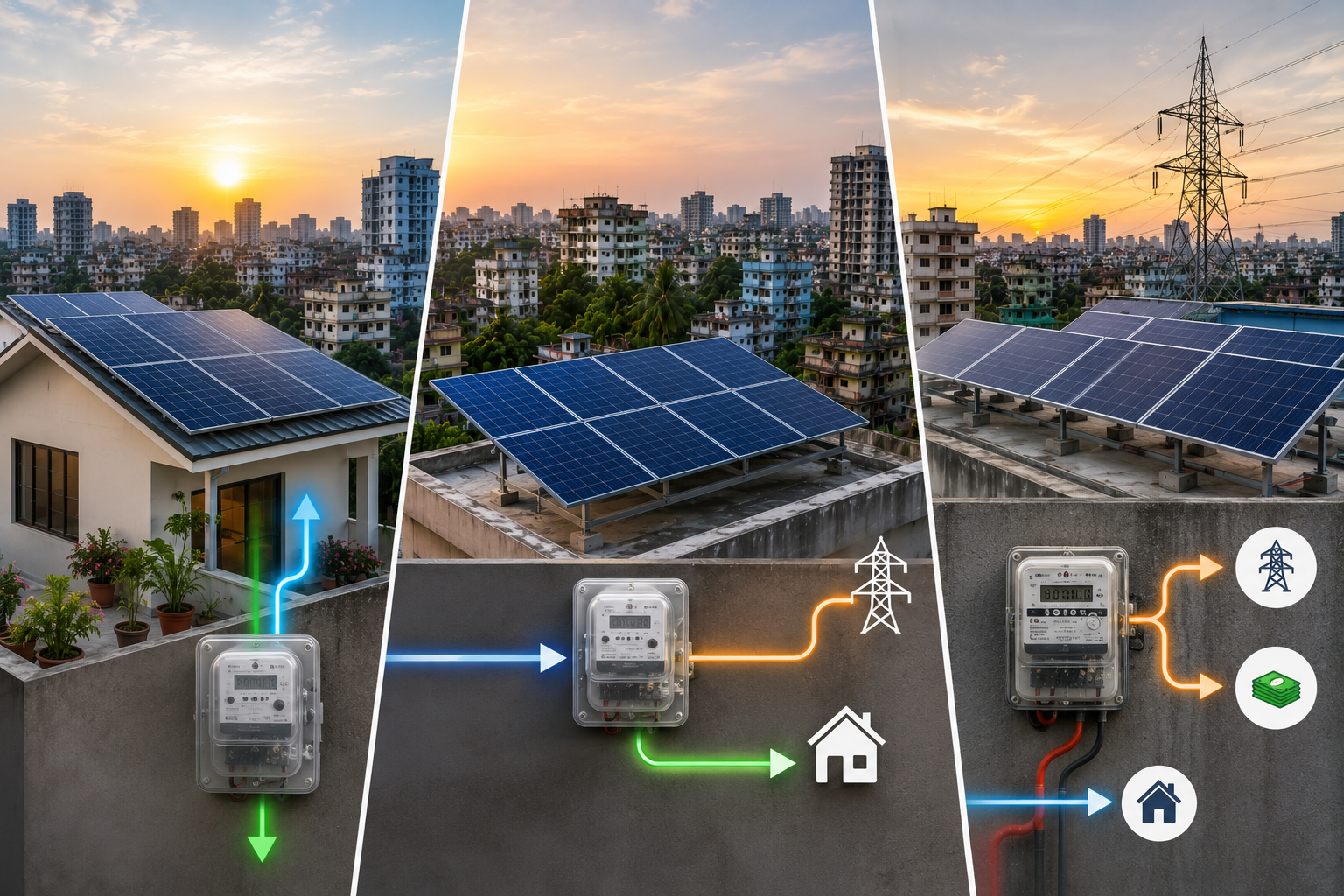
If your solar installer casually mentioned “net billing” instead of “net metering” and you just nodded along, you’re not alone. That one word swap can quietly change your annual solar savings by a few thousand rupees — or dollars, depending on where you live — and most people don’t realize it until their first electricity bill arrives looking nothing like what they expected.
Here’s the short version, because you shouldn’t have to read six paragraphs to get an answer: net metering lets you offset your bill using the solar power you generate, basically unit for unit. Net billing still lets you use your own solar power, but anything you send back to the grid gets credited at a lower rate than what you pay for electricity. Gross metering skips self-consumption altogether — you sell everything you generate to the grid and buy back everything you use, at full price.
Net metering is generally the best deal if you can get it. Net billing is the compromise plan when net metering isn’t on the table. And gross metering is really its own thing — more of an income arrangement than a bill-reduction one, and mostly used for commercial or large-scale setups.
Now let’s actually dig into what each of these means for your wallet.
What Is Net Metering?
Net metering is the setup where you use your own solar electricity first, and only the leftover gets pushed onto the grid. A bi-directional meter tracks how much you pulled from the grid and how much you sent back, and your bill is based on the difference — the net of the two.
Say your rooftop system produces 500 units in a month and you use 350 of them directly. The extra 150 units go to the grid, and depending on your local rules, those units either roll over as credit for a future month or get settled at the end of a billing cycle, sometimes called a true-up period.
This is the arrangement most homeowners hope for, because it essentially treats the grid like a savings account for your extra solar power.
Who It’s Best For
Homeowners and small businesses trying to shrink their monthly bill as much as possible. If your goal is self-consumption and long-term savings rather than income, this is the one you want.
What You Actually Get Paid
In most net metering setups, you’re not “paid” in cash — you’re credited in units, which offset future consumption. Some regions do settle unused surplus annually at a regulated rate, like the Average Pooled Power Cost (APPC) used in parts of India, but that rate is usually lower than what you’d get from simply using the credit yourself.
Common Pitfalls
A lot of people assume unused credits carry forward indefinitely. They don’t, in many regions — leftover credits can be forfeited or cashed out at a much lower rate at year-end. It’s worth checking your local DISCOM or utility’s true-up policy before you assume every unit you generate is “safe.”
What Is Net Billing?
Net billing looks similar on the surface but works differently underneath. Instead of netting import and export together, it treats them as two separate transactions. Electricity you pull from the grid is billed at the full retail rate. Electricity you export gets credited at a separate, usually lower, feed-in tariff.
As of 2026, it’s common in parts of India to see export rates sitting somewhere around ₹2.50 to ₹3.50 per unit, while retail electricity can cost around ₹8 per unit. That gap is the whole story with net billing — you’re still saving money by using your own solar power directly, but every unit you export is worth noticeably less than a unit you import.
Who It’s Best For
People who want partial solar savings but either don’t qualify for net metering or live somewhere the grid infrastructure can’t support it. It’s also common where utilities are shifting away from full net metering to manage grid load.
What You Actually Get Paid
You get paid (in bill credit) for exports, but at a fixed, regulator-set rate that’s usually well below retail. So the math only works in your favor if you’re using most of your solar power yourself rather than exporting a lot of it.
Common Pitfalls
Net billing can feel like a downgrade compared to net metering — and honestly, it often is, in terms of pure savings potential. The trap is assuming your export credit will offset your bill the same way net metering would. It won’t, not at that spread between retail and export rates.
What Is Gross Metering?
Gross metering flips the whole model. Every unit your system produces goes straight to the grid — none of it offsets your own usage directly. You still buy all the electricity you consume at the full retail tariff, separately. In exchange, you get paid a fixed feed-in tariff for everything you generate, functioning much like a small power purchase agreement between you and the utility.
Who It’s Best For
This is mostly a commercial or large-scale solar play, where the point is generating steady income from solar rather than trimming a household bill. Businesses with big rooftop or ground-mounted systems sometimes choose this deliberately, especially where feed-in tariffs are attractive relative to their own consumption needs.
What You Actually Get Paid
A fixed rate per unit generated, agreed upon in advance, regardless of how much electricity you personally use. It’s predictable, which some people genuinely prefer over the “it depends on your usage pattern” nature of net metering and net billing.
Common Pitfalls
If you’re a homeowner mainly hoping to lower your electricity bill, gross metering usually isn’t going to do that for you. You’re still paying full retail for your consumption. This system makes more sense as an investment income stream than a bill-reduction strategy.
A Real Example: Same System, Three Different Outcomes
Let’s put actual numbers on this instead of talking in the abstract.
Imagine a 5kW rooftop system generating around 600 units a month, and a household using 350 of those units directly, with 250 exported.
Under net metering: The 250 exported units offset future consumption almost unit-for-unit, so the household effectively only pays for the difference between total consumption and total generation across the billing cycle. Assuming a retail rate of ₹8/unit, that’s a meaningful chunk of a typical bill wiped out.
Under net billing: The 350 self-consumed units still save at the full ₹8/unit rate. But the 250 exported units are credited at, say, ₹3/unit instead of ₹8. That’s a difference of roughly ₹1,250 in credit compared to what net metering would have delivered for the same exported amount.
Under gross metering: All 600 units go to the grid at the fixed feed-in tariff — let’s say ₹3/unit, so ₹1,800 in income. But the household still pays full retail for all 350 units they used, meaning they get zero bill offset from their own solar system.
Same system, same generation, three very different financial outcomes. That’s the entire reason this distinction matters more than most people assume when they’re signing a solar contract.
How Do You Know Which One You Have?
This is the part most articles skip, and it’s usually the part people actually need. A few quick ways to check:
- Look at your electricity bill. If it shows a single net consumption figure (import minus export), you’re likely on net metering. If it shows import and export as two separate line items with different rates, that’s net billing.
- Check your meter type. A single bi-directional meter usually signals net metering or net billing. Two separate meters — one for import, one for export — often points to gross metering.
- Ask your utility or DISCOM directly. Policies vary by state and region, and installers don’t always volunteer this detail upfront. It’s a fair question to ask before signing anything.
- Check your system size against local thresholds. Many regions cap net metering eligibility at certain capacities (often below 10kW for residential), pushing larger systems into net billing or gross metering by default.
Can You Switch From Net Billing to Net Metering?
Sometimes, but it depends entirely on local policy and grid capacity. Some utilities allow a one-time conversion request; others have phased out net metering entirely for new connections and only grandfather in existing customers. If you’re currently on net billing and want net metering, it’s worth contacting your utility directly rather than assuming your installer’s original setup is permanent. Policies shift more often than people expect — what was available two years ago in your state or region may not be the default option today.
So Which One Should You Actually Choose?
If you have a genuine choice, net metering is usually the strongest option for maximizing savings, because it treats your exported power at close to the same value as the power you use yourself. Net billing is a reasonable fallback when net metering isn’t available or your system size disqualifies you — you’ll still save, just not as aggressively. Gross metering makes the most sense when your priority is generating income from a larger system rather than shrinking a household bill, which is why it shows up more often in commercial installations.
None of these is universally “better.” It genuinely comes down to your goals, your system size, and — more than anything — what your local utility actually permits. Regulations here shift often enough that it’s worth a quick check with your utility or DISCOM before assuming your neighbor’s setup applies to you too.
If you’re still early in understanding how solar systems actually generate and deliver power in the first place, it helps to start with the basics of how sunlight becomes electricity or get a clearer picture of what solar energy actually is before diving into billing specifics. And if you’re comparing system types rather than billing types, it’s worth reading up on the difference between on-grid, off-grid, and hybrid solar systems, since your billing options are often tied directly to which of those you choose.
FAQs
What’s the difference between net metering and net billing?
Net metering nets your total import and export together, so exported solar power offsets your bill at close to the retail rate. Net billing keeps import and export separate, charging you full retail for what you use and crediting exports at a lower, regulator-set rate.
Is net metering better than gross metering?
For most homeowners trying to lower their electricity bill, yes — net metering usually delivers better savings because it directly offsets your own consumption. Gross metering is better suited to those prioritizing fixed income from a larger solar installation rather than bill reduction.
How does solar net billing work?
Net billing measures electricity you import from the grid and electricity you export separately. You’re charged full retail for imports and credited at a lower feed-in rate for exports, meaning your savings depend heavily on how much solar power you use directly versus send back to the grid.
Is net metering going away?
In some regions, yes — utilities are gradually shifting new connections toward net billing as grid infrastructure and policy priorities change, though existing net metering customers are often grandfathered in. It varies significantly by state and utility, so it’s worth checking current local policy rather than assuming.
What happens to unused solar credits at year-end?
This depends on regional rules. Some utilities carry credits forward indefinitely, while others settle or forfeit surplus credits at the end of an annual true-up period, sometimes paying out at a lower regulated rate like the APPC used in parts of India.
Do I need a special meter for net billing?
Yes, typically a bi-directional meter capable of recording import and export separately, since net billing relies on distinct rates for each direction of electricity flow.
Is gross metering profitable for homeowners?
It can be, but it doesn’t reduce your electricity bill the way net metering or net billing does — you’re still paying full retail for what you consume. It tends to work better as an income arrangement for larger or commercial systems rather than a savings strategy for typical households.



![Government Subsidies for Solar in [CountryState]](https://muspana.com/wp-content/uploads/2026/07/Government-Subsidies-for-Solar-in-CountryState-300x200.avif)