Most people think battery backup means they’re off the grid. It doesn’t. And mixing up those two things is probably the single most common mistake I see homeowners make before they even talk to an installer.
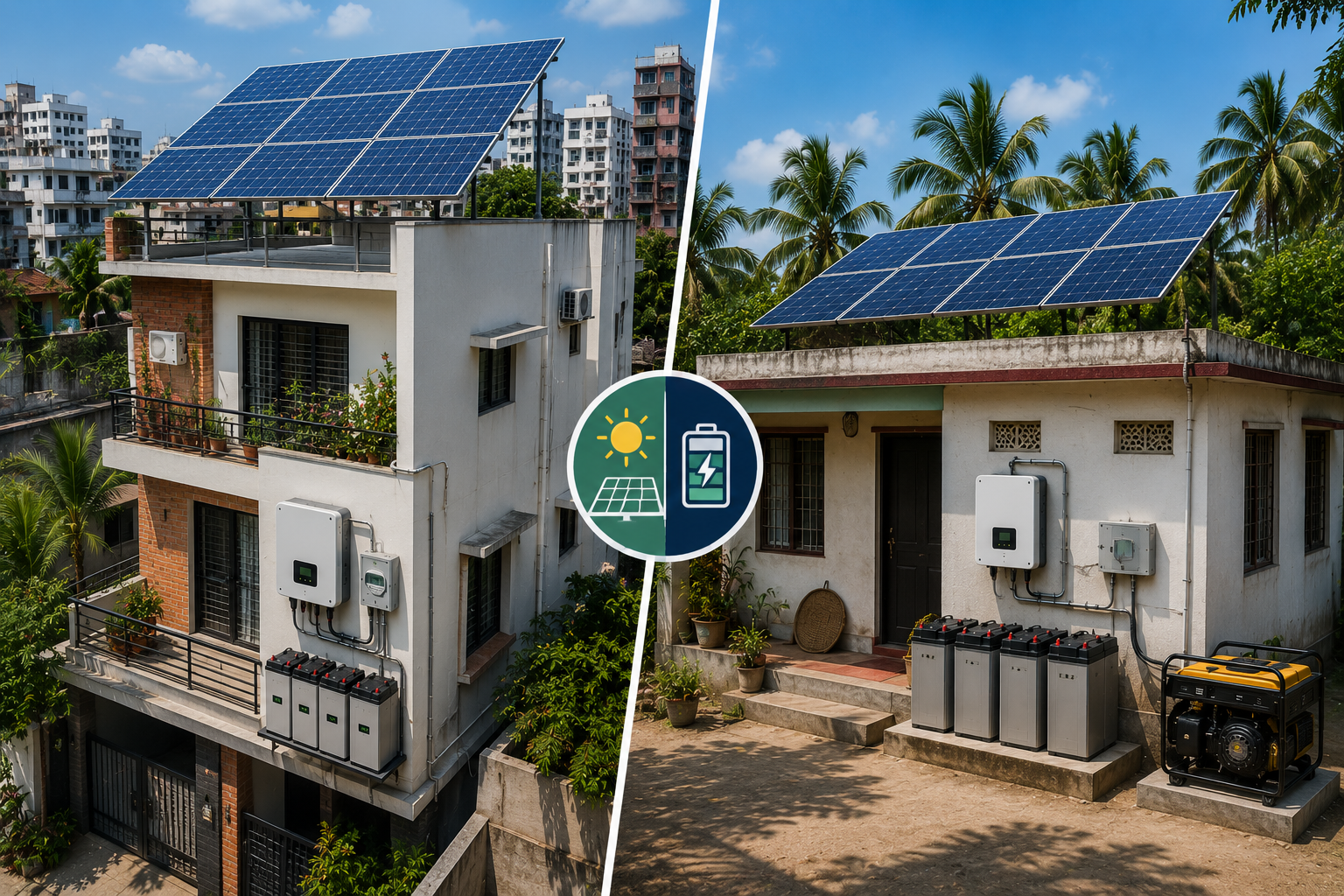
Here’s the short version: grid-tied with battery backup keeps you connected to the utility company but adds a battery that kicks in during an outage. Pure off-grid solar means you’ve cut ties with the utility entirely — no connection, no safety net, just your panels, batteries, and maybe a generator standing between you and the dark. Same starting point (solar panels on a roof), completely different philosophy underneath.
If you’ve been reading about what solar energy actually is and how the photovoltaic effect turns sunlight into usable power, you already understand the basics. This is where it gets practical — which setup should you actually put on your house.
What Is Grid-Tied With Battery Backup?
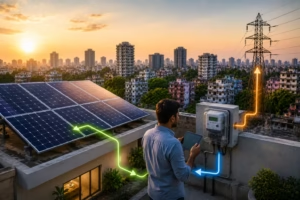
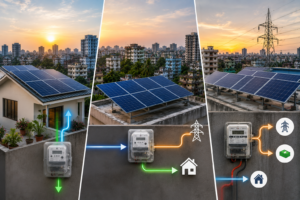
Grid-tied with battery backup is a hybrid system. Your panels feed power to your home during the day, any extra gets sent back to the grid (often through net metering), and a battery bank stores a chunk of that energy for later. When the grid goes down, the system automatically disconnects from the utility line — a process called islanding — and your battery keeps a set of “critical loads” running: fridge, some lights, maybe your internet router and a few outlets.
You’re still a utility customer. You still get a bill. The battery is there for resilience, not independence.
Pros:
- Lower upfront cost than full off-grid, since you don’t need to size the system to cover 100% of your needs year-round
- You can pull extra power from the grid on cloudy weeks instead of rationing
- Net metering can offset your electric bill significantly
- Backup power for outages without the complexity of full self-sufficiency
Cons:
- You’re not protected from long-term grid failures unless your battery bank is large (and expensive)
- Most residential setups only back up “critical loads,” not the whole house, unless you pay extra for a bigger battery
- Still dependent on the utility company for interconnection agreements, permitting, and rate structures
What Is Pure Off-Grid Solar?
Pure off-grid solar means there’s no wire running back to a utility pole. Your entire home’s electricity comes from your panels, stored in a battery bank sized to get you through nighttime and multiple cloudy days, often backed up by a generator for the worst stretches. This is the setup you see on remote cabins, rural homesteads, and properties where running a grid connection would cost more than the solar system itself.
Pros:
- Total independence — no utility bill, no dependency on grid stability
- Makes sense financially when grid connection costs are high (rural extensions can run $15,000–$50,000+ per mile in some areas)
- Appeals to people who want genuine self-sufficiency, not just backup power
Cons:
- Requires a much larger, more expensive battery bank and array to handle worst-case weather
- No safety net — if your system underperforms in winter, you’re rationing power or running a generator
- Higher maintenance burden; batteries and generators need real attention, not a “set it and forget it” mindset
- Upfront costs are typically 30–60% higher than a comparable grid-tied hybrid system
Grid-Tied With Battery Backup vs. Off-Grid: Quick Comparison
| Factor | Grid-Tied + Battery Backup | Pure Off-Grid |
| Connection to utility | Yes | None |
| Typical cost (avg home) | $20,000–$35,000 | $30,000–$60,000+ |
| Outage protection | Critical loads only (unless oversized) | Full home, if sized correctly |
| Maintenance | Low to moderate | Moderate to high |
| Best for | Suburban/urban homes with occasional outages | Remote properties, no grid access |
| Backup during long outages | Limited by battery size | Depends on array + battery + generator |
| Ongoing utility bill | Yes, often reduced | None |
Those numbers move around a lot depending on your region, battery brand, and how much of your home you want backed up — but they give you a realistic starting point instead of a shrug and a “it depends.”
How Much Backup Do You Actually Need?
This is where most people get it wrong. A single lithium battery (roughly 10–13.5 kWh, like a Tesla Powerwall or similar) will typically run a few critical circuits — fridge, some lights, wifi, maybe a sump pump — for somewhere around 8–24 hours, depending on what’s plugged in and how much sun you’re getting to recharge it.
If you’re picturing running your whole house, including AC and an electric water heater, through a multi-day outage, you’re looking at two or three of those units, easily pushing total system cost up by $15,000 or more. That’s the gap a lot of sales conversations gloss over: “battery backup” sounds like full protection, but the version most people can afford only covers the essentials.
Cost Differences, Realistically
A typical grid-tied hybrid system for an average-sized home lands somewhere between $20,000 and $35,000 installed, battery included, before incentives. Pure off-grid systems tend to start higher and climb fast, often $30,000 to $60,000 or more, because you’re not just adding a battery — you’re building an entire self-contained power plant sized for your worst month of sunlight, not your best.
Federal and state incentives can knock a meaningful chunk off either option, and financing terms vary a lot by installer, so treat these as ballpark figures for planning, not a quote.
Which One Fits Your Situation? Ask Yourself These Questions
Run through these before you call an installer — it’ll save you from getting steered toward the wrong (usually pricier) system.
- Do you have grid access at a reasonable connection cost? If yes, off-grid rarely makes financial sense.
- Are outages rare and short in your area (a few hours, a couple times a year)? Grid-tied with a modest battery is probably enough.
- Do you live somewhere prone to multi-day outages — hurricanes, wildfire shutoffs, ice storms? You’ll want a bigger battery bank or lean toward off-grid, depending on grid reliability overall.
- Is your property remote, with no utility line nearby? Off-grid might genuinely be cheaper than paying for a grid extension.
- Do you want to actively manage your energy use, monitor batteries, and maintain a generator? That’s the off-grid lifestyle. If that sounds like a chore rather than a project you enjoy, grid-tied is the more realistic long-term fit.
- Is your main goal saving money on your bill, or true independence? Grid-tied with net metering usually wins on pure economics. Off-grid wins on independence, not on payback period.
If you’re mostly worried about the power flickering during storms and want to keep your grocery bill and Wifi alive, grid-tied with battery backup covers that without the extra cost and upkeep. If you’re building somewhere genuinely remote, or grid connection would cost more than the solar system itself, off-grid starts making real sense.
Common Mistakes People Make
Assuming any battery means full outage protection. A small backup battery might get you through a few hours, not a week. Know what “critical loads” actually means for your setup before you sign anything.
Underestimating winter performance for off-grid systems. Off-grid systems have to be sized for your worst sunlight month, not your average one. A system that looks great in July can leave you running a generator constantly in December.
Skipping the maintenance conversation. Off-grid systems, especially with lead-acid batteries or a generator in the mix, need regular attention — checking fluid levels, running the generator periodically, monitoring battery health. Grid-tied systems with lithium batteries are much more hands-off.
Not asking about interconnection agreements. If you’re going grid-tied, your utility company has rules about how your system connects, what net metering rates apply, and what equipment is required. This varies a lot by state and utility — worth asking early, not after installation.
A Middle Ground Worth Knowing About
Some homeowners land somewhere between these two extremes — a larger battery bank on a grid-tied system that can cover most of the home for a day or two, without going fully independent. It’s not officially “off-grid,” but it closes a lot of the gap. If you’re weighing this option, it’s worth reading up on how hybrid solar systems are configured and how they compare to standard on-grid solar systems before deciding how big a battery bank actually makes sense for you.
And if remote power is genuinely your situation, it helps to understand the full picture of an off-grid solar system setup, including generator pairing and battery sizing, rather than just comparing sticker prices.
FAQs
Can you add battery backup to an existing grid-tied system?
Yes, in most cases. Adding a battery to an existing grid-tied array usually involves a compatible inverter (or a hybrid inverter upgrade) and a critical loads panel. Costs vary depending on your existing equipment, but retrofitting is common and often simpler than people expect.
How many batteries do you need to go off-grid?
It depends on your daily energy use and how many days of backup you want without sun. As a rough guide, an average home might need 20–40 kWh of storage (roughly two to four standard home battery units) to comfortably ride out several cloudy days, though usage habits and climate change that number significantly.
Is off-grid solar cheaper than grid-tied?
Generally, no — off-grid systems cost more upfront because they have to be sized for worst-case sunlight and total self-sufficiency. The exception is remote properties where extending a utility line would cost more than the entire solar system.
Do off-grid systems need a generator?
Most do, at least as a backup. Even a well-sized battery bank can run low during an extended stretch of poor weather, and a generator provides a safety net so you’re not left without power.
What happens to grid-tied solar during a blackout without battery?
Without a battery, a standard grid-tied system shuts off automatically during an outage. This is a safety requirement — it prevents your panels from sending power back into lines that utility workers might be repairing. No battery means no backup power, regardless of how sunny it is outside.
Which system is better for resale value?
Grid-tied systems, with or without battery backup, tend to be viewed more favorably by appraisers and buyers since they’re familiar and don’t require the buyer to change their utility relationship. Off-grid systems can be a harder sell unless the buyer specifically wants that lifestyle.