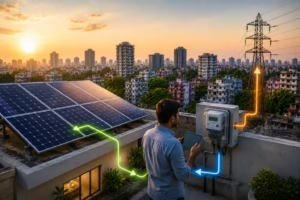

The power goes out. You’ve got solar panels on your roof, sun blazing outside, and your fridge still shuts off with everyone else’s on the block. That moment catches a lot of solar owners off guard — panels alone don’t keep the lights on when the grid goes down. That’s the gap a hybrid solar system is built to close.
A hybrid solar system is a home solar setup that combines solar panels, a battery, and a connection to the utility grid, so you can generate your own power, store the extra, and still draw from the grid whenever you need to. It’s not off-grid, and it’s not the basic grid-tied setup your neighbor might have. It sits in between, and that middle ground is exactly why it’s become the default recommendation for a lot of installers in 2026.
If you’ve been circling this topic for a while — reading spec sheets, half-listening to a sales pitch, trying to figure out if “hybrid” is a real technical category or just a word someone in marketing likes — you’re in the right place. Let’s get into what’s actually going on inside one of these systems.
How a Hybrid Solar System Actually Works
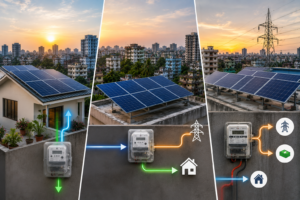
Strip away the branding and a hybrid system is really just smart traffic control for electricity. Here’s the sequence, start to finish:
- Generation — your panels absorb sunlight and produce direct current (DC) electricity. This is straight photovoltaic effect — nothing hybrid about this step yet.
- Conversion — the hybrid inverter (the real brain of the operation) converts that DC power into the alternating current (AC) your appliances actually use.
- Prioritization — the system decides, in real time, where that power goes: straight to your home, into the battery, or out to the grid.
- Storage — anything you’re not using immediately gets banked in the battery for later — evening use, a cloudy stretch, or an outage.
- Grid interaction — once the battery’s full or nearly there, extra power can flow back to the utility (often for a credit), and if your solar and battery ever fall short, the grid quietly fills in the difference.
None of this is exotic technology. What makes it “hybrid” is that single inverter juggling three power sources at once instead of just one or two. That’s genuinely the whole trick.
Grid-Tied vs. Off-Grid vs. Hybrid: What’s the Real Difference
This is the comparison most articles gesture at but never actually lay out clearly, and it’s the thing you need to understand before any of the rest matters.
| Grid-Tied | Off-Grid | Hybrid | |
| Battery included? | No | Yes (large capacity) | Yes (moderate capacity) |
| Connected to utility grid? | Yes | No | Yes |
| Works during a blackout? | No | Yes | Yes, for essential loads |
| Upfront cost | Lowest | Highest | Middle |
| Best for | Lowering bills only | Remote properties, no grid access | Bill savings + outage protection |
If you want the deeper mechanics of each category on its own, we’ve broken down on-grid solar systems and off-grid solar systems separately — and if you want the full side-by-side with more system configurations, our solar system types compared guide goes further than the table above.
Here’s the plain-language version: grid-tied is the cheapest way to shrink your bill, but it leaves you powerless the second the grid goes down. Off-grid gives you total independence, but it’s expensive and honestly overkill unless you’re building somewhere with no utility access at all. Hybrid splits the difference — you get real backup power and real savings, without the off-grid price tag or the off-grid lifestyle adjustments.
What’s Actually Inside One of These Systems
| Component | What It Does |
| Solar panels | Capture sunlight, generate DC electricity |
| Hybrid inverter | Converts DC to AC and routes power between panels, battery, and grid |
| Battery | Stores excess solar energy, usually lithium iron phosphate (LFP) |
| Switchboard / DCDB | Distributes power to your home’s circuits |
| Charge controller | Regulates how the battery charges, protects it from overcharging |
| Energy meter | Tracks production, consumption, and what’s flowing back to the grid |
That battery deserves a second look, because the chemistry inside it matters more than most people realize. Older systems leaned on lead-acid or AGM batteries — cheap, but they degrade fast and don’t love deep discharges. Most hybrid systems installed today use LFP batteries instead, which hold up for somewhere around 6,000+ charge cycles and roughly 10-15 years of service life at solid efficiency. That’s the difference between replacing your battery once a decade and replacing it every few years.
What You Actually Get (and What “Backup Power” Really Means)
The benefits get repeated everywhere, so let’s skip the fluff and get specific.
Lower bills. You’re using your own stored energy during peak-rate hours instead of buying expensive grid power at 6pm when everyone else is running their AC too. If your utility charges time-of-use rates, this is where a hybrid system earns its keep the fastest.
Real outage protection — with real limits. Here’s the part almost nobody puts a number on. A typical home battery holds somewhere around 10-13 kWh. That’s enough to run your fridge, some lighting, your router, and a few essentials for a good stretch — but it is not enough to run central air, an electric water heater, and a full kitchen simultaneously for very long. Whole-home backup during an extended outage usually means a larger battery bank, and that costs more. Anyone who tells you “unlimited backup power” without asking about your load first isn’t giving you the full picture.
Grid independence on your terms. You’re not fully off the grid, and honestly, that’s the point. You keep the safety net while gaining real leverage over when you pull from it.
What It Actually Costs You
This is the section most guides skip, and it’s the one that matters most once you’ve decided you’re interested.
Hybrid systems cost more upfront than plain grid-tied setups — you’re paying for the battery, the hybrid inverter, and usually a more involved install. The federal tax credit currently covers 30% of both the panels and the battery when they’re installed together, which softens that gap meaningfully, but it doesn’t erase it.
There’s also a space requirement nobody mentions in the marketing copy: the battery needs a dedicated, ventilated spot — a garage, basement, or utility room — protected from extreme heat and cold. If you’re short on that kind of space, factor it in before you fall in love with the idea.
Payback period varies a lot by region. If your utility still offers strong net metering, a hybrid system’s extra cost takes longer to earn back, because your grid-tied panels are already doing most of the bill-reduction work. If your state has weakened or eliminated net metering (California’s shift under NEM has pushed a lot of this decision-making), the battery starts paying for itself faster, because storing your own power becomes more valuable than selling it back cheap.
Is a Hybrid System Actually Right for You?
Skip the sales pitch and be honest with yourself here.
It probably makes sense if:
- Your area sees outages more than once or twice a year
- You have medical equipment, a home office, or anything else that genuinely can’t lose power
- Your utility’s net metering rates are weak or nonexistent
- You’re already planning to electrify more of your home (EV charging, heat pump) and want the flexibility
You can probably skip it if:
- Outages in your area are rare
- Your utility offers strong, old-style net metering
- Budget is tight and a plain grid-tied system already meets your savings goals
- You’re not bothered by losing power for a few hours occasionally
There’s no shame in landing in the second category. A hybrid system is a genuinely good tool for a specific set of circumstances — it’s not automatically the “better” choice just because it does more.
Can You Add a Battery to Solar Panels You Already Have?
Yes, in most cases — this is one of the most common questions from people who went solar a few years ago and are now eyeing battery backup. Retrofitting usually means installing an AC-coupled battery system alongside your existing grid-tied setup, which uses a separate battery inverter rather than replacing your whole system. It’s not always the cheapest configuration compared to installing a hybrid inverter from day one, but it means you’re not starting over. Worth a direct conversation with an installer about your specific inverter model before assuming either way — some older inverters play nicer with AC-coupled batteries than others, and the DC vs. AC-coupled solar setup you end up with will shape both cost and performance.
A Few Related Questions Worth Answering Directly
What’s the difference between a hybrid and a grid-tied system?
A grid-tied system has no battery — it only saves you money, it doesn’t provide backup power. A hybrid system adds a battery so you keep some power during an outage too.
What’s the difference between hybrid and off-grid?
Hybrid stays connected to the utility grid as a backup; off-grid is fully disconnected and relies entirely on your panels and battery, which usually means a much bigger, more expensive battery bank.
Do I need a battery for a hybrid solar system?
Yes — the battery is what makes it “hybrid” rather than a standard grid-tied setup. Without it, you’re just running grid-tied solar.
How long does a hybrid solar battery last in an outage?
It depends on battery size and what you’re running, but a typical home battery (around 10-13 kWh) can usually cover essentials — fridge, lights, internet — for a day or so. Whole-home backup for multiple days requires a larger, more expensive battery bank.
Is a hybrid solar system worth the extra cost?
It depends on your outage risk and your utility’s net metering policy. If outages are common or net metering is weak where you live, it usually pays off faster than people expect. If neither applies to you, a standard grid-tied system may get you most of the savings for less money.
Can I add a battery to my existing solar panels later?
In most cases, yes, through an AC-coupled battery setup. It’s worth checking compatibility with your current inverter before assuming it’s a simple add-on.
None of this is about picking the flashiest system — it’s about matching the setup to your actual risk and your actual budget. If blackouts genuinely worry you or your utility’s rates make hybrid math work in your favor, it’s a solid investment. If neither of those apply, a simpler grid-tied setup off sunlight-to-electricity fundamentals will probably do the job just fine — and there’s nothing wrong with that either.