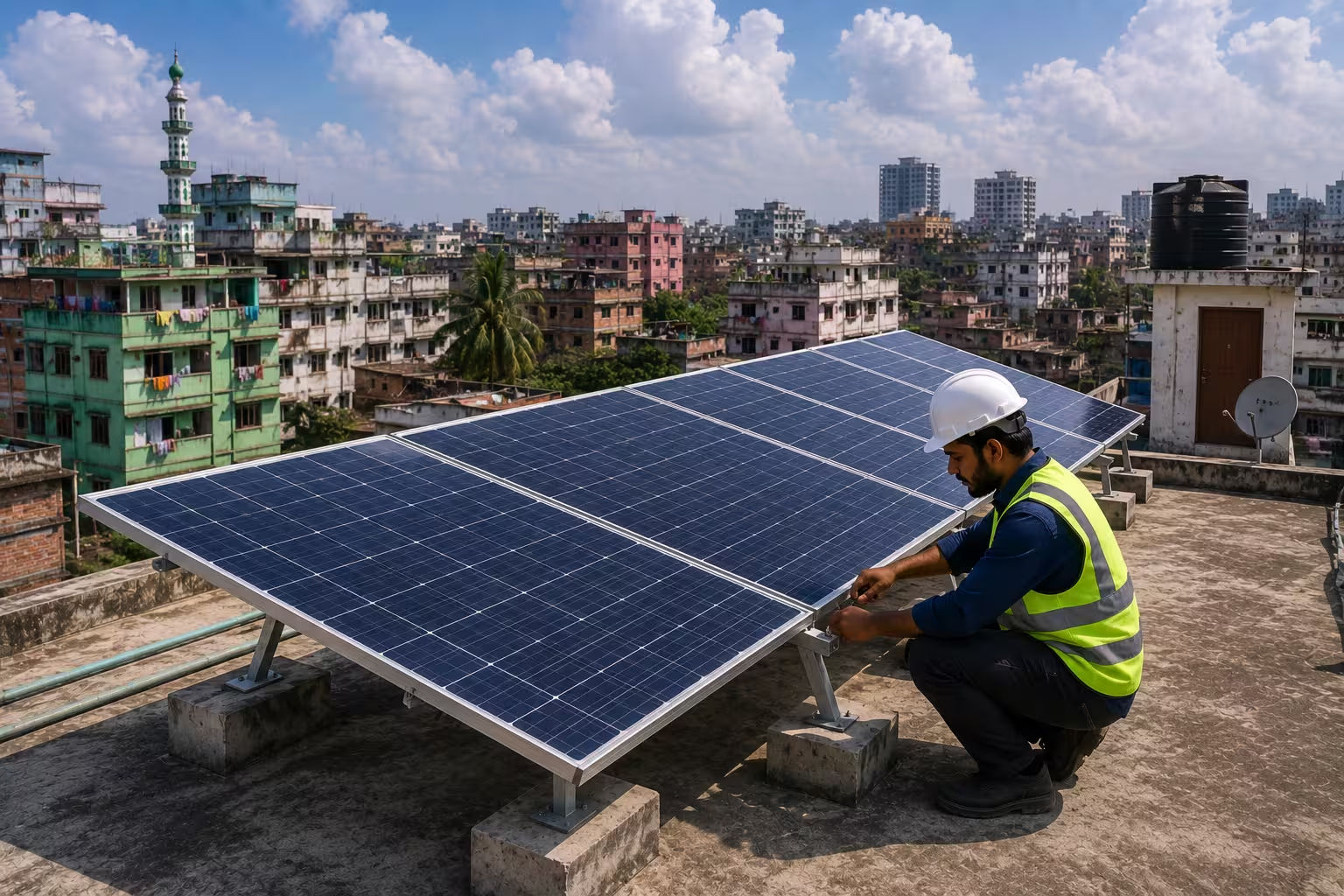
Somewhere on a rooftop in Dhaka, there’s a solar panel lying almost flat because the installer said “this is how everyone does it here.” It’s not producing what it should. Maybe 15% less than it could, month after month, quietly. Multiply that across a full system’s lifetime and you’re talking about a real chunk of money that never had to go missing.
The quick answer: for year-round performance, tilt your panels to match your local latitude. In Bangladesh, that’s roughly 20° to 26°, depending on where you live — Cox’s Bazar sits near the low end, Panchagarh near the high end. For seasonal fine-tuning, subtract about 15° in summer and add about 15° in winter.
That’s the formula in a sentence. Now let’s actually make it useful.
Why Tilt Angle Actually Matters
Tilt angle decides how directly sunlight hits your panel’s surface. Hit it straight-on, and you get close to maximum output. Hit it at a sharp angle, and a chunk of that energy just glances off, unused.
This isn’t a minor tweak. A poorly tilted panel — flat on a rooftop, or angled for the wrong season — can lose somewhere between 10% and 25% of its potential output over a year. On a typical residential system, that’s the difference between a solar setup that pays for itself in five years and one that takes six or seven. For someone running an off-grid Solar Home System in a rural area, it can mean the battery bank runs dry an hour earlier every evening.
It’s worth saying plainly: this range isn’t a guarantee. Shading from a neighbor’s building, monsoon cloud cover, dust buildup — all of that plays a role too. Tilt angle is one lever, not the only one.
The Formula, Broken Down
Solar installers use three simple variations of the same idea, all built around your latitude:
| Goal | Formula | Best for |
| Year-round balance | Tilt = Latitude | Fixed, set-and-forget systems |
| Summer optimization | Tilt = Latitude − 15° | Monsoon and pre-monsoon months (roughly April–September) |
| Winter optimization | Tilt = Latitude + 15° | Dry season months (roughly October–March) |
Bangladesh sits between about 20.5°N (near Cox’s Bazar and the southern coast) and 26.5°N (up near Panchagarh and Tetulia). That’s actually a fairly narrow band by global standards, which means the “right” angle doesn’t swing wildly whether you’re installing in Khulna or Rangpur — but it’s still worth getting your own number right rather than copying a neighbor’s setup.
Worked Example #1 — Dhaka (23.8°N)
Dhaka sits close to 24° north latitude. Running the numbers:
- Year-round tilt: ~24°
- Summer (monsoon) tilt: ~9°
- Winter (dry season) tilt: ~39°
In practice, most fixed rooftop installations in Dhaka are set somewhere around 20–25°, which lines up well with the year-round formula. If you’ve got a flatter roof and the installer just laid the panels close to horizontal “for simplicity,” you’re likely giving up meaningful output — especially during the drier months when the sun sits lower in the sky.
Worked Example #2 — Panchagarh (26.3°N)
Head up to the country’s northernmost tip, and the math shifts slightly:
- Year-round tilt: ~26°
- Summer tilt: ~11°
- Winter tilt: ~41°
Notice the gap between Dhaka and Panchagarh is only about 2–3°. In most parts of Bangladesh, you can round to the nearest whole number without losing much accuracy — this isn’t a country where someone in Sylhet needs a wildly different setup than someone in Barisal. What matters far more is getting close to your latitude and not leaving panels flat.
Tilt Isn’t the Whole Story — Orientation Matters Too
Here’s the part a lot of installers skip: tilt angle only does its job if the panel is also facing the right direction. In Bangladesh, since we’re north of the equator, panels should generally face true south — not magnetic south, which can be off by several degrees depending on your location.
A panel tilted at a perfect 24° but facing southeast or southwest instead of due south is still leaking output. Get both right — angle and orientation — and you’re working with the sun instead of guessing at it.
Is Seasonal Adjustment Actually Worth It?
Honestly? For most grid-tied homes in Dhaka or Chattogram with a fixed rooftop mount, probably not. Climbing up twice a year to re-tilt a bolted-down panel for a few extra percentage points of output usually isn’t worth the effort or the risk of loosening your mounting hardware.
It’s a different story for off-grid setups — the kind used widely under programs like IDCOL’s Solar Home System initiative in rural areas without grid access. When every watt-hour matters for running lights, a fan, or charging a phone through the evening, a seasonal adjustment (even a rough one, done by hand twice a year) can meaningfully extend your usable power, particularly heading into the drier winter months when sun angles drop.
Ground-mounted and adjustable-rack systems make this easier, since you’re not fighting a fixed roof pitch. If you’re designing a new system from scratch and have the choice, building in adjustability costs a little more upfront but pays back for anyone relying heavily on solar for daily power.
How to Find Your Exact Angle
Latitude gets you close, but it’s not the final word — your exact rooftop pitch, local shading, and even monsoon cloud patterns all shift the ideal number slightly. Free tools like NREL’s PVWatts calculator let you plug in your address and get a location-specific estimate rather than relying on a national average. It takes a few minutes and it’s worth doing before you finalize a mount design.
If you’re still working out the basics of how sunlight actually becomes electricity, it helps to back up a step and look at how solar panels convert sunlight to electricity or the underlying solar radiation and insolation that tilt angle is trying to capture more of. And if you’re deciding between mount types, it’s worth reading up on rooftop vs. ground-mounted solar before you commit to hardware.
For anyone weighing an off-grid setup against staying on the grid, on-grid vs off-grid solar systems and off-grid solar system basics are good next reads — tilt strategy genuinely differs between the two.
FAQs
What is the best tilt angle for solar panels in Bangladesh?
As a starting point, set your tilt equal to your local latitude — roughly 20° in the south (near Cox’s Bazar) up to about 26° in the far north (near Panchagarh). Most rooftop systems nationwide land comfortably in the 20–26° range.
Does solar panel tilt angle really matter?
Yes. A poorly angled panel can lose 10–25% of its potential yearly output compared to one set close to the optimal angle, depending on your climate and shading conditions.
Is it worth adjusting solar panel tilt by season in Bangladesh?
For most fixed, grid-tied rooftop systems, the effort usually isn’t worth a few extra percentage points. For off-grid Solar Home Systems where every watt-hour counts, a rough seasonal adjustment — flatter for monsoon months, steeper for the dry winter season — can be genuinely useful.
Does orientation (azimuth) matter more than tilt?
They work together, not against each other. In Bangladesh, panels should face true south. Get the direction wrong and even a perfectly tilted panel underperforms.
Can I just use my district’s latitude, or do I need a calculator?
Latitude gets you very close and is a fine starting point. For a precise number that accounts for your roof pitch and local conditions, a free tool like NREL’s PVWatts calculator is worth the five minutes it takes.