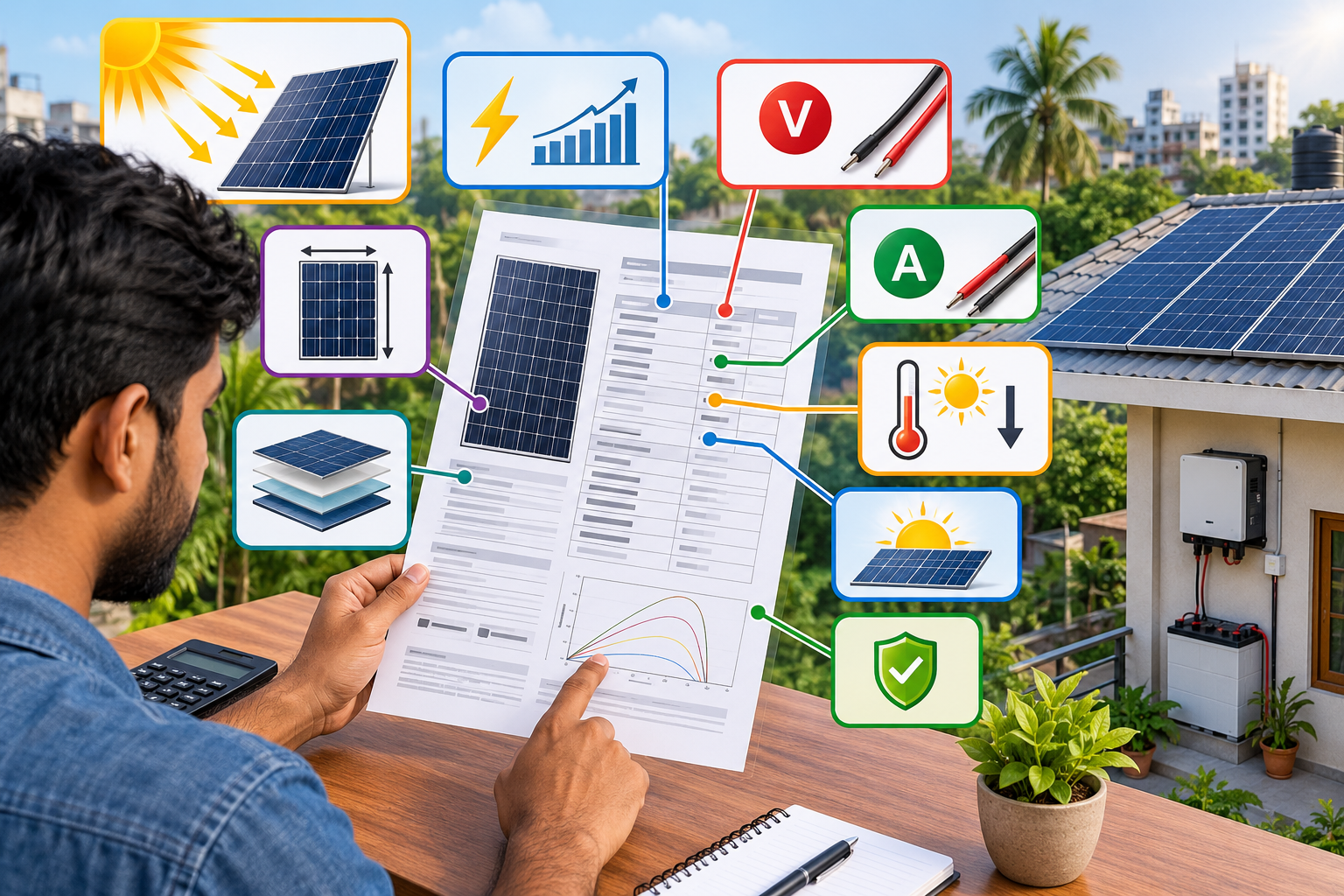
You’ve got a quote in hand, and somewhere in the paperwork is a one-page PDF crammed with numbers — Pmax, Voc, Isc, a temperature coefficient, a table of certifications. It looks technical enough that most people just skim past it and trust the salesperson’s summary.
That’s a mistake. A solar panel’s datasheet is the one document that tells you, in hard numbers, exactly what you’re paying for. Once you know what to look for, it takes about five minutes to read — and it can save you from panels that look fine on paper but underperform on your roof.
Here’s how to actually read one.
What Is a Solar Panel Datasheet?
A solar panel datasheet is a manufacturer-issued technical specification sheet that lists a panel’s electrical output, physical dimensions, durability ratings, and certifications, tested under standardized lab conditions. It’s the closest thing to an ingredients label for a solar panel — and like any label, it’s only useful if you know what the terms mean.
Almost everything on it is measured under Standard Test Conditions (STC): a cell temperature of 25°C and 1,000 W/m² of sunlight. Keep that in mind, because it matters a lot once you get to the temperature section below.
The Core Numbers: Pmax, Voc, Vmp, Isc, Imp
Every datasheet leads with five electrical specs. They sound similar, but they answer different questions.
| Spec | What it means | Why it matters |
| Pmax (Peak Power) | Maximum power output, in watts, under STC | The headline number — but check the tolerance next to it |
| Voc (Open-Circuit Voltage) | Voltage with no load connected | Used to make sure a string of panels doesn’t exceed your inverter’s max input voltage |
| Vmp (Voltage at Max Power) | The panel’s actual operating voltage | Used to check compatibility when panels are wired in parallel |
| Isc (Short-Circuit Current) | Maximum current the panel can produce | Used to size fuses and wiring correctly |
| Imp (Current at Max Power) | The panel’s actual operating current | Used to check compatibility when panels are wired in series |
The one people skip past most often is power tolerance — usually written as something like “+5W/-0W” next to Pmax. This tells you the guaranteed minimum output. A panel rated 450W with a -0W tolerance won’t legally ship below 450W. A panel with a wide tolerance and no lower bound stated clearly is worth asking about before you sign anything.
If you’re wiring multiple panels together and want to understand series versus parallel configurations in more depth, the solar string sizing guide walks through how Voc, Vmp, Isc, and Imp all interact once you’re combining panels rather than reading them in isolation.
Why STC Numbers Don’t Tell the Whole Story
This is the part most datasheet explainers skip, and it’s arguably the most relevant section for anyone buying panels in Bangladesh.
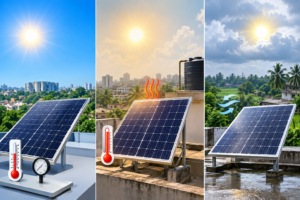
STC assumes a 25°C cell temperature. In practice, a panel sitting on a rooftop under direct sun for most of the year runs a lot hotter than that — cell temperatures well above 25°C are the norm, not the exception, across most of the country for large stretches of the year. And solar panels lose efficiency as they heat up.
That’s what the temperature coefficient tells you. It’s expressed as a percentage loss per degree Celsius above 25°C — something like -0.35%/°C. A lower negative number is better, because it means the panel loses less output as it heats up. In a consistently hot climate, the difference between a panel rated at -0.29%/°C and one at -0.45%/°C adds up meaningfully over a year of real operation, even though both look identical on paper at STC.
A more realistic reference point is NOCT (Nominal Operating Cell Temperature) — tested at a milder 20°C ambient temperature and 800 W/m² irradiance, closer to typical outdoor conditions than the lab-perfect STC setup. If a datasheet includes NOCT figures, they’re generally a better indicator of what you’ll actually see on your roof than the STC headline number alone.
Quick comparison:
| STC | NOCT | |
| Cell temperature | 25°C | ~45°C (cell heats up under real sun) |
| Ambient temperature | Not specified | 20°C |
| Irradiance | 1,000 W/m² | 800 W/m² |
| Best used for | Comparing panels on paper | Estimating real-world output |
If you want to go deeper on how heat and climate affect solar output generally, solar performance in extreme climates covers this beyond just the datasheet.
Mechanical Ratings: Do They Matter Here?
Datasheets also list mechanical load ratings, measured in Pascals (Pa) — one figure for front-side load (wind, and in colder markets, snow) and one for rear-side load (uplift wind pressure). Snow load is close to irrelevant for almost every installation in Bangladesh, so don’t spend much time on it.
Wind load is a different story, particularly for rooftop or ground-mounted systems in cyclone-exposed coastal areas, or for larger industrial arrays where structural failure risk is a real engineering concern, not a paperwork formality. If you’re evaluating mounting hardware alongside the panels themselves, the mounting structure selection guide is the more relevant read for that side of the decision.
How to Actually Compare Two Panels
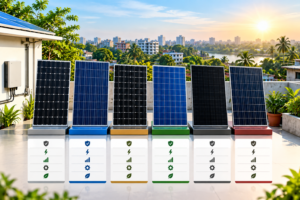
Say you’re choosing between two 450W panels from different suppliers. Here’s a simplified version of what that comparison should look like:
| Panel A | Panel B | |
| Pmax | 450W (+5/-0W) | 450W (+5/-3W) |
| Temperature coefficient | -0.29%/°C | -0.40%/°C |
| Degradation (year 1) | 1% | 2% |
| Performance warranty | 84% at year 25 | 80.7% at year 25 |
| Certifications listed | IEC 61215, IEC 61730 | IEC 61215 only |
On the surface, both are “450W panels.” In practice, Panel A is the stronger buy — tighter power tolerance, better heat performance, a more conservative degradation curve, and a fuller certification listing. None of that shows up if you only compare the headline wattage.
Degradation rate and performance warranty numbers deserve a quick note: they’re manufacturer-stated figures, not independently guaranteed physical laws. Treat a specific number like “0.3%/year” as a data point to compare between products, not as a promise carved in stone. For more on how and why panels lose output over time, PID and LID degradation explains the underlying mechanisms.
Certifications and Red Flags to Check
A trustworthy datasheet should list recognized certifications — most importantly IEC 61215 (design qualification and type approval) and IEC 61730 (safety qualification). These are genuine, independently verifiable international standards, not marketing badges, and their presence is one of the easiest ways to separate a serious manufacturer from a questionable one.
A few things worth treating as red flags:
- No power tolerance listed, or a tolerance with no clear lower bound
- Missing IEC certifications, or certifications referenced vaguely without numbers
- A degradation rate or performance warranty that sounds unusually generous with nothing else on the sheet to back it up
- A datasheet that doesn’t match the model number physically printed on the panel you’re being sold
That last one matters more than people expect. Because a large share of panels sold in Bangladesh are imported, it’s worth specifically confirming that the datasheet you were handed corresponds to the exact model delivered to your roof — not a similar-sounding variant. It’s a two-minute check that avoids a genuinely common mismatch.
Home Buyers vs. Commercial Buyers: What to Prioritize
If you’re buying for a home, the numbers that matter most are Pmax with its tolerance, the temperature coefficient (because of roof heat), and the performance warranty — these three tell you most of what you need for a residential-scale decision.
If you’re sizing a larger commercial or industrial array, Isc and Imp become more important because they determine how panels can be strung together safely, and degradation curves matter more since they affect long-term ROI modeling across a bigger investment. Mechanical load ratings also carry more weight at industrial scale, where a structural miscalculation is a bigger liability.
At Muspana, this is essentially the same checklist we work through when evaluating panels for Bangladesh installations — tolerance, temperature performance, certifications, and whether the paperwork actually matches the hardware. It’s not complicated once you know what each number is doing; it’s just rarely explained in plain language.
If you’ve already got a quote in hand and want a second set of eyes on the datasheet before you commit, that’s a conversation worth having before the purchase, not after.
FAQs
What is power tolerance on a solar panel datasheet?
Power tolerance is the acceptable range around a panel’s rated output, shown as something like “+5W/-0W.” It tells you the guaranteed minimum power the panel will deliver — a panel with a “-0W” lower bound can’t legally ship below its rated wattage.
Why does temperature coefficient matter for solar panels in Bangladesh?
Panels lose efficiency as they heat up, and rooftop cell temperatures in Bangladesh’s climate regularly run well above the 25°C lab standard for much of the year. A lower (more negative-number-closer-to-zero) temperature coefficient means less output loss in real heat, which affects actual annual generation more than the STC number suggests.
What certifications should a solar panel have?
Look for IEC 61215 (design and performance qualification) and IEC 61730 (safety qualification). Both are internationally recognized, independently verifiable standards — a datasheet missing them, or listing them vaguely without reference numbers, is worth questioning.
What’s the difference between STC and NOCT on a datasheet?
STC (Standard Test Conditions) is measured at 25°C cell temperature and 1,000 W/m² irradiance — ideal lab conditions. NOCT (Nominal Operating Cell Temperature) is measured at 20°C ambient temperature and 800 W/m², which more closely reflects real outdoor operating conditions. NOCT figures are generally more useful for estimating actual rooftop performance.
Is a higher wattage panel always the better choice?
Not necessarily. Two panels with identical wattage can perform very differently once you compare tolerance, temperature coefficient, degradation rate, and certifications. Wattage alone doesn’t capture how a panel behaves in real heat or over 25 years of use.