
Why Your 450W Panel Won’t Give You 450W on a Hot Afternoon
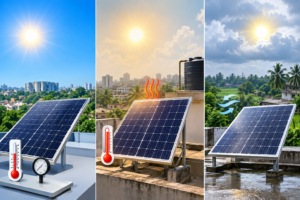
Every quote you get for a rooftop solar system lists a wattage number in big, bold type — 450W, 550W, whatever the panel is rated. What most quotes don’t explain is that this number was measured in a lab at 25°C, and your roof in Dhaka or Chattogram is rarely anywhere close to that on a sunny afternoon.
The spec that explains the gap is called the temperature coefficient. It’s buried on page two of every datasheet, usually written as something like “Pmax: -0.35%/°C,” and almost nobody explains what it actually means in plain terms. So here it is.
What Temperature Coefficient Actually Means
Temperature coefficient tells you how much a solar panel’s power output drops for every 1°C the panel rises above 25°C. It’s written as a negative percentage — something like -0.35%/°C — because silicon solar cells get less efficient as they heat up, not more.
That surprises a lot of people, since solar panels obviously need heat and sunlight to work. But the two aren’t the same thing. Sunlight generates electricity; heat is a side effect that works against the panel. A cooler panel in strong sunlight will usually outproduce a hotter panel in the same sunlight.
The physics is simple enough to sum up in one line: heat lowers the voltage a solar cell can produce, and lower voltage means lower power, even though the current barely changes.
It’s Not Just One Number — Datasheets List Three
Most people only ever hear about the Pmax coefficient (power), but a proper datasheet lists three:
- Pmax coefficient — how much power output drops per °C. This is the one that affects your electricity bill and is what most people mean by “temperature coefficient.”
- Voc coefficient — how much the open-circuit voltage drops per °C. Installers use this to make sure the system stays within the inverter’s voltage window.
- Isc coefficient — how much the current changes per °C. This one is small and rarely a practical concern for home systems.
For a homeowner, Pmax is the number worth understanding. Voc matters more to whoever is designing your system’s string sizing than to you directly — though it’s worth knowing it exists, because it’s part of why installers ask about your specific panel model before finalizing a design.
A Worked Example You Can Copy With Your Own Numbers
Here’s the calculation, using round numbers so it’s easy to follow.
Say you have a 450W panel with a Pmax temperature coefficient of -0.35%/°C. That rating was measured at a cell temperature of 25°C. On a hot, sunny afternoon in Bangladesh, a rooftop-mounted panel’s cell temperature can easily reach 55–60°C — not the air temperature, but the temperature of the cells themselves, which run well above ambient because of direct sun exposure and limited airflow underneath.
Take a cell temperature of 55°C. That’s 30°C above the 25°C reference point.
Power loss = 30°C × 0.35%/°C = 10.5%
450W × (1 − 0.105) ≈ 403W
So on that afternoon, your “450W” panel is realistically producing around 403W — not because anything is broken, but because heat is doing exactly what the datasheet predicted. Run the same math with your own panel’s coefficient and a realistic cell temperature for your roof, and you’ll get a decent estimate of your own hot-day output.
Typical Coefficient Ranges by Cell Technology
Not every panel handles heat the same way. Coefficients vary by cell technology, and this is the number worth comparing when you’re choosing between panel brands.
| Cell Technology | Typical Pmax Coefficient |
| Standard monocrystalline/PERC silicon | -0.35% to -0.45%/°C |
| TOPCon | -0.29% to -0.35%/°C |
| HJT (heterojunction) | -0.24% to -0.30%/°C |
| Thin-film | -0.20% to -0.30%/°C |
These are published industry ranges, not guarantees for any specific model — always check the actual datasheet for the panel you’re buying, since coefficients shift slightly between manufacturers and even between product generations from the same brand.
Does This Actually Matter in Bangladesh’s Climate?
Short answer: yes, more than in a mild climate, but probably less than a sales pitch will tell you.
Bangladesh’s combination of high heat and high humidity is a genuinely tougher environment for panel cooling than the dry-heat climates most solar content is written about. Research on rooftop solar in comparable hot, humid conditions has recorded cell temperatures peaking above 60°C during summer months, with meaningful daily efficiency reduction directly attributable to heat. Separate research in hot Middle Eastern climates has recorded module surface temperatures reaching as high as 80°C in summer. Humidity itself doesn’t heat panels up — but it does make it harder for a panel to shed heat through evaporative cooling the way it would in a dry climate, which is part of why humid-hot cities tend to see somewhat higher module temperatures than dry-hot ones at the same air temperature.
Practically, this means Bangladeshi rooftops — especially tin-roofed homes with panels mounted close to the roof surface — are exactly the kind of environment where temperature coefficient is not just a spec-sheet curiosity. It’s a real factor in how much energy your system delivers over a full year.
Is a Lower Coefficient Worth Paying More For?
This is the question most articles dodge, so here’s a straight answer: it depends on how much more you’re being asked to pay, and what else is competing for that money.
Temperature coefficient is one loss factor among several. Dust and soiling, module degradation over the panel’s lifetime, and shading from nearby buildings or trees typically cost a rooftop system more energy over a year than the difference between a -0.35%/°C panel and a -0.28%/°C panel ever will. A system with regular cleaning and a well-chosen coefficient will usually outperform an expensive HJT system with dirty panels and poor mounting placement.
That’s not an argument against premium panels — HJT and TOPCon technologies genuinely do lose less power in heat, and if you’re comparing two similarly priced options, the one with the better coefficient is the easy choice. But if the premium panel costs meaningfully more, it’s worth asking whether that money would do more for your system’s output going toward proper mounting, cleaning access, or simply a slightly larger array. For most home rooftops in Bangladesh, temperature coefficient is a factor to weigh, not the deciding one.
For a commercial or factory rooftop with a much larger system size, the math shifts — a 0.1%/°C difference across a 100kW array adds up to real energy over 25 years, and it’s worth asking your installer to run that comparison specifically for your site.
Practical Ways to Reduce Heat Loss, Regardless of Panel Choice
However good your panel’s coefficient is, how it’s mounted matters just as much:
- Leave an air gap under the panels. Flush-mounted panels on a tin roof run hotter than panels with a few inches of clearance, since airflow underneath helps carry heat away.
- Avoid mounting directly against RCC roof slabs without a gap — concrete holds and re-radiates heat through the day.
- Keep panels clean. Dust and grime trap heat as well as blocking light, compounding the loss.
- Don’t over-tilt panels flat against a hot surface if ventilation is possible with a raised structure instead.
None of this eliminates temperature loss — that’s built into the physics of silicon — but good mounting practice can meaningfully reduce how hot your panels actually get on a given afternoon.
Understanding a panel’s temperature coefficient alongside its degradation rate, NOCT rating, and soiling resistance gives a much fuller picture than looking at wattage or price alone — it’s one of several numbers worth asking about when evaluating a quote.
FAQs
Is a lower temperature coefficient always better?
It’s always technically better for hot-weather performance, but “better” doesn’t automatically mean “worth the extra cost.” For most home systems, other factors like cleaning, mounting, and shading affect annual output more than a small coefficient difference.
What’s a good temperature coefficient for a hot climate like Bangladesh’s?
Anything in the -0.30% to -0.35%/°C range from standard PERC or TOPCon panels performs reasonably well. HJT panels around -0.24% to -0.30%/°C perform noticeably better in sustained heat, but usually cost more.
Does temperature coefficient affect voltage and current too, not just power?
Yes. Datasheets list separate coefficients for Voc (voltage) and Isc (current). Voc drops with heat and matters mainly for inverter sizing; Isc changes very little and rarely affects home buying decisions.
How do I find my panel’s temperature coefficient?
Check the manufacturer’s datasheet — it’s usually listed under “Temperature Coefficients” alongside Pmax, Voc, and Isc values, near the electrical specifications table.
Does a higher temperature coefficient number mean a panel is faulty?
No. All silicon solar panels lose some power in heat — it’s normal physics, not a defect. The coefficient just tells you how much loss to expect, not whether something is wrong.