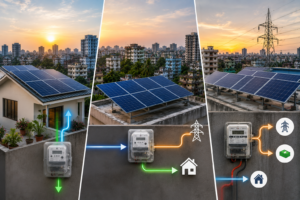

Somebody in a polo shirt with a solar company logo told you the system “pays for itself in seven years.” Maybe you believed it. Maybe you didn’t. Either way, you probably didn’t see the math behind that number — and that’s the actual problem with most solar sales conversations. The number gets handed to you like a fact, not a calculation.
So let’s actually do the calculation.
A solar payback period calculator answers one question: how many years of energy savings does it take to recover what you spent on the system? The formula is straightforward — net system cost divided by your annual savings — but the inputs behind it are where things get interesting, and where a lot of quotes quietly get optimistic.
For most U.S. homeowners in 2026, a realistic solar payback period lands somewhere between 6 and 10 years, assuming a 20–25 year panel lifespan. Anything under 6 years is excellent. Anything past 12 is worth questioning. If your quote says 4 years, ask what assumptions got you there — that’s usually where the sales math and the real math start to diverge.
The Actual Formula (and Why It’s Not as Simple as It Looks)
Here’s the base version:
Payback Period = Net System Cost ÷ Annual Electricity Savings
Net system cost means the price after incentives — not the sticker price the installer first quotes you. Annual savings means what you’d have paid the utility company for that same electricity, adjusted for your actual usage.
Say a 7kW system costs $21,000 before incentives. After the 30% federal solar tax credit (still active as of this writing, though incentive rules do shift, so check current terms before you commit), the net cost drops to about $14,700. If that system saves you $1,750 a year on electricity, you’re looking at:
$14,700 ÷ $1,750 = 8.4 years
That’s a solid, unremarkable, perfectly normal payback period. Nothing to write home about, nothing to worry about either.
Where people get tripped up is assuming that $1,750 stays flat for 25 years. It doesn’t — and this is where a slightly more honest version of the formula comes in.
Why Your Real Payback Period Isn’t a Straight Line
Two things pull in opposite directions over the life of a system:
- Utility rates tend to rise — historically averaging around 2–4% a year, depending on your region. That actually speeds up your payback, because the electricity you’re not buying gets more expensive over time.
- Panel output degrades slowly — typically around 0.4–0.6% per year. That slows down your payback slightly, because you’re generating a bit less each year.
In most cases, rising utility rates outweigh panel degradation, which is why real-world payback tends to land a little faster than a flat, static calculation suggests. It’s a small effect in year one and a noticeable one by year fifteen.
Three Worked Examples, Because One Number Never Tells the Whole Story
Example 1: Cash purchase, average sun exposure System cost: $22,000 → after 30% credit: $15,400 Annual savings: $1,900 Payback: 15,400 ÷ 1,900 = 8.1 years Total 25-year savings (accounting for rate increases): roughly $58,000–$65,000
Example 2: Financed with a solar loan Same system, financed over 15 years at a moderate interest rate. You’re not paying the $15,400 upfront, so your “payback” is really about when your loan payment plus reduced electricity bill drops below what you were paying before. That crossover point often lands around year 2–3, since you’re not fronting the full cost — but total lifetime savings end up lower than the cash scenario because of interest.
Example 3: Leased system or PPA With a lease or power purchase agreement, you don’t own the system, so there’s technically no “payback period” in the traditional sense — you’re just paying a lower, often escalating rate for solar electricity instead of grid electricity. Savings tend to be modest, and you typically won’t qualify for the tax credit yourself, since the leasing company claims it.
That’s the honest version, and it’s worth sitting with for a second: leases almost always have a worse ROI than buying, cash or financed. If someone’s steering you hard toward a lease and downplaying that, that’s worth noticing.
Cash vs. Loan vs. Lease — Side by Side
| Cash Purchase | Solar Loan | Lease / PPA | |
| Upfront cost | Full price | Low or $0 down | Usually $0 down |
| Own the system | Yes | Yes | No |
| Claim tax credit | Yes | Yes | No (installer keeps it) |
| Typical payback | 6–10 years | 2–4 years (breakeven vs. bill) | No true payback |
| 25-year savings | Highest | Moderate | Lowest |
| Best for | Homeowners staying long-term | Those without full cash upfront | Renters-of-equipment mindset |
What Actually Changes Your Number
The payback period isn’t one-size-fits-all, and honestly, most of the variation comes down to a handful of factors:
Where you live. Peak sun hours vary a lot by region, and that directly affects how much power your system generates per day — it’s worth understanding peak sun hours before you assume a national average applies to your roof. A system in Arizona and an identical system in Michigan will have meaningfully different payback timelines, even with the same electricity rate.
Your local electricity rate. Higher utility rates mean each kWh of solar you generate is worth more, which shortens payback. This is why solar tends to pencil out faster in states with expensive grid power, regardless of sun exposure.
Incentive stacking. Federal credit plus state rebates plus local utility programs can significantly cut your net cost. It’s genuinely worth checking what’s available where you live — this is one of the few parts of the math that changes almost every year, so don’t rely on last year’s numbers.
Your roof and system type. Shading, orientation, and whether you’re comparing a rooftop vs. ground-mounted solar setup all shift your output and, by extension, your payback math.
Battery storage. Adding a battery increases upfront cost and usually extends payback by a couple of years, unless you’re in an area with time-of-use rates or frequent outages where the battery earns its keep in other ways.
The Mistakes That Quietly Wreck the Math
A few patterns show up again and again in bad or inflated payback numbers:
- Using pre-incentive cost instead of net cost after credits — this alone can make an 8-year payback look like a 5-year one on paper.
- Assuming flat electricity usage for 25 years, ignoring that families’ usage changes (EVs, additions to the house, kids moving out).
- Ignoring degradation entirely, which slightly overstates long-term savings.
- Comparing quotes with different system sizes as if they’re apples-to-apples ROI comparisons — a bigger system with a longer payback isn’t automatically worse if it produces more total savings over its lifetime.
If a quote conveniently sidesteps one of these, it’s not necessarily dishonest — but it’s worth running your own numbers before you sign.
What If You Move Before Payback?
This is the fear nobody quite says out loud, and it’s a fair one. If you sell your home in year 4 of an 8-year payback, did you lose money?
Usually, no — and here’s why. Studies on solar and home value (including research from Zillow and the U.S. Department of Energy) have generally found that owned solar systems tend to increase resale value, often by roughly the remaining value of the system itself. So while you might not have technically “broken even” through utility savings alone, the home sale can effectively finish the payback for you.
The exception is leased systems, which can occasionally complicate a home sale, since the new buyer has to agree to take over the lease. That’s one more mark against leasing if there’s any chance you’ll move in the next decade.
What a Good Payback Period Actually Looks Like
There’s no universal magic number, but here’s a rough, honest framework:
- Excellent: 5–7 years
- Good / typical: 7–10 years
- Below average: 10–13 years
- Worth reconsidering: 13+ years
If you’re landing in that last bracket, it doesn’t necessarily mean solar is a bad idea for you — it might mean your roof gets significant shading, your local electricity rates are low, or the quote itself is priced high. Worth understanding how on-grid solar systems compare to off-grid setups too, since grid-tied systems (the vast majority of residential installs) generally have far better payback math than fully off-grid setups, which carry heavier battery costs.
It’s also worth zooming out on why this math matters at all right now. As solar adoption trends continue climbing and panel prices have dropped substantially over the past decade, payback periods across the board have gotten shorter than they were even five years ago — which is part of why older advice about solar ROI can be misleadingly pessimistic today.
None of this replaces getting an actual, personalized quote and running the real formula with your real numbers — your roof, your rates, your usage. But now you know what’s supposed to be inside that number, instead of just trusting whatever gets written on a proposal.
FAQs
What is a good solar payback period?
A payback period of 6–10 years is typical and considered solid for most U.S. homeowners. Under 6 years is excellent, while anything over 12–13 years is worth questioning or renegotiating.
Does financing change my solar ROI?
Yes. A cash purchase usually delivers the highest lifetime savings, while a loan lowers your upfront cost but adds interest, and a lease typically offers the lowest overall ROI since you don’t own the system or claim the tax credit.
How does net metering affect payback time?
Net metering lets you get credit for excess solar power you send back to the grid, which effectively increases your annual savings and shortens your payback period. Without it, any unused solar production is essentially wasted.
Do solar panels still work after the payback period?
Yes — most panels are rated for 25 years or more, meaning everything you save after the payback period is essentially pure profit on your original investment, minus a small annual dip from panel degradation.
Is solar worth it if I plan to move in a few years?
Often yes, since owned solar systems tend to add resale value roughly equal to the system’s remaining worth. Leased systems are trickier, since the buyer needs to agree to take over the lease terms.