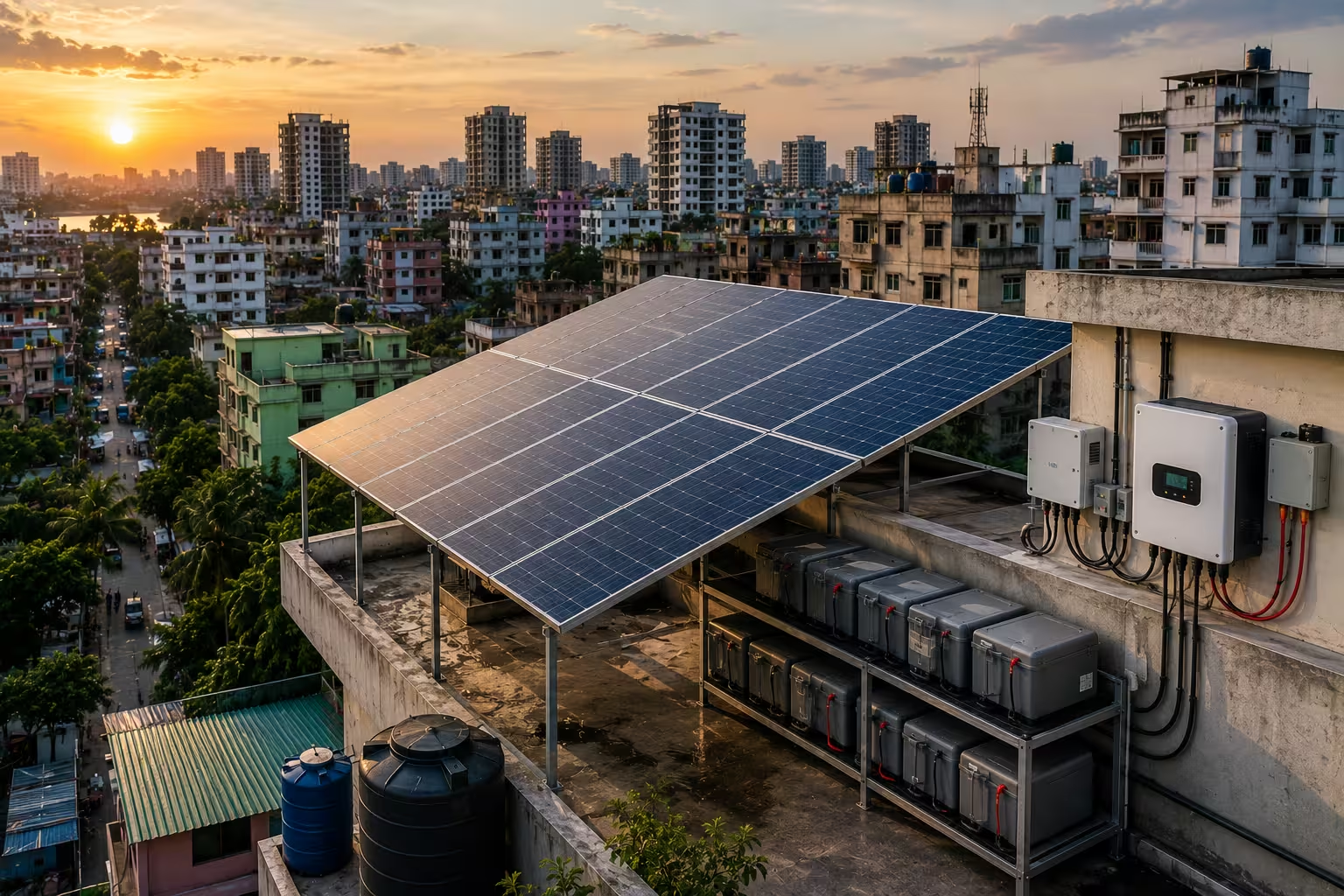
If you are thinking about going completely off-grid with solar in Bangladesh, the first question is probably:
“How much will the whole system actually cost?”
You will find plenty of solar packages advertised online, but comparing them can be confusing.
One package may include only solar panels and an inverter.
Another may include batteries, mounting structure, wiring and installation.
And a third package may look cheap simply because it uses a much smaller battery.
For an off-grid home, the battery can be one of the largest parts of the total investment.
So instead of looking at the price of one solar panel or one inverter, you need to understand the complete system cost.
In this guide, we will break down the major costs of an off-grid solar system in Bangladesh in 2026, explain what affects the final price, and show when going off-grid can actually make financial sense.
How Much Does an Off-Grid Solar System Cost in Bangladesh?
There is no single price because an off-grid system must be sized according to the property’s electricity consumption.
As a broad 2026 Bangladesh market indication:
| System Size | Typical Use | Indicative System Cost* |
|---|---|---|
| 1–2 kW | Small home / essential loads | ৳1.5–3 lakh |
| 3–5 kW | Typical small/medium home | ৳3.5–7 lakh |
| 5–8 kW | Larger home / higher loads | ৳6–12 lakh+ |
| 8–10+ kW | Large home / commercial use | ৳10–18 lakh+ |
*These are indicative planning ranges, not fixed quotations. Battery capacity, battery chemistry, inverter brand, panel quality, mounting structure, wiring, installation and required backup duration can move the final price significantly.
For a genuine full off-grid system, especially one designed to provide several days of battery autonomy, the battery bank can increase the cost dramatically.
Why Is an Off-Grid System More Expensive Than Basic Solar?
A basic on-grid solar system mainly needs:
- Solar panels
- Grid-tied inverter
- Mounting
- Wiring
- Protection equipment
An off-grid system needs much more.
You may need:
- Solar panels
- Large battery bank
- Off-grid or hybrid inverter
- MPPT charge control
- Mounting structure
- DC protection
- AC protection
- Heavy-duty cables
- Distribution equipment
- Monitoring
- Installation
- Backup generator in some cases
The biggest difference is the battery.
The original cost model in the attached source illustrates this clearly: batteries represented about $20,000 of a roughly $28,000 equipment budget.
The same principle applies in Bangladesh:
The more electricity you want to store, the more expensive your off-grid system becomes.
What Actually Determines the Price?
Your final price depends mainly on five things:
- Daily electricity consumption
- Required battery backup
- Solar panel capacity
- Inverter capacity
- Installation and electrical infrastructure
This is why two homes can have completely different solar system costs.
A small rural home using 3 kWh per day does not need the same system as a Dhaka house using 15 kWh per day.
Step 1: Calculate Your Daily Electricity Consumption
Before asking for a quotation, find out how much electricity your home actually uses.
Look at your electricity bills and calculate your average daily consumption in kWh.
For example, suppose a home uses:
8 kWh per day
That means the solar system needs to generate and store enough energy to support approximately 8 kWh of daily consumption.
But do not stop there.
Also make a list of your major appliances:
- Refrigerator
- Fans
- Lights
- Television
- Wi-Fi router
- Computers
- Water pump
- Washing machine
- Air conditioner
- Microwave
- Rice cooker
- Other appliances
The more accurately you calculate your load, the more accurately you can calculate the system cost.
Why Your Electricity Usage Matters So Much
Imagine two homes.
Home A
Daily electricity use:
4 kWh/day
Home B
Daily electricity use:
12 kWh/day
Home B uses three times as much electricity.
It will generally require:
- More solar panels
- More battery storage
- Potentially a larger inverter
- More electrical infrastructure
Therefore, it is impossible to give one “off-grid solar price” that applies to every home.
Step 2: Battery Cost
For many off-grid systems, the battery is the biggest single expense.
This is because the system needs to provide electricity when:
- The Sun is not shining
- Solar generation is low
- It is raining
- It is cloudy
- Your electricity demand is higher than solar production
How Much Battery Do You Need?
A simple starting formula is:
Battery Capacity = Daily Energy Use × Required Days of Autonomy ÷ Usable Battery Capacity
Suppose your home uses:
8 kWh/day
And you want:
2 days of autonomy
You would need:
8 × 2 = 16 kWh of usable energy
The actual nominal battery capacity needs to be higher depending on the battery’s usable depth of discharge.
LiFePO4 Battery Cost
Lithium iron phosphate, commonly called LiFePO4, is increasingly popular for solar energy storage because it is designed for frequent cycling and can provide a relatively high usable capacity.
However, the cost varies significantly based on:
- Battery capacity
- Brand
- Cell quality
- BMS
- Warranty
- Communication compatibility
- Indoor/outdoor rating
- Installation requirements
For example, a 5 kWh battery and a 15 kWh battery are obviously not comparable simply because both are “solar batteries.”
When comparing quotations, always ask for:
Usable kWh, not just nominal kWh.
Lead-Acid vs LiFePO4
Lead-acid batteries can have a lower initial purchase price.
However, they generally require more careful depth-of-discharge management and may have a shorter useful life under frequent deep cycling.
LiFePO4 batteries generally cost more upfront but can offer:
- Higher usable capacity
- Longer cycle life
- Lower maintenance
- Better suitability for frequent solar cycling
For a home that will use the battery every day, lifetime cost can be more important than the initial purchase price.
Step 3: Solar Panel Cost
After determining your energy requirement, the next major cost is the solar array.
Modern residential and commercial panels in Bangladesh commonly come in sizes around several hundred watts per panel.
The number of panels depends on:
- Daily electricity consumption
- Available sunlight
- Panel wattage
- System losses
- Roof or land area
- Required charging speed
- Seasonal performance
For example, if you need around 5 kW of solar capacity, you could use:
- 10 × 500 W panels
- 9 × 550 W panels
- 8 × 620 W panels
The exact combination depends on the panel model and inverter’s MPPT voltage/current limits.
Don’t Choose Panels Based Only on Price
A cheaper panel is not necessarily the cheapest system.
Look at:
- Panel efficiency
- Product warranty
- Performance warranty
- Cell technology
- Manufacturer reputation
- Local distributor support
- Availability of replacement units
A small difference in panel price may be less important than choosing a system that performs reliably for many years.
Step 4: Inverter Cost
The inverter is another major component.
It converts DC electricity from the solar panels and batteries into AC electricity that your home appliances can use.
For an off-grid home, you generally want an inverter capable of:
- Handling your maximum load
- Managing solar input
- Charging batteries
- Providing stable AC output
- Handling appliance startup surges
Current Bangladesh listings give an idea of the market: a 5 kW Growatt MPPT hybrid inverter is listed around ৳44,900, while a 6 kW Growatt off-grid storage inverter is listed around ৳49,500 as of July 2026. Actual market prices can vary by seller, stock, warranty and model.
Don’t Buy an Inverter Based Only on kW
Suppose your home normally uses:
3 kW
That does not automatically mean a 3 kW inverter is sufficient.
A refrigerator, pump or air conditioner may require significantly higher starting power.
So check both:
Continuous output
and
Surge/starting capacity
before purchasing.
Step 5: Mounting Structure
Solar panels need a secure mounting structure.
For a rooftop installation, the cost depends on:
- Roof type
- Roof height
- Mounting method
- Structure material
- Panel arrangement
- Wind loading
- Installation complexity
For a ground-mounted system, you may also need:
- Foundation
- Steel structure
- Civil work
- Additional cabling
- Security
In rural Bangladesh, ground-mounted systems may also need to consider:
- Flooding
- Drainage
- Soil conditions
- Theft/security
- Future land use
Step 6: Cables and Electrical Protection
This is one part of the solar quotation that homeowners sometimes overlook.
A complete off-grid system requires appropriate:
- DC cables
- AC cables
- MC4 connectors
- DC isolators
- AC breakers
- Fuses
- Surge protection
- Distribution board
- Earthing
- Lightning protection where appropriate
Cable size should be selected based on current, distance and acceptable voltage drop.
Saving money by using undersized cables or poor-quality protection equipment is not a good idea.
Step 7: Installation Cost
DIY installation can reduce labour costs, but a larger off-grid system is not a simple home improvement project.
You may be dealing with:
- High DC current
- Large battery banks
- High AC power
- Electrical protection
- Earthing
- Structural installation
Professional installation costs vary depending on:
- System size
- Location
- Roof height
- Wiring distance
- Ground work
- Complexity
For a residential system in or around Dhaka, installation may be relatively straightforward.
For a remote rural property, transportation and site work can add significantly to the cost.
A Practical 2026 Example
Let’s consider a hypothetical Bangladesh home using approximately:
8 kWh/day
Suppose the homeowner wants:
2 days of battery autonomy
That means approximately:
16 kWh of usable battery storage
A possible system might include:
- 5–6 kW solar array
- 5–6 kW off-grid/hybrid inverter
- Around 20 kWh nominal LiFePO4 storage, depending on usable DoD
- Mounting structure
- Complete DC/AC protection
- Appropriate wiring
- Installation
A system of this type could easily move into the several-lakh-taka range, and the battery configuration will have a major effect on the final price.
This is why a quotation that says simply:
“6 kW Solar System – ৳X lakh”
does not tell you enough.
You need to know exactly what is included.
Example Cost Breakdown
For a medium-sized off-grid home, a planning-level budget might look like this:
| Component | Approximate Share of Budget |
|---|---|
| Battery storage | 35–55% |
| Solar panels | 15–25% |
| Inverter | 10–20% |
| Mounting structure | 5–10% |
| Cables & protection | 5–10% |
| Installation & other works | 5–15% |
These are planning proportions, not fixed Bangladesh market prices.
Battery chemistry and required backup duration can change the balance significantly.
Why Battery Size Changes Everything
Suppose you want to increase battery autonomy from:
1 day → 3 days
Your battery requirement can potentially triple.
That does not necessarily mean the entire solar system cost will triple, because other components may remain similar.
But battery storage can add a very large amount to the total investment.
This is why homeowners should ask:
“Do I really need three days of battery backup?”
If a generator or another backup source is available, you may be able to design a smaller and more affordable battery bank.
What If You Want to Run Air Conditioners?
Air conditioning can dramatically change the cost of an off-grid system.
An AC requires significant continuous electricity and may also have starting or surge requirements.
A home using:
- Fans
- Lights
- Refrigerator
- TV
- Wi-Fi
- Computer
can have a relatively manageable solar requirement.
A home using:
- 2–3 AC units
- Water pump
- Refrigerator
- Freezer
- Electric oven
- Washing machine
will require a much larger system.
If you want full off-grid operation with multiple AC units, expect the solar array, inverter and battery bank to increase substantially.
Is an Off-Grid System Cheaper Than Grid Electricity?
That depends heavily on your property.
For a normal Dhaka home with an existing electricity connection, going completely off-grid is not automatically the cheapest option.
You already have access to the grid.
So you are effectively paying a large upfront cost to replace something that already exists.
But the calculation changes dramatically for remote properties.
When Off-Grid Solar Can Actually Save Money
Imagine you have a rural property where bringing grid electricity to the house requires:
- Long cable runs
- New poles
- Additional infrastructure
- Significant utility connection costs
If the grid connection itself is extremely expensive, an off-grid solar system may become financially attractive.
The original source makes the same point using U.S. utility-extension costs: when grid connection is expensive, an off-grid system can become the cheaper option.
In Bangladesh, the exact economics will depend on the local utility, distance, site conditions and required infrastructure.
What About Monthly Electricity Bills?
An off-grid system can potentially eliminate your normal grid electricity bill.
But “no electricity bill” does not mean “free electricity.”
You still need to account for:
- Battery replacement
- Inverter replacement
- Maintenance
- Panel cleaning
- Repairs
- Generator fuel, if used
- System monitoring
The correct comparison is therefore:
Lifetime off-grid cost vs lifetime grid electricity cost
—not simply:
Solar price vs today’s electricity bill.
What About On-Grid or Hybrid Solar?
If your property already has grid electricity, you should compare off-grid against on-grid and hybrid solar before making a decision.
On-Grid Solar
Best when your main goal is reducing electricity costs.
Eligible grid-connected systems may also benefit from Bangladesh’s current net-metering framework. SREDA’s Net Metering Guideline–2025 is the relevant current framework.
Hybrid Solar
Best when you want:
- Solar savings
- Battery backup
- Continued grid access
Off-Grid Solar
Best when you want:
- Maximum energy independence
- No dependence on the utility grid
- Reliable electricity at a remote location
For many urban homes, hybrid solar can therefore be a more financially balanced option than going completely off-grid.
What Is the Cheapest Way to Go Off-Grid?
The cheapest system is not necessarily the one with the cheapest components.
Instead, reduce the amount of energy you need.
Use Energy-Efficient Appliances
LED lights and efficient fans can reduce electricity consumption.
Reduce Unnecessary Loads
Do not design an expensive solar system to run appliances you rarely use.
Use High-Power Appliances During Solar Hours
Where practical, run pumps and other high-power appliances while solar generation is strong.
Use the Right Battery Size
Do not automatically buy the largest battery available.
Consider a Backup Generator
For some remote properties, a generator can be cheaper than installing enough batteries to handle every prolonged cloudy period.
How Much Battery Backup Do You Really Need?
There is no universal answer.
A homeowner might choose:
1 Day
Lower cost, but limited reserve.
2 Days
A stronger balance for many applications.
3 Days
More independence but significantly more battery investment.
More Than 3 Days
Usually requires a substantial battery bank or another backup generation strategy.
The right number depends on:
- Location
- Weather
- Solar capacity
- Electricity demand
- Critical loads
- Generator availability
Should You Oversize the System?
Some headroom can be useful.
Your electricity consumption may increase over time.
You may add:
- Air conditioner
- Refrigerator
- Freezer
- Home office
- Water pump
- EV charger
- Additional appliances
The attached source also recommends allowing some future capacity rather than designing a system with zero headroom.
However, oversizing everything can unnecessarily increase the initial investment.
The better approach is to identify likely future loads and design for them deliberately.
What About Solar During Bangladesh’s Monsoon?
This is particularly important for off-grid systems.
During cloudy and rainy periods, solar generation can fall.
That means a system designed only around average sunny-day performance may struggle during prolonged monsoon conditions.
A reliable off-grid design should consider:
- Seasonal solar generation
- Battery reserve
- Critical loads
- Energy efficiency
- Generator backup if necessary
This is one reason a professional site-specific design is more useful than buying a generic package online.
DIY vs Professional Installation
DIY installation can reduce labour costs.
But it is not suitable for everyone.
A small solar backup system may be relatively straightforward for someone with the necessary technical knowledge.
A large off-grid home system can involve:
- High DC current
- Large battery banks
- High-power inverters
- AC distribution
- Earthing
- Protection equipment
- Structural work
For a large residential or commercial installation, professional design and installation are strongly recommended.
What Should a Good Solar Quotation Include?
Before accepting a quotation, ask the installer to clearly list:
Solar Panels
- Brand
- Model
- Wattage
- Quantity
- Warranty
Battery
- Brand
- Chemistry
- Nominal kWh
- Usable kWh
- Voltage
- BMS
- Warranty
Inverter
- Brand
- Model
- Continuous output
- Surge capacity
- MPPT range
- Maximum PV input
Structure
- Material
- Roof/ground mounting
- Structural specification
- Corrosion protection
Electrical
- DC cables
- AC cables
- Breakers
- Fuses
- Surge protection
- Earthing
- Distribution board
Installation
- Labour
- Transportation
- Civil work
- Commissioning
- Monitoring setup
Without this information, it is difficult to compare two solar quotations fairly.
A 2026 Bangladesh Cost Checklist
When comparing prices, don’t just ask:
“How much is the solar system?”
Ask:
How much is the battery?
How much solar capacity am I getting?
Which inverter is included?
How much usable battery storage is included?
Is the structure included?
Are cables and protection included?
Is installation included?
What warranty do I get?
What happens if the inverter or battery fails?
These questions can reveal why one quotation is much cheaper than another.
Is Off-Grid Solar Worth It in Bangladesh?
It can be—but the answer depends on your location and electricity requirements.
It May Be Worth It If:
- You live in a remote area.
- Grid electricity is unavailable.
- Grid connection would be expensive.
- You need reliable electricity.
- You want energy independence.
- You have suitable rooftop or land space.
- Your electricity consumption is manageable.
- You are prepared for the upfront investment.
It May Not Be Worth It If:
- You already have a good grid connection.
- Your electricity bill is relatively low.
- You do not need backup power.
- You have very high electricity consumption.
- You would need a very large battery bank.
- A hybrid system could meet your needs at a lower cost.
Off-Grid vs Hybrid: A Simple Example
Suppose a Dhaka home already has grid electricity.
The homeowner wants:
- Lower electricity bills
- Backup during outages
- Solar generation
A hybrid system may make more sense.
The homeowner does not need to build enough battery storage to survive every possible period of low solar generation because the grid remains available.
Now consider a remote rural property with no practical grid connection.
That homeowner may need:
- Solar
- Battery
- Inverter
- Backup generator
In that case, an off-grid system may be the logical solution.
How Much Should You Budget?
There is no single “correct” off-grid solar price in Bangladesh.
For 2026 planning purposes, a small system may start around ৳1.5–3 lakh, while a more capable residential system can move into the ৳5–10 lakh+ range. Large homes with significant battery storage can easily exceed ৳10 lakh.
The biggest factor is not simply solar panel capacity.
It is how much electricity you want the system to store and how long you want it to run without sunlight or grid support.
If you already have grid electricity in Dhaka or another major city, compare off-grid carefully against a hybrid system.
If you are building a home, farm or business in a remote location where grid connection is difficult or expensive, off-grid solar can make much more financial sense.
At Muspana, we recommend starting with the electricity consumption rather than starting with a package price.
Calculate:
Daily kWh consumption
Peak load
Required battery autonomy
Solar panel capacity
Inverter capacity
Installation requirements
Then calculate the total investment.
That gives you a much more realistic picture of what your off-grid solar system will actually cost.
Frequently Asked Questions
How much does an off-grid solar system cost in Bangladesh in 2026?
A small residential system may cost roughly ৳1.5–3 lakh, while medium and larger systems can range from several lakhs to ৳10 lakh or more, depending heavily on battery capacity, inverter size, solar capacity and installation requirements.
What is the most expensive part of an off-grid solar system?
For systems requiring significant backup, the battery bank is often the largest single component of the equipment budget. The more days of autonomy you require, the more battery capacity you need.
How much battery do I need for an off-grid home?
Start with your daily electricity consumption and multiply it by the number of backup days you want. Then account for the battery’s usable depth of discharge.
Is LiFePO4 worth the extra cost?
For a battery that will be cycled frequently, LiFePO4 can be attractive because of its usable capacity, cycle life and relatively low maintenance. The decision should be based on total lifetime cost, not just purchase price.
Is off-grid solar cheaper than grid electricity?
If you already have a reliable grid connection, going completely off-grid is not necessarily cheaper. But for remote properties where grid connection is difficult or expensive, off-grid solar can potentially be the more economical option.
Is hybrid solar cheaper than off-grid solar?
Usually, a hybrid system can be less expensive for a grid-connected home because the grid remains available as a backup source. You do not necessarily need enough battery and solar capacity to operate independently for long periods.
How many solar panels do I need for an off-grid home?
It depends on your daily electricity consumption, available solar resource, panel wattage and system losses. Panel count should be calculated after determining your actual energy requirement.
Can an off-grid solar system run air conditioners?
Yes, but air conditioners can significantly increase the required inverter, solar and battery capacity. Multiple AC units can make a fully off-grid system substantially more expensive.
Does an off-grid system need a generator?
Not necessarily, but a generator can be useful for remote properties during prolonged periods of low solar generation. It can sometimes be more economical than installing an extremely large battery bank.
Can I install solar myself?
Small systems may be manageable for someone with appropriate electrical and solar knowledge. Larger off-grid systems involve significant electrical and battery safety considerations and should generally be designed and installed professionally.
Is solar worth it for a Dhaka home?
Solar can be worthwhile, but a completely off-grid system is not automatically the best financial choice when grid electricity is already available. For many Dhaka homes, on-grid or hybrid solar may provide a better balance between cost, savings and backup power.
What should I compare when getting solar quotations?
Compare the complete system—not just the number of panels. Check the battery’s usable kWh, inverter model and capacity, panel specifications, mounting structure, protection equipment, installation, warranty and after-sales support.
Final Thoughts
The price of an off-grid solar system is not really determined by the number of solar panels.
It is determined by the amount of electricity your home needs and how much independence you want from the grid.
A small home using only a few kilowatt-hours per day may need a relatively modest system.
A large home running multiple air conditioners, pumps and appliances can require a much larger solar array and a very large battery bank.
And that battery bank is often where the biggest part of the investment goes.
So before you ask:
“How much does a 5 kW solar system cost?”
ask:
“How many kWh does my home use every day?”
Then ask:
“How many hours or days do I want to run without the grid?”
Those two answers will tell you much more about the real cost.
For Bangladesh in 2026, the smartest approach is to compare on-grid, hybrid and off-grid options before making a final decision.
And if you truly need an off-grid system, make sure the quotation is based on your actual electricity consumption, battery requirement, solar resource and site conditions.
At Muspana, the objective should not be to sell you the biggest solar package.
It should be to design the right system for your home, your location and your budget.